



Frost & Sullivan'The 2020 China New Infrastructure Enterprise List Live Streaming Ceremony and the 13th Growth,Innovation and Leadership,The GIL Summit was held in Shanghai on August 18, 2020. The theme of the roundtable discussion was 'New Infrastructure for Great Integration'. Empowering the New Economy". The six participating guests are: ZTETu Jia Shun, Chief Scientist of NFV/SDN, Zheng Xilong, Chief Scientist of the Financial One Blockchain Research Institute at Ping An's joint venture company, Jin Yaoguang, Executive Deputy Dean of Nanjing New Materials Research Institute of China Iron and Steel Group, Chen Qunhui, Head of Intelligent Collaboration Marketing Engineering Department and Chief Product Management Expert at Huawei Technologies Co., Ltd., Bao Min, Deputy General Manager of TESLINK Solutions, and Yang Xiaocheng, CEO of LeadLeo.
atIn the policy and capital wave of 'New Infrastructure', where all industries are facing uncertain directions, how can enterprises meet new challenges and seize new opportunities? Experts and leaders from the Frost & Sullivan 2020 China New Infrastructure Enterprise List believe that with the development of new infrastructure technologies, traditional industries are seeking transformation and upgrading, which instead injects new vitality into enterprises and creates new profit margins. At the same time, more and more scenario applications will target pain points, embrace new infrastructure, and ultimately create greater value for the Chinese economy and people's lives.
The following are the transcripts of all speeches during the roundtable forum session:
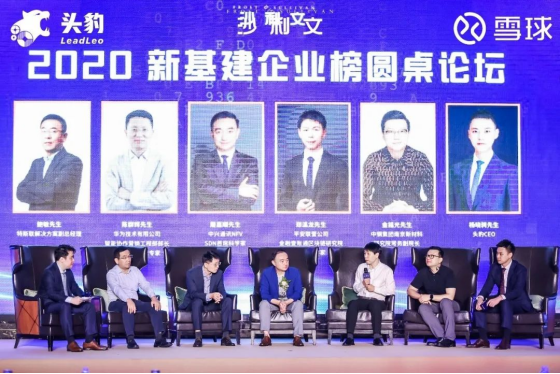
New Infrastructure for Great Integration Scene of the Roundtable Forum on Empowering the New Economy
Moderator: Today, we have already released more than half of our agenda items.The six major lists, including 5G, Internet of Things, cloud computing, innovative infrastructure, data centers, and computing centers, have also given us a certain understanding of each industry sector through our video materials. These industries may seem independent, but they actually support and depend on each other, jointly building a new infrastructure for China's economic development over the next 10 years or even longer. We are honored to invite representatives from various industries and experts from listed companies to discuss with us how new infrastructure can exert its effects and empower the new economy together.
5G can be said to be the foundation for all technologies and applications, and the leader in new infrastructure construction. First of all, I would like to ask Mr. Tu Jia Shun, how do you think 5G supports the development and implementation of other technologies, and how can we maximize the leading role of new infrastructure in the future?
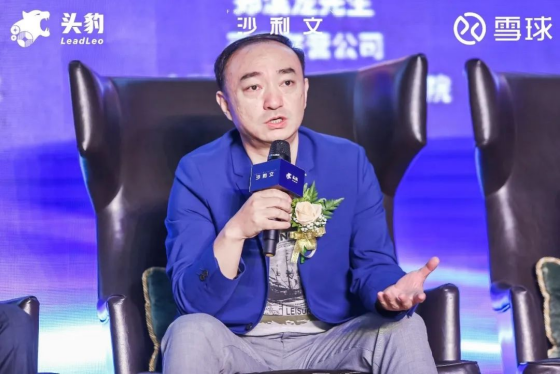 Mr. Tu Jia Shun made a speech
Tu Jia Shun: Since we are talking about new infrastructure, one word comes to mind: old infrastructure. We know that in traditional infrastructure projects, there is a term that everyone is familiar with, which is the so-called 'to get rich, build roads first.' Here, 'roads' refer to"Railway, highway, and airport." What is the foundation of new infrastructure? This is a very important term today - 5G. In new infrastructure, 5G is like the foundation of traditional infrastructure; it plays a decisive role in the entire new infrastructure project. This is why we have always placed 5G in a very important position within new infrastructure. We believe that compared to traditional 4G networks, 5G has achieved significant improvements. Why has 5G network performance improved so much? The bandwidth of each terminal in a 5G network has increased by nearly 10 times, and energy efficiency has dropped to one-tenth or even lower compared to 4G networks. The number of connected terminals, including IoT terminals, has increased several times, but it is noticed that the maintenance staff at operators has been reduced. Instead, the cost per TB that ordinary people pay has decreased.
Why?5G has applied a large number of digital technologies, including cloud computing and AI. These technologies will bring about earth-shaking changes to the telecommunications industry. We firmly believe that 5G will also bring about earth-shaking changes to other related industrial sectors, which we commonly refer to as vertical industries. If we were to express these changes in terms of a scale, I think they would be at least two orders of magnitude more significant than the transformation that 5G has brought to 4G. Thank you.
Moderator: Thank you, President Tu. And asWith the continuous expansion of 5G scale-out and IoT application scenarios, these related fields will become development opportunities for smart cities and major applications. Next question: Mr. Bao Min, please. Our current smart city construction is still mainly focused on urban informatization. From which aspects should we break through the current development stage to truly achieve a people-oriented smart society?
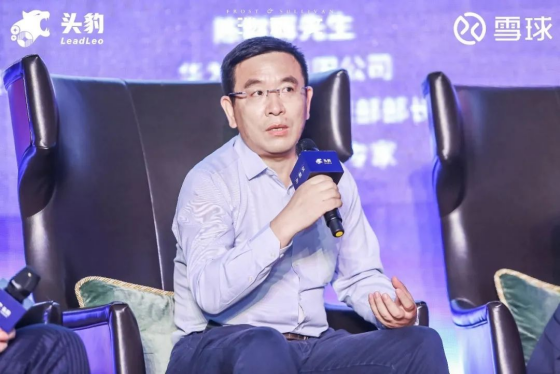 Mr. Bao Min made a speech
Bao Min: Thank you, host, and thank you all the guests and leaders. Although the application of smart cities is now in the informationization phase,The rapid development of 5G will indeed bring certain breakthroughs and applications to the construction and application of smart cities. From our current situation, there are several aspects that can be changed.
The first is the change in way of thinking. In many cases, the construction of smart cities takes more into account management as a demand. If people are at the center, then it is a service-oriented demand. Whether it is all societies, smart societies, or intelligent societies, if people are at the center and service is the guiding principle, management will be more natural.
Second, technology-oriented.From a technical perspective, 5G and artificial intelligence share a significant characteristic. With the development of artificial intelligence and the Internet of Things, the products we design should be scenario-oriented, aiming not to interfere with or disrupt the use of citizens or ordinary people. In fact, this model will be integrated into it. Currently, many products still rely heavily on hardware. Our future development will be more intelligent, and services that are experienced through vision and smart voice will be more valuable.
The last point is participation. Everyone, every citizen, and every person who comes to the city, as well as industries, have more opportunities for participation or interaction through intelligent policies. Only by forming multi-party interactive relationships between people and organizations can we achieve a highly intelligent smart society where everyone shares and participates in services.
Host: Thank you.5G, the Internet of Things, smart cities, and intelligent transportation - these new infrastructure projects are intertwined and support each other. Compared to blockchain technology, people tend to think of Bitcoin more often. Next, we invite Mr. Zheng Xilong. What do you think blockchain technology can play a proper role in new infrastructure projects? What cooperation opportunities should it find and acquire from other new infrastructure projects?
 Mr. Zheng Xilong made a speech
Zheng Xilong: Thank you, host and all the guests. As mentioned earlier during the guest presentationsThe path of 5G is more about data links. In our blockchain, there is also a path that connects our original isolated islands together. Just now, the guest also shared that in the scenario of smart cities, to connect with the government and citizens, how can we better link government departments together and between the government and citizens? In this process, blockchain technology can play a significant role. The host also mentioned Bitcoin, which traditionally, as the origin of blockchain, is a decentralized system. Today, we have more of a multi-centralized system rather than complete decentralization. This is like during this pandemic, where the Chinese government has very strong execution because everyone has a consistent goal. Many foreign governments do not have such strong execution because their goals are not entirely the same. Blockchain has a coexistence mechanism, which can be understood as a way for us in our country to easily reach consensus. Everyone's goal is to fight the pandemic, and once the pandemic is controlled, everyone resumes production. Therefore, blockchain technology can be applied in many aspects, becoming infrastructure in new infrastructure projects, where people can build many scenario applications through blockchain. At the same time, blockchain can also help us solve problems that are currently not well solved, such as many information silos. How can we connect information silos? In fact, technology is not an obstacle; it's more about how everyone clarifies and is willing to exchange information. In the exchange of information, we need to maintain information security and ensure that this information is used legally. These pain points can all be solved with blockchain technology. Ma Dong from Ping An often tells us that we must start from the pain points of our customers. Only by understanding the pain points of customers can we truly bring value to them.
Host: Thank you, Mr. Zheng. Mr. Zheng, you just gave an example that the current pandemic has made us better understand how blockchain technology can realize the power of a smart society. So, in the process of new infrastructure development, new materials are playing more of a role in providing raw materials for the industrial chain. Mr. Jin Yaoguang, please ask your next question. How do you view the research and development of new materials, and how should the new materials industry better support the future development of new infrastructure?
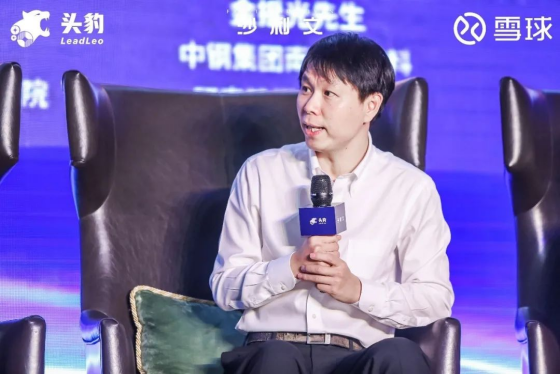
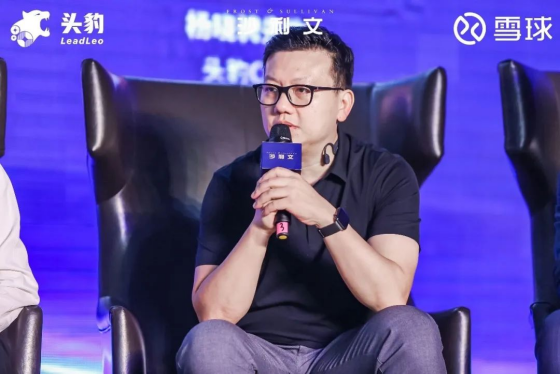 Mr. Jin Yaoguang made a statement
Jin Yaoguang: Regarding the materials industry, I believe it is a bridge.The activation of 5G has put forward higher requirements for the materials industry. For example, 5G phones generate a significant amount of heat, and graphene's thermal dissipation film can play a corresponding role. Graphene has also found relatively reliable application areas. The application market for 5G did not exist before, as it was born with 5G. It is precisely because of the emergence of the 5G application market that materials have become profitable and can provide greater market impetus. It is not because 5G has created material demand that the new materials industry will necessarily generate this demand; it is driven by the market. After the launch of 5G, we have carried out a great deal of development and matching work for the application of 5G new materials at the material end. What was previously a challenge for the metallurgical industry may now be extended to the new infrastructure industry. This has a significant driving effect on the entire materials industry.
Secondly, the production materials are traditional industries themselves, and we hope5G and new infrastructure empower traditional material industries. The profit margin of traditional industries is limited, and once many intelligent technologies are introduced, costs increase. If the cost increase erodes the profit margin, companies lack motivation, and so does the industry. What should be done? It is essential to transcend into the excess profit space of new infrastructure, using the surplus profits to help enterprises with intelligent construction. If your materials cannot achieve excess profits, dataization of your material industry and 5G construction are not feasible, which is also a cycle. Therefore, I prefer to call myself a traditional industry professional, hoping to engage more with the new infrastructure industry. What exactly needs to be done in the middle between traditional industries and the cloud? This is a very worthwhile consideration, as it harbors tremendous market value.
Host: Thank you, Mr. Jin. As soon as we arrived at the venue, we saw a very impressive piece of equipment, which comes from Huawei's latest intelligent collaboration platform.IdeaHub, where I would like to ask Mr. Chen Qunhui for a spoiler. How does IdeaHub assist enterprises in new infrastructure sectors in better technology research and development, business expansion, product upgrades, and so on?
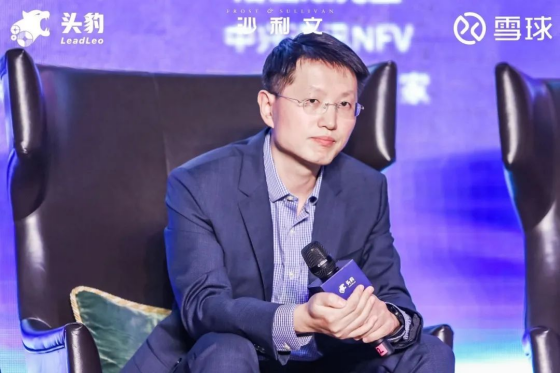 Mr. Chen Qunhui made a speech
Chen Qunhui: Today we are discussing new infrastructure. I believe that one of the important aspects of new infrastructure is to enhance the digitalization level of all industries. Digitalization refers to adjustments around the work efficiency of enterprise employees. Huawei has a philosophy of using the bestIT equipment enhances the efficiency of work and team collaboration within enterprises, which is our original intention in launching IdeaHub. Everyone should understand the importance of improving team work efficiency. For example, during meetings, many people are either at the meeting or on their way there. During meetings, there may be reports, discussions, etc., and at this time you need a good screen mirroring function, and you might even need a handwriting function; many enterprises are geographically dispersed, requiring remote video and communication across regions, and even allowing people from different locations to collaborate on a single image or document to stimulate creativity. Market personnel can find many business opportunities around tablets for business promotion, including education and healthcare, which is the role of IdeaHub. Our goal is to change Chinese meeting rooms, including office areas. What we want to achieve is to enable everyone to enjoy an intelligent working style and stimulate organizational efficiency.
Host: Thank you, Mr. Chen. We know that LeadLeo Research Institute has comprehensive data collection across various fields of new infrastructure and a very forward-looking industry understanding. LeadLeo carries the research achievements of the institute and is one of the leading ones in China.One of the large databases with over 300,000+ data volumes. Mr. Yang Xiaocheng, could you please introduce whether there are any applications of new infrastructure in the generation of massive data?
 Mr. Yang Xiaocheng made a speech
Yang Xiaocheng: Just now Dean Jin mentioned that materials are a traditional industry. I've always felt that consulting is also an extremely traditional field. It has existed since ancient times and has developed over thousands of years. We have been thinking about such issues recently, not only about new infrastructure but also about the new economy proposed a few years ago, as well as innovative technologies such as artificial intelligence and blockchain. After these new technologies were born, we have been pondering, includingHow 5G and cloud empower very traditional service industries like ours. We have made quite a few attempts in recent years. In fact, LeadLeo originated from Frost & Sullivan; it was an incubated project by us that has since gone independent. We like to compare ourselves to technology companies. In terms of personnel ratio, our technical staff and industry researchers make up a 2:8 ratio, meaning that 20% are engaged in technology development, creating new information systems and technologies. As I mentioned during my morning sharing, LeadLeo covers 3,000 sub-industries, producing over 300,000 pieces of data with independent intellectual property rights, and the data is constantly being generated, covering more industries. This makes traditional consulting very difficult; to use an inappropriate analogy, we can also be considered labor-intensive. The number of areas I can cover depends on how many analysts I have. With 100 people, they might cover 200 industries, or 200 people might cover 500-600 industries; if I want to cover 3,000 industries, then the number of people is a huge issue. As an innovative company, we cannot cover so many people. Over the past few years, we have been constantly experimenting, including artificial intelligence and blockchain applications in our platforms and systems. After several years of experimentation, we have basically achieved semi-automatic report writing. What does this mean? It means that in most cases, our analysts should focus on more valuable tasks such as interviews and field research, while basic work can now be largely achieved through information systems and artificial intelligence algorithms.
Secondly, we have also applied algorithms at the presentation level. For example, on LeadLeo's platform, several of you here are involved in new infrastructure...An expert in the 5G field, if we want to see something, he may proactively push information and content that meet your needs based on your daily browsing habits and records. At the same time, we also have some blockchain applications integrated into our system. Our industry places great emphasis on traceability; is the data accurate? To be honest, everyone has their own opinions. Ultimately, it depends on whether your data model is built with strong logic and whether the underlying data is reliable. We have added blockchain to the production process of LeadLeo data. Where does the underlying data come from, and where is our methodology built? Where does the data generate? This year, with the black swan event of the COVID-19 pandemic, it may have had some impact on our data predictions. We will use a process with evidence chains at each stage through blockchain, which allows for clear traceability. I believe that as an application scenario within the new infrastructure, LeadLeo is also evolving with the development of various new infrastructure technologies. This change has also been very beneficial to us, helping us improve work efficiency and better manage evidence and retention.
Host: Today, in addition to the guests who are here in person, there are also many snowball friends and netizens who are watching the live broadcast online. They have some questions for the experts, so let's pick out a few and ask everyone to help answer them. First question, Mr. Tu from ZTE, as mentioned just now5G is the foundation of foundations, fully empowering the development of other new infrastructure industries. May I ask, Mr. Tu, what arrangements and preparations have been made by ZTE for this?
Tu Jia Shun: Just now, President Jin raised a question. As an industry, especially one in traditional sectors, how can we carry out digital transformation under the guidance of national policies? Perhaps everyone has this same confusion. The same is true for data centers.Ten years ago, 5G was in its infancy, and we faced similar confusion. At that time, our goal for 5G was to achieve Internet of Everything, with bandwidth reaching 1GB, latency reduced by two orders of magnitude, and energy efficiency improved by two levels. It seemed impossible at the time. Why? Ten years ago, we thought 4G was already very good; smartphones had just been introduced. How could we achieve seemingly impossible goals? Frankly speaking, ZTE has also undergone a transformation in the traditional telecommunications industry. How did we face this? We raised this question for ourselves. Over the past decade, the entire telecommunications industry has spontaneously undergone a digital transformation, undergoing tremendous changes. We know that Huawei is a cloud company, and in a sense, ZTE is also a cloud company, but not ten years ago. Our current R&D is based on cloud version management, with version storage and distribution entirely on the cloud. This includes AI engines and big data analysis, which have been fully deployed or applied to telecommunications networks. This is why 5G has made such significant progress compared to 4G and is even cheaper. ZTE not only provides end-to-end 5G services, including terminals, but we can also use these technologies to apply what are called R&D personnel, big data engines, and AI engines; moreover, experts will conduct personalized analysis in the industry to help you apply them. For example, edge computing, which is commonly referred to as edge cloud. Clouds are often thought of as being far away, in places like Guizhou or Alaska, but that's not the case. If data still has to run through Guizhou, it's not secure. I can store this cloud within a range of 1 kilometer of your location, perhaps on a base station upstairs.
Secondly, there is another important aspect: traditional industries must be high-profit sectors to undergo digital transformation, not necessarily the case.The most important feature of 5G over 4G is that it is cheaper. The cost per bit connection and energy consumption are lower. Why? 5G aims for the interconnection of everything. If everyone uses a plan costing 128 yuan, would you also want to pay 128 yuan for every street light and meter? 5G makes every bit connection cheaper, allowing traditional industries to apply it. It's not because it's trendy or new, but because it's cheaper, more affordable than traditional technologies, which can bring you profits, so to speak, making it more economical. We have successfully applied this in the telecommunications industry and verified that by making connections cheaper and ubiquitous, everyone and every industry can afford them.
Host: Thank you, Mr. Tu. We hope for an earlier arrival of this era. Next question, we invite Mr. Zheng Xilong. We know that most current blockchain applications are still concentrated in the financial sector. What do we need to know about the main reasons? And do you think blockchain technology can be applied in other fields?
Zheng Xilong: Let me first share a statistic with you: Dr. Xiao Jing, the chief scientist of Ping An Group, has shared such a statistic that as efficiency improvesA 1% increase will bring in 10 billion yuan to Ping An Group. Ping An Group is primarily focused on finance, where efficiency is highly valued, just as Toyota values it too. As long as efficiency can be improved and risks can be reduced, both our revenue and profit can be significantly increased. Previously, blockchain technology was relatively expensive, and people wondered if a technology that is too costly could develop. In the financial sector, whether the technology itself is expensive or not, the financial value generated is enormous. If we look at the financial sector, a small investment can leverage a large portion of revenue. This is why many new technologies, not just blockchain, are first applied in the financial sector. This includes online banking, mobile banking, and smart terminals that generate efficiency in the financial sector, making it a place where new technologies are considered first. However, with the development of technology, blockchain is no longer an expensive technology and can gradually be applied in various industries. For example, LeadLeo can already use blockchain for analysis, and there are blockchain scenarios in various cities. Previously, there was more of a concept of 'blockchain+', and people started from the technology to see what blockchain could do. Today, it is 'scenario + blockchain'. As an infrastructure, blockchain can help existing scenarios solve practical problems in many ways. I am often asked a question: many things can be solved without blockchain, so why use it? My usual answer is that today many systems have a database, so can't we solve this problem without a database? It is also possible. The same principle applies to blockchain; without blockchain, this problem can also be solved, but overall it is not cost-effective. I believe that in the future, blockchain will be implemented in more scenarios. We will no longer discuss whether blockchain can be applied, but rather how people can share how they use blockchain in their scenarios, whether it has increased or decreased their revenue. Thank you.
Host: Third question, Mr. Yang Xiaocheng from LeadLeo, just now President Zheng also mentioned that LeadLeo has conducted research on various new technologies. Could you please briefly describe what we have selected?How were the 150 companies on the list selected?
Yang Xiaocheng: This is a very significant issue, and LeadLeo Research Institute was deeply involved in the entire selection, evaluation, and review process of this Frost & Sullivan China New Infrastructure Enterprise List. In the early stages, I remember that there were probably aroundThere are over 400 companies. After reviewing these, we found that they are indeed excellent in various industries, especially in the field of new infrastructure. We ultimately selected 150 out of more than 400 candidate companies. I believe the selection process of the Frost & Sullivan China New Infrastructure Enterprise List is very innovative and novel, as it is divided into two parts: 50% based on expert review and 50% on votes from stock investors such as Snowball. This encompasses both aspects of what we consider a 'good company'. First, from an expert's perspective, is the company particularly strong in its core positions within various sectors under new infrastructure projects? Is the company's governance structure sound? Can it create value for shareholders? This is the responsibility of the expert review. The second part is left to the market, especially since the vast majority of companies on our list this time are listed companies. What makes a good listed company? A core aspect is whether the company's PR and IR are done well in the market. With the advent of 5G, it is an era of information explosion; it's no longer about being secretive if your product is good. Can you make the market know that you have good technology and products? Can you make investors and stockholders in the market aware and believe in it? These are the two parts of the review. I believe that the 150 companies selected this time meet both criteria. Among them are companies like Huawei, Ping An, and ZTE, which are definitely industry leaders with very large market values; there are also many small but beautiful companies with technology that perform very well in the market and are highly recognized by the market and stockholders. The 150 companies truly deserve their reputation.
Host: Thank you, Mr. Yang, and also thank you all the guests for their remarks. Due to time constraints, we are unable to answer all the questions from the audience one by one. Subsequently, analysts from the LeadLeo Research Institute will select the questions that the audience has focused on and answer them one by one on the platform. We hope everyone will pay close attention to the LeadLeo Research Institute's WeChat public account and Snowball account.
New infrastructure will build a basic network to support new drivers of China's economy, bringing a tremendous acceleration to China's new economy. At the same time, it will also drive the formation of short-term and long-term economic growth points. As for the specific heights that each industry sector will reach in the future, we are very much looking forward to seeing these industry leaders on today's list, including the experts present here, play a leading role, guiding us and new infrastructure, so that China's new economy can radiate with new vitality and brilliance!




