


The 18th Frost & Sullivan China Growth, Innovation and Leadership Summit and the 3rd New Investment Conference Life Sciences New Investment Summit Forum were held in Shanghai from August 28th to 29th, 2024. The forum brought together more than 40 industry leaders, biopharmaceutical companies, medical device companies, investment institutions and professional service providers. With the theme of "Responding to Changes and Opening up New Horizons," all participants discussed new models of investment cooperation, aiming to build a closer, more efficient and win-win cooperation network to jointly promote the vigorous development of the domestic and international life sciences industry.
At this forum, Dr. Pande Si, Deputy General Manager and Chief Scientific Officer of Microchip Biosciences, shared a keynote speech titled "Scientific Insights and Future Prospects under the Surge of China's Medical Innovation." The speech mainly focused on three parts: the development history of medical innovation in China, Microchip Biosciences' technology platform and innovation model, and the challenges and opportunities faced by the market.
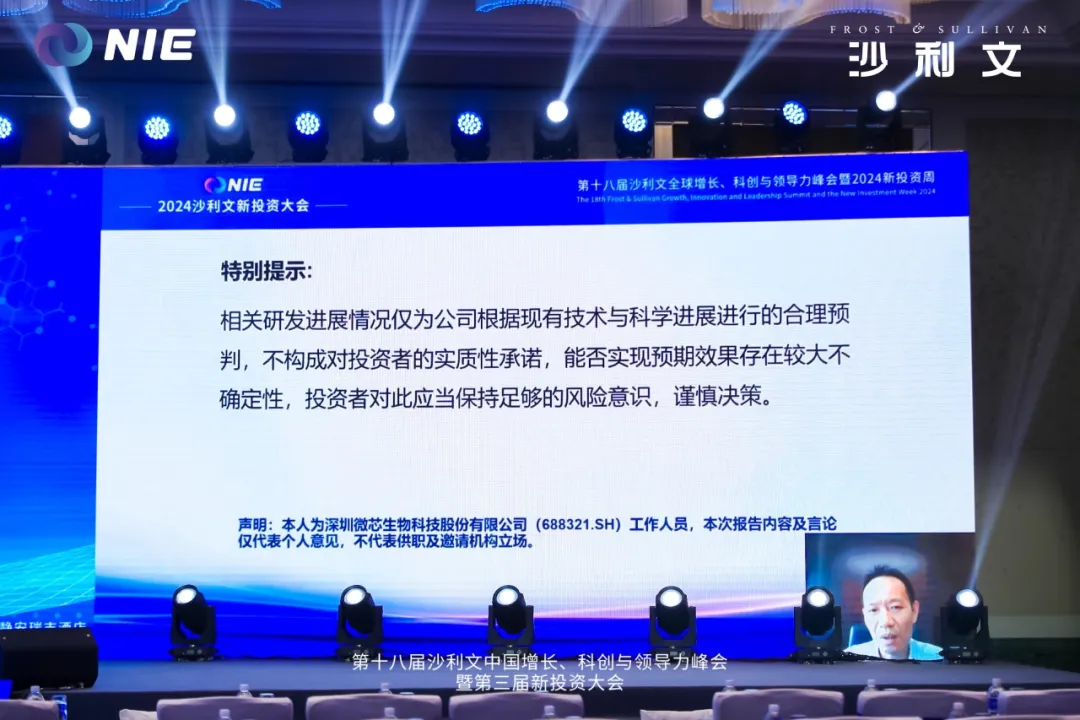
Dr. Pande, Deputy General Manager and Chief Scientific Officer of Microchip Biosciences
The following are the key points from Dr. Pande's speech:
The development process of pharmaceutical innovation in China
Looking back at the overall development of China's pharmaceutical industry, Dr. Pensil emphasizes that the characteristics of the pharmaceutical industry are high risk, high investment, high return, and a long cycle, among which the impact of the long cycle is becoming increasingly important. He pointed out that over the past 20 years, China has started with high-quality generic drugs, gradually moved towards the development of improved new drugs, and now to the rise of innovative drugs. Initially, Chinese pharmaceutical companies modeled after Western drugs for imitation and gradually developed their own 'me-too' drugs. Dr. Pensil specifically mentioned the breakthroughs in 2011 by Hengrui and BeiGene Pharmaceuticals, marking the beginning of China's innovative drug development.
By 2014, Microchip Biotechnology had launched the world's first independently developed small molecule innovative drug, 'Cedbinamide', which is China's first 'first-in-class' innovative drug, marking a solid step forward in the R&D of innovative drugs in China's pharmaceutical industry. With the improvement of China's pharmaceutical R&D capabilities, the number of innovative drugs has continued to grow. Although the industry still faces some twists and challenges, China's innovative drug industry has shown clear progress on the global stage.
Dr. Pande introduced Japan's Takeda Pharmaceutical, China's electronics industry, and the development of new energy to illustrate that the tortuous development of China's pharmaceutical industry is not an isolated phenomenon. The transformation process of Hengrui, the koi effect at WuXi AppTec, and the medical device giant Mindray are representative cases. He introduced the current situation of China's innovative drug industry and compared it with global market competition. Despite the rapid increase in the number of drug research and development projects and high internal competition, there is still a lack of innovation. Taking the oncology field as an example, there are still limited drugs that are truly innovative and competitive in international markets. He used data to show the gap in innovation between imported drugs and Chinese drugs and pointed out that China's pharmaceutical industry must pay more attention to the quality of innovative drugs rather than quantity in the future.
The technology platform and innovation model of Microchip Biosciences
Dr. Pan Deshi then recounted the development journey of Microchip Biosciences as an innovative enterprise. He emphasized that since its establishment, Microchip Biosciences has focused on promoting drug research and development through independent innovation. From early small-scale research and development to the launch of multiple innovative drugs into the market today, Microchip Biosciences has developed into a modern biopharmaceutical company that is sustainable, based on core technologies as the engine for innovative research and development and a rich original drug product line.
Dr. Pande introduced the representative drugs of Microbiomics Biologics—cedaverimab and sitagliptin sodium. He pointed out that cedaverimab is the world's first subtype-selective histone deacetylase oral inhibitor and belongs to the category of epigenetic regulators. This drug has expanded the application of epigenetic drugs from blood tumors to solid tumors, becoming the cover molecule of the Journal of the American Chemical Society in 2017 and representing the field of epigenetic drug research and development. Cedaverimab has pioneered pan-tumor epigenetic immunotherapy, which is the combination of epigenetic regulatory drugs with immunotherapy. Sitagliptin sodium is expected to become a core component of metabolic disease treatment, including weight management, cardiovascular and cerebrovascular diseases, chronic inflammation, etc.
Market Challenges and Opportunities
Despite the outstanding innovation and clinical value of sintilimab and sitagliptin sodium, Dr. Pande pointed out that they still face market challenges. China's basic medical needs are based on prices that fit national conditions. The centralized procurement of generic drugs and the negotiation of innovative drug prices have reduced the prices of various drugs, which is a reality that innovative drugs need to face in the long term. The development of innovative drugs in China is an area where market allocation fails. The development costs of hundreds of millions to billions are difficult to sustain long-term solely through the domestic market. At this time, it is necessary to explore overseas markets. For example, BeiGene, with nearly 90% of its sales coming from overseas, especially Zanubrutinib. However, as foreign investment and R&D risk management become more stringent, the domestic ecosystem's improvement, professional teams, the rise of biopharmaceutical innovation, as well as considerations of scale and comprehensive cost will be China's advantages.
Dr. Pande believes that market challenges require pharmaceutical companies to return to the essence of innovative drugs. The first is to adhere to science-driven innovation. He emphasizes that the essence of innovative drugs is science-driven, and only through in-depth basic research can breakthroughs be made in new mechanisms, new targets, etc. All this cannot be achieved without the construction of talent teams. The second is market demand. The long cycle of drug research and development makes forward-looking market predictions particularly important. Whether developing original drugs or various generics, the essence is to judge from future market value. Finally, new methods and technologies must also be valued, but more importantly, global clinical development and commercial cooperation are needed to join the constantly changing global environment. Dr. Pande specifically added that AI technology can significantly improve research and development efficiency in the early drug discovery stage, helping companies accelerate drug development and cope with the uncertainties brought about by the long cycle.
Finally, Dr. Pan Deshi emphasized that the Chinese government has begun to recognize the importance of innovative drugs and has provided policy support. In 2024, the government's support for innovative drugs has been further increased, providing a favorable development environment for Chinese pharmaceutical companies. However, he also pointed out that companies need to truly possess innovative capabilities to seize opportunities in this favorable policy environment and achieve sustainable development.




