On August 28th, at the sub-forum on 'AI Evolution Theory - Building Intelligent Systems in the Physical World', Li Qing, Executive Director of Frost & Sullivan Greater China, released the '2025 Research Report on Best Application Practices in China's GenAl Industry' (hereinafter referred to as the 'White Paper').
This white paper adopts a diversified research methodology to construct an innovative multi-dimensional evaluation system. It provides an objective and fair assessment of the application practice cases of generative AI in various industries. It also conducts research on the latest trends in generative AI for 2025 and provides an in-depth analysis of high-quality overseas generative AI application practice cases. The research integrates survey data from generative AI technology providers and enterprise users with thematic interviews, and analyzes the current application status and development trends of generative AI globally and in China across various industries from multiple perspectives for 2025. According to the market research and analysis by Frost & Sullivan, the core findings of the report focus on the practical applications of generative AI in infrastructure, manufacturing, finance, public services, and the internet, as well as its significant achievements in improving operational efficiency and creating non-financial value for enterprises.
01
In 2025, generative AI will see four major trends: technological optimization and cost reduction, Agentic AI creating new value paradigms, synthetic data becoming the core engine driving continuous iteration and scenario-based implementation of large models, and AI security governance systems accelerating towards systematization and standardization.
In 2025, generative artificial intelligence is reshaping the technological landscape and industrial ecosystem with unprecedented depth and breadth. Its development presents four core trends that together construct a critical path for AI to move from 'capability breakthroughs' to 'value implementation'. Firstly, in terms of technical optimization and cost reduction, the industry has achieved a strategic transformation from 'pursuing parameter scale' to 'emphasizing efficiency and practicality'. With the continuous evolution of Transformer architectures, the refinement of training algorithms, and the widespread application of sparse architectures such as MoE (Mixed Expert Systems), the training and inference efficiency of large models has significantly improved. It is estimated that under the same performance conditions, the training cost of large models has decreased by more than 90% compared to 2024, making enterprise-level deployment and real-time applications the norm.
Secondly, AGentic AI is creating entirely new value paradigms. 2025 is regarded as the year of intelligent agents; AI is no longer just a tool that responds passively to commands, but has evolved into 'autonomous intelligent agents' capable of setting goals, breaking tasks down, invoking tools, executing autonomously, and providing environmental feedback. Multi-agent systems can complete complex business processes from market research, code generation, supply chain optimization to personalized marketing through collaboration, competition, and division of labor. By the end of 2025, it is expected that more than 40% of enterprises globally will deploy AGentic AI systems for at least one core business process. AI is moving from 'enhancing human capabilities' to a new stage of 'autonomously creating value', profoundly reconstructing organizational structures and work models.
Thirdly, synthetic data has become the core engine driving the continuous iteration and scenario-based implementation of large models. In the face of challenges such as the increasing scarcity of high-quality real data, stricter privacy and compliance requirements, and insufficient data in specific domains, creating high-fidelity, controllable, and annotatable synthetic data using generative AI has become a key path for training and validating the next generation of models. By 2025, world models will begin to possess the capability to build a complete 'digital twin data ecosystem', which can not only simulate extreme scenarios and generate adversarial samples to enhance model robustness but also support the training of models for high-value applications such as autonomous driving and embodied intelligence without touching on original sensitive information. This has significantly shortened the model iteration cycle and reduced data acquisition costs, becoming an important support for large models to achieve commercial closed-loop operations and differentiated competition.
Finally, AI security governance systems are accelerating towards systematization and standardization. With the deep application of generative AI in key areas, potential risks such as the illusion of generated content, model bias, data leakage, and compliance blind spots caused by malicious abuse have sparked widespread concern. Over the past few years, major global economies have established relatively complete regulatory frameworks: China has continuously promoted the implementation of the 'Interim Measures for the Administration of Generative Artificial Intelligence Services', emphasizing the legality of data sources, traceability of content, and safety assessments; the EU's 'Artificial Intelligence Act' has officially entered into force, implementing full lifecycle supervision for high-risk AI systems. AI security has shifted from passive response to active defense, with the deep integration of technology, systems, and ethics laying a solid safety foundation for the sustainable and responsible development of generative AI, ensuring a dynamic balance between innovation and risk.
02
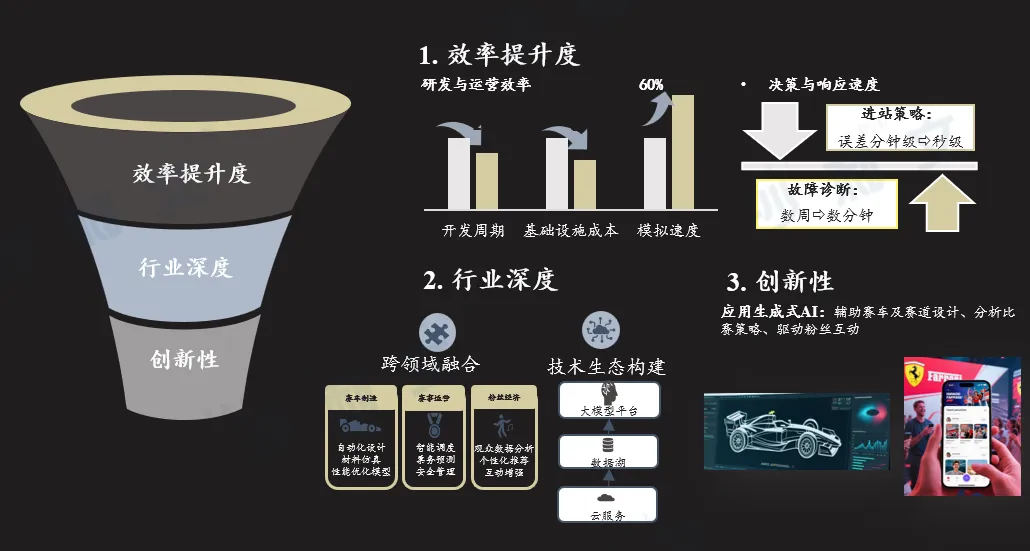
High-quality overseas generative AI cases are analyzed and presented from three dimensions: efficiency improvement, technological innovation, and industry depth. They comprehensively reveal the practical achievements and leading experiences in cost reduction and efficiency enhancement, driving business transformation, leading technology frontiers, and deep cultivation of vertical fields. These provide a benchmark paradigm for generative AI applications.
Generative AI mainly improves efficiency in the following ways: reduced cost-effectiveness, such as significantly reducing human and time input through automated content generation, code writing, or document processing; increased production efficiency, reflected in faster task completion speed, shortened process cycles, and increased output per unit of time; and optimized resource utilization, which refers to improving the efficiency of key resources such as human labor, computing power, and equipment through intelligent scheduling, predictive maintenance, or data-driven decision-making.
Technological innovation in generative AI practices refers to advancements in model architecture, training methods, multimodal fusion, or inference optimization; application mode innovation is reflected in the creation of new use cases, such as AI agents autonomously performing complex tasks and generating personalized services in real time; business model innovation focuses on reimagining product forms, service methods, or revenue structures through AI, such as transitioning from traditional subscription models to demand-based elastic service models.
In generative AI cases, the industry depth refers to the breadth and integration of AI applications across R&D, production, marketing, service, and other aspects. Industry specialization is reflected in the model's ability to understand and accurately apply domain knowledge (such as medical terminology, financial rules, engineering specifications). Industry influence includes the capability to promote the formation of industry standards, improve overall digitalization levels, or lead peers in emulation.
Data source: Frost & Sullivan analysis, LeadLeo research institute
03
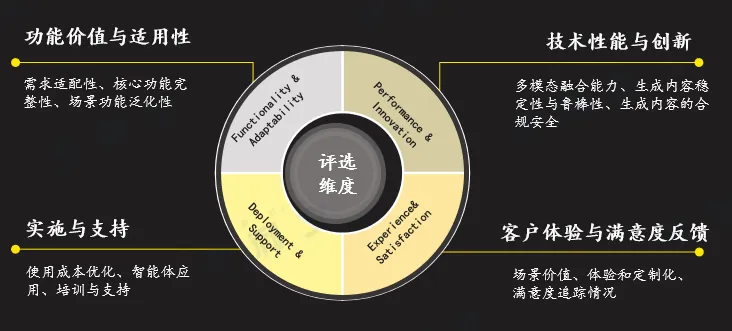
The value of generative AI industry application practice solutions is comprehensively examined through four core capability dimensions: functional value and applicability, technical performance and innovation, implementation and support, and customer experience and satisfaction feedback.
The industry applications of generative AI need to be comprehensively evaluated through a comprehensive multi-dimensional assessment system to fully examine their value and potential. Frost & Sullivan's market research integrates traditional research methods and has innovated a multi-dimensional assessment system that covers functional value and applicability, technical performance and innovation, implementation and service support, as well as customer experience and satisfaction feedback. Each dimension is an indispensable part of the success of a solution.
The applicability of features and value includes: Requirement Adaptability focuses on whether the product can accurately match users' business needs and scenario logic, evaluating performance in terms of goal achievement, revenue realization, cost consideration, and strategic alignment to ensure its adaptability and solution to market demands. Core Feature Integrity concerns whether the product has complete core feature modules, including the synergy and maturity of core modules such as natural language processing, image generation, and voice interaction, to meet the actual business closed-loop. Scenario Feature Generalization measures the adaptability and scalability of the product in different application scenarios to achieve seamless adaptation across business scenarios. Generalization ability determines the reuse value and long-term sustainability of technology and is a key indicator for measuring system scalability.
Technical performance and innovation dimensions include multimodal fusion capabilities: focusing on whether the product can efficiently process multimodal data such as text, images, audio, and video, and achieve cross-modal content generation capabilities. This capability is the core support for realizing intelligent handling of complex scenarios. Stability and robustness of generated content focus on the consistency and reliability of output content under different input conditions, as well as fault tolerance capabilities in abnormal inputs (such as ambiguous instructions or noisy data), ensuring that generated results always meet expectations. At the same time, attention is paid to solutions for improving generation quality. Compliance and security of generated content focus on legal, ethical, and data security risks during the content generation process, model compliance status, automated monitoring, and compliance assurance measures. It also includes fault tolerance capabilities and emergency response systems in abnormal scenarios.
The implementation and support dimensions include cost optimization: focusing on the full lifecycle costs of deploying, running, and maintaining generative AI systems, including hardware resource consumption, algorithm iteration costs, and labor input. Attention is paid to cost reduction solutions such as lightweight models and cloud-native architectures to enhance technology penetration and cost-effectiveness. Agent applications: Paying attention to the actual effectiveness of agents in simulating human decision-making and automated processes, verifying their response efficiency and accuracy in scenarios such as customer service and operations, as well as their contribution to optimizing business processes. Attention is also given to the capabilities of agents and the transformation of their technical value. Training and support: Focusing on user understanding and operational thresholds, as well as the resources and service support, real-time technical support, and case libraries provided by vendors after implementation for customers, reducing the complexity of technical applications and accelerating the implementation process.
Data source: Frost & Sullivan analysis, LeadLeo research institute
04
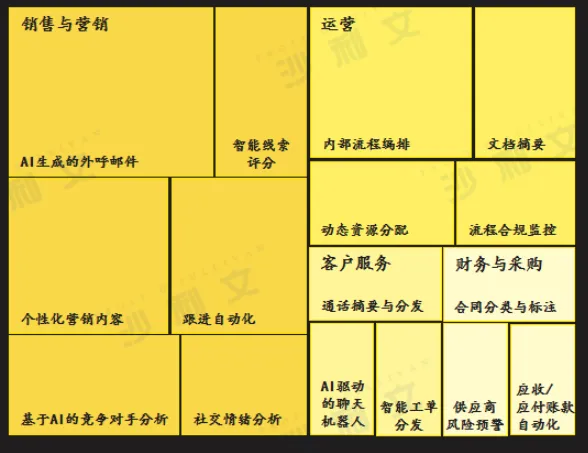
Analysis of the Current Investment in Generative AI (GenAI): Sales and marketing are dominant, but there is great potential for backend automation
Over the past year, approximately 50% of generative AI budgets were invested in sales and marketing, indicating the strong interest of enterprises in using generative AI technology to enhance customer experience and optimize sales processes. However, in reality, backend automation often yields higher return on investment.
Firstly, in terms of internal process optimization, generative AI can help enterprises achieve a high degree of automation in business processes from order processing to inventory management, reducing human errors while significantly increasing processing speed. Secondly, document management and data processing have become more intelligent and efficient due to the application of generative AI, such as automatic summarization and information extraction functions, which can greatly shorten the time for information retrieval and processing.
In addition, the potential of generative AI in dynamic resource allocation cannot be underestimated. By analyzing real-time and historical data, AI systems can predict future demand and optimize resource allocation accordingly to ensure maximum resource utilization efficiency. This forward-looking resource planning is crucial for reducing operational costs.
Data source: Frost & Sullivan analysis, LeadLeo research institute
05
Classical case analysis
Zhongguancun KEGIN and Ningxia Jiaojian jointly launched the country's first large-scale transportation infrastructure model, "Lingzhu Zhi Gong," focusing on the vertical field of transportation infrastructure. It precisely matches key business scenarios such as construction, accounting, and bidding, significantly improving target achievement efficiency and corporate strategic synergy. Based on the Dahuo Large Model platform, through training with tens of thousands of industry specifications and engineering technical documents, the model's professionalism has been enhanced. An intelligent agent platform covering knowledge Q&A, document writing, report generation, data analysis, and intelligent bidding has also been constructed to meet the urgent needs of the transportation infrastructure industry for professional intelligent understanding, efficient document processing, and intelligent decision support.
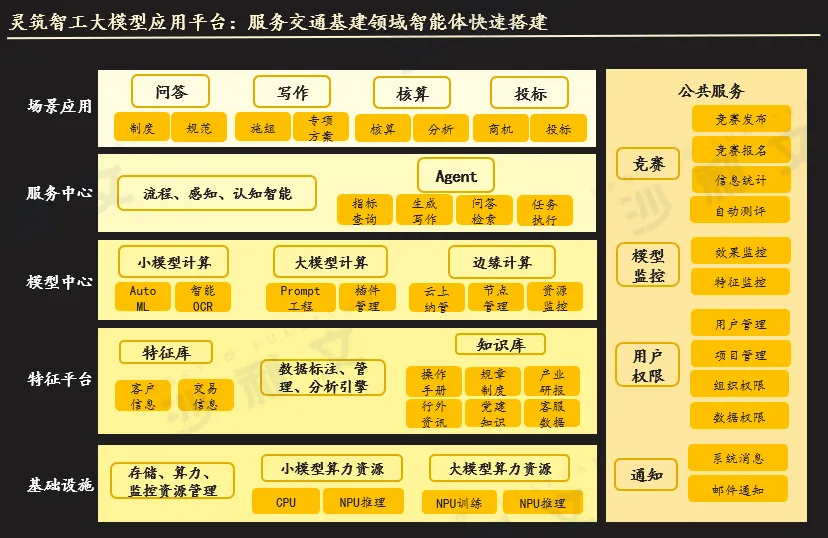
Data source: Frost & Sullivan analysis, LeadLeo research institute
Recommended Reading