



On August 28th, the 19th Frost & Sullivan Global Growth, Innovation and Leadership Summit and 4th New Investment Conference (hereinafter referred to as the '2025 Frost & Sullivan New Investment Conference') AI Evolution Theory - Physical World Intelligent Systems Sub-forum, hosted by the world-leading growth consulting firm Frost & Sullivan (Frost & Sullivan, abbreviated as 'Frost & Sullivan'), was held in Shanghai.
At this forum, Ravi Krishnaswamy, Managing Director of Frost & Sullivan's Asia-Pacific region, shared a keynote speech titled 'Artificial Intelligence-Driven Industrial Transformation'.
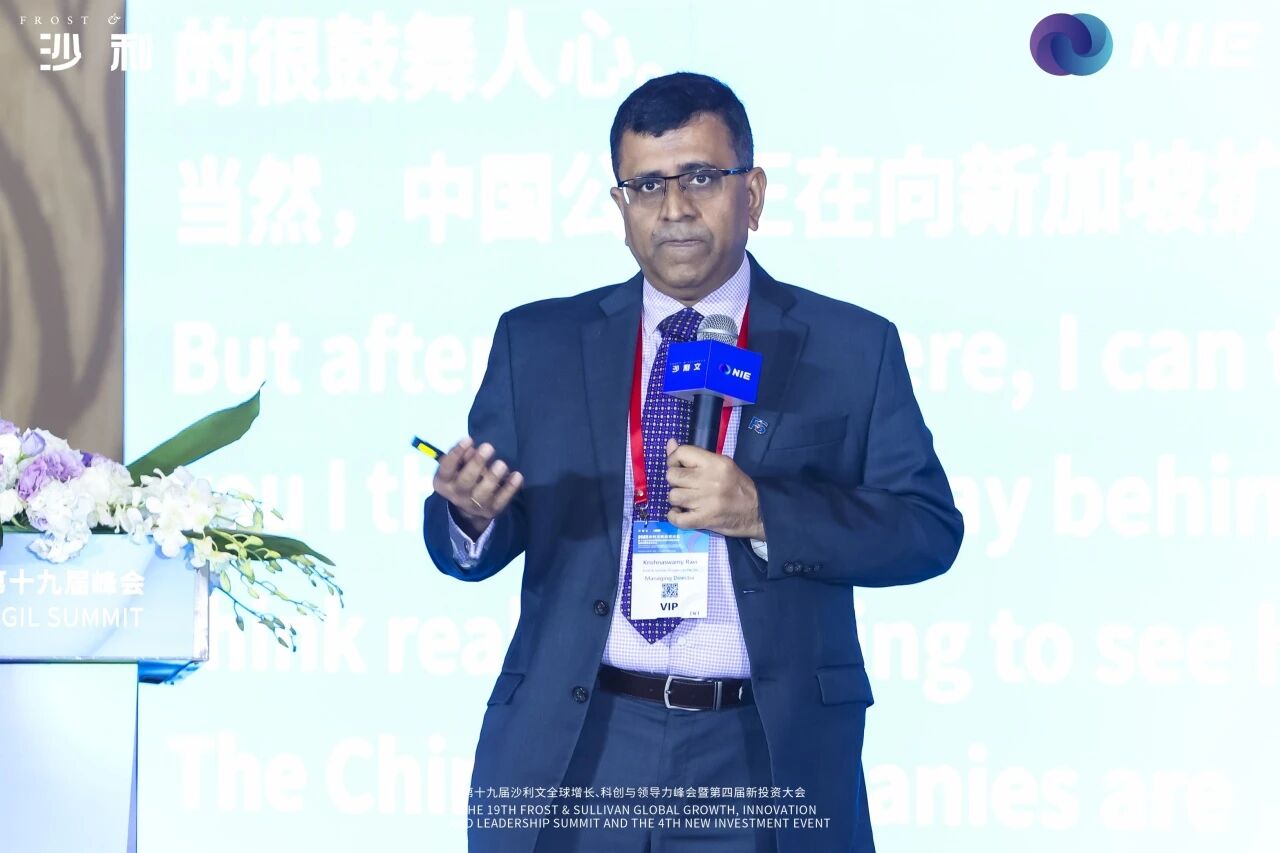
Ravi Krishnaswamy, Managing Director of Frost & Sullivan APAC
The following are the key points from Ravi Krishnaswamy's speech:
Transformation of manufacturing and operations
Ravi Krishnaswamy pointed out that artificial intelligence improves industrial automation by automatically identifying inefficiencies and adjusting conditions to enhance energy efficiency and reduce operating costs. The strategic focus of industrial enterprises has always been on business resilience and operational flexibility, which will shift in the future towards open-source large models for experimentation, as well as the creation of smaller and more efficient models. Open ecosystems, OPEX-based participatory models, software-defined automation, and AI-infused applications are some of the paradigms in application.
Artificial intelligence and robotics transform industrial automation
Machine learning, especially deep reinforcement learning (DRL), has greatly enhanced robot capabilities by enabling robots to manage more complex and continuous action-state spaces. The introduction of cutting-edge technologies such as industrial robots, drones, autonomous mobile robots (AMRs), and digital twins (DTs) is leading to revolutionary changes in motion science. Manufacturers are also seeking optimal artificial intelligence systems to solve their challenges, focusing on ethical data collection and application to improve existing processes.
The potential applications of industrial artificial intelligence include product innovation, process applications, and insight applications. Among them, product innovation has brought opportunities to industrial artificial intelligence and had an impact on all aspects of the industry. Five aspects in which industrial artificial intelligence drives efficiency improvement and innovation are as follows: 1. Transition to decision-making artificial intelligence; 2. Capture and transmission capabilities; 3. Autonomous agents; 4. Integration of AI with control systems; 5. Explainable industrial artificial intelligence.
The Trend of Transformation: AI Agent Deployment in Key Industry Areas
-
Production: Agentic AI dynamically adjusts production processes in real time, reducing waste, downtime, and bottlenecks, cutting unplanned downtime by up to 40%.
-
Supply chain optimization: Integrating real-time data from the Internet of Things and adjusting workflows based on demand fluctuations to optimize production lines;
-
Energy and Utilities: Autonomous grid management, adjusting energy supply according to real-time demand fluctuations;
-
Transportation and Logistics: Shortening delivery times and saving costs in route optimization and automated warehousing applications;
-
Mobility: L4/L5 autonomous driving, the ecological route for commercial fleets, predictive maintenance of railway systems, and fleet charging optimization for micro-mobility.
At the same time, Ravi Krishnaswamy also pointed out that the future of process automation lies in areas such as digitalization, cloud operations, software-centric automation, and intelligent AI agents.
What are the differences between Industry 4.0 and Industry 5.0?
Ravi Krishnaswamy pointed out that the focus of Industry 5.0 will go beyond product construction and service delivery, entering into areas that offer unexpected experiences, thereby breaking through customers' current status quo. The emergence of Industry 5.0 will not prevent the arrival of Industry 4.0; on the contrary, these two revolutions will occur simultaneously.
Key points
Finally, Ravi Krishnaswamy pointed out the key to the development of industrial artificial intelligence:
The transformation from rule-based automation to AI-driven autonomous systems enables industries to perceive, understand, and take action without minimal human intervention;
2. Artificial intelligence is transforming business models by improving productivity, realizing the integration of IT and OT, and promoting innovation through generative AI, robotics, and digital twins;
3. AI is transforming quality inspection, predictive maintenance, operator training, and energy management. Trends include decision-making AI, autonomous agents, and explainable AI systems, which can build trust and improve operational efficiency.




