



On August 28th, the 19th Frost & Sullivan Global Growth, Innovation and Leadership Summit & 4th New Investment Conference (hereinafter referred to as '2025 Frost & Sullivan New Investment Conference') AI Evolution - Physical World Intelligent Systems Sub-forum, hosted by the world-leading growth consulting firm Frost & Sullivan (Frost & Sullivan, abbreviated as 'Frost & Sullivan'), was held in Shanghai.
At this forum, EY1Liu Mingrui, Partner of Strategy and Transaction Consulting, shared the keynote speech titled 'New Transformations, New Opportunities: Trend Insights into AI Entering the Physical World'.
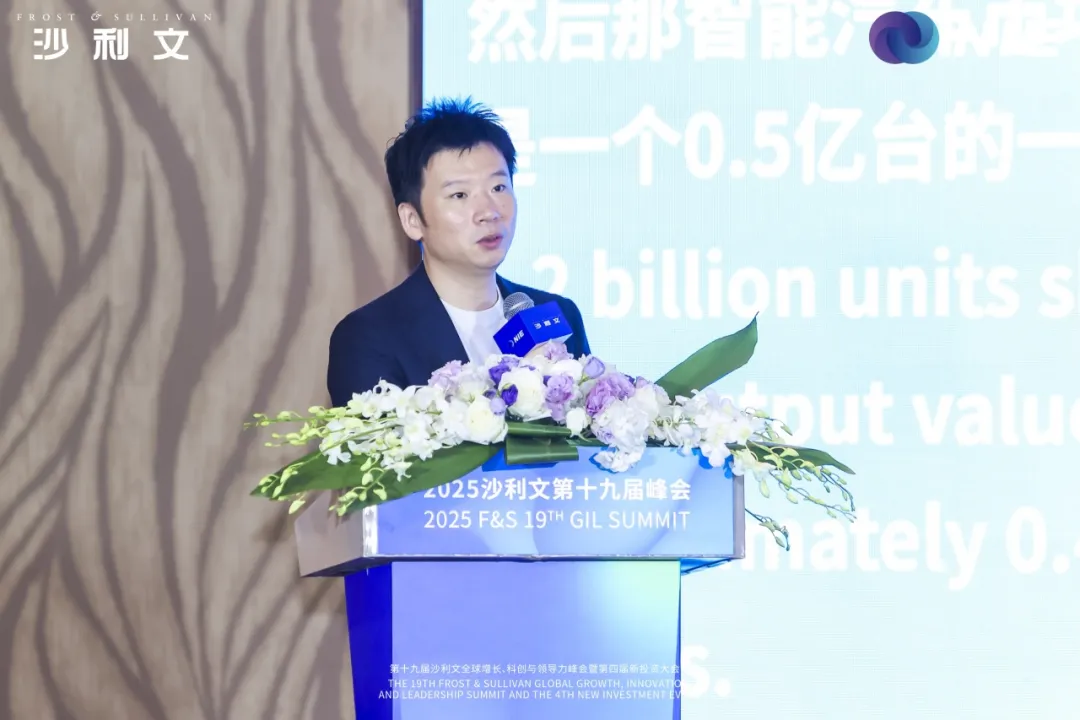
Liu Mingrui, Partner at EY's Strategy and Transaction Advisory
The following are the key points of Liu Mingrui's speech:
New Revolution: Embodied intelligence drives the next paradigm shift, upgrades human interaction methods, and accelerates the emergence of new platforms
Liu Mingrui pointed out that embodied intelligence has the potential to surpass smartphones and smart cars, becoming the electronic consumer product with the largest market scale in human history. The changes that this brings about are:
New Paradigm: An integrated system of 'Perception-Decision-Action', where AI will take over the digital world and transform the physical world in the future. Embodied robots will drive the next paradigm revolution.
New Entrance: Multimodal operations and interactive experiences, a revolution in human interaction methods and operating systems. Embodied robots combine audio-visual and other multimodal sensory inputs to provide richer interactive experiences.
New Platform: The integration of multiple technologies fosters the emergence of new platforms. The convergence of general-purpose technology platforms drives the proliferation of new ones, with the integration of general-purpose technologies leading to exponential economic growth, with a compound annual growth rate of up to 40%.
New Opportunities: Accelerating the Implementation of China's Embodied Intelligence Industry Applications through Policy, Technology, Hardware, and Supply Chain Factors
In terms of policies, the central government and local authorities have introduced a number of related policies and increased industrial investment. National policies have continued to be strengthened, with the government work report for 2025 for the first time including 'embodied intelligence' and 'intelligent robots' in national strategy, clearly cultivating future industries such as biomanufacturing, quantum technology, and embodied intelligence. Industrial policies have been intensively implemented locally, with the establishment of industrial development funds and innovation centers. The ultimate goal is to achieve international leadership in comprehensive strength by 2035. In terms of technology, the industry has divided general applicability levels into G1-G5, with most embodied intelligence companies currently at the G2 stage. The G2 stage refers to preliminary general applicability, where atomic skills that can be reused are refined to enable generalized operations across a large range of similar scenarios. In hardware, high-precision multi-dimensional sensors and planetary roller screws still await domestic breakthroughs—embodied and panembodied systems have certain synergies in hardware, as evidenced by the continuous narrowing of the gap between domestic and foreign hardware capabilities; the localization rate is gradually increasing. In terms of supply chain, China possesses an extremely strong supply chain capability and has natural advantages in the field of complete robot manufacturing.
In response to data challenges, Liu Mingrui believes that the lack of data is the biggest bottleneck in realizing generalization capabilities with embodied intelligence. Due to cost and scenario limitations, the scale of data is severely constrained, making it difficult to achieve a high degree of generalization with embodied skills.
The key is how to balance the 'impossible triangle' of accuracy, execution speed, and versatility, while trend analysis indicates that 'high versatility' will become the primary choice for future scenarios.
Liu Mingrui pointed out that EY's services cover the entire chain of content from industry insights to growth co-construction.
In terms of technology and market insights, identify emerging trends such as embodied intelligence, assess the maturity of software and hardware, and lock in high-potential scenarios;
In terms of ecological strategy and cooperation, connect capital, technology, and scenarios to identify high-potential partners for collaborative innovation;
In terms of top-level architecture and strategic design, it helps enterprises establish market breakthrough points, forming technical, product, and ecological competitiveness; in innovation and growth co-construction, it creates new business engines and uses embodied intelligence as the second growth curve.
Note1EY (China) Business Consulting Limited




