



On August 28th, the 19th Frost & Sullivan Global Growth, Innovation and Leadership Summit & 4th New Investment Conference (hereinafter referred to as '2025 Frost & Sullivan New Investment Conference') AI Evolution - Physical World Intelligent Systems Sub-forum, hosted by the world-leading growth consulting firm Frost & Sullivan (Frost & Sullivan, abbreviated as 'Frost & Sullivan'), was held in Shanghai.
At this forum, Nie Kaixuan, founder and CEO of Shanghai Songying Technology Co., Ltd., shared a keynote speech titled "Physical AI Simulation Systems, Accelerating the Industrialization of Embodied Robots."
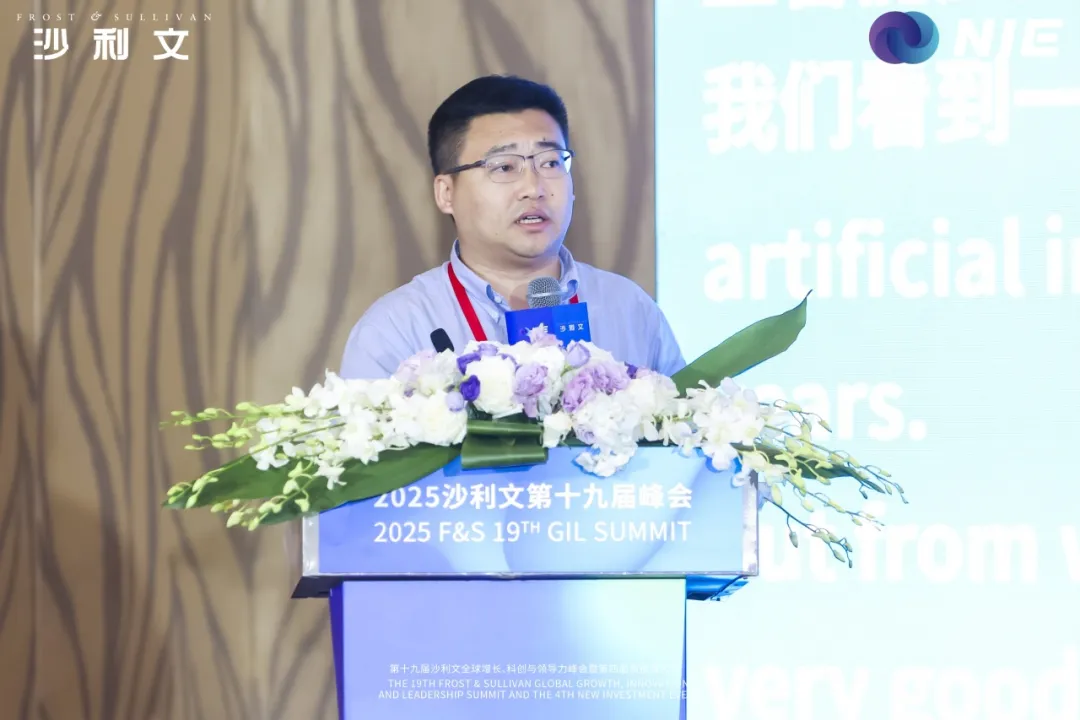
Nie Kaixuan, Founder and CEO of Shanghai Songying Technology Co., Ltd.
The following are the key points of Nie Kaixuan's speech:
Trends in Artificial Intelligence Development
Nie Kaixuan pointed out that the development of artificial intelligence has formed a clear path: evolving from perceptual AI to generative AI and agent-based AI, and ultimately towards physical AI - where physical laws are becoming a new core dimension of AI evolution. He further explained that the core logic of robot intelligence is to use data as 'fuel', through data input, model algorithms, and skill training (specific actions such as grasping, assembling, movement, and general capabilities), to ultimately achieve intelligence.
The Embodied Intelligence Development Journey of Songying Technology
Songying Technology's embodied intelligence layout began in 2021: the ORCA project was officially launched, with concurrent research on basic physical simulation technology and product development; in 2022, the core architecture direction of the ORCA system was clarified, and technical verification of basic modules was completed; in 2023, the foundational setup of the ORCA system was achieved; in 2024, it entered a critical commercialization phase, with a beta version released in June and market feedback collected. By the end of the year, ORCA 1.0 was officially commercialized, with the signing of the first batch of customers (including national and provincial humanoid robot centers); in 2025, it is planned to iterate to ORCA 2.0, aiming to build a technical moat and mature ecosystem, create a cross-industry general physical AI simulation platform, achieve collaborative simulation of complex systems across multiple fields, become a core component of industrial 4.0 infrastructure, and expand customer reach to national and provincial units as well as well-known domestic and international enterprises.
The Bottlenecks and Solutions in the Development of Embodied Intelligent Robots
Nie Kaixuan introduced that the core advantage of Songying ORCA is to build a physically accurate multi-scenario, multi-form simulation and emulation platform, which is achieved through four major capabilities: high-precision physical rendering and simulation, efficient parallel simulation control, comprehensive robot perception, and simulation synthesis data generation.
As the 'virtual training ground' for embodied robots, ORCA provides a high-fidelity physical AI training environment that covers 20 dimensions of data collection, significantly improving the learning efficiency and multi-scenario adaptability of embodied robots.
He also highlighted ORCA's unique '1:8:1 training data strategy': 10% physical/virtual action demonstration data, 80% synthetic data, and 10% fine-tuning data for the physical environment, which can precisely meet the diverse task data needs of various robots in different scenarios. In addition, ORCA supports model self-training, achieving efficient training based on synthetic data and defining a new embodied intelligent training paradigm of 'synthetic pre-training - lightweight fine-tuning'.
ORCA Physical AI Simulation System and Synthetic Data: Accelerating Development and Physical World Model Training
Nie Kaixuan positioned Songying ORCA as 'a physically accurate industrial digital intelligent collaboration platform':
① Physical-level precise simulation, reducing trial-and-error costs: Relying on ORCA RTX real-time ray tracing and a high-performance physics engine, a high-fidelity digital twin environment is constructed to accurately simulate the mechanical, fluid dynamics, and optical characteristics of the real world;
② Generate synthetic data for driving AI training: Support high-fidelity data synthesis, automatically generate annotated physical compliance data, and directly solve the scarcity of training samples for industrial AI.
③ Breaking down data silos and achieving cross-tool collaboration: By using the OpenUSD (Universal Scene Description) framework to unify data standards from multiple sources, it seamlessly connects with mainstream industrial software;
④ Physical Deployment and Continuous Optimization: Deploy virtual verification strategies (such as AGV scheduling systems) to physical robots to form an 'simulation-real' closed-loop feedback system, continuously iterating and optimizing.
Nie Kaixuan mentioned that Songying Technology, as a core participating unit of 'Molding Shanghai', has been involved in the construction of Shanghai's virtual-real integration super-large-scale training ground. This training ground is China's first super-large-scale urban-level artificial intelligence digital twin training ground. As one of the four foundational bases of 'Molding Shanghai', it will focus on empowering the implementation and scenario verification of cutting-edge technologies such as autonomous driving and embodied intelligence.




