



On August 28th, the 19th Frost & Sullivan Global Growth, Innovation and Leadership Summit and the 4th New Investment Conference (hereinafter referred to as the '2025 Frost & Sullivan New Investment Conference') AI Evolution - Physical World Intelligent Systems Sub-forum, hosted by the world-leading growth consulting firm Frost & Sullivan (Frost & Sullivan, abbreviated as 'Frost & Sullivan'), was held in Shanghai.
At this forum, Yang Zijiang, founder of Shenzhen Kechuang Information Technology Co., Ltd., shared a keynote speech titled "Empowering Embodied Intelligence to Move from Relying on Human Data to Autonomous Exploration of the World."
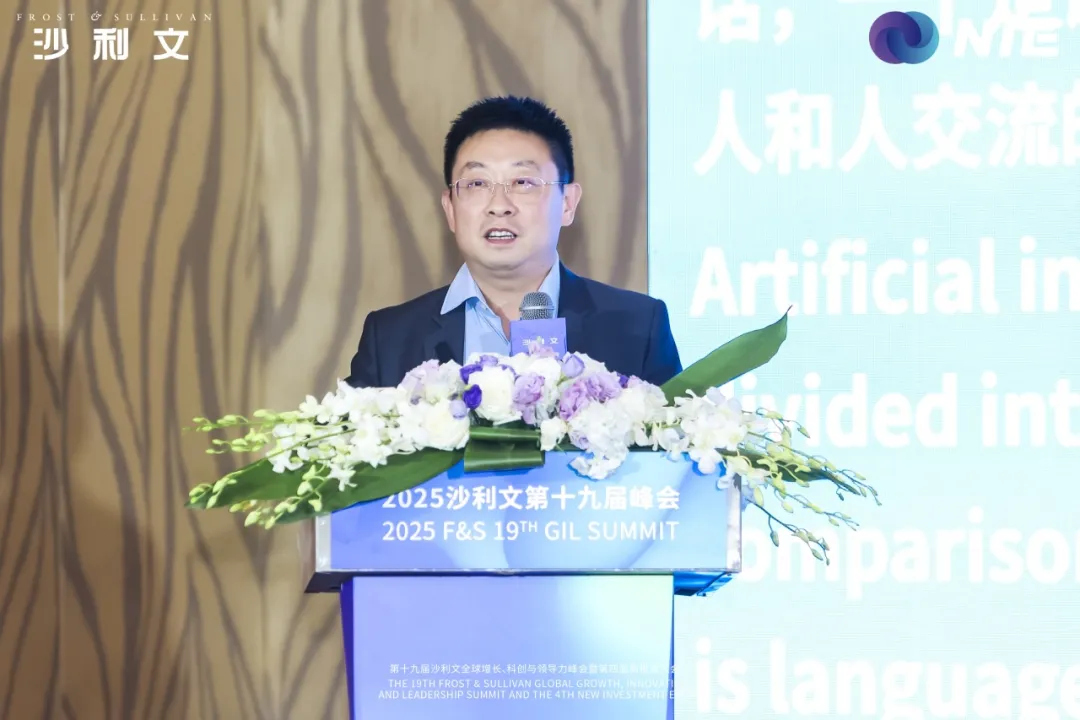
Deeply believes in Yang Zijiang, founder of Shenzhen Kechuang Information Technology Co., Ltd.
The following are the key points of Yang Zijiang's speech:
"Human data dependence" to "autonomous world exploration"
Yang Zijiang pointed out that current artificial intelligence is undergoing a major leap from 'language intelligence' to 'spatial intelligence'. Although large language models (LLMs) have made breakthroughs in text and image processing, even passing the Turing test, spatial intelligence has not been fully achieved. For embodied intelligence (such as autonomous driving and humanoid robots), the data they require is no longer static or fragmented text or images, but continuous, dynamic, and high-dimensional scene stream data. This type of data must cover three-dimensional space and time dimensions, posing higher requirements for data collection, processing, and simulation.
Data Loopback and Synthetic Simulation: Intelligent Upgrade Driven by Core Technologies
To address this challenge, Shenzhen Kechuang has built an 'end-to-end' full-link data closed-loop system, covering the entire process of 'data collection - data processing - simulation deduction - algorithm training'. Yang Zijiang particularly emphasized the core role of the simulation platform: it can not only generate a large amount of high-fidelity synthetic data based on real data, significantly reducing acquisition costs and privacy risks, but also automatically generate extreme scenarios (such as suddenly crossing pedestrians, bad weather, etc.), accelerating algorithm iteration and security verification.
The simulation platform in this system is particularly critical, featuring multi-sensor simulation, dynamic scene generalization, and extreme condition generation capabilities. The specific technical implementation includes a multi-sensor fusion acquisition system that supports 32 cameras and 16 lidar sensors, with power consumption being only 1/10 that of traditional devices; a 4D scene reconstruction and automatic annotation platform that achieves high-precision restoration of dynamic scenes; as well as synthetic data generation and generalization technology based on real-world data seeds, effectively breaking through privacy, security, and compliance constraints of real data.
Cross-border application and industry recognition of patents and technological strength: from autonomous driving to a new industrial intelligence ecosystem
Deeply believing that starting with autonomous driving, the company has expanded its technology to industrial intelligence and robotics. In industrial scenarios, through vertical industry data collection and simulation replication, it has achieved algorithm training and deployment in high-risk and high-cost environments such as nuclear power, ports, and mines, significantly improving production safety and efficiency. In the robotics field, the company constructs service scenario training environments through simulation platforms, supporting robot behavior learning and optimization in complex physical environments.
Currently, Shenzhen Xinkong Technology has served as a technology partner for many leading enterprises including Geely, GAC, Changan, Chery, Volkswagen, and supported scientific research and teaching at multiple universities.




