



On August 28th, the 19th Frost & Sullivan Global Growth, Innovation and Leadership Summit, as well as the 4th New Investment Conference (hereinafter referred to as the '2025 Frost & Sullivan New Investment Conference'), AI Evolution Theory - Physical World Intelligent Systems sub-forum, organized by the world-leading growth consulting firm Frost & Sullivan (Frost & Sullivan, abbreviated as 'Frost & Sullivan'), was held in Shanghai.
At this forum, Sae-Jun Park, Head of Frost & Sullivan's Korea region, shared the keynote speech 'Top 50 Transforming Technologies for 2025 —— Driving Future Disruptive Technologies'.
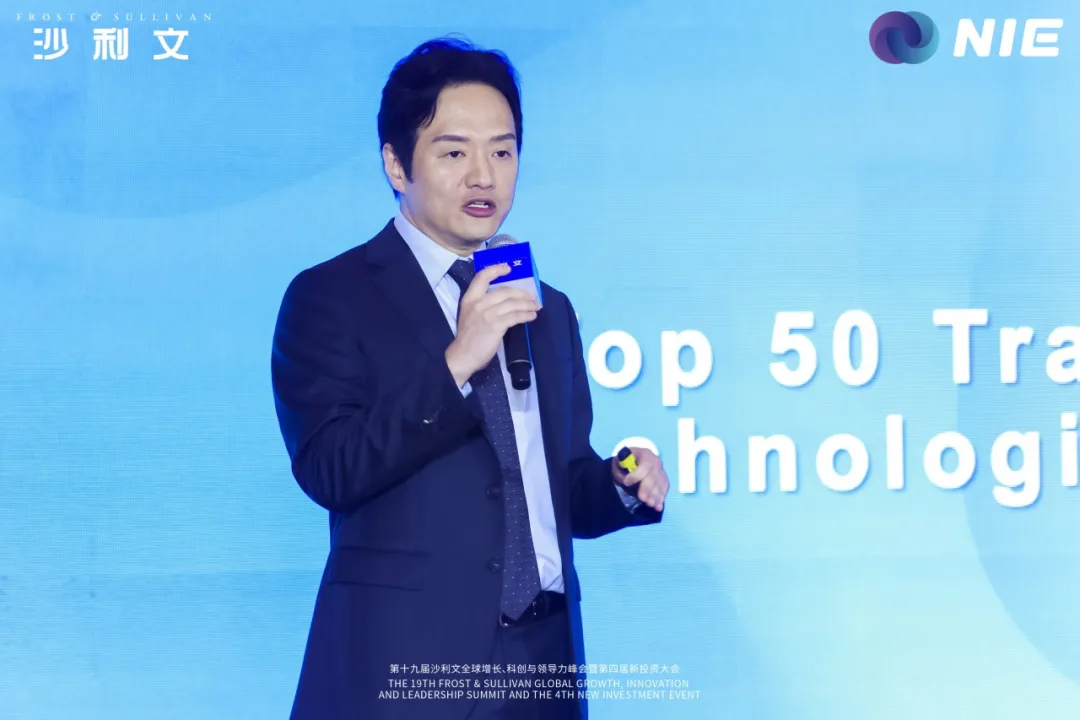
Sae-Jun Park, Head of Frost & Sullivan Korea
The following are the key points from Sae-Jun Park's presentation:
Enterprise Growth Challenges and Strategic Imperatives
Sae-Jun Park pointed out that in the face of rapidly changing market environments, enterprises are facing growth pressure and strategic dilemmas. The so-called 'eight elements of strategy' encompass disruptive technology uncertainties, industry integration trends, ambiguity brought about by mega-trends, difficulty in implementing innovative business models, and internal resistance to change. If enterprises cannot proactively respond, they will face stagnation or decline in the life cycle curve. Therefore, 'jumping to the next curve' has become a key strategy for enterprises to achieve sustained growth.
Top 50 technical screening methods and evaluation dimensions
Frost & Sullivan selects the 50 most transformative technologies from over 1,000 technologies globally based on eight major indicators: technological disruption, market potential, patent/IP strength, capital investment, macro-trend alignment, economic impact, and regional application potential. The technologies involved range from TRL 3 to 9, covering areas such as AI, energy, microelectronics, health, and sustainable innovation.
Representative technical cases
In terms of technical cases, Sae-Jun Park focused on sharing three representative innovative technologies. The first is Agentic AI, which can provide intelligent assistant services in multiple scenarios such as retail, e-commerce customer service, IT automation, HR, and research, significantly improving enterprise efficiency. Since 2023, global financing in the field of Agentic AI has been about $6.4 billion, with a cumulative number of related patents exceeding 52,000, and the market potential is expected to reach $170.27 billion from 2025 to 2029. North America leads in technology research and development and application, while Europe and Asia-Pacific regions are also rapidly catching up.
The second is energy-efficient manufacturing technology, which achieves green manufacturing through sensors, lightweight materials, smart factories, and waste heat recovery. The investment scale for 2023-2024 is about $2 billion, with 577 related patents. It is expected that the market potential from 2025-2029 will exceed $75 billion cumulatively. Specific cases include ENGIE's 10MW waste heat recovery project at its cement plant in the UAE, which can reduce CO₂ emissions by 29,000 tons per year, demonstrating the dual advantages of green manufacturing technology in carbon emission reduction and economic value.
The third category is SWIR (Short Wave Infrared) sensor technology, which has application scenarios covering industrial automation, material inspection, medical diagnosis, autonomous driving, and national defense security, among others. In 2023-2024, investments in this field are expected to be around $800 million to $1 billion, with a total of over 9,000 patents, and market potential is projected to exceed $4 billion from 2025 to 2029. Taking the acquisition of NIT by Lynred in France as an example, this move further expands the high-resolution SWIR imaging market, demonstrating the strong potential for technological integration and industrial expansion.
Technology Integration and Cross-industry Trends
Sae-Jun Park emphasized that single technological innovation can no longer meet market demands, and cross-technology integration has become the core driving force for future development. Technological integration can create capabilities that a single technology cannot achieve, while also opening up value chains, generating compound effects, and achieving exponential growth. Looking ahead to 2025, five major cross-industry trends are worth noting. The first is sustainable innovation, involving the research and development and application of carbon-neutral fuels, hydrogen energy, and recycled materials. The second is next-generation energy and energy storage technologies, including sodium-ion batteries, iron-phosphorus batteries, and efficient solar systems. The third is the integration of advanced microelectronics and sensing, such as 3D integration technology and brain-like sensors, which have great potential in intelligent devices and industrial automation. The fourth is mature and integrated AI, from Agentic AI to cognitive digital twins, which will drive enterprises to achieve a qualitative leap in decision-making, automation, and innovation. The last is the trend towards health precision and personalization, with AI-assisted diagnosis and bioengineering innovation bringing more efficient and personalized solutions to the healthcare field.
Strategic Implications for 2025
At the end of his speech, Sae-Jun Park proposed four key directions for future corporate strategies. The first is integration and collaboration, where the interconnectedness of AI, materials, and energy systems will become the core of competitiveness; second is green and regulation, with ESG and policy-driven investment in green technology directly affecting the long-term development of enterprises; third is security and trust, where AI-driven threat analysis and zero-knowledge proof technology will become an important guarantee for digital trust; and finally, rapid innovation, through autonomous systems and rapid prototyping, enables enterprises to shorten market cycles and seize the initiative. Sae-Jun Park emphasized that only by actively embracing technological change and cross-industry integration can enterprises achieve sustained growth and strategic advantages in future competition.




