



On August 28th, the 19th Frost & Sullivan Global Growth, Innovation and Leadership Summit and the 4th New Investment Conference (hereinafter referred to as '2025 Frost & Sullivan New Investment Conference') AI Evolution Theory - Physical World Intelligent Systems Sub-forum, hosted by Frost & Sullivan, a globally leading growth consulting firm (Frost & Sullivan, abbreviated as 'Frost & Sullivan'), was held in Shanghai.
At this forum, Wang Fei, Executive Director of SenseTime's Jet Scan, shared a keynote speech titled "Jet Scan's World Model for Insight - Spatial Intelligence and Data Generation to Assist in Autonomous Driving".
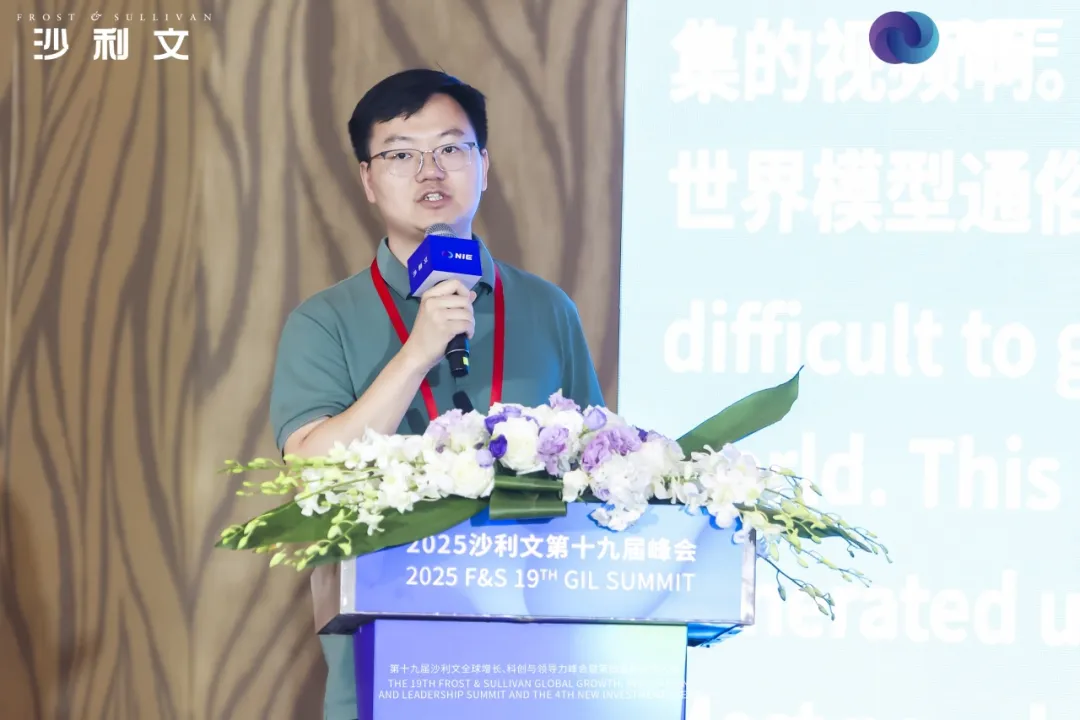
Wang Fei, Chief Executive Officer of Shangtang Jueying
The following are the key points of Wang Fei's speech:
World Model - Absolence "Enlightenment"
The World Model is a generative AI model that understands the dynamics of physical and spatial attributes in the real world, representing 'different projections of a world'.
The World Model of Shang Tang aims to understand how to construct the real world, drive spatial intelligent interaction, and achieve real-time interaction in virtual worlds. By learning physical laws such as time and space from massive data, it generates a 4D real world that is consistent in space and time and highly realistic.
Promote interactive innovation between virtual and real worlds
Wang Fei introduced that 'Jueying Kaiwu' possesses powerful controllable scene generation capabilities, capable of generating diverse virtual scenes on demand and flexibly editing real-world elements. It supports the free combination and coupling of multiple elements, especially excelling in constructing and arbitrarily editing long-tail scenes that are difficult to collect. In terms of spatial world interaction, the model supports algorithm entities to autonomously interact within the world engine, achieving highly realistic closed-loop simulation. 'Jueying Kaiwu' supports super-large-scale 4D spatial reconstruction capabilities, capable of achieving high-precision digital reproduction of real-world environments within a range of up to 1 square kilometer, providing richer and more realistic perspective data for vehicle models. At the same time, the system supports customizing foreground traffic participants and their interaction behaviors, quickly constructing complex and diverse simulation scenarios covering long-tail risks, and ensuring that the entire simulation process has 1:1 real-time interactive performance, meeting the stringent requirements of closed-loop simulation for real-time performance, significantly enhancing the credibility and practical value of test results.
Wang Fei pointed out that 'Jueying Kaiwu' is the industry's first generative world model product platform, currently available for trial use simultaneously to B2B and B2C users. The platform supports highly flexible scenario customization, capable of generating multiple perspectives, weather conditions, and road types. Users can freely edit and generalize diverse scenario elements; it is simple and easy to use, with one-click generation of diverse scenarios based on prompts alone. Relying on the powerful 4D spatial free interaction capabilities of the 'Kaiwu' world model, the platform has achieved large-scale data generation for mass production and high-precision reproduction of complex scenarios, constructing a virtual training field that supports 4D real-time interaction, providing an efficient and reliable closed-loop simulation and testing environment for fields such as autonomous driving.
Major breakthrough in driving assisted driving: evolving towards "general intelligence agents"
Wang Fei pointed out that world models are driving three key breakthroughs in assisted driving technology. Firstly, by generating infinite-scale long-tail scenarios, the dependence on real-world data is significantly reduced, reducing the demand for real corner case data by two orders of magnitude. Secondly, in simulation environments, the system verifies that technical safety boundaries are fully explored across diverse scenarios, providing perceptible deterministic safety guarantees. Thirdly, the system achieves autonomous evolution, driving performance surpasses human levels, and the collision rate is reduced by an order of magnitude compared to manual driving. The imitation learning based on world models effectively aligns with human driving strategies, and the reinforcement learning process is also fully enhanced in virtual environments, greatly expanding the exploration capabilities for complex scenarios and safety limits. The system has also constructed an 'augmented reality' 4D real-world data paradigm, establishing new standards for model training and evaluation.
World models not only drive leapfrog progress in assisted driving technology but also continuously empower embodied intelligence development, accelerating the evolution of systems from specialized functional entities to 'general intelligence entities'. This progress marks the official entry of intelligent driving into a new paradigm phase centered on 'perception-reasoning-evolution'.




