



On August 27th, the 19th Frost & Sullivan Global Growth, Innovation and Leadership Summit and the 4th New Investment Conference (hereinafter referred to as the '2025 Frost & Sullivan New Investment Conference') ESG and New Productivity Summit Forum, hosted by the world-leading growth consulting firm Frost & Sullivan (Frost & Sullivan, abbreviated as 'Frost & Sullivan'), was grandly held at the Shanghai Jing'an Shangri-La Hotel. The forum, themed 'Sustainable Development and New Productivity', brought together industry leaders, leading enterprises, investment institutions, and professional service providers. It focused on new investment and financing opportunities in the fields of sustainable development and new productivity, and jointly explored the capital and industrial forces for enterprises to navigate through cycles.
At this forum, Liu Jia, General Manager of the Industry Research Department at Guoxuan High-Tech, delivered a speech on the globalization strategy and ESG responses of Chinese lithium battery enterprises. Liu Jia pointed out that with the accelerating transformation of the global energy structure and the increasingly prominent low-carbon trend, the lithium battery industry is at a critical development window period. Chinese enterprises must focus on globalization strategies and ESG practices to drive industrial chain upgrading and international development.
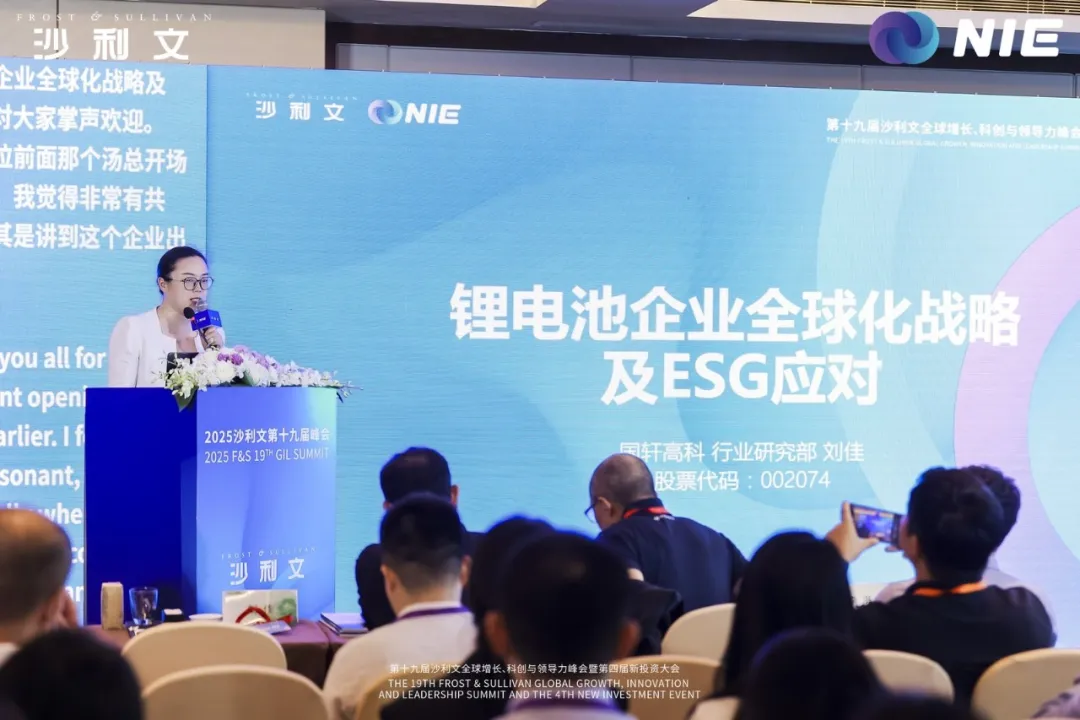
Liu Jia, General Manager of Industry Research Department at Guoxuan High-Tech
The following are the key points of Liu Jia's speech:
I.Going global is an inevitable choice for lithium battery companies
Liu Jia stated that the global lithium battery market is experiencing rapid growth. It is predicted that by 2025, global lithium battery shipments will reach 1.9 terawatt-hours (TWh), and by 2030, they will soar to 4.5 TWh. The Asia-Pacific market is expected to quadruple its growth by 2030 compared to 2025, becoming the region with the fastest growth rate; the annual compound growth rate in Europe and Africa is expected to reach 28%, while in the Americas it will be 26%. Driven by both the explosive growth of energy storage scenarios and the rapid popularization of new energy vehicles, overseas markets will contribute the main incremental growth to the future lithium battery industry.
However, Chinese enterprises currently generally face problems such as low capacity utilization rates and continuous decline in gross profit margins. Relying solely on the domestic market can no longer accommodate the rapidly expanding production capacity. For this reason, 'going global' is not just a strategic choice but a reality-driven imperative. Only by localizing factories, engaging in joint ventures, aligning with international carbon standards, and building closed-loop recycling systems can Chinese enterprises effectively mitigate risks and deeply integrate into the international market.
At the same time, the trend of 'de-Sinicization' overseas and policy barriers are accelerating this process. The United States has set limits in relevant bills for 'Foreign-Owned Enterprises' (PFEs) and 'Material Capabilities Ratio' (MACR), and has increased tariffs on energy storage batteries to a maximum of 155.9% and power batteries to a maximum of 73.4%; Europe has proposed a series of requirements such as carbon footprint disclosure, digital battery passports, and recycling ratios through battery bills; the Southeast Asian market has also explicitly increased localization rates, for example, Indonesia requires a localization rate of 80% for batteries after 2030. Faced with this series of policy constraints, Chinese companies can only avoid being 'passively phased out' by going global and making local layouts.

II. Guoxuan's Globalization Journey
As a representative enterprise in the domestic lithium battery field, Guoxuan High-Tech has always adhered to an internationalization strategy since its establishment. Liu Jia introduced that Guoxuan has fully launched its globalization layout since 2021, actively promoting capacity construction in Europe, North America, and the Asia-Pacific region, and establishing deep cooperation with leading international automakers. Currently, Guoxuan has established 8 R&D centers in the United States, Germany, India, Japan, and other places, and owns 20 battery manufacturing bases globally, gradually forming an industrial network covering the entire world.
This layout has begun to show results. In 2024, Guoxuan's overseas revenue reached 11 billion yuan, a year-on-year increase of 71%, accounting for 31% of the total revenue. The power battery and energy storage business have formed a dual-wheel drive pattern, with power battery revenue increasing by 11% year-on-year, accounting for 72%, and energy storage revenue increasing by 13% year-on-year, accounting for 22%. In terms of production capacity, Guoxuan plans to achieve an overseas production capacity of 100 GWh by 2025 and further increase it to 300 GWh by 2030.
Guoxuan not only promotes the globalization of production capacity but also actively drives the globalization of technology and supply chain. The battery cell technology continues to iterate, moving towards higher energy density, faster charging speeds, and stronger safety performance; at the same time, the vertical integration layout of the supply chain is continuously improving, aiming to achieve self-sufficiency in raw materials for Europe, America, Asia-Pacific, and China within the next five years, constructing a closed-loop overseas industrial chain to reduce market and policy fluctuations risks.
III. EU Regulations and ESG Strategy
Speaking of the EU market, Liu Jia pointed out that the European Green New Deal and battery regulations have become key hurdles that lithium battery companies must face in local operations. From carbon footprint disclosure, raw material compliance to battery passports and recycling, Europe is promoting a green transformation of the industrial chain through a combination of measures such as the EU Battery and Waste Batteries Regulation and the Key Raw Materials Directive. This is both a challenge for Chinese companies and an important opportunity to enhance their international competitiveness.
Guoxuan has been actively promoting the construction of green performance and zero-carbon factories in recent years. In 2024, the company's photovoltaic power generation reached 5,074 megawatt-hours, with a green electricity supply of 377 million kilowatt-hours. The equivalent of carbon dioxide emissions from greenhouse gases was reduced by 256,000 tons, and carbon emissions per unit product decreased by 16.2% year-on-year. In the next five years, Guoxuan High-Tech plans to gradually achieve full carbon neutrality in new and renovated factories. It will implement multi-dimensional measures such as advanced processes, intelligent energy and carbon emission management systems, product ecological design, and process optimization to achieve carbon monitoring throughout the entire life cycle.
IV. Battery Passport ESG Practice
Liu Jia further pointed out that by 2027, electric vehicle batteries entering the EU must be equipped with a 'battery passport'. The battery passport not only records battery performance indicators and material sources but also covers ESG-related data such as carbon footprint and recycling rate, becoming an important tool for transparency and compliance in the industrial chain.
For lithium battery companies, this system is both a challenge and an opportunity for value reshaping. It requires enterprises to comprehensively improve their ESG management level throughout the entire process, from design, raw material procurement, manufacturing to recycling, achieving a green closed-loop system. Guoxuan has already made early arrangements for related systems, actively exploring the use of digital means to achieve full-chain traceability and carbon emission optimization, and aligning them with international standards to lay the foundation for future global competition.
In the future, enterprises that can seize both globalization opportunities and ESG trends are expected to stand out in international competition. For Chinese lithium battery companies, globalization is not only a process of market expansion but also a comprehensive test of technical strength, compliance capabilities, and sustainable development concepts. Enterprises that can adhere to long-termism, enhance the resilience of their industrial chain, and actively assume green responsibilities will occupy a more critical position in the global lithium battery industry landscape.



