



On August 27th, the 19th Frost & Sullivan Global Growth, Innovation and Leadership Summit and the 4th New Investment Conference (hereinafter referred to as '2025 Frost & Sullivan New Investment Conference') ESG and New Productivity Summit Forum, hosted by the world-leading growth consulting firm Frost & Sullivan (Frost & Sullivan, abbreviated as 'Frost & Sullivan'), was grandly held at the Shanghai Jing'an Shangri-La Hotel. The forum, themed 'Sustainable Development and New Productivity', brought together industry leaders, leading enterprises, investment institutions, and professional service providers. It focused on new investment and financing opportunities in the fields of sustainable development and new productivity, and jointly explored the capital and industrial forces that enable enterprises to navigate through cycles.
At this forum, Wu Jiaye, Partner of Strategy and Transaction Advisory at EY (China) LLP, delivered a speech on global and Chinese energy transformation and analysis.
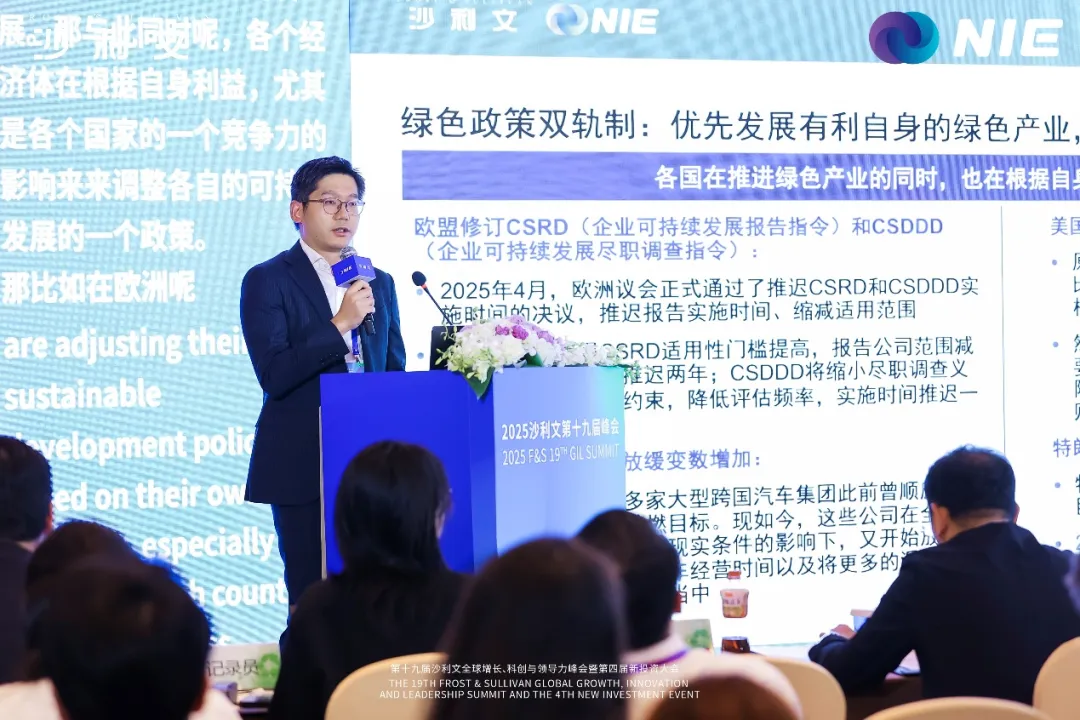
The speech mainly unfolds from two aspects: the dual-track system of global green policies and China's breakthrough in energy transformation through new quality productivity, comprehensively analyzing global and Chinese energy transformation.
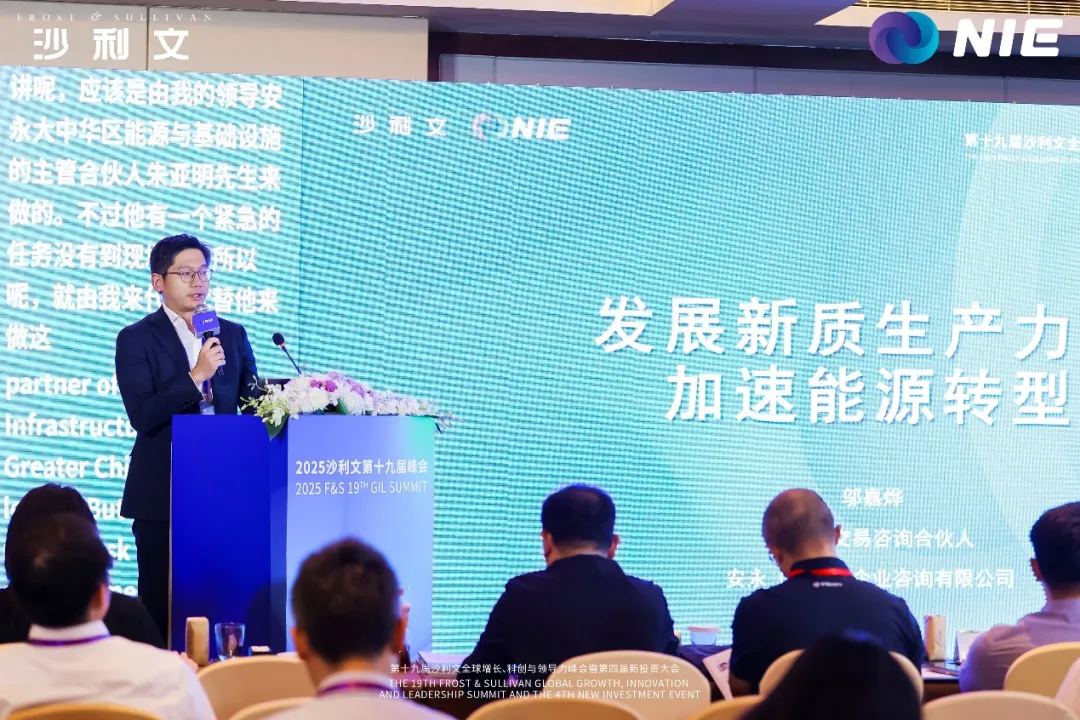
Wu Jiaye, Partner of Strategy and Transaction Advisory at EY (China) LLP
The following are the key points of Wu Jiaye's speech:
I. Global Perspective: Continuous Progress in Energy Transformation
At a critical moment of global energy transformation, economies are promoting the development of green industries that suit their interests and priorities, while postponing potentially unfavorable sustainable development policies. Recently, several European and American countries have seen a rollback of green policies, creating a unique 'green dual-track system'.
In April 2025, the European Parliament passed a resolution to postpone the implementation of the 'Corporate Sustainability Reporting Directive' and the 'Corporate Sustainability Due Diligence Directive', reducing their scope of application by 80% and postponing their reporting obligations by two years. At the same time, there have also been changes to the EU's fuel vehicle sales ban, with several automakers such as Volvo announcing a slowdown in their electrification process and extending their fuel vehicle production plans.
On the other side of the Atlantic, the United States has also seen a policy reversal. In March 2025, the US Securities and Exchange Commission (SEC) terminated its legal defense of climate disclosure rules, abandoning its requirement for listed companies to disclose greenhouse gas emissions information. After returning to the White House, the Trump administration announced its withdrawal from the Paris Agreement in January this year and abolished electric vehicle subsidies and renewable energy incentives, once again providing policy support to the traditional energy industry.
Despite short-term policy fluctuations, the global trend towards green and low-carbon transformation is irreversible. According to predictions by energy data agencies, by 2030, electricity will account for 24% of global energy consumption, and by 2050, this figure will further reach 32%. Renewable energy generation is expected to exceed 50% for the first time in 2038, achieving a historic leap.
In this stage filled with gaming and challenges, countries are actively deploying strategies to ensure their leading position in new energy technology, market, and supply chain. The demand for mineral and metal resources, which are crucial for building new energy assets and infrastructure, has increased significantly, making competition more intense. The critical matrix for mineral and metal resources takes into account ESG pressures, geopolitics, capital accessibility, regulatory environment, and potential threats from substitutes, considering both challenges and impacts.
II. China's Energy Transformation and the Development of New Quality Productivity
Against this backdrop, China has become an important driving force behind global energy transformation. In 2024, China's newly installed renewable energy capacity accounted for more than 60% of the global total, contributing over 45% to the growth of global non-fossil energy consumption over the past decade. According to the 'White Paper on China's Energy Transformation', China plans to increase the proportion of non-fossil energy consumption to about 25% by 2030, basically achieve the popularization of green energy production and consumption methods by 2035, and strive for carbon neutrality by 2060.
China is solving the challenges of transformation by developing 'new quality productive forces'. This advanced productive force, which is driven by revolutionary technological breakthroughs, innovative allocation of production factors, and deep transformation and upgrading of industries, is promoting the intelligent transformation of traditional industries. Following the principle of advancing simultaneously in three fronts—upgrading traditional industries, strengthening emerging industries, and cultivating future industries—innovation is carried out without abandoning traditional industries, accelerating the digitization and intelligence of traditional 'high-tech and high-end' industries. At the same time, efforts are accelerated to cultivate strategic emerging industries with high technological content and low resource consumption, such as new energy, new materials, and new energy vehicles, as well as to layout future industries such as new energy storage.
In the 'Eight Emerging Industries + Nine Future Industries' plan proposed at the 20th National Congress of the Communist Party of China, five major energy-related industries—new energy, new energy vehicles, energy conservation and environmental protection, new materials, and new energy storage—are listed as key development directions. China adheres to the principle of 'establishing first and then breaking through,' coordinating strategic security with supply security, and advancing energy transformation through six pathways: promoting high-quality transformation of coal-fired power with advanced technology, actively exploring electrification paths in the industrial sector, vigorously developing circular economy models, accelerating the construction of a digital and intelligent energy system, focusing on cultivating market demand that 'promotes supply based on demand,' and effectively leveraging the supporting role of transformation finance.
Experts point out that China's energy transformation path takes into account both international competitive dynamics and domestic actual needs. Against the backdrop where the dominance of the new energy industry chain has become an international competitive focal point, China is providing unique solutions for global energy transformation through technological innovation and industrial collaboration. With the in-depth advancement of the 'Opinions on Accelerating the Comprehensive Green Transformation of Economic and Social Development', China is expected to achieve green and low-carbon transformation while ensuring energy security, making significant contributions to global climate change response.




