



The 19th Frost & Sullivan Global Growth, Innovation and Leadership Summit & 4th New Investment Conference - Life Sciences New Investment Summit Forum, hosted by the world-leading growth consulting firm Frost & Sullivan (Frost & Sullivan, abbreviated as Frost & Sullivan), was successfully held in Shanghai on August 28, 2025. The forum brought together more than 50 industry leaders, biopharmaceutical companies, medical device companies, investment institutions and professional service providers. With the theme of "Strengthening Foundations Internally and Steadily Riding the Waves", it focused on cutting-edge trends, innovative technologies and globalization development strategies in the field of life sciences, aiming to promote industrial development and global cooperation.
At this forum, Rhenu Bhuller, a strategic advisor on life sciences and digital health at Frost & Sullivan, shared her keynote speech titled 'The Future of Healthcare: Innovation, Investment and Global Collaboration — Activating China's Potential'.
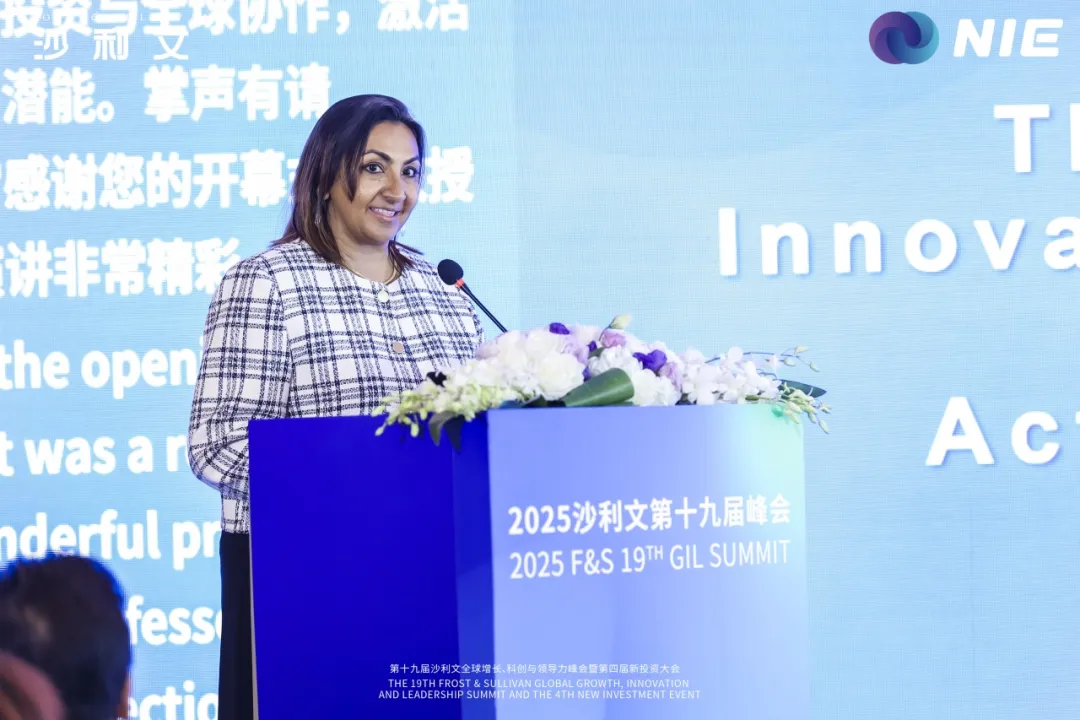
Rhenu Bhuller, Life Sciences and Digital Health Strategy Advisor at Frost & Sullivan
The following are the key points from Rhenu Bhuller's speech:
The global healthcare sector is at a critical time of adjustment and reorganization.
Currently, the global healthcare sector is undergoing profound adjustments and reorganizations, with multiple factors shaping a new industry landscape. Geopolitically, tensions have had a significant impact on the healthcare sector, changing resource allocation and cooperation models; at the policy level, policies are constantly being adjusted to reshape investment directions. For example, the United States has promoted domestic drug production through the 'Made in America' executive order, China has listed biotechnology as a strategic industry under 'Made in China 2025', and Australia has committed to building autonomous innovation capabilities through its 'Biotechnology Blueprint'. Technologically, disruptive technologies such as artificial intelligence are accelerating drug research and development processes, injecting new vitality into the industry; at the same time, cross-border collaboration has also become an important trend in the healthcare sector.
Driven by policies, the healthcare sector in various countries has shown rapid development momentum and potential for global collaboration. In terms of innovation focus, the United States is focusing on the application of advanced therapies and artificial intelligence in clinical trials, China has high research and development efficiency in areas such as antibodies and antibody conjugates, while Australia emphasizes innovation in oncology, vaccines, and other fields; in terms of regulatory environment, countries are optimizing processes, such as the US FDA's reforming accelerated approval process and China simplifying the review of new drug clinical trial applications; in terms of financial support, countries provide guarantees through different methods, with the United States having orphan drug legislation and tax credits, China having a large amount of public funding, and Australia also having research and development tax incentives and national appropriations. In addition, global pharmaceutical expenditure is showing an upward trend. According to data from the IQVIA Institute in May 2025, global pharmaceutical expenditure has been continuously changing between 2019 and 2029 (forecast), with different types of countries and drug categories showing varying performance, reflecting the development vitality and potential of the global healthcare sector in its adjustment and restructuring.
Market-driven strategic model and the development path of biotech enterprises
In the global healthcare market, various biotech companies are driving their development with different strategic models, injecting vitality into the market. From the performance of several companies, strategic catalysts play a key role in corporate development and also provide valuable experience for the industry. For example, CSL Limited (ASX: CSL) in Australia has seen its stock price fall by about 20% since the beginning of the year, with a market value exceeding 100 billion Australian dollars. Its measures such as Seqirus spin-off, cost optimization, and share repurchases reflect mature market restructuring strategies and its leading position in the regional vaccine field; China's Innovent Biologics (HKEX:1801) has seen its stock price rise by about 170% since the beginning of the year, with a market value reaching 170 billion Hong Kong dollars. With the Hong Kong Stock Exchange's 18A listing system, cooperation with Eli Lilly and the expansion of biosimilars, it demonstrates the advantages of Hong Kong's biotech system, the importance of global trial integration, and strategic alliances.
China's Rise in the Field of Biotechnology and Global Collaboration Opportunities
China's biotechnology sector is embracing significant development opportunities and showing a strong growth momentum. Despite facing regulatory uncertainties, geopolitical reviews, and data integrity issues, Chinese biotech stocks have performed outstandingly, surpassing technology stocks over the past year. Looking at the comparison between the Hang Seng Biotechnology Index and the Hang Seng Technology Index, from June 2024 to June 2025 (as of June 12, 2024, standardized), the Hang Seng Biotechnology Index has seen a significant increase, reflecting market confidence in China's biotechnology sector. At the same time, Chinese biotech companies have also been active in licensing and mergers and acquisitions. From 2014 to 2024, the total transaction value of more than $20 million and prepayments of more than $10 million for licensing or mergers and acquisitions reached by Chinese companies headquartered abroad gradually increased, reaching a high level in 2024, reflecting the active actions of Chinese biotech companies in global cooperation and resource integration.
In terms of global collaboration, Chinese biotech companies have many opportunities, especially in the ASEAN and Australia regions. Geographically strategically, ASEAN and Australia provide Chinese companies with regional market access and diversified supply chains, making them ideal choices for expanding beyond Western markets. For example, EZZ Life Sciences (ASX:EZZ) has entered multiple markets including Australia, China, and Vietnam, and is actively exploring new markets such as the United States and Thailand. Its genomics-driven health brand has gained funding and Western recognition through listing in Australia, achieved regional scale expansion through distribution, and obtained FDA approval to enter the US market.




