



The 19th Frost & Sullivan Global Growth, Innovation and Leadership Summit & 4th New Investment Conference - Life Sciences New Investment Summit Forum, hosted by Frost & Sullivan (Frost & Sullivan, abbreviated as F&S), a globally leading growth consulting firm, was successfully held in Shanghai on August 28, 2025. The forum brought together more than 50 industry leaders, biopharmaceutical companies, medical device enterprises, investment institutions and professional service providers. With the theme of "Strengthening Foundations and Steadily Riding the Waves", it focused on cutting-edge trends, innovative technologies and globalization development strategies in the field of life sciences, aiming to promote industrial development and global cooperation.
At this forum, Jing Lan, Vice President of Business Development at Tongrui Biopharmaceutical (Shanghai) Co., Ltd., shared a keynote speech titled 'RDC Industry Development and Opportunities: Current Status of Cu-64 Labelled Radioactive Drug Development'.
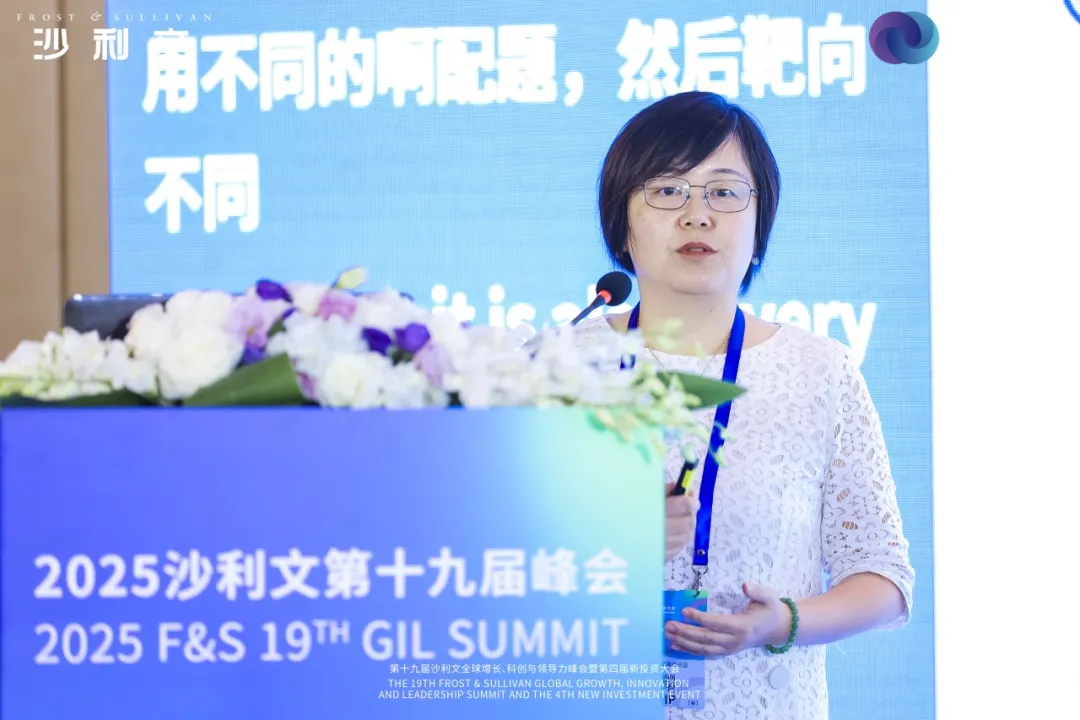
Jing Lan, Vice President of Business Development at Tongrui Biopharmaceutical (Shanghai) Co., Ltd.
I. Current Status of the Global Radiopharmaceutical Market
Novartis' radiopharmaceutical Pluvicto (¹⁷⁷Lu-PSMA-617), as a blockbuster product worth over 1 billion USD, has driven rapid growth in the field of radiopharmaceuticals. The drug's sales reached $1.392 billion in 2024 and $825 million in the first half of 2025, with a quarterly growth rate of 72%. The future peak sales are expected to reach $5 billion. The key to its success lies in its first-mover advantage, capacity expansion, market access, and the expansion of indications.
In terms of market size, the radioactive drug market as a whole is experiencing rapid growth. In 2021, the market size of radioactive diagnostic drugs was about $5 billion, expected to reach $10 billion by 2031, with a compound annual growth rate (CAGR) of 7.2%; in 2021, the market size of radioactive therapeutic drugs was about $1.3 billion, expected to soar to $25 billion by 2031, with a CAGR as high as 34.4%; the combined market size will grow from $6.3 billion in 2021 to $35 billion in 2031, with a CAGR of 18.7%.
In terms of product segmentation, diagnostic drugs such as 18F-DCFPyL have performed outstandingly, with sales reaching $1.058 billion in 2024, a year-on-year increase of 24.3% and a quarterly growth rate of 33%. This further confirms the growth potential of the radioactive drug market.
II. RDC Industry Development and 64Cu Radiotherapy Drug Development
Radioligand therapy (RLT) has become a new trend in the oncology field, with multinational pharmaceutical companies (MNCs) entering the market through mergers and acquisitions. After 2020, overseas radiopharmaceutical companies saw a significant increase in financing, with alpha-nucleotides and innovative molecules becoming hot topics. For example, in 2024, Aktis Oncology received a Series B financing of $175 million, and Alpha-9 Oncology received a Series C financing of $175 million. Domestic companies' financing entered a fast track after 2021, with high-frequency and large-value transactions in 2024. Tongrui Biotech completed an A+ round financing exceeding $100 million in November 2024, while Fuliang Technology completed a B round financing of $47.3 million and a credit line of $16 million in January 2024.
In terms of industry pain points, the overseas radioactive drug industry has been constrained by the number of clinical projects in the past. Currently, it faces bottlenecks such as isotope supply, manufacturing, and assets. In the future, as clinical pipelines advance, the bottleneck of GMP production will become prominent. Domestically, there are issues such as limited isotope supply, lack of large-scale production platforms, irregular distribution systems, insufficient innovative research and development, and the need to strengthen clinical application coordination.
⁶⁴Cu radionuclide drugs, as an important direction in the RDC field, possess significant advantages. With a half-life of 12.7 hours, they support delayed scanning and multiple scans, allowing for flexible patient scheduling with multiple examinations arranged on the same day; they have high resolution and are particularly valuable for diagnosing oligomorphic lesions such as prostate cancer; they can be produced centrally with controllable quality, and they can also label macromolecular precursors, showing potential for new molecule research and development. Currently,⁶⁴Cu labeled products have been marketed and included in the NCCN guidelines, such as Curium's⁶⁴Cu-DOTATATE, and other⁶⁴Cu/²²⁵Ac,⁶⁴Cu/⁶⁷Cu paired pipelines are also in clinical exploration. Tongrui Biotech has a deep layout in the⁶⁴Cu radionuclide drug field, with the 64Cu-TR0529 injection scheduled to apply for a Chinese IND in July 2025, the 64Cu-TR2205 injection in June 2025, and the 225Ac-TR2205 about to apply for a Chinese IND.
III. Industry Trends and Tongrui Biotech's Layout
The pipeline for new drugs in global RDC (Radiotherapy-Drug Conjugates) is rich, with diagnostic RDC targets covering HER2, FAP-&alpha, PSMA, etc., and therapeutic RDC targets including PSMA, SSTR, etc. In terms of radionuclides, diagnostic use mainly includes 68Ga and 18F, while therapeutic use primarily includes 177Lu and 225Ac. Different RLT (Radiotherapy-Drug Conjugates) carrier molecules each have their own characteristics; small molecule drugs are low-cost and safe but require optimization of tumor retention time, peptide targets have high specificity, antibody targets have extremely high specificity but are costly, with significant toxicity risks.
In terms of industry trends, strategic cooperation leads RLT's innovative research and development, with high interest in innovative targets and molecular types. Short half-life diagnostic radiopharmaceuticals rely on a network of nuclear pharmacies, and the United States has established and improved an independent network of nuclear pharmacies. In China, it is necessary to accelerate the improvement of the production and distribution system. In the future, the global radioactive drug industry will develop in the direction of technological innovation, industrial chain integration, and globalization layout.
Tongrui Biotech is an innovative radiopharmaceutical company based in China, targeting the global market. Founded in 2021, the company has raised approximately $200 million in total financing and possesses full lifecycle management capabilities from research and development to production. It has established a research and development quality system that includes GLP-like standards. The company holds the first Class A 'Radiation Safety License' among domestic emerging enterprises and has built a research and development production base covering 100 acres in Chengdu that complies with global cGMP standards. It is equipped with fully automated intelligent production lines and is committed to constructing an open platform integrating 'industry-university-research-application'. The R&D pipeline revolves around nuclides such as⁶⁴Cu, ²²⁵Ac, ¹⁷⁷Lu, and has developed multiple tumor diagnostic and therapeutic drugs, aiming to push the creation of radiopharmaceuticals in China to international advanced levels.




