



The 19th Frost & Sullivan Global Growth, Innovation and Leadership Summit —— New Investment Conference - Life Sciences New Investment Summit Forum, hosted by the world-leading growth consulting firm Frost & Sullivan (Frost & Sullivan, abbreviated as: FSS), was successfully held in Shanghai on August 28, 2025. The forum brought together more than 50 industry leaders, biopharmaceutical companies, medical device companies, investment institutions and professional service providers. With the theme of "Strengthening Foundations and Steadily Riding the Waves", it focused on the cutting-edge trends, innovative technologies and globalization development strategies in the field of life sciences, aiming to promote industrial development and global cooperation.
At this forum, Cao Le, Director of Strategic Investment at iQbit, shared a keynote speech titled "Analysis of New Trends in the Consumer Healthcare Ecosystem".
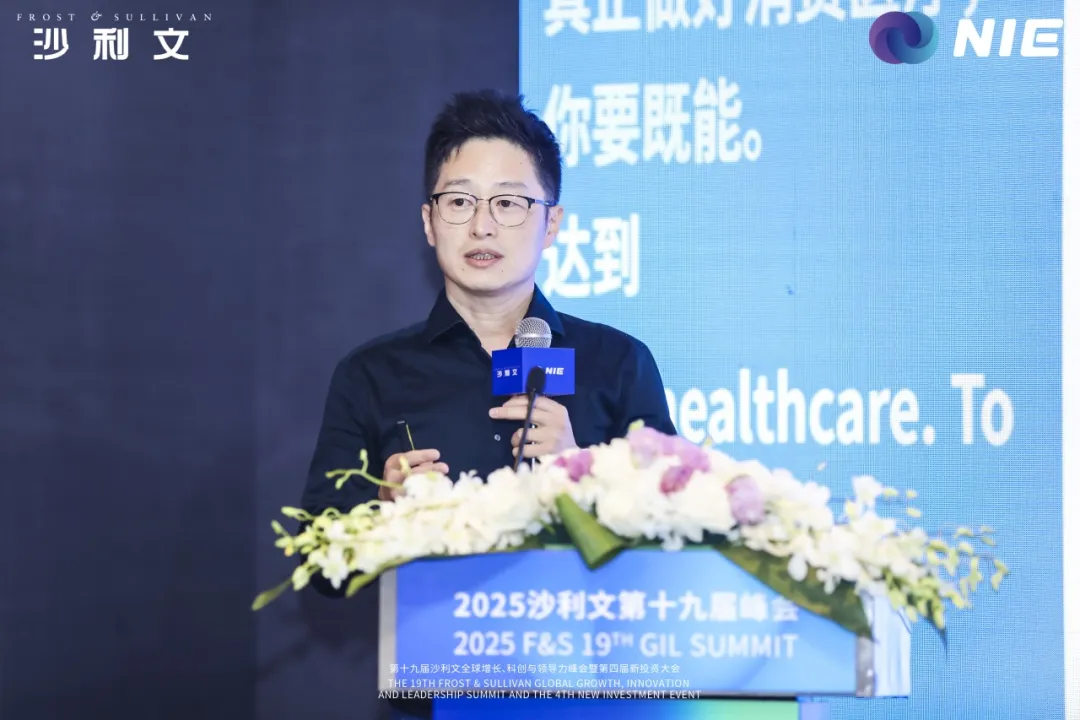
Cao Le, Director of Strategic Investment Department for Asia-Pacific Region at iQIYI Technology
The following are the key points from Cao Le's speech:
I. Development Background and Driving Factors of the Consumer Healthcare Industry
Cao Le pointed out that consumer healthcare is a fusion of 'consumption attributes' and 'medical attributes'. It not only needs to follow scientific norms, policy supervision, and professional education in the medical field but also satisfy experience optimization, trust building, and value perception in consumer scenarios. It has risen rapidly with the upgrading of health consumption needs and policy support.
From the perspective of policy environment, multiple national departments have intensively introduced favorable policies to safeguard the industry. The 'Special Action Plan to Boost Consumption' deploys seven major actions including increasing income for urban and rural residents and improving the quality of service consumption, incorporating health care into key support areas; the 'Special Action Plan to Promote Healthy Consumption' specifies ten tasks, including strengthening new health service models and enhancing the service capabilities of the silver-haired market; the fiscal interest subsidy policy for personal consumer loans further covers health care consumption, with interest subsidies available for key areas with a single transaction amount of over 50,000 yuan, reducing the cost of residents' health consumption. At the same time, under the advancement of the 'Healthy China 2030' plan outline, the health literacy of Chinese residents continues to improve and life expectancy per capita extends. By 2030, the expected life expectancy per capita will reach 79 years, with health needs shifting from 'disease treatment' to 'active health management,' laying the demand foundation for consumer healthcare.
From the perspective of socio-economic factors, changes in population structure and enhanced consumption capabilities have jointly driven industry development. After the implementation of a gradual delayed retirement policy, the demand for health maintenance and chronic disease management among the middle-aged and elderly has increased; the growth of disposable income combined with changes in consumption concepts has led to a rise in the proportion of 'self-care-oriented' health consumption. The demand for fields such as oral and ophthalmology, medical aesthetics, and health check-ups has rapidly released, with consumer healthcare gradually becoming a trillion-level market, demonstrating resilience across economic cycles.
II. Current Situation and Core Development Characteristics of the Consumer Healthcare Industry
Cao Le introduced that the current consumer healthcare industry is characterized by 'demand differentiation, service upgrading, and technology-driven innovation.' The demand side has been further subdivided into two main directions: 'refined consumption' and 'inclusive consumption.' Refined consumption focuses on 'pleasing oneself, aesthetics, and personalization,' mainly served by private institutions, offering differentiated high and medium-priced projects with high frequency of use. The payment methods are primarily personal self-payment and commercial insurance; inclusive consumption emphasizes 'treatment, efficacy, and standardization,' relying on public and community medical institutions to provide a broader range of comprehensive basic health services, which are combined with medical insurance and personal payments. This differentiation not only meets the quality needs of the middle and high-income groups but also covers the basic health protection of the general public, continuously expanding the market scale.
In terms of service models, the industry is shifting from 'single-scenario passive treatment' to 'full-linkage active health management', reconstructing service processes centered around consumers. From understanding health needs and professional diagnosis, to simulating treatment plans and customized interventions, to monitoring the treatment process and home health management, a closed-loop service system has been formed. For example, in the field of oral health, through intraoral scanning, digital plan design, remote monitoring, and other links, a full-cycle coverage of 'diagnosis - treatment - follow-up' is achieved, improving service efficiency and patient experience.
Technological innovation has become the core driving force of the industry, with digitalization and AI deeply penetrating every aspect. On one hand, internally, through digital platforms, diagnostic and treatment data are integrated, and AI is used to optimize product design and treatment plans. For example, digital diagnostic and treatment systems in fields such as oral aesthetics can customize treatment plan paths based on patient data; on the other hand, externally, ecological cooperation is established to integrate new material technologies to improve product performance and achieve rapid iteration. At the same time, the O2O channel model has emerged, with online channels such as short video marketing, platform subscriptions, and email reach collaborating with offline institutions to break service time and space limitations and make consumer healthcare services more accessible.
III. Future Trends in Consumer Healthcare and iHealthTech Practices
Cao Le believes that future consumer healthcare will develop in the direction of 'personalization, platformization, and globalization.' Technological innovation and ecological construction are key competencies. In terms of technology application, AI-driven 'simulation prediction' technology will become widely popular. For example, aesthetic simulation and smile simulation tools can help patients preview treatment effects in advance, improving decision-making efficiency; digital diagnosis and treatment platforms further integrate imaging, diagnostic, and treatment data to achieve 'data-driven precision medicine.' Aiqi Technology, relying on the iTero intraoral scanner and Invisalign invisible orthodontic system, has built a database containing over 20 million patient data and over 100 million intraoral scan data, providing support for AI model training and personalized plan design.
In terms of ecological layout, 'platform-based integration' has become a trend. By constructing an open digital health ecosystem that connects medical institutions, laboratories, and third-party service providers, it achieves standardization of diagnosis and treatment processes and efficient allocation of resources. For example, iHealthcare's ADP ecosystem platform integrates functions such as intraoral scanning, treatment planning, 3D printing, and remote collaboration to form an integrated solution of 'diagnosis - treatment - follow-up', promoting the transformation of oral healthcare from 'fragmented services' to 'continuous health management'.
In market expansion, the combination of globalization and localization has become an important path. Leading enterprises promote the homogenization of global consumer healthcare services by exporting technical and service standards. At the same time, they adjust products and services according to regional needs, such as launching inclusive oral care products suitable for mass consumption in the Chinese market, balancing quality with cost-effectiveness. In addition, commercial insurance cooperation will be further deepened, and the integration of consumer healthcare and insurance products (such as oral insurance and medical beauty insurance) will lower consumption thresholds and expand market coverage.
Cao Le emphasized that the future development of consumer healthcare needs to return to its medical essence and innovate within the framework of regulation. As policy supervision becomes stricter, the industry will pay more attention to compliant operations and professional capacity building; at the same time, through technological innovation and model optimization, it will promote the 'inclusive and accessible' development of health services, ultimately achieving a 'regulated, innovative, and win-win' development pattern. Under the new opportunities of global AI-powered smart healthcare, it will help the industry move towards higher-quality development.




