



The 19th Frost & Sullivan Global Growth, Innovation and Leadership Summit - the Fourth New Investment Conference —— Life Sciences New Investment Summit Forum, hosted by the world-leading growth consulting firm Frost & Sullivan (Frost & Sullivan, abbreviated as: Frost & Sullivan), was successfully held in Shanghai on August 28, 2025. The forum brought together more than 50 industry leaders, biopharmaceutical companies, medical device companies, investment institutions and professional service providers. With the theme of "Strengthening Foundations and Stabilizing in the Face of Wind and Waves", it focused on the cutting-edge trends, innovative technologies and globalization development strategies in the field of life sciences, aiming to promote industrial development and global cooperation.
At this forum, Xiaozuo Xiang, Chairman and CEO of Zhejiang Shimai Pharmaceutical Co., Ltd., shared a keynote speech titled "Analysis of the Prospects for New Generation TCE Technologies".
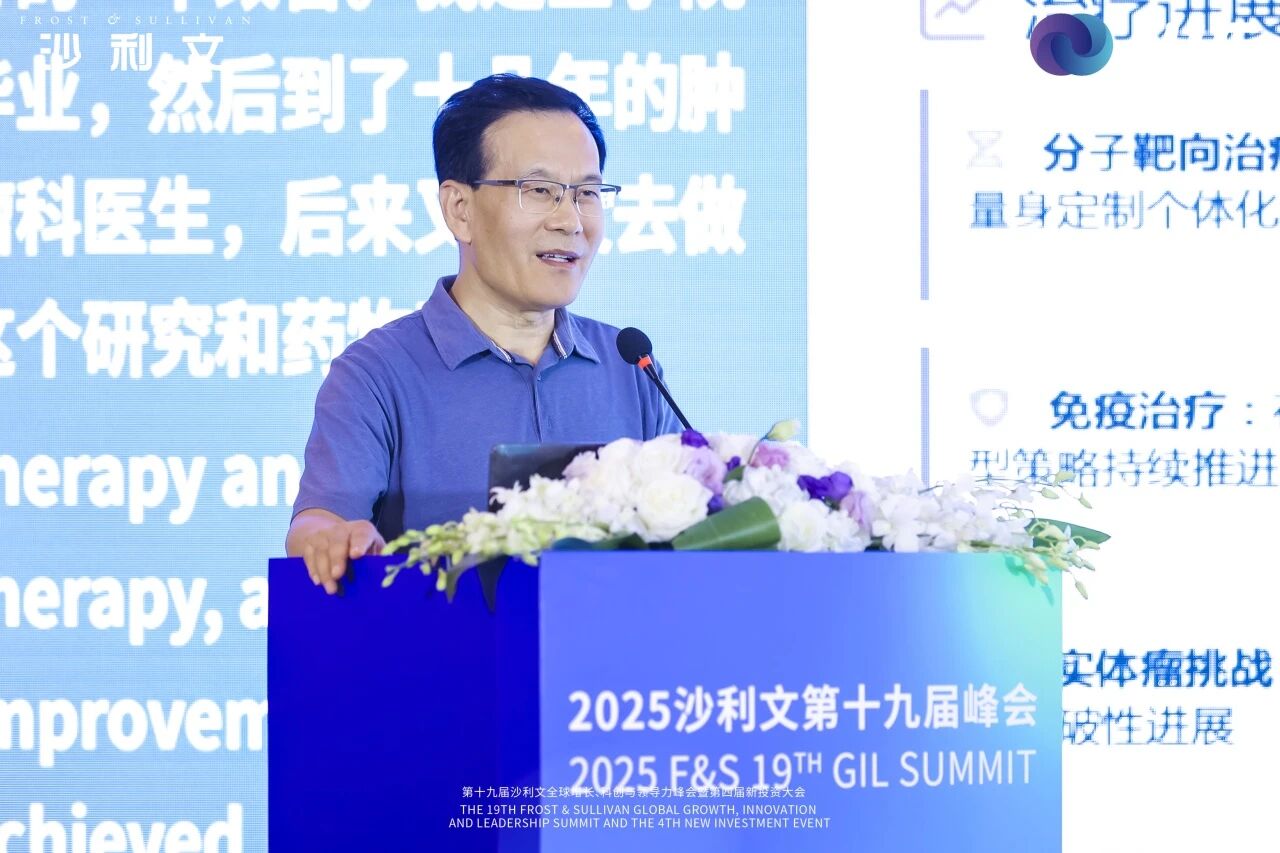
Xiao Zuoxiang, Chairman and CEO of Zhejiang Shimai Pharmaceutical Co., Ltd.
The following are the key points of Xiaozuo Xiang's speech:
I. Current Status of Solid Tumor Treatment and Background of TCE Technology
Xiao Zuoxiang pointed out that global cancer treatment faces severe challenges. In 2022, nearly 20 million new cases of malignant tumors occurred globally, with more than 9.7 million deaths. In China, there were 4.8247 million new cases and 2.5742 million deaths, among which solid tumors such as lung cancer, liver cancer, and gastric cancer account for a high proportion and are difficult to treat. Currently, there are two core pain points in solid tumor treatment: one is the issue of drug resistance. Even with combined therapies such as 'EGFR-TKI+MET inhibitors' and 'targeted drugs + PD-1/PD-L1', drug resistance remains difficult to avoid, and it may increase the risk of toxicities such as interstitial pneumonia. Dynamic monitoring of ctDNA can only alert for 30%-40% of drug-resistant events; the other is safety issues. Preventive medication has limited control over immune-related adverse reactions (irAEs) and special toxicities of targeted drugs, with a clinical application rate of biomarkers less than 10%, failing to meet clinical needs significantly.
In the evolution of treatment technologies, bispecific antibodies (BsAb) have gradually become a focus due to their advantages such as 'bimodal binding, stronger precision, and lower off-target toxicity.' T cell conjugates (TCE), as an important type of bispecific antibody, stand out with their unique mechanism. One end of TCE binds to tumor-associated antigens (TAA) on the surface of tumor cells, while the other end binds to CD3 molecules on T cells. It can directly activate T cells and gather around tumors to achieve precise killing. Compared to traditional therapies, TCE has significant advantages: compared to monoclonal antibodies, its efficiency in activating T cells for killing is superior to the Fc-mediated ADCC effect; compared to ADCs, it relies on the host immune system rather than a chemical payload, making it effective against both dormant and dividing cancer cells with higher safety; compared to CAR-T, which is a 'off-the-shelf' drug, it has lower R&D and manufacturing costs, simpler usage procedures, and greater accessibility, providing a new direction for solid tumor treatment.
II. Current Development Status and Market Potential of TCE Technology
Xiao Zuoxiang introduced that currently, there is active global TCE R&D pipelines. There are 186 monoclonal antibody products in clinical stages, mainly in Phase I. CD3+BCMA, CD3+CD19, and CD3+CD20 are the top three targets, followed closely by solid tumor targets such as EGFR and HER2. In terms of indication development, the hematological malignancy field has become relatively mature, with multiple drugs such as Blinatumomab (CD19/CD3) and Teclistamab (BCMA/CD3) approved. Among them, the median overall survival of Blinatumomab in treating acute lymphoblastic leukemia reaches 36.5 months; the solid tumor field has become a new track, with Tebentafusp (uveal melanoma) and Tarlatamab (small cell lung cancer) being successively approved or entering late clinical trials. Claudin18.2-targeted TCE has an ORR of 48.6% and DCR of 73.0% in Phase I clinical trials of gastrointestinal tumors, showing good potential.
In terms of market scale, the TCE industry is experiencing rapid growth. The global TCE drug market size is expected to increase from about $1 billion in 2022 to over $1211 billion by 2035, with an annual compound growth rate exceeding 40%. Although the Chinese market started a bit later, it is growing rapidly. The scale in 2024 was about 7 billion yuan, and it is expected to reach 1596 billion yuan by 2035. Looking at the competitive landscape, both international pharmaceutical companies and local biotech companies are accelerating their layout, focusing on target antigens highly expressed in solid tumors such as EGFR, HER2, and Claudin18.2. The technical route is iterating towards "improving tumor specificity and reducing toxicity," highlighting investment value. The industry has advantages such as "unmet demand, mature technology platforms, and concentrated R&D investment," but it also faces risks such as cytokine release syndrome (CRS), insufficient penetration of solid tumors, and high R&D costs. Attention should be paid to differentiated technology platforms and leading enterprises in clinical progress.
III. TCE Technological Innovation Trends and Timely Pharmaceutical Practice
Xiao Zuoxiang emphasized that TCE technology is breaking through in the direction of 'precision, multifunctionality, and intelligence'. The first is the conditional activation strategy, which ensures that TCE is only activated in the tumor microenvironment through methods such as 'protease activation', 'pH-sensitive', and 'separable design'. For example, Timm Pharmaceutical's CMDE005 uses cleavable masking peptides to block CD3 binding activity in normal tissues. It is activated after being specifically cleaved by proteases in tumor tissue, with an in vitro masking efficiency exceeding 10,000 times, significantly reducing off-target toxicity. The second is multi-specific design. The tri-specific TCE, designed with 'CD3+ dual TAA' and 'CD3+ TAA+ co-stimulatory molecules', overcomes antigen heterogeneity, enhances T cell activation, and expands the therapeutic window. The third is AI-driven development, using tools like AlphaFold to optimize antibody structures, predict toxicity and efficacy, and improve R&D efficiency.
As an industry participant, Shimai Pharmaceutical focuses on 'source innovation' as its core and constructs four major technology platforms: a discovery platform for multiple novel antibody sequences (including 4 human IgM libraries with 10^1-10^3 capacity), the H-BiTE platform (solving the problems of drugability and toxicity of bispecific antibodies, with a yield of 4 g/L), the multifunctional TCE structure platform (flexibly designing tri-specific antibodies with multi-mechanism synergy), and the Pro-BiTE platform (a globally leading enzyme-controlled system that achieves targeted enrichment of tumor tissues). In terms of pipeline layout, focusing on solid tumors, SMET12 (EGFR/CD3) has achieved a DCR of 100% and ORR of 41.7% in the treatment of non-small cell lung cancer where targeted therapy has failed, with a maximum PFS exceeding 9 months; CMDE005 (enzyme-controlled EGFR/CD3), as a globally leading masked TCE, has been approved for IND in both China and the US, with no CRS or grade ≥3 adverse events observed during clinical trials; CMD011 (GPC3/CD3) for liver cancer has shown disease stabilization effects in the low-dose group.
Xiao Zuoxiang believes that TCE technology is opening a new chapter in the treatment of solid tumors, and in the future, it is necessary to continuously break through technical bottlenecks such as 'tumor microenvironment penetration' and 'toxicity control'. Shimai Pharmaceutical will rely on its patent layout (more than 60 core patents, including international patents for proteolytic cleavable bispecific antibodies) and a dual-center R&D system in China and the US to promote TCE from 'technology verification' to 'clinical popularization', helping Chinese innovative drugs take a leading position in the global TCE track and providing more efficient and safe treatment options for cancer patients.




