


In recent years, with the accelerating pace of digital transformation in enterprises and government agencies, electronic signature technology has seen further development in its application within and outside various organizations. Third-party electronic signature vendors use electronic signatures as the underlying technology to provide identity authentication, electronic contract signing, seal management, data preservation, and data issuance services for government agencies and enterprises from a third-party perspective.Frost & Sullivan (Frost & Sullivan, abbreviated as "Frost & Sullivan") hereby releases the "White Paper on China's Third-Party Electronic Signature Market 2022".
In recent years, with the accelerating pace of digital transformation in enterprises and government agencies, electronic signature technology has seen further development in its application within and outside various organizations. According to the 'Electronic Signature Law of the People's Republic of China' issued by the Standing Committee of the National People's Congress in April 2005A clear electronic signature refers to the data contained in an electronic message, attached thereto, which is used to identify the signer and indicate that the signer acknowledges the content therein.An electronic signature is considered reliable if it meets the following conditions: (1) The data used to create the electronic signature is exclusive to the signer; (2) At the time of signing, the electronic signature creation data is only controlled by the signer; (3) Any changes made to the electronic signature after signing can be detected; (4) Any changes made to the content and form of the data message after signing can be detected.
01 Definition and Classification of Third-Party Electronic Signatures
Third-party electronic signature vendors use electronic signatures as the underlying technology, providing identity authentication, electronic contract signing, seal management, data storage and certification, and data issuance services for government agencies and enterprises from a third-party perspective. Based on deployment methods, they can be divided into public cloud, local deployment, hybrid cloud, and Ukey electronic signatures; in terms of product classification, they mainly include a series of services such as electronic signatures and digital authentication.
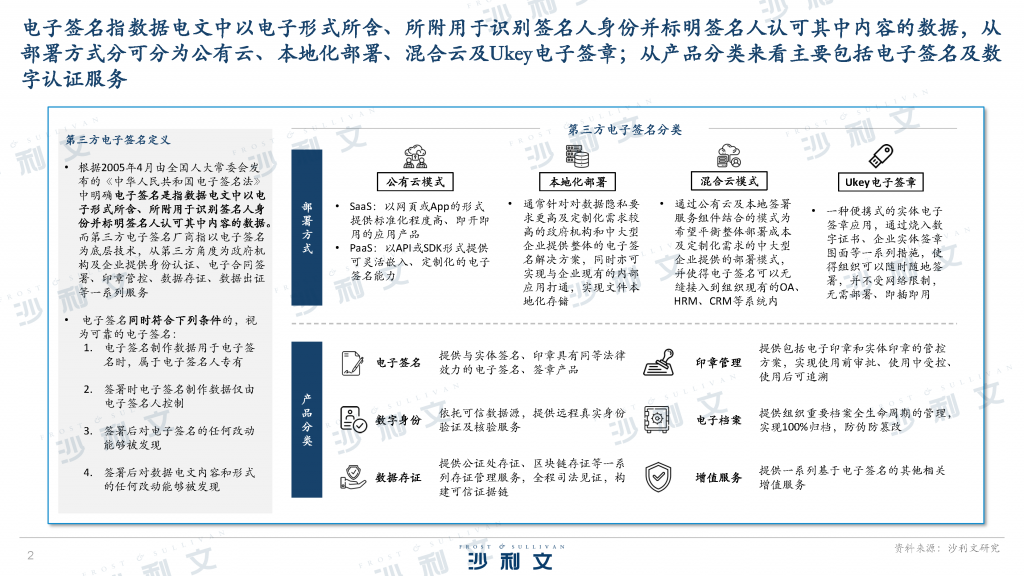
Looking at the comparison of four main electronic signature deployment modes, the public cloud mode is mainly targeted at small and medium-sized enterprises as well as individual users. The local deployment mode and hybrid cloud mode are primarily aimed at large and medium-sized enterprises as well as government agencies. Ukey electronic signatures can usually be applied to various types of enterprises and government agencies. Although local deployment and hybrid cloud modes have the characteristics of higher upfront investment and higher operational costs in the later stages, they are adopted by more large and medium-sized enterprises and government agencies because they meet their higher customization needs and can satisfy higher data privacy requirements through local data storage.

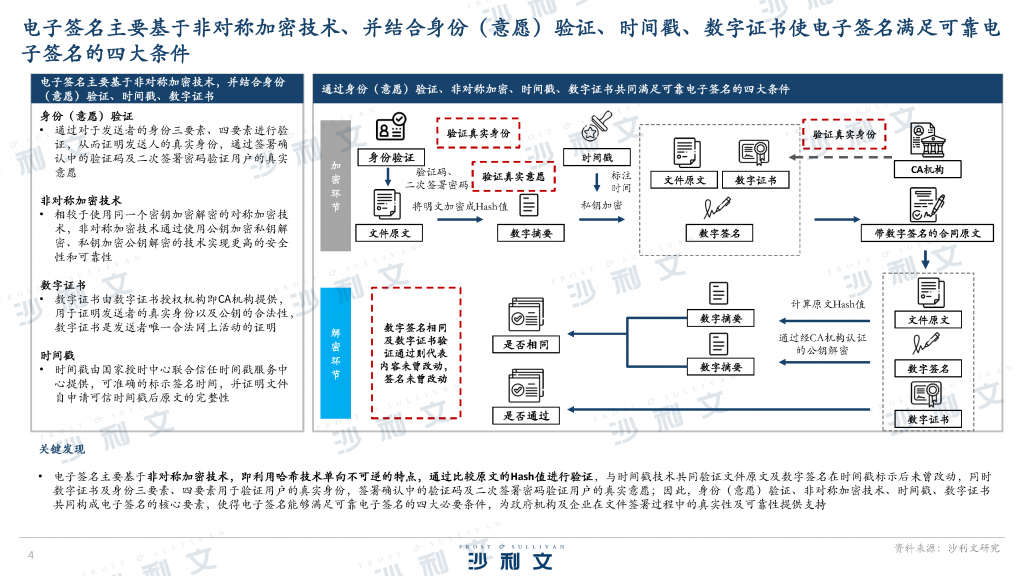
Electronic signatures are primarily based on asymmetric encryption technology, which utilizes the one-way and irreversible nature of hash technology. They verify by comparing the Hash values of the original text. Together with timestamp technology, they ensure that the original document and digital signature have not been altered after being timestamped. At the same time, digital certificates and the three or four elements of identity are used to verify the user's true identity. The verification codes and secondary signing passwords during the signing process confirm the user's true intention. Therefore, identity (intention) verification, asymmetric encryption technology, timestamps, and digital certificates together constitute the core elements of electronic signatures, enabling them to meet the four necessary conditions for reliable electronic signatures and providing support for the authenticity and reliability of document signing processes in government agencies and enterprises.
02 Third-Party E-Signature Market Industry Chain
The third-party electronic signature market industry chain can be divided into upstream service providers, midstream third-party electronic signature vendors, downstream application customers, as well as channel partners and ecosystem partners within the industry chain. Upstream service providers mainly include real-name authentication institutions, CA institutions, and timestamp service providers. Third-party electronic signature vendors need to connect with real-name authentication institutions, CA institutions, and timestamp service providers to fulfill the verification requirements for user-signed documents, ensuring that electronic signatures meet the conditions of reliable electronic signatures. Midstream third-party electronic signature vendors can be categorized into independent third-party electronic signature vendors, CA institution vendors, electronic data preservation and security institutions/information security vendors, and internet service providers. They convey products and services to downstream application customers through channel partner cooperation models or direct sales models. Downstream application customers can be divided into government agencies, enterprises, and a small number of individual users. At the same time, third-party electronic signature vendors are also actively seeking ecosystem partners. In addition to directly exporting their products, they can integrate electronic signature capabilities into the applications of different software vendors, thereby establishing an electronic signature ecosystem.

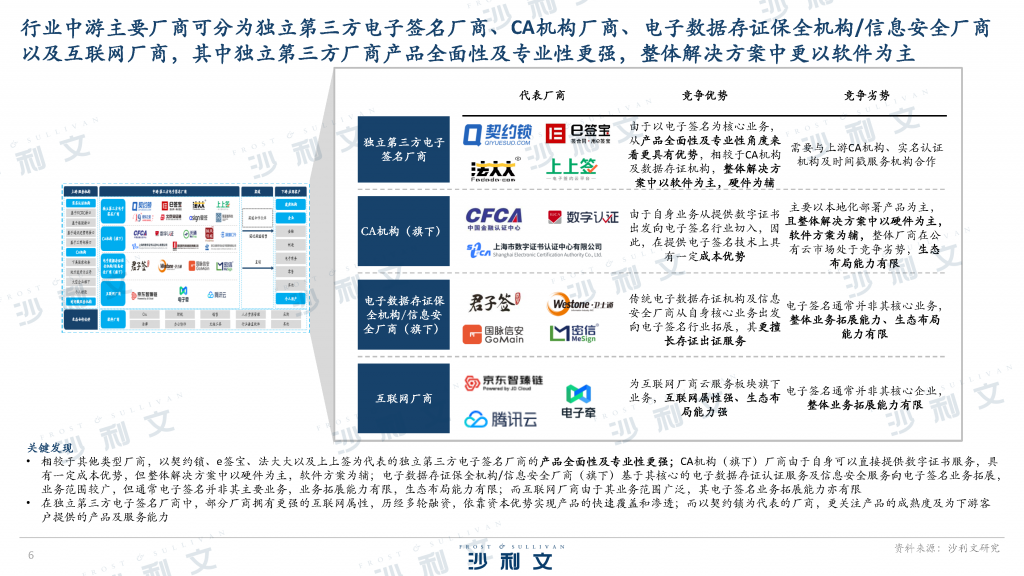
The main players in the midstream of the industry can be divided into independent third-party electronic signature vendors, CA (Certificate Authority) institutions, electronic data preservation and security institutions/information security vendors, and internet service providers. Among them, independent third-party vendors offer more comprehensive and professional products, with software being the primary component of their overall solutions.
Compared to other types of manufacturers, independent third-party electronic signature vendors represented by contract lock, e-sign PayPal, Faraday, and Shangshang Sign have more comprehensive and professional products; CA institution vendors have a certain cost advantage as they can directly provide digital certificate services, but their overall solutions are mainly hardware-based with software as a supplement; Electronic Data Preservation and Authentication Institutions/Information Security Vendors expand into the electronic signature business based on their core electronic data preservation and authentication services as well as information security services, with a wide range of businesses. However, electronic signatures are usually not their main business, limiting their business expansion capabilities and ecological layout abilities; Internet vendors also have limited business expansion capabilities for electronic signature services due to their broad scope of operations.
Among independent third-party electronic signature vendors, some possess stronger internet attributes. Having gone through multiple rounds of financing, they leverage capital advantages to achieve rapid product coverage and penetration. In contrast, vendors represented by contract locks focus more on the maturity of their products and the capabilities of the products and services they provide to downstream customers.
The downstream customers of the industry are mainly government agencies and enterprises. The main application scenarios for government agencies include internal and external document signing and querying, while those for enterprises include human resource management, sales, procurement, supply chain finance, etc.

03 Third-Party E-Signature Applications
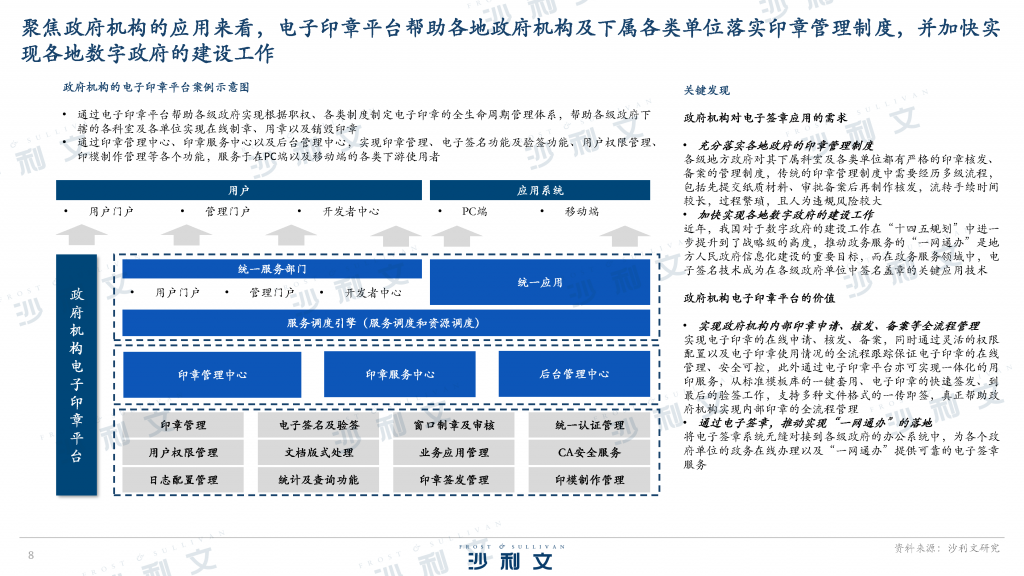
Looking at the application of government agencies, e-signature platforms help local government agencies and various subordinate units implement seal management systems and accelerate the construction of digital governments across the region.
Today, the application of electronic signature technology in enterprises is continuously deepening. The arrival of the COVID-19 pandemic has accelerated the pace of digital transformation within companies. Through the technical capabilities of electronic signatures, enterprises and employees can achieve online and remote work. From signing contracts face-to-face offline to completing express contract signings, and now to completing the entire contract signing process through electronic signatures, enterprises' management of online contract signing is more in line with the current normalized online office model under the pandemic. It also provides one of the important tools for cost reduction and efficiency improvement for both parties involved in business. In addition, the application of electronic signatures by enterprises has further extended from initial human resource management, sales management, and procurement management to all aspects of business operations, including design and investment promotion. It truly helps enterprises achieve cost reduction and efficiency improvement.

04 Overview of the Development of the Third-Party Electronic Signature Market
The third-party electronic signature market began to germinate in the early 21st century. With the clarification of the legal validity of electronic signatures, the continuous enrichment of participating manufacturers, and the accelerating digital transformation process, the electronic signature industry has developed at a rapid pace.
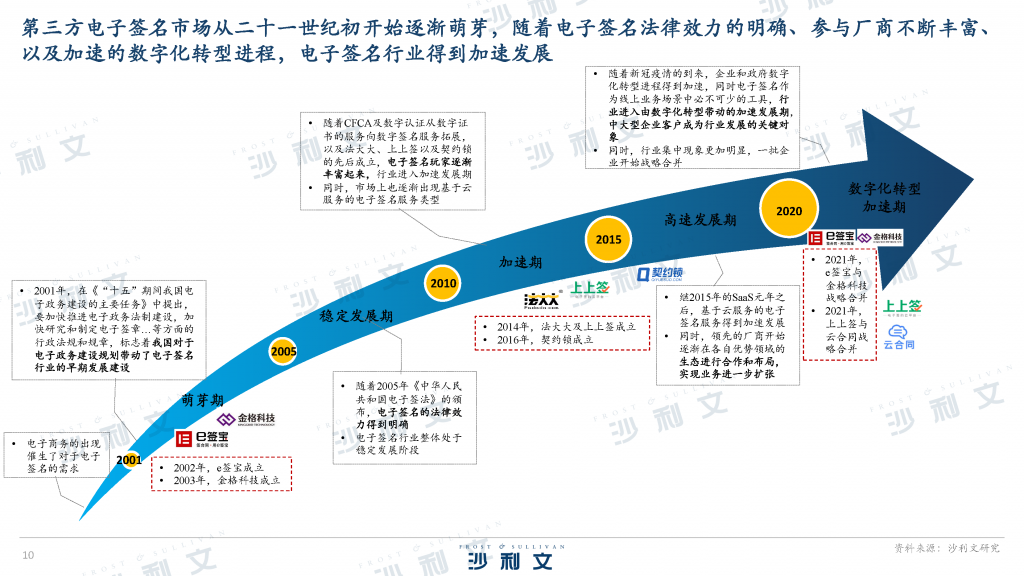
The healthy development of third-party electronic signatures in China over the past two decades has been inseparable from favorable factors such as the high demand for electronic signatures by governments and enterprises, the mature application of core technologies and cloud services along with blockchain technology, the active expansion of manufacturers, and policy support.

Looking at the policy side, since April 2005 when the 'Electronic Signature Law of the People's Republic of China' promulgated by the State Council clearly established that a reliable electronic signature has the same legal effect as a handwritten signature or seal, whether from the perspective of regulations related to the electronic signature industry itself or from the viewpoint of downstream application scenarios,The legal validity, requirements, and norms of electronic signatures in different application scenarios are being continuously improved and emphasized. This is aimed at safeguarding the legitimate rights and interests of relevant organizations and individuals, and providing a favorable development foundation for the healthy and orderly development of the electronic signature industry.

In recent years, China's 'delegating power, improving regulation, and optimizing services' (FAROS) reform has been continuously deepening. The concept of FAROS was first introduced in May 2015 during the State Council's 'National Television and Telephone Conference on Promoting the Integration of Streamlining Administration, Delegating Power, and Improving Regulation with Functional Transformations'; 'delegating' represents streamlining administration and reducing entry barriers, 'improving regulation' means innovating supervision to promote fair competition, and 'optimizing services' refers to providing efficient services and creating a convenient environment. In September 2018, the Ministry of Public Security took the lead in implementing the 'FAROS' reform for public security traffic management. In December of the same year, it began to deepen the 'FAROS' reform for public security management by reducing the supporting materials required for enterprises to handle affairs, thereby alleviating their burden and improving work efficiency, thus further facilitating various types of enterprises and the public to handle affairs and start businesses.
Electronic signature technology highly complies with the national requirements for the 'decentralization, regulation reduction, and service improvement' (Fangguanfu) reform, helping China build a digital government and the digital economy. In recent years, with high support and encouragement from the state, electronic signature technology has been continuously incorporated into the planning and implementation plans of local governments at all levels, such as Shanghai, Beijing, Shenzhen, Chongqing, Guangdong, Shaanxi, Heilongjiang, Hainan, Qinghai, Jiangxi, Inner Mongolia Autonomous Region, Ningxia Autonomous Region, and other governments. These regions have specifically proposed to accelerate the application of electronic signature technology to enhance the overall level of digital construction.

On the other hand, in recent years, China's encouragement of electronic signatures has also been continuously translated into specific downstream applications across various industries, including labor contract signing, procurement contract signing, intellectual property protection, housing contract signing, and more, further promoting the implementation of electronic signatures.

05 Development Trends of the Third-Party Electronic Signature Market
Looking ahead, from the perspective of manufacturers, third-party electronic signatures will further extend other value-added services and expand ecological cooperation. From an industry perspective, policies and large enterprises will further promote stable growth in the sector.In the process of digital transformation, various system login authentication methods within organizations remain chaotic, posing security risks such as identity fraud and information leakage. An electronic signature system with authentication and tamper-proof capabilities will play an important role in achieving trusted identities and behaviors during organizational digital transformation. By providing organizations with authentication and verification capabilities, it enables unified authentication and login across all systems within the organization, archiving key operations, and effectively helping organizations build a network-credible digital identity system.

06 Major Manufacturers in the Independent Third-Party E-Signature Market
Looking at the leading domestic independent third-party e-signature providers, including ContractLock, e-Sign Treasure, Shangshang Sign, and FadaDa.
Contract lock:Established in Shanghai in 2016, as a digital trust infrastructure service provider, we focus on providing government agencies and enterprises with trusted digital basic products that integrate 'trusted digital identity, electronic signatures, seal management, and electronic archive management'. We support multiple deployment methods such as public cloud, local deployment, and hybrid cloud. In terms of product completeness, number of medium to large customers, number of local deployment customers, scale of local service teams, and the number of cities covered, we are ranked first among independent third-party e-signature vendors in China. Our Contract Lock has been integrated with nearly a hundred enterprise application software such as WeCom, DingTalk, and Panwei, continuously enriching its application scenarios for electronic signatures.
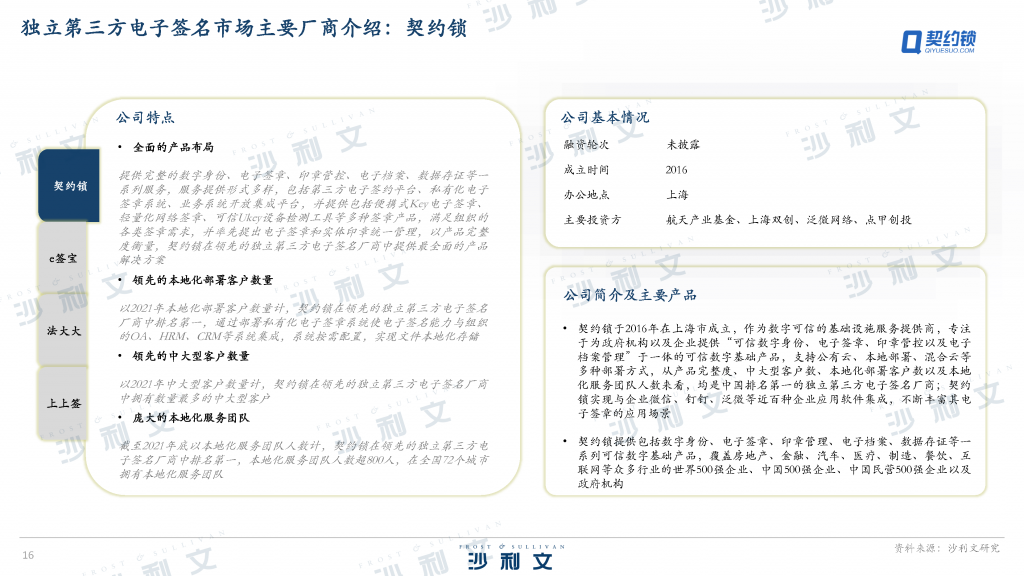
eSign PayPal:Established in Hangzhou, Zhejiang Province in 2002, it mainly provides electronic signature solutions based on public cloud, local deployment, and hybrid cloud deployment for enterprises, government agencies, and individual users. In terms of overall revenue in 2021, it is also a leading independent third-party e-signature provider in China. In September 2021, it completed a Series E financing of 1.2 billion RMB and announced a strategic acquisition of Jinke Technology in the same month. As of August 2021, eSignBank has accumulated services with over 100 Fortune Global 500 enterprise customers, more than 200 Fortune Global 500 Chinese customers, and has jointly created over 1,500 government service application scenarios with governments at all levels.

Fada Daya:Established in Shenzhen, Guangdong Province in 2014, it is one of the well-known independent third-party electronic signature manufacturers in China. It mainly provides legal digital signature technology for enterprises, government agencies, and individuals through electronic contract cloud platforms or hybrid clouds. Its founder originally had many years of experience in the legal field. By combining his familiar professional expertise with the electronic signature technology capabilities provided by the enterprise, it offers a series of extended services around legal needs before and after contract signing. In 2019, Faraday announced its acquisition of Yunhai CA.

Best of luck:Established in Hangzhou, Zhejiang Province in 2014, it is one of the well-known independent third-party e-signature providers in China. Based on both public cloud models and public cloud API models, it provides a range of value-added services such as electronic contracts and online signature verification for enterprise customers. In May 2019, Shangshang Sign announced a strategic merger with Cloud Contract, another independent third-party e-signature provider.

Leading vendors in the industry all offer basic software functions such as electronic signatures, trusted identity authentication, seal management, and electronic file management. In terms of deployment methods, apart from public cloud, some vendors also provide private or hybrid cloud deployment options to meet the diverse deployment needs of downstream customers. Additionally, a few vendors also offer portable hardware products to further satisfy customers' requirements for security and convenience. In terms of product completeness, Contract Lock provides the most comprehensive product solutions among leading independent third-party electronic signature vendors.
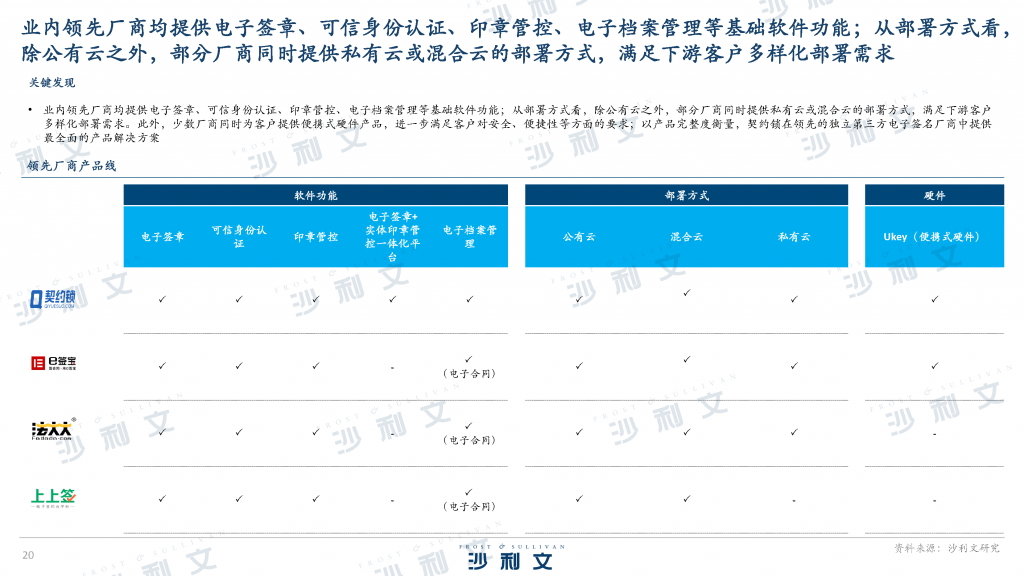
Medium and large customer groups are typically the downstream customers who are among the first to try electronic signatures, as well as the main paying customers. Therefore, they have become a key target customer group for many manufacturers in competing for market share; in terms of the number of medium and large customers, Contract Lock has the largest number of such customers among leading independent third-party e-signature vendors.

Customers who choose localized deployment are typically government agencies or medium to large enterprises. Therefore, vendors with a rich portfolio of medium to large customers often hold a leading position in the localized deployment market segment. In terms of the number of localized deployment customers, Contract Lock ranks first among leading independent third-party e-signature vendors.

The Chinese electronic signature market is still in the early stages of industry development. Downstream customers' awareness, acceptance, and usage habits of products are still in the cultivation phase. During this stage, downstream customers typically require manufacturers to provide comprehensive localization services to respond promptly to customer service needs. In terms of the number of cities covered by localization service teams and the number of team members, Contract Lock ranks first among leading independent third-party electronic signature vendors.






