



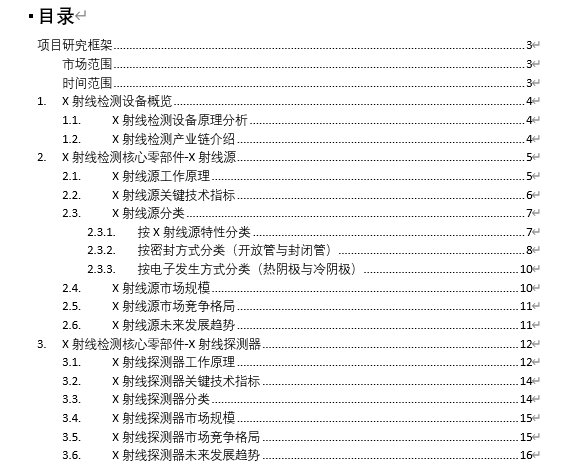
Project research framework
market scope
- Core components of X-ray inspection equipment, including radiation sources and detectors
Time range
- Base year: 2021
- Historical Years: 2017 to 2021
- Forecast period: 2022 to 2026
1. Overview of X-ray Inspection Equipment
1.1. Principle analysis of X-ray inspection equipment
X-rays are actually a type of electromagnetic wave with an extremely short wavelength and high energy, located between ultraviolet light and gamma rays. In X-ray detection equipment, the method of generating X-rays involves accelerating electrons to strike a metal anode target. During the collision, the electrons suddenly decelerate, and the kinetic energy they lose is radiated out as X-ray photons, thus producing X-rays. Due to their short wavelength and high energy, when X-rays strike an object, only a portion is absorbed by the object, while most pass through the atomic gaps of the object, exhibiting strong penetrating power.
As shown in the figure below, an X-ray source generates X-rays. Utilizing the penetrating properties of X-rays, by detecting the difference in the attenuation of X-rays passing through different densities (or thicknesses) of materials, that is, the number of remaining photons detected by the X-ray detector after passing through the object being measured, the internal structure of the object can be imaged. Through image analysis, it is possible to determine whether there are defects within the object and their type and grade. At the same time, the computer image processing system completes the storage of images, ensuring the traceability of detection data. Due to its non-destructive, rapid detection method, as well as intuitive and clear detection results, X-ray inspection equipment is widely used in various industries.

1.2. Introduction to the X-ray Inspection Industry Chain
2. X-ray inspection core components - X-ray source
2.1. Working Principle of X-ray Source
2.2. Key Technical Indicators of X-ray Sources
- focus size
- tube voltage
- Filament current (or target power)
2.3. Classification of X-ray sources
2.3.1. Classification by X-ray source characteristics
2.3.2. Classification by sealing method (open tube and closed tube)
2.3.3. Classification by electron generation method (thermal cathode vs. cold cathode)
2.4. Market Size of X-ray Sources
2.5. Market Competition Landscape of X-ray Sources
2.6. Future Development Trends of X-ray Sources
(1) Conduct independent research and development to solve 'bottleneck' technologies and achieve localization substitution
(2) Continuously advancing the research and development of cold cathode X-ray source technology
3. X-ray inspection core components - X-ray detectors
3.1. Working Principle of X-ray Detector
(1) Image Enhancer
(2) Flat panel detector
(3) Linear array detector
3.2. Key Technical Indicators of X-ray Detectors
- Resolution
- Detector size
- Detection efficiency
3.3. Classification of X-ray detectors

3.4. Market Size of X-ray Detectors
3.5. Competitive landscape of X-ray detectors
3.6. Future Development Trends of X-ray Detectors
(1) TFT flat panel detectors will become the mainstream in the future, while CMOS flat panel detectors continue to develop.
(2) Customer demand drives the product development towards digitalization, and domestic substitution is expected to intensify.




