1. Overview of the Macroeconomy
1.1 Nominal GDP and per capita nominal GDP of China, along with their growth rates (2016 - 2025E)
The economy has stabilized and recovered, with GDP maintaining a positive growth trend throughout 2020. The 'dual circulation' development pattern is accelerating its formation.
In 2020, China's nominal GDP achieved a growth rate of 3.0%, reaching approximately 101.6 trillion yuan. Against the backdrop of the global pandemic, it became the only major economy in the world to achieve positive economic growth. This is mainly due to three main reasons: First, significant progress has been made in technological innovation, which has greatly promoted the deep integration of technology with the economy and society, supporting and leading new achievements in high-quality development. Second, the Central Economic Work Conference emphasized counter-cyclical regulation and the 'six stabilities', with proactive fiscal policies and prudent monetary policy working together. Third, a new development pattern has been gradually established, with the domestic big cycle as the main body and mutual promotion between domestic and international dual cycles, enhancing the overall efficiency of the national economic system.
The "Proposal of the Central Committee of the Communist Party of China on Formulating the Fourteenth Five-Year Plan for National Economic and Social Development and the Long-Range Objectives Through the Year 2035" proposes to reach a per capita GDP level equivalent to that of moderately developed countries by 2035. General Secretary Xi Jinping pointed out in his explanation of the "Plan Proposal" that by the end of the "14th Five-Year Plan" period, the current high-income national standard should be met, and by 2035, the total economic volume or per capita income should double. Based on this calculation, valued in RMB, the average annual GDP growth rate during the "14th Five-Year Plan" period (2021-2025) should be 4.7%. Combined with estimates, the compound annual growth rate of nominal GDP across the country during the "14th Five-Year Plan" period should not be less than 6.3%.
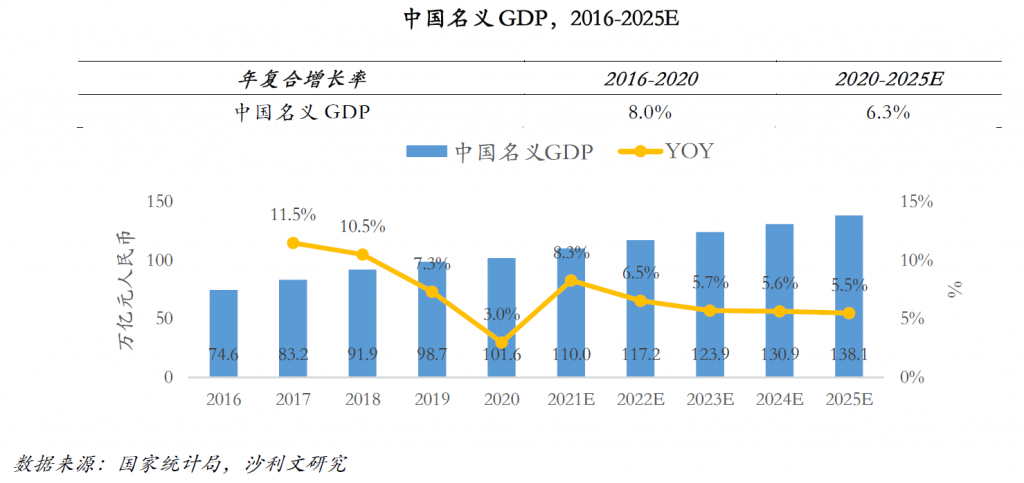
Affected by the COVID-19 pandemic, the global economic environment is turbulent, and the downward pressure on economies in various countries and regions has increased. The Chinese economy still has strong resilience; in the fourth quarter of 2020, the gross domestic product (GDP) exceeded 101 trillion yuan, with a year-on-year growth rate of 6.5%. The annual economic growth was about 3%. It is expected that the overall trend of a steady upward recovery of the Chinese economy in 2021 will remain unchanged, with both consumption and investment expected to accelerate their recovery.
In 2020, China's per capita nominal GDP grew by about 2.4%, reaching approximately 72,600 RMB, breaking through the 10,000 RMB mark and falling into the middle to high-income category, just one step away from high-income economies. At the same time, it also faces the issue of efficiency depletion under equal levels of total factor productivity, known as the 'middle-income trap'. China's per capita nominal GDP is expected to reach about 99,000 RMB by 2025, with a compound growth rate of 6.4% from 2020 to 2025.

1.2 US nominal GDP and per capita nominal GDP and growth rate, (2016 - 2025E)
The pandemic has had a significant impact on the US economy. The new administration will strengthen government efforts in stimulating the economy, narrowing the wealth gap, and improving social welfare security. It is expected that the economy will rebound significantly in 2021.
In 2020, nominal GDP reached $20.9 trillion, a year-on-year decrease of 2.3%. It is expected that the US economy will experience a significant rebound in 2021, with medium- to long-term potential growth rates increasing. The new government's strengthening of epidemic prevention and control is conducive to providing an orderly economic operation, facilitating supply recovery. Economic stimulus policies are beneficial for expanding aggregate demand. Tariff cuts and a return to multilateralism are conducive to promoting global trade activities to warm up.
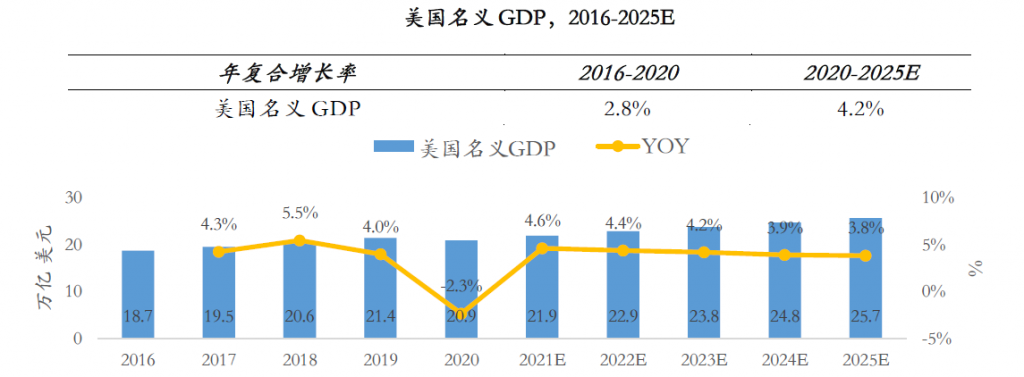
Data source: U.S. Economic Analysis Bureau, Frost & Sullivan research
In 2019, the per capita nominal GDP of the United States reached approximately $65,200. From 2016 to 2020, the annual compound growth rate of the per capita nominal GDP of the United States was about 2.3%. Against the backdrop of a slowdown in macroeconomic growth, the outbreak of the COVID-19 pandemic at the beginning of 2020 also had a negative impact on the economic development of the first half of the year. As of December 31, Eastern Time in the United States, the cumulative number of confirmed cases exceeded 20 million, ranking first globally. With the continued increase in testing numbers, the number of confirmed cases will continue to rise in the future. In 2020, the per capita nominal GDP of the United States decreased by 2.8% year-on-year, to approximately $63,000, still at a leading level globally. The U.S. economy is in a post-pandemic rebound phase, but it is expected that the growth rate slope will slow down due to the impact of repeated outbreaks and the uncertainty of new government policies being implemented.

2. Overview of the High-Pressure Cleaning Equipment Market
2.1 Definition and Classification of High-Pressure Cleaning Equipment
High-pressure cleaning equipment, as an efficient outdoor cleaning device, operates by a power unit that converts ordinary pressure water into high-pressure water through a high-pressure pump. The high-pressure water then travels through high-pressure pipelines to reach the control device. Finally, the high-pressure nozzle converts the high-pressure water into a high-pressure jet to flush the surface of objects. When the impact force of the water is greater than the adhesion between dirt and the object's surface, the high-pressure jet will peel off and wash away the dirt, thereby achieving the purpose of cleaning the object. It is currently recognized as one of the most environmentally friendly, economical, and scientific cleaning methods in the world.
According to application fields, they can be divided into civil high-pressure cleaners and commercial high-pressure cleaners; according to power source, they can be categorized into motor-driven high-pressure cleaning equipment, gasoline engine-driven high-pressure cleaning equipment, and diesel engine-driven high-pressure cleaning equipment.
Civil high-pressure cleaning equipment: With the improvement of people's living standards, the steady increase in automobile ownership, and the continuous enhancement of cleanliness standards for residential living environments, the market demand for high-pressure cleaning equipment is rapidly growing. Civil high-pressure cleaning equipment has lower specification standards and places more emphasis on water conservation, economy, portability, flexibility, simplicity, and ease of use. It is suitable for residential courtyards, walls and roofs, swimming pools, private cars, and other areas.
Commercial high-pressure cleaning equipment: Commercial high-pressure cleaning equipment has more stringent specification parameters and a wide range of application fields. It features advantages such as efficient cleaning, labor savings, water conservation, and environmental protection.
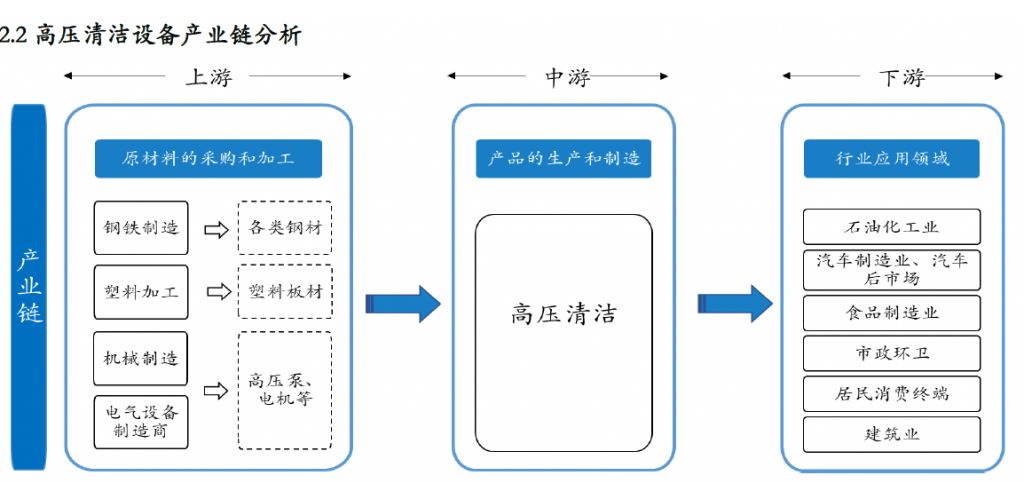
Upstream of the industrial chain
The upstream industries of high-pressure cleaning equipment mainly include steel manufacturing, plastic processing, machinery manufacturing, electrical equipment, and other manufacturing sectors. In recent years, China's manufacturing added value has maintained a relatively high level, consistently ranking first in the world. The COVID-19 pandemic has had a certain impact on the production and operation of some manufacturing enterprises, with the China Manufacturing PMI index dropping to 35.7 in February 2020. With effective prevention and control of the epidemic in China, manufacturing has steadily recovered. From February 2020 to January 2021, the PMI index remained above the boom-bust line for eleven consecutive months, with production and operation steadily recovering. In 2020, the steel industry's production was relatively stable, and the industry maintained a relatively stable operation, demonstrating strong risk resistance and providing strong support for the development of the high-pressure cleaning equipment industry. The pandemic has had a certain impact on the plastic industry. With the control of the epidemic, the order of employees' attendance, production, and daily life, as well as national infrastructure construction, has gradually recovered. The demand and supply of plastic products have risen steadily, showing the industry's strong resilience and fully meeting the development needs of the high-pressure cleaning equipment manufacturing industry.
Midstream of the industrial chain
The midstream consists of high-pressure cleaning equipment manufacturers, with the main participants being brand owners and manufacturers. Brand owners are mainly responsible for brand sales, while manufacturers operate primarily under OBM (Own Brand Manufacturer), ODM (Original Design Manufacturer), and OEM (Original Equipment Manufacturer) models. OBM manufacturers produce high-pressure cleaning equipment with their own brands and market them through these brands; ODM manufacturers design and produce high-pressure cleaning equipment for other brands; OEM manufacturers are mainly responsible for the production of high-pressure cleaning equipment.
Currently, the main consumer markets for high-pressure cleaning equipment are in regions such as Europe and North America. The market is relatively mature with high brand recognition and technical standards. The Asia-Pacific region has great market development potential. With the continuous favorable macroeconomic and policy conditions in the Chinese market, the market share of high-pressure cleaning equipment with efficient, water-saving, and mobile flexibility features in China is expected to further increase.
Downstream of the industrial chain
The application of high-pressure cleaning equipment in downstream industries is mainly divided into commercial and civil sectors. In the civil sector, it is generally used for various vehicle cleaning, watering trees, streets, home balconies, floors, glass, and other stubborn stains. With its excellent product features and continuous technological innovation, high-pressure cleaning equipment has a good alternative to traditional manual cleaning and chemical cleaning methods. At the same time, as the product categories of high-pressure cleaning equipment continue to enrich, such as the emergence of handheld portable high-pressure cleaners, they will continuously supplement and enrich the application scenarios and user experiences of high-pressure cleaning equipment in towns. The commercial sector is widely used in manufacturing, automotive after-sales market, construction industry, petrochemical industry, municipal sanitation, etc., with a relatively wide range of application areas and a high acceptance and recognition of products, indicating potential for deep market penetration in the future.
2.3 Global Sales, Revenue and Growth Rate of High-Pressure Cleaning Equipment (2016 - 2025E)
Over the past five years, benefiting from favorable macroeconomic conditions and the rapid development of the high-pressure cleaning equipment market, global sales volume and revenue of high-pressure cleaning equipment have shown a relatively fast growth trend. From 2016 to 2020, sales volume increased from about 22 million units to about 25 million units, with an annual compound growth rate of about 3.3%. Revenue increased from about $2.59 billion to about $3.36 billion, with an annual compound growth rate of 6.8%. In 2020, due to the global outbreak of COVID-19, home quarantine policies were widely implemented in China and European and American countries, stimulating household cleaning demand. This became one of the growth points for the global high-pressure cleaning equipment market scale. In 2020, the global sales volume of high-pressure cleaning equipment increased by about 5.8%, with sales volume of about 25 million units. It is expected that over the next five years, global sales volume and revenue of high-pressure cleaning equipment will generally show an upward trend, with annual growth rates gradually slowing down. The annual compound growth rate of sales volume will be about 1.9%, and the annual compound growth rate of revenue will be about 4.6%.

Data source: Frost & Sullivan research
2.4 U.S. Sales, Revenue and Growth Rate of High-Pressure Cleaning Equipment (2016 - 2025E)
The application scope of the high-pressure cleaning equipment market in the United States is relatively wide, with a high penetration rate. In both commercial and residential fields, there is a high acceptance and demand for high-pressure cleaning equipment. Over the past five years, the annual compound growth rate of sales in the US high-pressure cleaning equipment market has been about 3.0%, and the annual compound growth rate of sales revenue has been about 2.7%. The COVID-19 pandemic that broke out in the United States at the beginning of 2020 had a limited impact on the market. Instead, demand for high-pressure cleaning equipment increased. In 2020, sales volume and revenue showed positive growth, with an annual increase of about 2.1% in sales volume and about 1.8% in revenue, resulting in an annual sales revenue of about $1.39 billion. It is expected that in the next five years, with the success of vaccine research and development and the increasing vaccination rate, combined with the improvement of macroeconomic conditions, sales volume and revenue in the US high-pressure cleaning equipment market will continue to grow, and the penetration rate will be further enhanced. The annual compound growth rate of sales volume is expected to be about 1.6%, and the annual compound growth rate of sales revenue is about 2.6%.

2.5 Sales volume, sales amount and growth rate of high-pressure cleaning equipment in China (2016 - 2025E)
The Chinese high-pressure cleaning equipment market is still in the growth phase. Benefiting from favorable economic conditions and positive impacts of consumption upgrading, the expansion of the middle-income group, the continuous improvement of people's living standards, and the gradual enhancement of people's comfort, convenience, and personalization of cleaning tools have led to an expected rapid increase in the popularity of high-pressure cleaning equipment in China. Over the past five years, the overall sales volume and sales amount in the Chinese market have been growing, with an annual compound growth rate of about 5.2% for sales volume and about 8.6% for sales amount. In 2020, the market was generally less affected by the COVID-19 pandemic and will maintain an incremental state. It is expected that from 2020 to 2025, the sales volume and sales amount in the Chinese market will continue to grow rapidly, with a slight slowdown in growth rate, with an annual compound growth rate of about 3.6% for sales volume and about 7.5% for sales amount.

2.6 Analysis of Driving Forces for the Development of the High-Pressure Cleaning Equipment Market
- The growth of the high-pressure cleaning equipment market is driven by the increasing demand for cleanings led by macro policies:
The high-pressure cleaning equipment market in Europe and America has entered a relatively mature development stage, with a large market size and stable growth rates. In Asia-Pacific regions such as China, the penetration rate of high-pressure cleaning equipment is still low, indicating that the market is in its early stages of development and has great potential for growth. The 'Healthy China 2030' plan outline, national strategies such as new urbanization, and policies have all played a significant role in promoting the cleaning industry. High-pressure cleaning equipment, which combines environmental protection, efficiency, and labor savings, can meet the cleaning needs and growth in urban and rural areas. In the commercial sector, high-pressure cleaning equipment continues to develop deeply in manufacturing, construction, civil affairs and sanitation, automotive aftermarket, and other fields, and continuously enriches product categories to meet the cleaning needs of different industries.
- The cleaning methods and characteristics of high-pressure cleaning equipment can play a certain role in replacing traditional cleaning methods:
High-pressure cleaning equipment is characterized by low cleaning costs, no harmful substances produced after cleaning, and minimal water consumption. The product principle utilizes the high-pressure and high-flow velocity jet of the high-pressure cleaning equipment to remove dirt attached to the surface of objects with a high impact force, thereby flushing away the dirt to achieve the purpose of cleaning. The nozzle diameter of high-pressure cleaning equipment is relatively small, allowing for various spraying methods such as fine flow and fan-shaped spraying to remove dirt. Usually, only tap water is needed, and it can clean general dirt without adding chemical detergents. It consumes less water, has higher cleaning efficiency, reduces cleaning costs, does not produce excess harmful substances, and minimizes dependence on manual labor and chemical detergents.
2.7 Analysis of Market Barriers to High-Pressure Cleaning Equipment
- Technical barriers:
The research, development, and manufacturing of high-pressure cleaning equipment involve numerous technical fields. It requires systematic R&D from parts to complete machines across disciplines such as fluid mechanics, pipeline design, jet technology, new materials, and anti-corrosion protection. Production enterprises need to possess a high level of technical research and development and production processes in product research and development, industrial design, and process implementation. The standards for the professional experience of talents are also quite high. Therefore, professional technology is one of the most important barriers to entering the industry.
- Market access barriers:
On the basis of meeting technical research and development requirements, different countries and regions have varying needs for market access certification for high-pressure cleaning equipment, including aspects such as safety, environmental protection, and emissions. In the Chinese market, the technical standards for high-pressure cleaning equipment are constantly being updated. The national standard for high-pressure cleaning equipment issued by the National Technical Committee for Spray Equipment Standardization in November 2020 replaced the product standard from 2011, raising market entry barriers. Overseas markets also see increasingly stringent certification standards for high-pressure cleaning equipment, which require permits before export to relevant countries. This demands significant investment in capital, technology, human resources, etc., further increasing market access barriers.
2.8 Analysis of the industry development trend of high-pressure cleaning equipment market
- The gradual upgrading of high-pressure cleaning technical standards promotes the steady development of the industry:
With the continuous upgrading of market access licensing standards and product standards for high-pressure cleaning equipment in China, Europe, and America, manufacturers are innovating technically to meet new standards in manufacturing production. Currently, the high-pressure cleaning equipment market in our country is still in a stage of rapid growth. The improvement of product and production standards is conducive to promoting the steady development of the industry, standardizing market competition, and enhancing consumers' recognition and usage experience of high-pressure cleaning equipment.
- The multi-functional and integrated development of high-pressure cleaning equipment will improve the practicality of products:
At present, the functions of high-pressure cleaning equipment are relatively single, mainly using high-pressure jets to clean stains. In the future, the functions of high-pressure cleaning equipment can be further expanded. The product functions can integrate analysis of stains, vacuuming, sewage recovery, sterilization and disinfection, etc., to achieve a full-process cleaning of the area being cleaned by the high-pressure cleaning equipment, including analyzing stains, high-pressure cleaning, dust collection, sewage recovery, and sterilization and disinfection. This will improve the practicality of the product and the consumer's product usage experience.
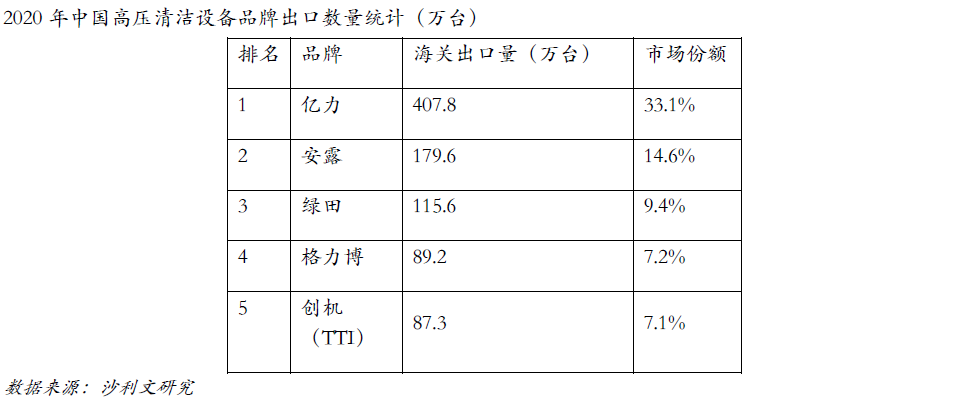
2.9 Statistics on the Customs Export Quantity of Chinese High-Voltage Cleaning Equipment Brands