


Recently, the globally renowned growth consulting firm Frost & Sullivan released the 'Global and China Electronic Measurement Instruments Industry Independent Market research report'. The report provides a detailed analysis of the market overview, driving factors, and future development trends of the global and Chinese electronic measurement instruments industries.

1. Basic situation of China's electronic measurement industry (example)
1.1 Main industry laws, regulations and policies
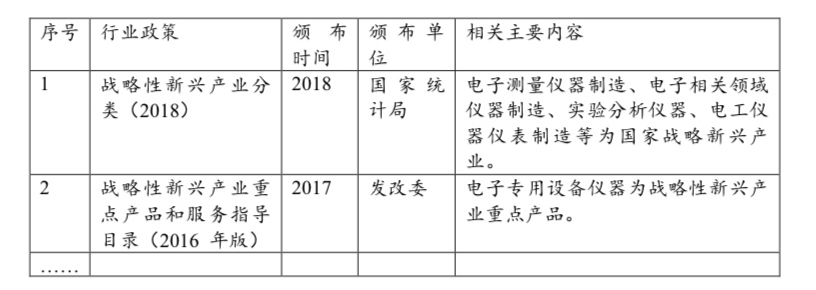
The electronic measurement instrument industry is a national basic and strategic industry. In recent years, relevant ministries such as the State Council, the National Development and Reform Commission, and the Ministry of Industry and Information Technology have successively introduced a number of specific industrial policies to encourage and support the development of the electronic measurement instrument industry. At the same time, encouraged by policies in specific application industries of electronic measurement instruments, electronic measurement instruments and meters have achieved industrial upgrading along the directions of high-endization, precision, and intelligence, and promoted the large-scale agglomeration of the industry.
1.2 Industry Technology Overview
Measurement is the process of describing observed phenomena with numbers according to certain rules, making quantitative descriptions of things. One of the important characteristics of modern science and technology, production, and national defense is the need for a large amount of observation and statistics. In modern industrial mass production, the time and cost spent on measurement account for about 20%-30% of the total production costs. Improving measurement levels, reducing measurement costs, minimizing measurement errors, and enhancing measurement efficiency are crucial for all fields of the national economy. Therefore, the modernization of measurement methods has been recognized as an important condition and clear sign of scientific and technological and production modernization.
1.3 Industry technical characteristics and development trends
1.3.1. Characteristics of electronic measurement
(1) Wide frequency range
Frequency range as low as 10−4Hz, up to THz (terahertz), requires different measurement methods and instruments for measurements at different frequency bands.
(2) Wide measurement range
Range is the difference between the upper limit and lower limit of an instrument's measurement capability. Due to the significant variation in the size of the measured quantities, it is necessary for measuring instruments to have sufficient range. For an electronic instrument, it is usually required that the highest range differ by several or even more than a dozen orders of magnitude from the lowest range.
……
2. Overview of the Global and Chinese Electronic Measurement Instruments Market (Example)
2.1. Definition and Classification of Electronic Measurement Instruments
There are numerous types of electronic measuring instruments, which can be divided into general-purpose instruments and specialized instruments according to different application fields. Specialized instruments aim at a single or several specific functions, with extremely high design and manufacturing difficulty, limited application areas, but indispensable in certain niche fields such as optical fiber testing instruments and electromagnetic compatibility (EMC) testing equipment. General-purpose electronic measuring instruments are basic equipment for modern industry and one of the important strategic and foundational industries of the electronics industry. They have a wide range of application scenarios and high demand. General-purpose electronic measuring instruments can be classified into the following major categories based on their basic testing functions:
Figure 1. Classification of Electronic Measurement Instruments

Data source: CNKI, expert interviews, Frost & Sullivan
2.2 Market size and segmentation of electronic measurement instruments, 2015 - 2025E
2.2.1 Global Market Size and Segmentation of Electronic Measurement Instruments (Digital Oscilloscopes, Spectrum Analyzers, etc.)
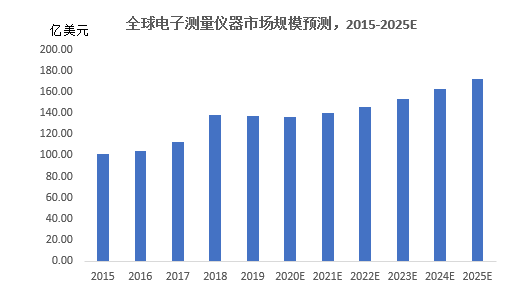
Benefiting from the growth of the global economy and the improvement in industrial technology levels, the market size of electronic measuring instruments globally has maintained a continuous upward trend. According to Frost & Sullivan's statistics, the market size of electronic measuring instruments increased from $10.095 billion in 2015 to $13.678 billion in 2020, with an average annual compound growth rate of 6.3% during this period. With the commercialization of 5G, the rising market share of new energy vehicles, and the development of information communication and industrial production, the demand for electronic measuring equipment globally will continue to grow. It is estimated that the global market size of the electronic measuring instrument industry will increase at a compound annual growth rate of 4.7% from 2020 to 2025, reaching $17.238 billion.
Figure 2. Global Electronic Measurement Instrument Market Forecast (2015 - 2025E)
Data sources: corporate annual reports, expert interviews, Frost & Sullivan
2.3 Analysis of the Electronic Measurement Instrument Market Industrial Chain
The electronic measurement instrument industry is an important component of the electronic information industry chain and a crucial foundation for the informatization, automation, and standardization of the industry chain. In every link of the electronic information industry chain, electronic measurement instruments play an irreplaceable role. Electronic measurement instruments are technology-intensive and knowledge-intensive products that are the basic conditions and important means for scientific research, production, testing, and maintenance in modern electronic information and related industries. They hold a strategic fundamental position in modern economic construction and national defense. The industry chain is complex, with diverse upstream, midstream, and downstream enterprises.
Figure 3. Analysis of the industrial chain of electronic measurement instruments

Data sources: expert interviews, public documents, Frost & Sullivan
3. Analysis of the Competitive Landscape of Electronic Measurement Instruments Globally and in China (Example)
The main leading companies in the global electronic measurement instrument market include Keysight Technologies, Rohde & Schwarz, Anritsu, Tektronix, LeCOS, etc., mostly established European and American enterprises. In addition to the aforementioned overseas companies that also operate in China, the main leading domestic companies in the Chinese electronic measurement instrument market also include a group of emerging local enterprises such as Puyuan Precision Instrumentation, DingYang, Yoleide, and Systech (also known as No. 41 Research Institute). Among them, Puyuan Precision Instrumentation has a prominent advantage as the only domestic measurement instrument company with its own chips.
3.1 Overview of the global and Chinese competitive landscape of electronic measuring instruments, 2019
3.1.1. Ranking and Market Share
The top five companies in the global electronic measurement instrument market accounted for a total of 48.7% of the total market share in 2019. Among them, Rohde & Schwarz ranked first with 25.9% of the total market share, and its revenue from electronic measurement instruments was $3.554 billion. The German company Rödel & Schwarz ranked second with $1.506 billion in revenue, accounting for 11% of the global market share. The third-ranked company in the market is ABB from Japan, which accounted for 5.2% of the global market share with $715 million in revenue. American companies Tektronix and LeCOS ranked fourth and fifth respectively, accounting for 4.7% and 1.9% of the global market share with $643 million and $264 million in revenue. The top five companies in the global market mainly come from the United States.
……
3.1.2 Market Concentration Analysis
From the perspective of global and Chinese enterprises in electronic measurement instruments, the industry is highly concentrated. The top five companies account for about 50% of the total market share, with each coming from the United States, Japan, and Germany. All five companies have experienced a long development period and have made good technical accumulations. In comparison to these enterprises, the Chinese electronic measurement instrument industry started relatively late, has a short development history, and has relatively weak technical accumulation. Due to the high technical barriers of electronic measurement instruments, which are limited by semiconductor processes, single-function module technology, system architecture technology, etc., Chinese enterprises do not currently have an obvious technological advantage in the market compared to international giants.
3.2 Overview of the Global and Chinese Digital Oscilloscope Market Competition Landscape, 2019
3.3. Competitive landscape of the top five global digital oscilloscopes
(1) Keysight
(2) Tektronix
(3) Teledyne LeCroy
(4) Rohde & Schwarz
(5) RIGOL Technologies
The above is an overview of some content from the 'Global and China Electronic Measurement Instruments Industry Independent Market research report'. For more information or to purchase the complete report, please contact Frost & Sullivan.




