Recently, the globally renowned growth consulting firm Frost & Sullivan (hereinafter referred to as 'Frost & Sullivan') released the 'Global and China Antibody Reagent Industry Independent Market research report'. The report provides a detailed analysis of the industry and classification of antibody reagents, the market size of their main application areas, and future development trends.
Antibodies and antibody-related reagents are at the upstream stage of industries such as biomedicine and in vitro diagnostics, and are the most fundamental and core materials for basic research and drug development. In the process of basic research and drug development, the quality of antibodies is crucial to the success or failure of experiments, having a significant impact on the time cost and capital investment of trials. Therefore, the selection of antibodies and the control of their quality are vital for basic research and drug development. It is expected that the global antibody reagent market will maintain stable growth over the next few years, with the scientific research antibody reagent market size reaching $3.36 billion by 2024, representing an average annual compound growth rate of 5.1% compared to 2019.
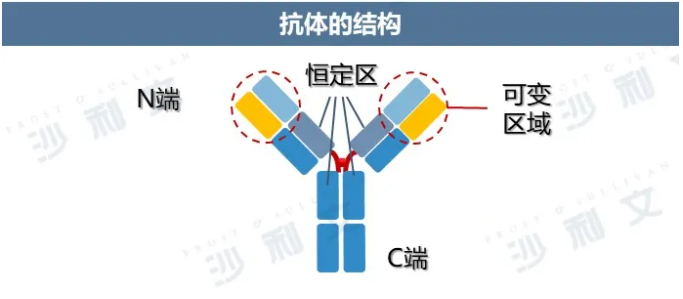
Antibodies are a class of immunoglobulins that can specifically bind to antigens.
Antibodies are a class of immunoglobulins that can specifically bind to antigens. They consist of four polypeptide chains, with the two larger chains called heavy chains (H chains) and the two smaller chains called light chains (L chains). Immunoglobulins (Ig) are globular proteins with antibody activity and a chemical structure similar to that of antibodies.
Source: Frost & Sullivan research
According to the product type, antibodies are mainly divided into primary antibodies and secondary antibodies.
● Primary Antibody:Abbreviated as IgA, it is an antibody that can specifically bind to antigens. Types of IgA include monoclonal antibodies and polyclonal antibodies. The function of IgA is to identify what needs to be detected in the test;
● Secondary Antibody:Abbreviated as secondary antibody, it can bind to antibodies, that is, an antibody's antibody. Secondary antibodies are specific against all antibodies of a particular species and carry detectable labels such as fluorescence, radioactivity, or chemiluminescence, saving time and cost. Therefore, the role of secondary antibodies is to detect the presence of primary antibodies and amplify their signals.
In addition, based on the progress of technology development, antibodies can be divided into polyclonal antibodies, monoclonal antibodies, and genetically engineered antibodies. Genetically engineered antibodies are further categorized into chimeric antibodies, small molecule antibodies, bispecific antibodies, antibody conjugates, and antibody fusion proteins.Among them, monoclonal antibodies have been widely used in modern biology and medical fields.
![]()
Source: Frost & Sullivan research
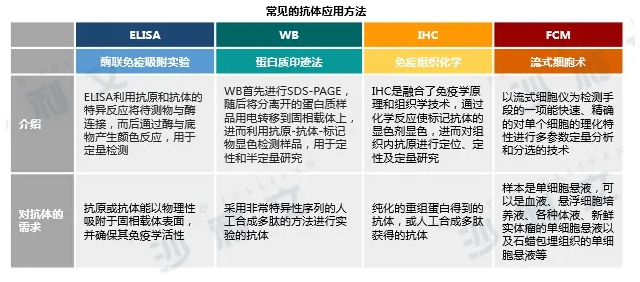
Antibody quality is crucial to the success or failure of experiments, and different experimental methods have varying requirements for antibodies.
In scientific research, experimental methods such as ELISA, IHC, WB, IP, ICC, FC, CHIP, and IF all require the use of antibodies. The quality of antibodies is crucial to the success or failure of experiments, and different experimental methods have varying requirements for antibodies. For example, enzyme-linked immunosorbent assay (ELISA) uses antibodies or antigens conjugated with enzymes as labels to detect specific proteins, especially corresponding antigens or antibodies. Immunohistochemistry (IHC) detects specific antigens in tissues, Western blotting (WB) identifies proteins by binding to specific antibodies, immunocytochemistry (ICC) detects the antigen composition of cells using immunological methods, flow cytometry (FC) identifies and separates different types of cells by detecting fluorescence stimulated by lasers, etc.
Source: Frost & Sullivan research
The antibody reagent industry chain consists of upstream antibody reagent manufacturers, midstream antibody reagent agents, and downstream customer groups.
Globally, countries such as Europe and America have developed life science reagents earlier, with leading enterprises mastering the most cutting-edge technologies and dominating innovation and development in the global life science industry. More than 90% of the antibody reagent market in China is monopolized by European and American countries, with monoclonal antibody products entirely dependent on imports. The main participants include American companies represented by ThermoFisher and CST, as well as European companies represented by Abcam from the UK and Merck from Germany. After nearly 10 years of rapid development, the Chinese antibody reagent market has formed a fully competitive market pattern with numerous market participants but low concentration. Currently, most of the participating enterprises are international brand agents, divided into national and regional agents, with a few domestic independent brands also developing from these agent companies.
![]()
Source: Frost & Sullivan research
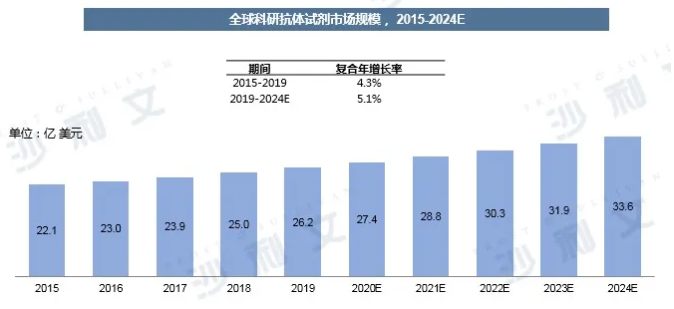
It is estimated that by 2024, the global market size for scientific research antibody reagents will reach as high as $3.36 billion.
Antibody reagents, as typical scientific research reagents, have scientific research users as their main downstream market participants. Scientific research users usually have high requirements for reagent quality, low price sensitivity, and strong tolerance for imported high-priced reagents. Antibody reagents are important basic research tools used in scientific research to discover, quantify, and modify proteins. According to the statistics and analysis of this report, it is expected that the global antibody reagent market size will maintain stable growth in the coming years. Among them, the market size of scientific research antibody reagents reached $2.21 billion in 2015 and will grow at an annual compound rate of 4.3% to reach $26.2 billion by 2019. Due to demand growth, the market size is expected to reach $33.6 billion by 2024, with an annual compound growth rate of 5.1% during this period.
Source: Frost & Sullivan research
Based on procurement analysis, there is a high preference for well-known overseas brands.
The distribution of antibody service providers shows that North America accounts for more than 55% of the global service providers. Europe and Asia account for 35.2% and 7.4%, respectively. The domestic antibody testing reagent market in China has long been monopolized by leading European and American companies such as Abcam and Thermo Fisher, with an import market share reaching about 90%. European and American antibody testing reagent manufacturers hold cutting-edge technologies and have high technical barriers, dominating innovation and development in the global antibody testing reagent industry.
![]()
Source: Frost & Sullivan research
In recent years, the competition in the antibody reagent market has been fierce. To date, there are no domestic enterprises that have achieved an absolute advantage in scale. There is a significant gap between them and countries or regions such as the United States and Europe in terms of product technology, quality, and scale, leading to intense competition among enterprises. A few enterprises engaged in independent research and development and production of anti-biological test reagents are at a lower market share due to shortcomings such as insufficient talent, technology, capital, management, and brand accumulation. With the improvement of local enterprises' scientific research capabilities, product quality, and business levels, products will gradually replace imported ones, increasing market share, and the overall industry will reduce its dependence on imported products.