Full text length: 3353 words | Reading time: 6 minutes
Medical robots are intelligent service robots used in multiple medical fields such as diagnosis, treatment, surgery, rehabilitation, and nursing. After more than 30 years of rapid development, medical robots have been widely applied in various fields including neurosurgery, abdominal surgery, thoracic surgery, orthopedics, vascular intervention, and craniofacial surgery.
According to different application areas, medical robots can be divided into surgical robots, rehabilitation robots, assistive robots, and service robots: (1) Surgical robots integrate multiple modern high-tech means and can be used for surgical image guidance and minimally invasive surgeries. Surgical robots can overcome technical defects such as low positioning accuracy in traditional surgeries, long operation times, easy fatigue of surgeons, and lack of three-dimensional medical image navigation, significantly improving operation accuracy and shortening surgical time. At the same time, in surgeries involving robots, patients have smaller wounds, less bleeding, and faster recovery. In the future, surgical robots will have great potential in the medical field; (2) Rehabilitation robots are designed based on bionic principles and ergonomics. After being worn by patients, they can maintain high-degree coaxial motion with the device, providing good comfort and effectively promoting the functional reorganization, compensation, and regeneration of the nervous system, and effectively alleviating muscle and joint atrophy. Rehabilitation robots are widely favored by various rehabilitation medical institutions in China because they can help solve the serious shortage of rehabilitation physicians; (3) Assistive robots are widely used in home care facilities. They can replace nurses to take care of the elderly and the sick, helping them move, eat, clean their bodies, and even helping Alzheimer's patients relieve their condition and improve their cognitive level; (4) Service robots are medical devices that can help medical staff share the heavy, tedious, and low-tech work and improve their work efficiency. Common medical service robots include disinfection and sterilization robots, hospital transport robots, etc.
Classification of medical robots in China
Source: Edited and organized by LeadLeo Research Institute
Although the medical robot industry in China started relatively late, its independent innovation ability is outstanding
The concept of medical robots was first proposed in 1985. The world's first robot surgery was completed with the assistance of the industrial robot arm PUMA560. The medical robot industry in China started relatively late. It was not until 1997 that the first robot stereotactic cranio-pharyngioma radiotherapy surgery was completed under the joint operation of two doctors and a computer expert, opening a new chapter in the clinical application of medical robots in China. With government policy support and unremitting efforts of scientific researchers, medical robots have performed excellently at both technical and application levels. In 2010, China's first medical robot with full independent intellectual property rights, the "Orthopedic Navigation Robot", obtained the national medical device registration license and was put into clinical use. Since then, China's medical robot industry has shaken off the situation of mainly imitating foreign advanced medical robot products in the early stage and entered a new stage of independent innovation. In the future, China will continue to adhere to independent innovation research and development of medical robots, continuously improve existing technologies, and catch up with the world's advanced level.
The market development space for medical robots in China is huge
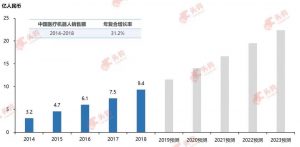
Medical robots are widely used in the United States and Europe. In these two regions, the sales proportion of medical robots accounts for more than 80%. In the past five years, medical robots have been rapidly popularized and developed in China. According to LeadLeo data, by 2018, the sales volume of medical robots in the Chinese market had risen to 940 million yuan, with a compound annual growth rate of 31.2% in five years. Due to the current shortage of medical personnel resources in China, it is difficult to meet the growing needs for medical treatment, rehabilitation, and nursing. The emergence of medical robots can effectively alleviate this situation, so the potential market for medical robots is huge. In addition, the Chinese government has continuously promulgated relevant policies and regulations, which are favorable to the independent innovation research and development and popularization of medical robots. At the same time, technologies such as artificial intelligence are developing very rapidly in China, and medical robot technology is constantly popularizing. Therefore, the medical robot market will still maintain rapid growth in the next five years.
Market scale of medical robots in China, forecast from 2014 to 2023
Source: Edited and organized by LeadLeo Research Institute
The number of elderly population is increasing, and the demand for medical robots is rising
At present, the aging of the Chinese population is becoming increasingly serious. Data from the National Office on Aging shows that as of January 2018, the elderly population over 60 years old in China exceeded 230 million, making China the only country in the world with an elderly population exceeding 200 million, accounting for 16.7% of the total population; the elderly population over 65 years old exceeded 150 million, accounting for 10.8% of the total population. It is estimated that by 2050, the elderly population in China will reach 480 million, accounting for about two-fifths of the Asian elderly population and one-fourth of the global elderly population at that time, exceeding the combined population of the United States, the United Kingdom, and Germany today. In the future, the pressure of supporting the elderly population will gradually increase, putting forward higher requirements for the accessibility of medical services. However, domestic medical resources are limited and difficult to meet the growing medical service needs of patients. What will emerge is a broad medical robot market. Some robots have experimentally entered hospitals and families to engage in some auxiliary service work. Compared with traditional manual surgeries, medical robots have the characteristics of refinement, intelligence, and minimization. They can diagnose patient symptoms more accurately, scientifically analyze pathology, reduce human operation errors, and reduce the pain of patients during surgery and speed up the recovery of patients' diseases. In addition, medical robots can achieve remote surgeries, alleviate the phenomenon of uneven regional distribution of medical resources, enable more patients to enjoy convenient and intelligent medical services, so medical robots are becoming increasingly important in modern medicine.
The state has introduced relevant favorable policies to assist the development of the industry
Since 2015, relevant Chinese institutions have successively issued a series of important policy documents to promote the transformation and upgrading of Made in China. As an important livelihood field, the medical field has become the focus of policy support. As high-tech and high-performance medical devices, medical robots have also received support and encouragement from major policies. In May 2015, the "Made in China 2025" issued by the State Council proposed that "improving the innovation ability and industrialization level of medical devices, and focusing on developing high-performance diagnosis and treatment equipment such as medical robots" should be one of the key contents of the "Industry 4.0" plan. With the support of this policy, the period from 2015 to 2025 will be the "golden decade" for the vigorous development of medical robots. In June 2015, the Beijing Municipal Science and Technology Commission immediately responded to the national call, actively deployed scientific and technological innovation and achievement transformation work for intelligent robots, requiring breakthroughs in the technical bottlenecks of service robots, especially medical service robots, and relevant technologies should reach international advanced levels as soon as possible. In January 2016, the State Council clearly proposed in the "Development Plan for the Construction of the National Standardization System (2016 - 2020)" to carry out standardization work in the fields of diagnosis and treatment equipment such as medical robots and household health monitoring and diagnosis and treatment instruments. The medical robot industry has bid farewell to the situation of "barbaric growth" and developed more healthily and orderly. In April 2016, the Ministry of Industry and Information Technology, the National Development and Reform Commission, and the Department of Finance jointly issued the "Robot Industry Development Plan (2016 - 2020)", proposing to carry out pilot demonstrations of surgical robots in intelligent surgery centers of Class III Grade A hospitals and vigorously promote the popularization and application of service robots in medical, elderly care, rehabilitation and other fields. This policy accelerated the popularization and application of downstream products in the medical robot industry and created greater space for the development of the industry.
Support policies for the development of the medical robot industry in China, from 2015 to 2017
Source: Edited and organized by LeadLeo Research Institute
The development of medical robot technology is difficult and time-consuming
The technology of integrating medicine and engineering is complex and the process is long. The development of medical robots requires doctors to put forward functional requirements and safety requirements, technicians to initially plan design schemes according to the requirements put forward by doctors, form engineering language, both parties to discuss and modify multiple times according to the existing schemes, and also conduct technical tests, doctor tests, evaluation, and modification. The lack of compound talents in the development of medical robots leads to a long process of research and design, greatly limiting the development speed of the entire industry.
The discipline of intelligent medical engineering has been initially established, and the training cycle for compound talents is long. Intelligent medical engineering is a new discipline that highly intersects medicine, science, and engineering, closely integrating medical health and the robot industry. It is a discipline that helps to cultivate high-quality talents who can invent medical robots. According to the "Notice of the Ministry of Education on Announcing the Filing and Approval Results of Undergraduate Majors in Regular Higher Education Institutions in 2017", two universities in China, Tianjin University and Nankai University, have opened the intelligent medical engineering major for the first time. Tianjin University has started undergraduate enrollment in 2018, enrolling 30 undergraduates in the first phase. The discipline of intelligent medical engineering has been initially established in China, and the teaching system is not yet mature. The number of enrolled students is small, the training cycle is long, and it still cannot meet the demand for compound talents in the Chinese medical robot industry.
Medical robots are expected to subvert traditional medical methods and open a new era of smart healthcare
Medical robots gather world-leading achievements. In the future, there may be a new round of development trends in the fields of single-port endoscopic surgical robots and nanorobotics. Compared with multi-port endoscopic robots, single-port endoscopic surgical robots have the characteristics of less trauma and lower cost. With the breakthrough of technical bottlenecks and the acceleration of industrialization progress, single-port endoscopic surgical robots will become new surgical robot products with huge market space. As a representative of multi-port laparoscopic surgical robots, the Da Vinci robot has achieved great success in global clinical application and commercial operation, with more than 700,000 surgeries in 2016. The advent of single-port surgical robots will completely break the market monopoly of the Da Vinci robot. At present, North America, the European Union, Japan, and South Korea have successively established single-port surgical robot research projects. Shanghai Jiao Tong University in China is at the world's leading level in single-port robot research and is expected to become a new emerging field that will achieve great breakthroughs in the Chinese medical robot industry. Nanorotational robots are important applications of micro robots in the medical field. At present, medical micro robots are represented by capsule robots and are mainly used in fields such as gastroscopy. The application scope is relatively limited. With the continuous maturity of nanotechnology, nanorotational robots controlled by magnetic fields and injected through blood vessels can move freely in the human body and deliver drugs to the targeted areas of human diseases. Harbin Institute of Technology and Tianjin University in China have already achieved important research results in the field of nanorotational robots. This technology is expected to be first applied to tissues such as the urinary tract and eyeballs and will become a disruptive new technology in the fields of cancer treatment.
The aging of the Chinese population is becoming increasingly serious, and patients' requirements for the accessibility of medical services are constantly increasing. Intelligent, minimally invasive, and refined medical robots will gradually replace traditional medical services and become the future development trend. With the continuous maturity of nanotechnology, the technology of integrating medicine and engineering is gradually breaking through bottlenecks, and the medical robot industry will also enter a stage of rapid development.