


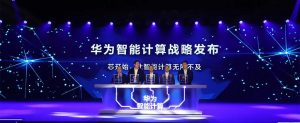
On December 21, 2018, Huawei held its first Huawei Smart Computing Conference and China Smart Computing Business Strategy Release Event in Beijing with the theme 'Start with the Chip, Empowering Intelligent Computing Everywhere'. As Huawei's fifth business unit, the 'Smart Computing Business Unit', was officially established today. Huawei Smart Computing is designed to meet the industry's demand for intelligent transformation. Based on chips, algorithms, architecture, etc., and focusing on four aspects: computing power, engineering, cloud-edge collaboration, and integrated solutions, it aims to build full-stack and full-scenario intelligent solutions for industries, accelerate the process of industry intelligence, and enable the intelligent reconstruction of industries.
In recent years, intelligent technologies represented by artificial intelligence, big data, cloud computing, and other technologies have been widely applied in various fields of the economy and society. The prosperity of the information economy has also begun to be regarded as an important indicator for evaluating a country's overall economic strength. As a result, multiple relevant departments such as the State Council, the National Development and Reform Commission, and the Ministry of Industry and Information Technology have introduced policies targeting intelligent technology fields to promote the healthy and rapid development of the intelligent technology industry. They have elevated the acceleration of the development of the intelligent technology industry to a national strategic level and accelerated the process of China's modernization drive. However, many factors such as the scarcity of computing power supply and the difficulty in achieving interconnectivity of cloud data have become challenges in the intelligentization process.
Huawei Smart Computing is committed to exceeding customer expectations in computing power through chip capabilities, meeting deployment requirements in harsh environments with universal engineering capabilities, and realizing data collaboration and intercommunication through cloud-edge coordination and seamless network coverage. It further provides integrated solutions to lower the threshold for AI use, comprehensively build an AI ecosystem, and accelerate society's progress towards intelligence.

Huawei's Hyper Computing (HPC) solutions build high-performance, highly reliable computing platforms with Huawei servers, storage, and network products. They provide customers in various industries with board-level and cabinet-level high-efficiency liquid-cooled solutions and prefabricated HPC infrastructure, enabling the implementation of HPC cluster solutions for different computing scale requirements.
Huawei SAPHANA All-in-One Machine is a database all-in-one machine based on in-memory computing. It is equipped with industry-leading SAP HANA in-memory database software within Huawei's innovative hardware and software platform, accelerating key applications such as enterprise ERP and data warehouses. It helps enterprises quickly analyze and obtain critical data, seizing the opportunity for business decision-making.
Microsoft and Huawei jointly create industry-leading hybrid cloud solutions to accelerate users' cloud adoption, providing a truly one-stop cloud solution. It helps enterprises and service providers conveniently deploy, run, and manage cloud applications, bringing users the same experience as public clouds.
Huawei Atlas intelligent computing platform is based on Huawei Ascend series AI processors and mainstream heterogeneous computing components in the industry. Through a rich variety of product forms such as modules, boards, small stations, and integrated machines, it creates a full-scenario AI infrastructure solution oriented towards "endpoints, edge devices, and cloud". It can be widely used in fields such as "Safe City", "Smart Transportation", "Smart Healthcare", and "AI Inference".
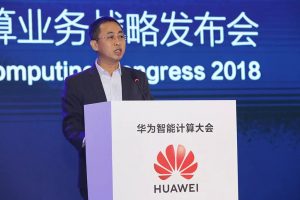
Hou Jinlong, President of Huawei's IT Product Line, stated: "We are entering an intelligent world where computing is its core driving force. Consequently, the demand for computing power will be even stronger. The form of computing needs to become richer and more diverse. At the same time, it poses a huge challenge to unified architecture computing platforms. It is against this new situation and challenges that Huawei's Intelligent Computing focuses on the industry's intelligent transformation needs. Based on innovations in chips, algorithms, architectures, etc., we work hand in hand with partners to build a win-win ecosystem, helping industry customers lead the digital economy and gain the upper hand in intelligent transformation."
In the cloud computing industry, Frost & Sullivan data shows that the overall market size of cloud computing in China reached 67.36 billion yuan in 2017, with a compound growth rate of 32.8% from 2013 to 2017. Over the next five years, based on the continuous increasing demand for the cloud computing market and further expansion of cloud computing service offerings, Frost & Sullivan expects a compound annual growth rate of 26.7% for the cloud computing market size in China from 2018 to 2022.
China's cloud computing market scale, forecast from 2013 to 2022

Source: Compiled by fsTEAM software and Frost & Sullivan data center.
Qiu Long, President of Huawei's Intelligent Computing Business Unit, stated, "The computing industry, originally driven by Moore's Law, is struggling to meet the explosive demand for computing. Artificial intelligence has brought four major challenges to the computing industry. Huawei's intelligent computing will combine our four core capabilities, through chip and technology innovation, to meet customers' expectations for computing power; through universal engineering capabilities to adapt to the deployment requirements of harsh industry environments; through a cloud-edge collaborative architecture and high-bandwidth, low-latency, seamless network coverage to achieve data collaboration and interoperability; through integrated solutions to lower the threshold for AI use, making AI simpler and as convenient as using water and electricity. Ultimately, we aim to realize the intelligentization of data centers, accelerate the process of industry intelligence transformation, and empower industry-wide intelligent reconstruction."
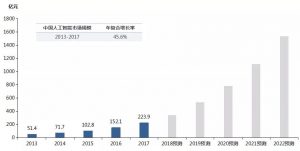
According to data from Frost & Sullivan, thanks to the active entry of the capital market, the scale of the artificial intelligence industry has entered a period of explosive growth in recent years. The scale of China's artificial intelligence market increased from 5.14 billion yuan in 2013 to 1538.0 billion yuan in 2017, with an annual compound growth rate of 44.5% from 2013 to 2017. In the next five years, benefiting from the accelerated implementation of industrial policies, continuous technological breakthroughs, and large-scale commercial applications, the development prospects of China's artificial intelligence market are very broad. Frost & Sullivan expects a compound annual growth rate of 45.6% for the period from 2018 to 2022.
China's Artificial Intelligence Market Size, Forecast 2013 - 2022
Source: Compiled by fsTEAM software and Frost & Sullivan data center.
Dr. Wang Xin, Global Partner of Frost & Sullivan, Vice President of Global Market Strategy Planning and President of the China Region, pointed out that as the birthplace and testing ground for intelligent technologies, the Internet sector will be the first to feel the innovation and transformation brought about by these technologies. In network information technology, new-generation technologies such as artificial intelligence, big data, the Internet of Things (IoT), and cloud computing are typical representatives that are closely interconnected with each other. The deep integration and innovation of emerging technologies are at the core of industrial transformation and upgrading. The development of the IoT is conducive to the acquisition of big data; cloud computing provides basic support for the big data industry; artificial intelligence integrates into the big data analysis system, and big data can provide new business value for cloud computing. In the future, the depth of integration between big data and cloud computing, IoT, and artificial intelligence will continue to deepen, and integrated innovation will emerge continuously.




