



Report on research scope
market scope
-
Global LED Lighting Market
-
Global LED mobile lighting market
-
Global LED Professional Mobile Lighting Market
Time range
-
Base year: 2021
-
Forecast Years: 2022 to 2026
Regional scope
-
global
Mainland China
North America
─ European region
1. Overview of the Global LED Lighting Market
1.1. LED Lighting Definition and Development History
Lighting plays an indispensable role in human civilized life. With the rapid development of the social economy and continuous progress in science and technology, human living forms and lifestyles are constantly changing, and new lighting tools and their application methods are emerging continuously. LED is a semiconductor solid-state light-emitting device that uses solid semiconductors as the light-emitting material. In the semiconductor, carriers recombine, releasing excess energy that causes photon emission, producing light of various colors. Entering the 21st century, with the acceleration of industrialization and urbanization processes, energy and environmental pollution issues have become increasingly severe. LED has seen rapid development due to its green and environmentally friendly characteristics. Initially, LEDs were mainly used in backlight scenarios. With continuous technological development and maturity, they are gradually replacing traditional incandescent lamps, expanding their application scenarios and becoming the main lighting source. In recent years, global awareness of energy conservation and environmental protection has risen. LED lighting, with its characteristics such as energy saving, long lifespan, and high brightness, has become one of the green and environmentally friendly industries vigorously promoted by governments and relevant enterprises around the world, and has also become one of the key industries driving the rapid development of China's national economy.
Lighting is one of the most basic needs for human survival. In 1860, the English inventor Thomas Edison invented the prototype of the incandescent lamp—a semi-vacuum carbon filament lamp. Later, Edison improved the semi-vacuum carbon filament lamp and in 1883, he co-founded the Edison & Swan Electric Light Company with Swann in the UK to begin commercial production of incandescent lamps, kicking off the prelude to the electrical lighting industry. In 1906, the first high-pressure mercury lamp was introduced and began to be sold as a lighting tool officially in 1932. The mercury lamp appeared in 1934, marking the official entry of gas discharge lamps into the lighting market. In 1938, General Electric scientist Irving E. Sargent invented the fluorescent lamp, which began to replace incandescent lamps. In 1980, energy-saving fluorescent lamps were introduced by Philips, and in the 1990s, electrodeless fluorescent lamps were mass-produced into the market.
General Electric invented the light-emitting diode (LED) in 1962, converting electrical energy into light energy. The first generation of high-brightness LEDs was introduced in 1980, and Nippon Denko successfully developed white LEDs in 1993. During the same period, the industrialization of blue LEDs was achieved. Entering the 21st century, with the deepening of the concept of energy conservation and environmental protection, governments around the world have vigorously promoted LED lighting. LEDs have gradually replaced light sources such as incandescent lamps and fluorescent lamps, marking a rapid development phase for the industry.
1.2. Analysis of the global LED lighting market
In the mid-20th century, LEDs sparked a technological revolution in the global lighting sector and have since gradually developed into an important product in this field. Since entering the 21st century, the global economy has continued to develop rapidly, and LED lighting has further expanded its application in the lighting sector due to its excellent performance. For the purpose of saving energy and developing a low-carbon economy, governments around the world have successively introduced policies banning the use of traditional incandescent lamps, providing strong policy support for the development of the LED lighting industry.

Source: Frost & Sullivan
1.3. Analysis of the China LED Lighting Market
With the continuous acceleration of industrialization and urbanization in China, lighting energy consumption has gradually risen, posing a huge energy pressure. Researching and finding more efficient and energy-saving lighting methods have become an important topic in the lighting industry. In 1996, China began implementing the Green Lighting Project, encouraging traditional lighting enterprises mainly using incandescent lamps to transform and develop, and promoting the improvement of lighting product quality.
1.4. Analysis of policies in China's LED lighting industry
2. Overview of the Global LED Mobile Lighting Market
2.1. LED mobile lighting definition and classification
According to the installation methods and usage scenarios of LED lighting, it can be divided into general lighting, vehicle lighting, mobile lighting, and other LED lighting products. General lighting includes devices such as home fixed lighting fixtures and street lights; vehicle lighting refers to on-board lighting equipment used in moving tools like cars, such as high beams, low beams, interior lighting, and instrument lights; mobile lighting includes specialized lighting tools, outdoor lighting, and household lighting; other LED lighting includes LED lighting components, billboards, etc.

Source: Frost & Sullivan
2.2. Analysis of the LED mobile lighting industry chain
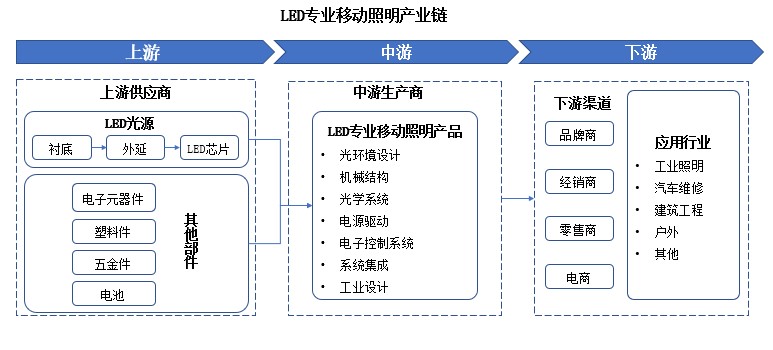 Source: Frost & Sullivan
2.3. Global and China LED mobile lighting market size (supply side)
2.3.1 Global LED mobile lighting market size
2.3.2. China LED mobile lighting market size
2.4. Global LED mobile lighting market size (demand side, by region)
2.5. Analysis of China's LED Lighting Exports
2.6. Main operating models of the LED mobile industry
2.7. Analysis of the Driving Forces in the LED Mobile Lighting Industry
2.7.1. Technological upgrades drive LED mobile lighting products towards diversified functions and intelligence
2.7.2. Energy-saving and environmental awareness drive the rapid development of the LED lighting market
2.7.3. With the increasing richness of downstream application scenarios, the market capacity of the mobile lighting industry has been rising
2.8. Analysis of the development trend of LED mobile lighting industry
2.8.1. Mobile lighting tools will become more portable
2.8.2. The features of mobile lighting tools will integrate more requirements
2.8.3. Mobile lighting tools will further reduce energy consumption and extend usage time.
2.8.4. The functionality of mobile lighting tools will develop towards intelligence.
3. Overview of the Global LED Professional Mobile Lighting Market
3.1. Definition and demand analysis of LED professional mobile lighting
3.2. Global and China LED Professional Mobile Lighting Market Size (Supply Side)
3.2.1. Global LED Professional Mobile Lighting Market Size
3.2.2. Market Size of Professional Mobile Lighting with LED in China
3.3. Global LED Professional Mobile Lighting Market Size (Demand Side, by Region)
3.4. Global LED Professional Mobile Lighting Market Segmentation by Scenario (Demand Side)
3.4.1. Global use cases
3.4.2. North American use cases
3.4.3. European use cases
3.5. Global LED Professional Mobile Lighting Market Competition Landscape (Demand Side)
3.6. Global LED Professional Mobile Lighting Market Competition Landscape (Supply Side)
3.7. Analysis of the Professional Mobile Lighting Technology Level of LEDs
3.7.1. Product R&D and Design
3.7.2. Secondary light distribution technology
3.7.3. Intelligent Control Technology
3.7.4. AC-DC Power Board Design and Production Technology
3.7.5. Board Design and Manufacturing Technology
3.7.6. Integration Technology
3.7.7. Thermal dissipation technology
3.8. Periodicity and regional analysis of the LED professional mobile lighting industry
3.8.1. Periodic analysis
3.8.2. Regional analysis
4. Appendix
4.1. Introduction to Major Enterprises in the LED Professional Mobile Lighting Industry (Supply Side)
The LED professional mobile lighting industry is relatively concentrated, mainly located in the Pearl River Delta and Yangtze River Delta regions. Enterprises within the industry conduct research and development and production of mobile lighting products according to the needs of different market segments. The products not only share similarities in type but also exhibit differences in function and usage scenarios. The main enterprises within the industry are shown in the following table:
| serial number | Company Name | Main products |
| 1 | Shenzhen Changfang Group Co., Ltd. | |
| 2 | Guangdong Jiuliang Co., Ltd. | |
| 3 | Guangdong Jinlait Electric Appliance Co., Ltd. | |
| 4 | Ocean King Lighting Technology Co., Ltd. | |
| 5 | Shanghai Zhihui Electric Appliance Co., Ltd. | |
| 6 | Xiamen Dong'ang Technology Co., Ltd. | |
| 7 | Ningbo Changrong Optoelectronics Technology Co., Ltd. | |
| 8 | Hangzhou Superstar Technology Co., Ltd. | |
| 9 | Shenzhen Topcon Co., Ltd. | |
| 10 | Zhejiang Shuangyu Electronic Technology Co., Ltd. | |
| … | Others |
4.1.1 Shenzhen Changfang Group Co., Ltd.
4.1.2. Guangdong Jiuliang Co., Ltd.
4.1.3. Guangdong Jinlait Electric Appliance Co., Ltd.
4.1.4. Ocean King Lighting Technology Co., Ltd.
4.1.5. Shanghai Zhihui Electric Appliance Co., Ltd.
4.1.6. Xiamen Dongang Technology Co., Ltd.
4.1.7. Ningbo Changrong Optoelectronics Technology Co., Ltd.
4.1.8. Hangzhou Giant Technology Co., Ltd.
4.1.9. Shenzhen Topcon Technology Co., Ltd.
4.1.10. Zhejiang Shuangyu Electronic Technology Co., Ltd.
4.2. Introduction to Major Enterprises in the LED Professional Mobile Lighting Industry (Demand Side)
4.2.1. Snap-on
4.2.2. Würth (Wortmannswerke)
4.2.3. Berner
4.2.4. Milwaukee
4.2.5. Scangrip
4.2.6. Stanley




