


Starlink Information Technology(shanghai)Limited Liability Company (Stock Code:688031) on2022year10month18The company successfully accessed the Sci-tech Innovation Board on the 1st. It is a leading domestic enterprise-level big data foundational software developer, providing basic software and services throughout the entire lifecycle of data, including integration, storage, governance, modeling, analysis, mining, and circulation. The company has established a software product matrix comprising big data and cloud foundational platforms, distributed relational databases, and data development and intelligent analysis tools. This supports customers and partners in developing data application systems and business application systems, helping them achieve digital transformation. Frost & SullivanFrost & Sullivan,Frost & Sullivan (hereinafter referred to as 'Frost & Sullivan') hereby warmly congratulates the company on its successful listing.
Starlink Information Technology(shanghai)The joint-stock limited company (hereinafter referred to as 'Starlink Technology') was incorporated on2022year10month18The company was successfully listed on the stock market, with the number of shares issued being3,021.0610,000 shares, issue price per share47.34yuan.
The company is a leading domestic enterprise-level big data infrastructure software developer, providing basic software and services for the entire lifecycle of data, including integration, storage, governance, modeling, analysis, mining, and circulation. It has formed a software product matrix consisting of big data and cloud infrastructure platforms, distributed relational databases, and data development and intelligent analysis tools. The company supports customers and partners in developing data application systems and business application systems, helping them achieve digital transformation. The company mainly provides two categories of products and services: The first category is big data infrastructure software business, which includes basic software products and technical services; the second category is applications and solutions, mainly targeting big data application scenarios, providing consulting and customized development services for related scenarios such as big data storage, processing, and analysis. Frost & Sullivan has long been focusing on the global and Chinese data analysis industries, publishing a large number of research reports that are widely cited in the prospectuses of leading companies listed on the Sci-Tech Innovation Board, helping customers accelerate their growth.
Overview of China's Big Data Market
Big data refers to datasets that exceed the capacity of traditional database software tools for collection, storage, management, and analysis. The big data industry mainly addresses issues such as big data storage, processing, analysis, and value discovery, aiming to realize the business value of big data. In terms of products and services, the big data market includes three main parts: big data hardware, big data software, and big data professional services.
Industry background of the development of big data market
1Traditional data management software faces various challenges in the era of big data
In recent years, with the development of the Internet, mobile Internet, Internet of Things,5GWith the continuous development of information and communication technologies and industries, global data volume has been experiencing explosive growth. As a production factor similar to land, capital, labor, and technology, data's status has become increasingly prominent in the process of the deepening development of the digital economy. Currently, data resources generally show that “4V"The characteristic of ” is massive data scale (volume), diverse data typesvariety), low value densityvalue), and rapid data flowvelocity).
With the rapid development of information technology and actual business needs, traditional data management software cannot adapt well to big data scenarios when dealing with “4V"The feature faces many technical challenges. Therefore, traditional data management software urgently needs technological innovation."
2The traditional centralized software stack is evolving towards the emerging distributed software stack.
As technology continues to mature, distributed architecture will gradually become mainstream. From bottom-up, traditional centralized resource management and scheduling are evolving towards cloud-native-based distributed unified resource management platforms; the technical architecture of data management software will also undergo significant changes due to the transformation of computing models, with traditional centralized databases gradually developing towards distributed and multi-model databases; traditional data analysis software is gradually evolving towards new types of distributed data development and intelligent analysis software.
3Domestic basic software is entering a period of explosive growth
Currently, China's big data software sector is in a period of historical opportunity for development. Our country attaches great importance to the role of big data in economic and social development. The Fifth Plenary Session of the 18th Central Committee proposed to 'implement the national big data strategy,' and the 'Action Plan for Promoting Big Data Development' issued by the State Council states that establishing a secure and trustworthy big data technology system is an important goal for advancing basic research and core technology breakthroughs in the big data industry. The 14th Five-Year Plan and2035The Outline of the Long-Term Objectives proposes to cultivate and strengthen emerging digital industries such as artificial intelligence and big data, fully leverage the advantages of massive data and rich application scenarios, promote the deep integration of digital technology with the real economy, empower traditional industries for transformation and upgrading, and create new advantages in the digital economy.
The global new generation information industry is in an accelerated transformation period, with underlying big data technologies undergoing innovative breakthroughs. Domestic market demand is in an explosive phase, bringing clear growth opportunities to domestic basic software vendors. At the same time, with the continuous increase in domestic basic software talent, domestically formed basic software vendors with independent R&D capabilities and capable of competing with foreign manufacturers have begun to achieve large-scale industrialization and implementation.
Big data market scale
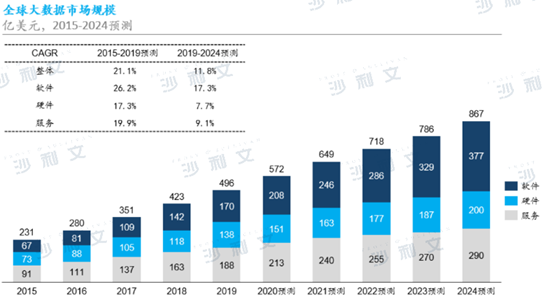
The global big data market size is2015year231USD billion growth to2019year496billions, with an annual compound growth rate of about21.1%The global overall market scale is expected to be in2024more than800billion US dollars2019till2024The annual compound growth rate is about11.8%. in2015In the year, big data services remained the largest revenue source in the global big data market, accounting for approximately91billion US dollars, while hardware and software revenues reached73billion dollars and67Billions of dollars. With the decline in hardware costs and the enhancement of software added value, it is expected that the contribution of hardware and service revenue to the global big data market will gradually decrease in the future, with software surpassing services and hardware as the main source of revenue in the global big data market.
The global market size of big data software is2015year67USD billion growth to2019year170billion US dollars, with an annual compound growth rate of26.2%Exceeding the growth rate of hardware and service revenue, and it is expected that the software market size will be2024Annual achievement377billions, with an annual compound growth rate of about17.3%The big data management platform remains the primary source of revenue in the big data software market. However, with the maturity of data application middleware and data intelligent analysis tool products, products other than the big data infrastructure platform will contribute a larger proportion of revenue.
Source: Frost & Sullivan report
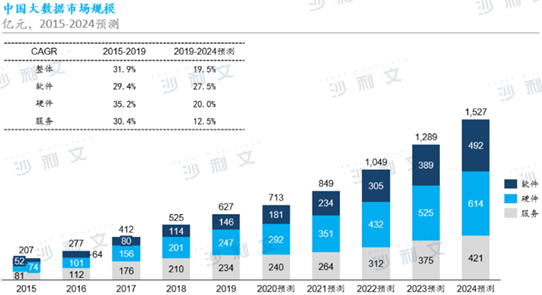
The Chinese big data market has experienced rapid growth in the past five years, with the overall market size growing at a faster rate than the global market as a whole.2019In [year], the market scale of big data in China reached627yuan,2015 - 2019The annual compound growth rate reached31.9%Among them, big data hardware remains the main source of revenue for the market.2019The hardware revenue of the big data market reached247100 million yuan.
The big data software market consists of2015year52RMB billion growth to2019year146Yuan, with an annual compound growth rate of29.4%With the increasing emphasis on data value by government departments and large enterprises, as well as the growth in big data software procurement budgets, China's big data software market will continue to maintain its momentum over the next five yearsWith a high-growth trend, the overall software market size will be in2024Annual achievement492yuan,2019 - 2024Annual compound growth rate27.5%Although the revenue proportion of big data software is still relatively small at this stage, it is expected that due to the higher growth rate of the segmented market size, big data software will occupy a larger market share in the future.
Source: Frost & Sullivan report
Opportunities Faced by the Domestic Big Data Software Industry
1Industrial policies have been introduced intensively, and a multi-level policy system is becoming increasingly sound.
Since the launch of 'New Infrastructure',2018year12Since it was first proposed at the Central Economic Work Conference in October, the central government and local governments have intensively deployed a series of guidelines and policies surrounding the construction of 'new infrastructure'.2020year4In the month, the National Development and Reform Commission clarified that 'new infrastructure' is an infrastructure system driven by technological innovation, based on information networks, aimed at meeting the needs of high-quality development, and providing services such as digital transformation, intelligent upgrading, and integrated innovation.
Among them, 'Important measures to strengthen the capabilities in key areas of new-generation information technology include: promoting the integrated development of new-generation information technology with manufacturing, accelerating the digital and intelligent transformation of industrial enterprises, improving the level of digitalization, networking, and intelligence development in manufacturing, advancing changes in manufacturing models, production methods, and corporate forms, and driving industrial transformation and upgrading.' The development of emerging industries and the digital economy in the future will rely more on data resources, and the construction of data infrastructure is also essential.5GAs the foundation of new-generation information technology infrastructure such as data centers and industrial Internet, big data is an important component of 'new infrastructure' and will also promote the rapid development of core domestic software such as underlying big data software.
2The trend of domesticizing data management software is evident, and domestic big data products are expected to achieve overtaking on a new track.
In the era of big data, data management software is gradually evolving from centralized architecture to distributed architecture. Domestic big data products are expected to achieve a shift and overtaking, replacing foreign data management software. In terms of functionality, domestic big data products based on emerging distributed architectures can already meet the basic needs of the vast majority of data application scenarios in the market. However, whether domestic big data products can win in market competition and occupy more market share still depends on whether they can build an independently developed ecosystem and their global competitiveness.
Currently, to ensure national information security, a domestically developed big data ecosystem is taking shape. Previously, obstacles faced by the development of domestic software and hardware, such as scattered development patterns, an imperfect ecosystem foundation, and a lack of large-scale user groups, are being gradually overcome. As the domestic big data ecosystem enters a stage of rapid collaborative development, domestic big data products and services are facing good development opportunities.
3Data has become a new factor of production, and there is a huge demand for big data applications across various industries
Activating the potential of data elements, accelerating the construction of a digital economy, digital society, and digital government, and driving transformation in production methods, lifestyles, and governance through digitization have become the focus of our current development. Enterprises building digital capabilities to efficiently solve operational problems, optimize business processes, and improve efficiency are one of the core competencies for enterprise development. There is an enormous demand to practically enhance digital capabilities in important sectors of the national economy such as finance, transportation, energy, manufacturing, etc.
In addition, with the increasing digitalization of governments and enterprises, it is an inevitable trend for data to move towards resource utilization.,In the process of data resourceization, establish an efficient data exchange mechanism among industries to achieve data interconnection, information sharing, and business collaboration.,It serves as an effective way to integrate information resources and make deep use of decentralized data. Accelerating digital transformation, building a data sharing service system, and promoting the rapid integration of data with business applications will help the Chinese economy shift from high-speed growth to high-quality development and drive the construction of a Digital China.
4The rapid development of big data applications has driven a surge in demand for big data management platforms.
In recent years, the growth of big data has been concentrated in IoT devices, multimedia, logs, social information, etc. These data are characterized by multiple data types, large volumes, fast transfer speeds, and low value density.
Traditional relational databases cannot meet the needs of processing semi-structured and unstructured data. Large-scale data management platforms with comprehensive capabilities have characteristics such as easy scalability, unordered storage, and distributed architecture, which can better satisfy the storage requirements for these types of data compared to traditional relational databases. Large-scale data management platforms not only possess the ability to store massive amounts of data, high data processing performance, and ease of scalability but also maintain support for traditional relational databases.acidandSQLFeatures such as querying support relational data models. With the development of the big data market, the demand for big data management platforms is growing rapidly.
5The demand for in-depth exploration of data value will drive the rapid development of intelligent analysis tools.
Intelligent analysis tools mainly focus on providing tools and related solutions for key data analysis and mining processes such as data preprocessing, feature engineering, data modeling, and predictive analysis. They are important tools for enterprises to achieve in-depth mining of massive data. With the deepening complexity of data analysis in the big data environment, data science platforms need to continuously optimize their platform processes, collaboration, and model governance features to remain consistent with best practices in software development.
At the same time, data science platform vendors will also differentiate themselves by integrating innovative solutions for tasks such as algorithm filtering, distributed model training, model management, knowledge graphs, and high-performance inference. To quickly help customers make AI-powered business decisions in big data environments, intelligent analysis tools are poised for rapid development opportunities, including cloud-native,AIPlay a greater role in engineering, low-code development, privacy security, cloud-edge integration, and more.

Frost & Sullivan company inTMTThe firm has rich research experience and has assisted well-known enterprises in successfully listing on the capital market. Successful listings include: Xuanwu Cloud Technology (2392.HK), Huitongda9878.HK), innovative wisdom2121.HK), Shangtang Technology0020.HK), Qinhuai DataNASDAQ:CD-ROM), Mingyuan Cloud0909.HK), Genesis Group1849.HK), WeCom Group2013.HK), Wancala One Link1762.HK), Yaxin Technology1675.HK), Hongya Holdings1723.HK), Aurora MovementNASDAQ:JG), Jingguan Holdings8606.HK), Qiyi Technology1739.HK), WeCom Finance (2003.HK), Huifu Tianxia(1806.HK),Atlinks(8043.HK),Zioncom(8287.HK),ISP Global(8487.HK),Vobile(3738.HK), Aibo Technology2708.HK),iClick(NASDAQ:ICLK), Shengye Capital6069.HK), Anling International8410.HK), Anke Systems8353.HK), Junmeng International8062.HK), Feisida8342.HK),Future Data(8229.HK) and Asiy Backup8290.HK) etc.
Recommended Reading
02.Frost & Sullivan assisted Huitongda in successfully going public in Hong Kong(9878.HK)
03.Frost & Sullivan helps innovative startups successfully go public in Hong Kong(2121.HK)
04.Frost & Sullivan assisted SenseTime in successfully going public in Hong Kong(0020.HK)
05.Frost & Sullivan assisted Qinhuai Data in successfully going public in the US(NASDAQ: CD)
06.Frost & Sullivan assisted Mingyuan Cloud in successfully going public in Hong Kong(0909.HK)
07.Frost & Sullivan assisted CenturyLink in successfully going public in Hong Kong(1849.HK)
08.Frost & Sullivan assisted WeCom Group in successfully going public in Hong Kong(2013.HK)
09.Frost & Sullivan assisted Wan Kailian in successfully going public in Hong Kong(1762.HK)
10.Frost & Sullivan assisted Yixin Technology in successfully going public in Hong Kong(1675.HK)
12.Frost & Sullivan assisted Aurora Mobile in successfully going public in the US(NASDAQ: JG)
14.Frost & Sullivan assisted Qiyi Technology in successfully going public in Hong Kong(1739.HK)
17.Frost & Sullivan assistanceAtlinksSuccessfully listed on the Hong Kong stock market(8043.HK)
18.Frost & Sullivan assistanceZioncomSuccessfully listed on the Hong Kong stock market(8287.HK)
19.Frost & Sullivan assistanceISP GlobalSuccessfully listed on the Hong Kong stock market(8487.HK)
20.Frost & Sullivan assistanceVobileSuccessfully listed on the Hong Kong stock market(3738.HK)
21.Frost & Sullivan assisted Abbot Technology in successfully going public in Hong Kong(2708.HK)
22.Frost & Sullivan helpsiClickSuccessfully listed in the US(NASDAQ: ICLK)
25.Frost & Sullivan assisted Ankox Systems in successfully going public in Hong Kong(8353.HK)
27.Frost & Sullivan assisted Feida in successfully listing on the Hong Kong Stock Exchange(8342.HK)
28.Frost & Sullivan assistanceFuture DataSuccessfully listed on the Hong Kong stock market(8229.HK)
29.Frost & Sullivan assisted Asia Backup in successfully going public in Hong Kong(8290.HK)
*The above order is not sequential and is arranged in reverse chronological order by listing time.




