



Project Research Framework
Market Scope
- China's pressure vessel industry, including pressure vessels in the fields of chemical engineering, LNG, solar photovoltaics, nuclear power, etc.
Time Range
- Base Year: 2022
- Historical Years: 2019 to 2022
- Forecast Years: 2023 to 2027
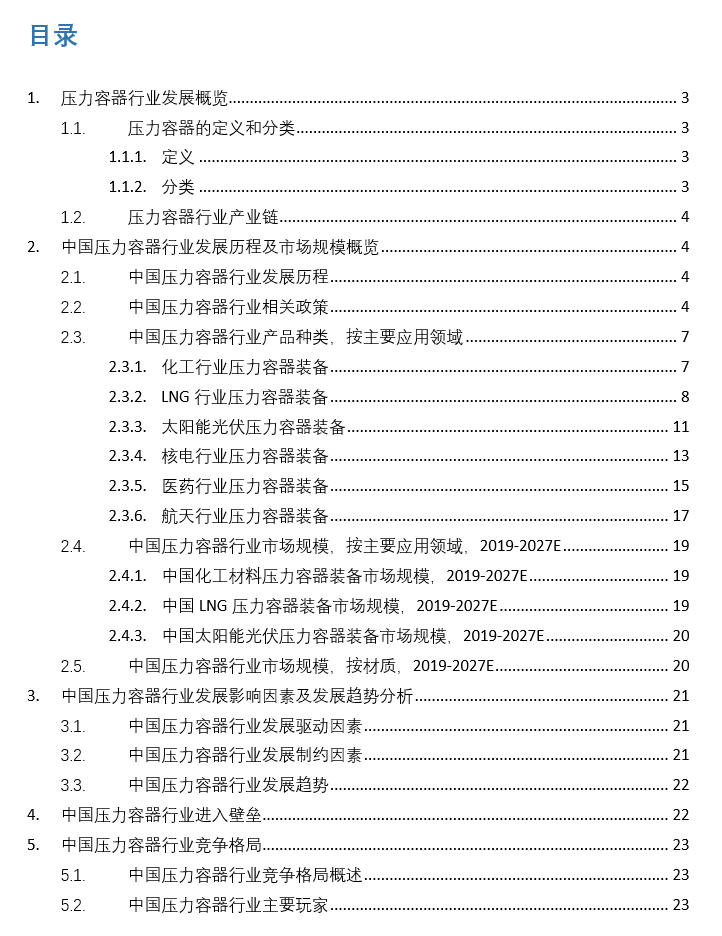
1. Overview of the Development of the Pressure Vessel Industry
1.1 Definition and Classification of the Pressure Vessel Industry
1.1.1 Definition
Vessels can be divided into atmospheric pressure vessels and pressure vessels according to the magnitude of pressure they bear. There are significant differences in structure and design principles between the two types of vessels. Pressure vessels generally refer to closed containers used for completing production processes such as reaction, heat exchange, absorption, extraction, separation, and storage, and capable of withstanding a certain pressure.
Different standards or regulations have different interpretations of the concept of pressure vessels. According to the provisions of GB 150-2011 "Pressure Vessels," vessels with a designed pressure (P) greater than or equal to 0.1 MPa fall within the scope of standard application. In TSG R0004-2009 "Safety Technical Supervision Regulations for Fixed Pressure Vessels," pressure vessels must meet 1) working pressure (Pw) greater than or equal to 0.1 MPa; 2) the product of working pressure and volume greater than or equal to 2.5 MPa·L; 3) the medium contained is gas, liquefied gas, or a liquid whose highest operating temperature is higher than or equal to its standard boiling point. According to the "Regulations on the Safety Supervision of Special Equipment" published by the State Council, pressure vessels refer to enclosed equipment containing gas or liquid that bears a certain pressure, defined as fixed and mobile vessels with a maximum working pressure greater than or equal to 0.1 MPa (gauge pressure), and the product of pressure and volume greater than or equal to 2.5 MPa·L, as well as gas cylinders with a nominal working pressure greater than or equal to 0.2 MPa (gauge pressure), and the product of pressure and volume greater than or equal to 1.0 MPa·L; gas cylinders containing gas with a standard boiling point equal to or lower than 60°C.
1.1.2 Classification
1.2 Industrial Chain of the Pressure Vessel Industry
2. Overview of the Development History and Market Scale of China's Pressure Vessel Industry
2.1 Development History of China's Pressure Vessel Industry
2.2 Relevant Policies of China's Pressure Vessel Industry
2.3 Product Types of China's Pressure Vessel Industry, by Main Application Areas
2.3.1 Pressure Vessel Equipment in the Chemical Industry
2.3.2 Pressure Vessel Equipment in the LNG Industry
2.3.3 Pressure Vessel Equipment in Solar Photovoltaics
2.3.4 Pressure Vessel Equipment in the Nuclear Power Industry
2.3.5 Pressure Vessel Equipment in the Pharmaceutical Industry
2.3.6 Pressure Vessel Equipment in the Aerospace Industry
2.4 Market Scale of China's Pressure Vessel Industry, by Main Application Areas, 2019-2027E
2.4.1 Market Scale of China's Chemical Material Pressure Vessel Equipment, 2019-2027E
2.4.2 Market Scale of China's LNG Pressure Vessel Equipment, 2019-2027E
2.4.3 Market Scale of China's Solar Photovoltaic Pressure Vessel Equipment, 2019-2027E
2.5 Market Scale of China's Pressure Vessel Industry, by Material, 2019-2027E
3. Analysis of Influencing Factors and Development Trends in the Development of China's Pressure Vessel Industry
3.1 Driving Factors for the Development of China's Pressure Vessel Industry
3.2 Restricting Factors for the Development of China's Pressure Vessel Industry
3.3 Development Trends of China's Pressure Vessel Industry
4. Barriers to Entry into China's Pressure Vessel Industry
5. Competitive Landscape of China's Pressure Vessel Industry
5.1 Overview of the Competitive Landscape of China's Pressure Vessel Industry
5.2 Major Players in China's Pressure Vessel Industry




