



 Databases have always been one of the important infrastructures for enterprise digitization and innovation. From traditional relational databases to NoSQL, analytical databases, and multi-model databases, this field has been evolving and changing continuously, giving rise to many new database products to meet the needs of different enterprises. Nevertheless, relational databases (RDS) still dominate the entire database market, accounting for more than 50% of the overall database market share in China in the first half of 2023. The substitution of domestic databases has entered a scaled-out phase, with local databases being increasingly used in key industries and enterprise core systems. It is expected that by 2025, the growth rate of the local deployment database market will return to normal levels, while the demand for distributed relational databases is also growing rapidly, and their share in the local deployment market will continue to increase.
Based on long-term research into the database industry, Frost & Sullivan has released 'The Development and Industry Applications of Relational Databases in China 2023'.
Long-press to scan the QR code below to obtain the report

01 Concept and Classification of Databases
A database is a software collection that organizes, stores, manages data according to a specific structure, and is shareable. It serves as the foundation for storage and computation in IT systems, along with chips and operating systems, forming the core of the IT system. It widely supports various industry applications and is an important hub for constructing the software industry ecosystem.
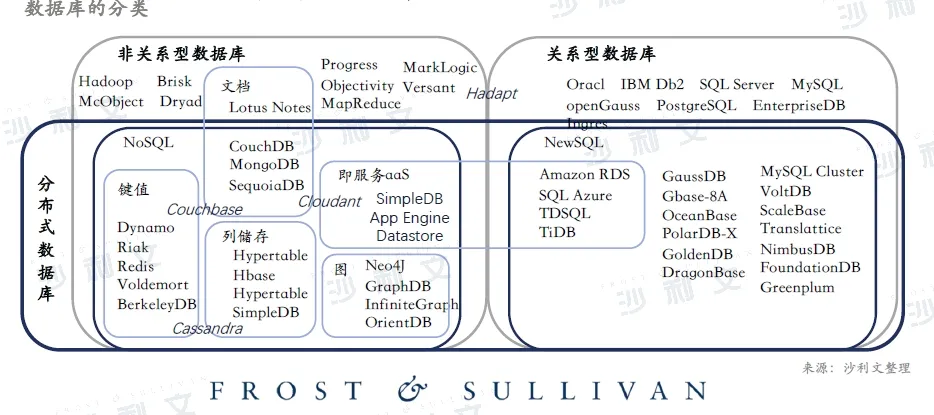
According to different dimensions, databases are divided into different categories:
1) According to the data structure model, they can be divided into relational databases and non-relational databases;
2) Based on network architecture, they can be divided into single-machine databases, in-memory computing databases, centralized databases, and distributed databases;
3) Cloud database refers to a database that is optimized or deployed in a virtual computing environment.
02 Current Market Situation of Relational Databases
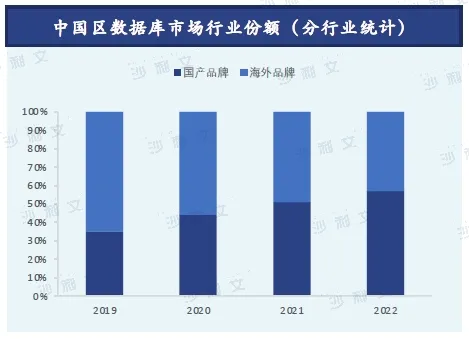
In the Chinese relational database market, local brands have risen to prominence, with the combined share of the top five domestic vendors increasing from 27.1% in 2018 to 55.4% in 2022; conversely, the combined share of the top five international vendors decreased from 57.3% in 2018 to 27.3% in 2022. This includes not only the rapid development of local public cloud database services but also the continuous efforts and high-speed business growth of traditional Chinese database vendors in recent years.
Local database products are increasingly being used to replace other existing databases in key industries and enterprise core systems. In the markets for distributed, cloud-native, HTAP, and other incremental databases, the advantages of local database brands are becoming more apparent. The market structure of relational databases in China is being reshaped. With the opening up of epidemic control measures, the business operations of database vendors have returned to normal, and enterprise database construction projects are widely underway. 2023 will be a very important year for establishing a new market pattern. After more than 20 years of development, domestic database products have gradually matured in technology, and the domestic database industry is presenting a scene of diverse development and competition.
Domestic database vendors are accelerating their pursuit of international leaders. In terms of basic research, innovative theories continue to emerge. In terms of technological breakthroughs, significant breakthroughs have been made in several key technology areas. The industry has basically acquired the capability to develop key technologies and is forming a positive competitive edge. The entire database industry presents a scene of flourishing diversity: mainly relational databases with non-relational databases as a supplement, with diverse development paths. Database products such as distributed and cloud-based ones continue to gain popularity. At the same time, domestic database procurement volumes have increased significantly, and market scale has grown steadily, laying the foundation for 'commercial use' in core scenarios across various industries. In 2022, the market share of domestic databases rose from 35% in 2019 to 57%.
Source: Compiled by Frost & Sullivan
03 Current Situation of the Non-cloud Offline Centralized Database Market in Key Industries
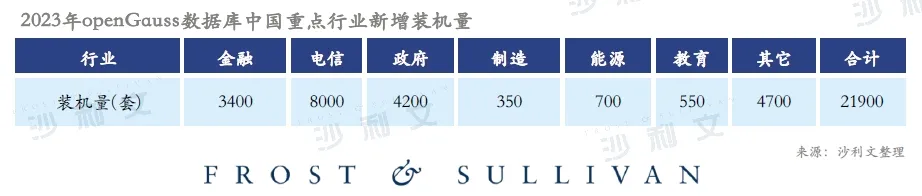
openGauss is a new generation enterprise-level open-source database launched by Huawei, based on the domestic independent root community, with independent innovation and implementation of intellectual property rights. It is distributed under the Mulan Open License v2, providing ultimate performance, full-link business and data security, AI tuning, and efficient operation and maintenance capabilities. As of the end of 2023, nearly 600 enterprises and 6,200 developers have contributed to the openGauss community. Fifteen DBV partners or enterprise users have released commercial or self-use versions based on openGauss. By 2023, openGauss and its DBV partner editions had completed a cumulative installation of 61,000 enterprise applications, adding another 30,900, including 9,000 cloud database services and 21,900 offline centralized deployments, accounting for 21.9% of the new offline centralized database installations in China in 2023.
04 Technical Development Trends in the Relational Database Industry
(1) Database architecture is moving towards separation of storage and computing, and resource pooling. The separation of storage and computing architecture fully decouples computing and storage resources and implements resource pooling. Computing nodes become stateless nodes, supporting on-demand allocation; external shared storage can use centralized storage clusters to enhance storage reliability and scalability. Separation of storage and computing splits storage and computing resources into independent modules for construction, offering significant advantages in resource utilization, efficient shared storage resources, flexible deployment across multiple scenarios, etc. In addition, with the emergence of new technologies such as high-performance disks, NVMe protocols, and RDMA/NoF networks, it provides better technical support for the separation of storage and computing architecture, making it the choice in terms of technological evolution trends. Currently, AWS Aurora, Alibaba Cloud PolarDB, openGauss, and others have all adopted the separation of storage and computing architecture to improve the overall capabilities of their databases.
(2) The demand for hybrid transaction and analytical databases is growing continuously. In scenarios where both OLTP and OLAP are required, an innovative computing storage framework ensures that real-time analysis can be supported on the same data while transactions are being processed. This eliminates time-consuming ETL processes and constructs a hybrid transaction and analytical processing (HTAP) database. HTAP databases use various technologies such as transaction processing, analytical processing, data synchronization, query optimization, resource scheduling, etc., to regularly merge incremental data into column storage on top of transactional row storage to meet analytical loads. It also combines distributed scheduling technology for parallelization to further accelerate processing. Currently, major vendors are deploying HTAP, such as Alibaba Cloud PolarDB, Tencent Cloud TDSQL, openGauss, etc.
(3) Multi-modal databases will become the next mode of popular databases, evolving towards multi-modal capabilities while supporting relational, KV, document, graph, temporal, and other modes. Multi-modal databases support flexible data storage types, centrally storing, querying, and processing various types of data, meeting the unified management needs of applications for structured, semi-structured, and unstructured data. There are already several native multi-modal databases such as ArangoDB and OrientDB, as well as traditional relational databases like PostgreSQL and openGauss, which support multiple modalities such as temporal and spatiotemporal through plugin extensions.
05 Current Application Status of Relational Databases in Industries
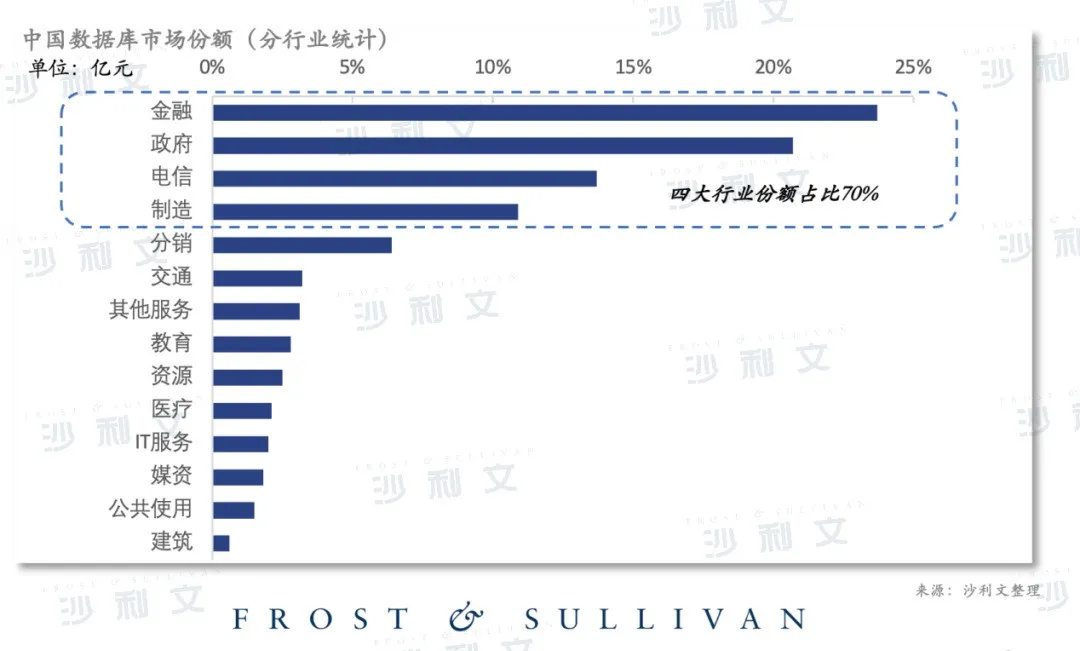
The application of domestic databases in several key industries in China, including finance, telecommunications, government, and manufacturing, is significantly increasing, and their market share is also expanding year by year. As the largest user of the database market in China, the financial industry has seen domestic databases account for 48.5% of its general systems. At the same time, the telecommunications industry is also actively adopting advanced database platforms such as database all-in-one machines, with domestic databases accounting for 45.3% of general systems.
The government industry ranks second in sales scale in the database market, accounting for 20.7% of the market share. Among general systems, domestic databases account for as high as 53.3%. Manufacturing is at a critical stage of digital transformation, and databases play a central role in this process. In general systems of this industry, the proportion of domestic databases has reached 42.3%.
06 Application Trends of Relational Databases in the Industry
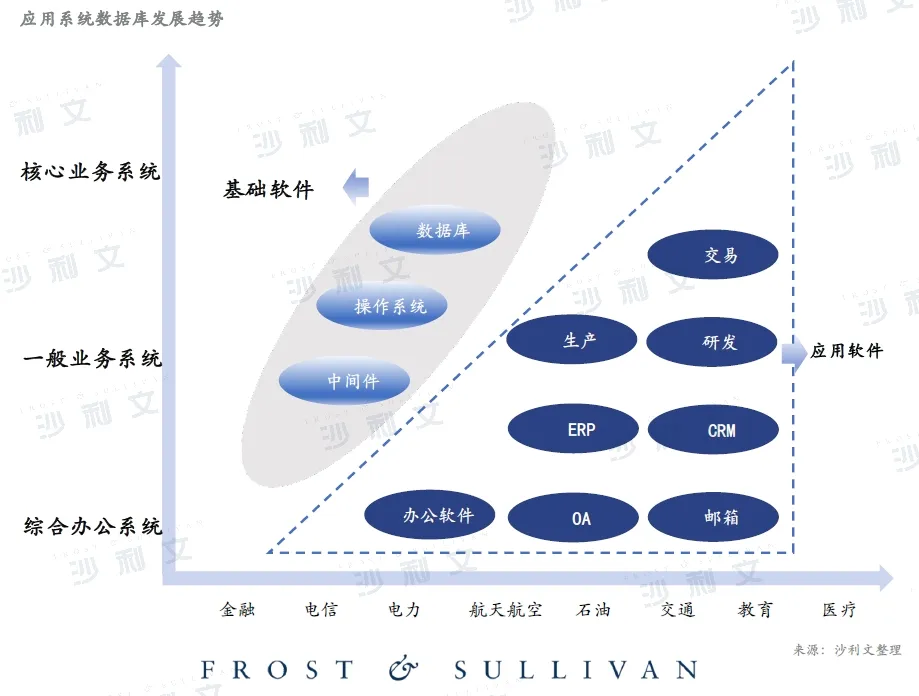
Domestic customers in 14 key industries are actively innovating and transforming application systems. Among them, database applications are gradually penetrating from general systems into core systems, becoming a development trend in key industries.
In terms of database architecture, although centralized databases remain the mainstream, distributed databases are gradually emerging as a new force in the field due to their ability to meet high data processing requirements.
Meanwhile, enterprises are facing a major challenge of how to effectively manage the data flowing through various applications, which has become one of the urgent problems that enterprises need to solve.
Finally, the number of database migration project cases is increasing continuously, and the corresponding migration planning theories are also becoming increasingly mature. This reflects that enterprises are gradually recognizing the necessity of migration in terms of databases and have accumulated rich experience through practice. Overall, the database field is facing multi-level changes and development.
07 Problems and Countermeasures Faced by Industry Applications
With the deepening of industry applications, domestic databases are facing a series of severe challenges. Firstly, the migration and replacement of industry applications have become exceptionally difficult due to their complexity. At the same time, the layout of forces within the industrial ecosystem is relatively fragmented, lacking synergies, which has hindered overall development. In addition, industrial risk issues urgently need to be addressed, and the shortage of professional database R&D talent has also become a constraint on the development of domestic databases.
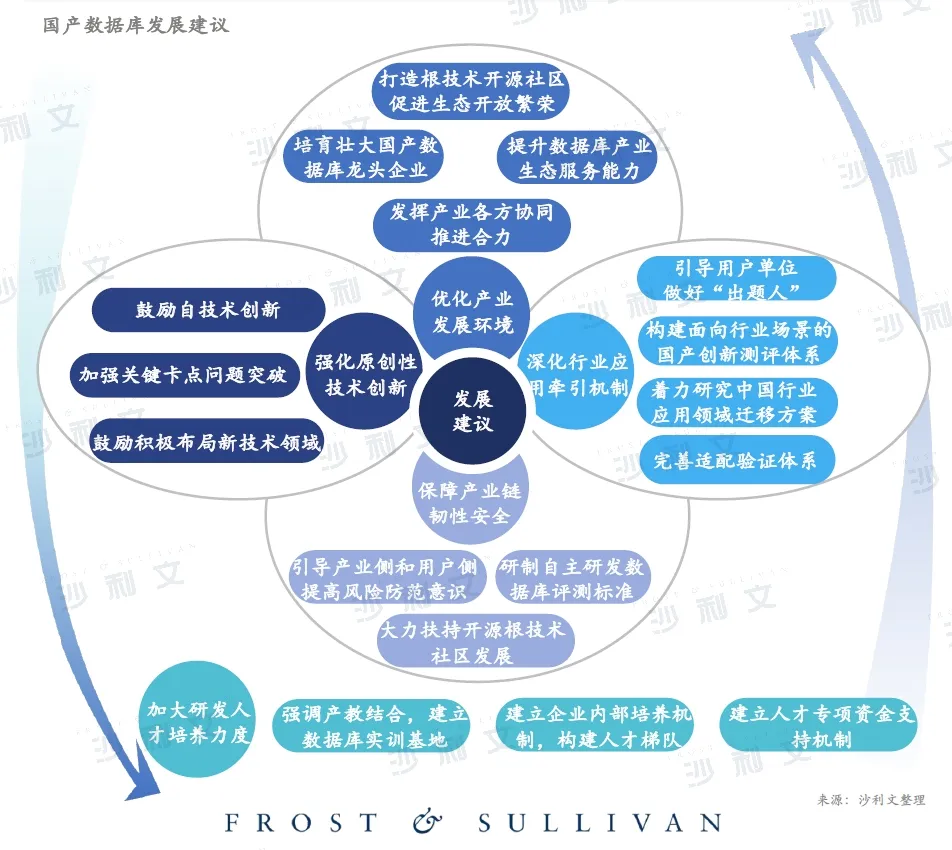
To address these challenges, the following strategies can be adopted:
(1) Strengthen original technological innovation: Encourage independent technological innovation, enhance breakthroughs in key bottleneck issues, and actively layout in new technology areas; (2) Deepen industry application traction mechanisms: Guide user units to clarify development requirements and build a domestic evaluation system tailored to industry scenarios;
(3) Optimize the industrial development environment: Build an open-source community for root technologies, cultivate and strengthen leading enterprises, enhance ecological service capabilities, leverage the synergy of industrial collaboration, and promote the standardized development and ecological construction of the database industry;
(4) Ensuring the resilience and security of the industrial chain: Enhance risk prevention awareness and improve risk prevention measures;
(5) Increase efforts in cultivating R&D talents: To strengthen the cultivation of database talents, it is necessary to combine industry with education and establish an internal training mechanism within the enterprise.
Recommended reading for this article
↓↓Long-press the QR code below to scan it ↓↓

Frost & Sullivan, a global growth consulting firm, brings together 64 years of consulting experience. Over the past 27 years, it has dedicated itself to serving the booming Chinese market with a global perspective, helping clients accelerate their business growth and achieve benchmarks in industry growth, innovation, and leadership. 1925 original articles
Contact number: 021-5407-5836
Email: PR@frostchina.com
Copyright Notice Thank you for your attention and support of Frost & Sullivan. If you wish to repost an article from our WeChat official account, please:
• Leave a message in the original text, indicating the name and introduction of the reprinting institution, as well as its WeChat official account ID; • Fill in 'Frost & Sullivan' at the author's section on the editing page;
• All reposts must not alter, misinterpret, interpret or adapt the original text in any way. Frost & Sullivan reserves the copyright and the right to interpret all original articles. In case of violation, Frost & Sullivan reserves the right to pursue legal responsibility according to the law.
About Frost & Sullivan
Frost & Sullivan, a global growth consulting firm, integrates 63 years of consulting experience. Over the past 26 years, it has dedicated itself to serving the booming Chinese market with a global perspective. It helps more than 10,000 clients accelerate their business growth, achieve benchmark positions in industry growth, innovation, and leadership, and realize capital operation goals such as financing and listing.
Frost & Sullivan is deeply involved in global capital markets and corporate consulting services. By innovatively introducing 'Total Investment Management (TIM)', it provides comprehensive investment and financing as well as various other professional consulting services for enterprises, including investment and financing CDD, valuation services, technology consulting, financial consulting, ESG, fundraising and investment feasibility studies, bond issuance industry advisory, industry advisory, assessment services, award services, industry white papers, strategic and management consulting, planning consulting, technical insights, and more.
Frost & Sullivan's investment and financing business in Greater China has achieved full industry coverage of China's national economy, including a high level of attention to all economic hotspots such as the new economy and new infrastructure. It covers digital infrastructure, consumer electronics, dual-carbon new energy, healthcare and life sciences, catering and new retail, semiconductors and integrated circuits, smart homes, automotive and mobility, health services, food and beverages, information and communication technology, fintech, real estate and property management, mining and smelting, beauty and fashion, big data and artificial intelligence, logistics and supply chain, construction technology and decoration, special new materials, culture and entertainment, enterprise-level services, cross-border e-commerce trade, infrastructure construction, environmental protection and energy-saving technology, education and training, etc.
Since the Frost & Sullivan team began providing investment and financing advisory services to corporate leaders and their management teams, it has helped nearly a thousand companies successfully list on the Hong Kong and overseas stock exchanges. It is a leading enterprise in the field of investment and financing strategy consulting in China. Over the past decade, Frost & Sullivan has consistently ranked first in the market share of professional industry consultants for Chinese enterprises listing on Hong Kong and overseas stock exchanges; moreover, in recent years, Frost & Sullivan reports have been widely cited in the prospectuses of leading A-share and STAR Market listed companies, as well as primary and secondary market research reports and other capital market disclosure documents.
For over 63 years, Frost & Sullivan has helped a large number of clients (including Fortune Global 1000 companies, top domestic and international financial institutions, and other leading enterprises) achieve strategic goals by completing tasks including but not limited to due diligence, valuation analysis, and third-party evaluations through its nearly 50 offices around the world, utilizing its powerful database and expert library, and employing rich professional knowledge and consulting tools. It has established a market position confirmation system and innovatively proposed the 'FSBVFrost & Sullivan Brand Value Model'. It has provided market position confirmation and brand valuation services to over 500 enterprises, continuously helping a large number of Chinese brands towards their growth future.
White Paper 170 White Paper · Table of Contents
Last time, Frost & Sullivan released the 'Current Situation and Future Development of the Active Vitamin D (Calcitriol) Industry Report' (with full text available for download).
Next up: Frost & Sullivan releases 'The Development and Industry Applications of Relational Databases in China 2023'




