Zhejiang Rongtai Electrical Equipment Co., Ltd. (Stock Code:603119.SH) on2023year8month1The company successfully logged onto the main board of the Shanghai Stock Exchange on the same day. The company is committed to the research, development, production, and sales of various high-temperature resistant insulating mica products. After years of technological innovation, product development, and market expansion, the company has now accumulated extensive customer resources in downstream application industries such as new energy vehicles, small household appliances, wires and cables, etc. The products have passed the USUL,FDAGermanyTÜVAnd the European UnionRoHS,PAHs,REACHStandard testing. Frost & SullivanFrost & SullivanFrost & Sullivan, hereinafter referred to as 'Frost & Sullivan', hereby warmly congratulates the company on its successful listing.
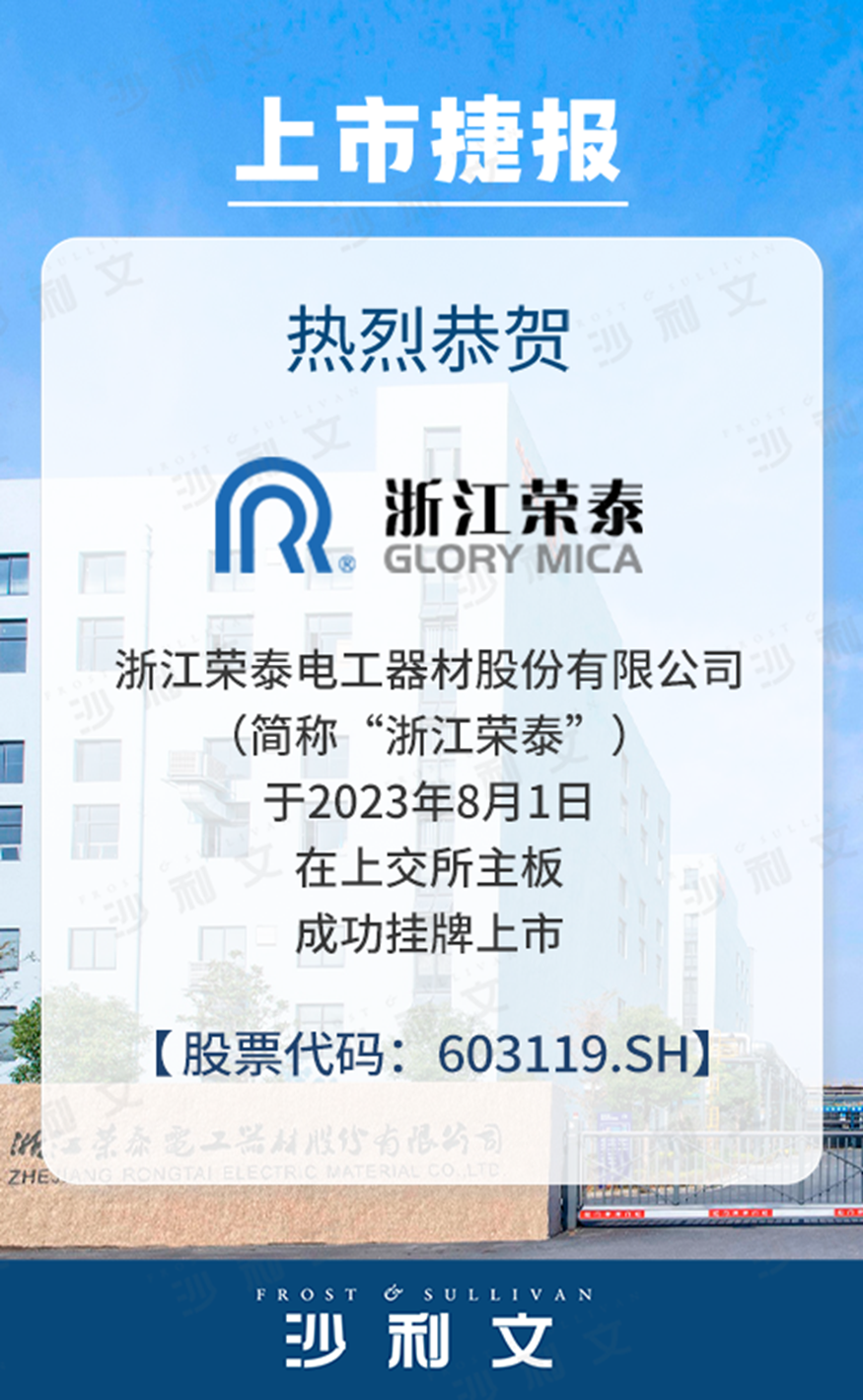
Zhejiang Rongtai Electrical Equipment Co., Ltd. (referred to as 'Zhejiang Rongtai') was established in2023year8month1The company was successfully listed on the stock market, with the number of shares issued being7,000.0010,000 shares, issue price per share15.32yuan.
Investment highlights
The company has developed a new raw material formula and created an integrated gluing and pressing forming process, achieving three-dimensional shaping preparation of mica products. This has broken through the shape limitations of existing mica products, expanding from a two-dimensional structure to a three-dimensional one.
The company actively participates in the design and development stages for downstream industry customers, not only undertaking a large number of prototype and mold design requests from clients but also investing a significant amount of R&D expenses to collaborate with clients in design and development. This deep integration of the company's technology research and development with downstream industry needs enables the company to build an interactive R&D model that relies on mutual support with downstream customers, becoming an indispensable part of the industrial chain.
The company has formed multiple independent intellectual properties. As of2022At the end of the year, the company and its subsidiaries owned23Invention patent,81Utility model patent,3Patent for exterior design, presided over or participated in drafting and revising multiple national, industry, or group standards;
The company is gradually transforming from a single-product manufacturer to a comprehensive solution provider, continuously attracting high-quality customer resources from the industry to gather around it. Currently, the company's clients include world-renowned automotive brands such as Tesla, Volkswagen, BMW, Mercedes-Benz, Volvo, as well as battery leader Contemporary Amperex Technology Co., Ltd., well-known household appliance companies like Midea and Panasonic, and internationally or domestically renowned wire and cable enterprises such as Nexans, Baosheng, and Far East Electric.
The company's supply chain system and production system are effectively connected, achieving flexible production processing line configuration and an intelligent order-rolling production organization model.
Frost & Sullivan has long been focusing on the global and Chinese chemical and materials industries, releasing a large number of research reports that are widely cited in the prospectuses of leading listed companies in the industry, helping clients accelerate growth.
Mica Materials Market Overview
Mica is a rock-forming mineral, typically appearing as hexagonal or rhombohedral platy, flaky, or prismatic crystals. Mica has properties such as insulation, high temperature resistance, luster, and stable physical and chemical properties. It is widely used in fields such as pyrometallurgy, electricity, automotive, and cosmetics. According to product categories, there are two types of mica:
· natural mica
Natural mica is a naturally occurring rock-forming mineral and is considered a non-renewable resource. Depending on the iron content, natural mica comes in three types: muscovite, biotite, and anthophyllite. Muscovite and biotite are widely used in industry, especially the electrical industry.
· synthetic mica
Synthetic mica is a mineral synthesized by mimicking the composition and structure of natural mica. Synthetic mica has advantages in insulation, high-temperature resistance, and corrosion prevention. Synthetic mica powder is generally used in the production of cosmetic-grade and automotive-grade pearlescent pigment products, among other fields.
Mica material product classification
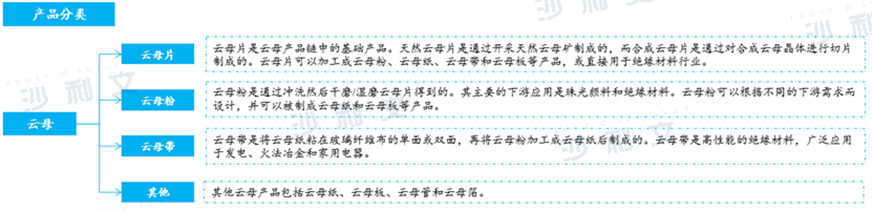
Source: Frost & Sullivan report
Analysis of the Mica Material Industry Chain
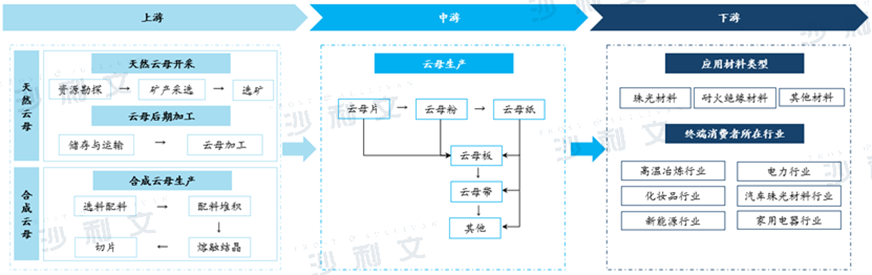
The value chain of the mica market consists of three main segments. The upstream segment includes the mining of natural mica ore and the production of synthetic mica. The midstream segment involves mica product manufacturers, who process raw materials into a range of mica material products. The downstream segment is the application sector for mica materials, including different types of materials and industries where they are used.
In the upstream, the production of synthetic mica requires four steps: material selection and batching, mixing materials by pushing and piling, melting and crystallization, and slicing. Among these, melting and crystallization are the most critical steps, determining the quality and yield of synthetic mica crystals. Leading enterprises have mastered advanced melting and crystallization technologies as well as advanced grinding techniques to manufacture mica powder of different specifications to meet various downstream needs. In the midstream, both synthetic mica and natural mica can be further processed into mica materials. Mica flakes are the basic product of all other mica products. They can be processed into mica powder and mica sheets, or directly applied in the insulation material industry. Pearlescent pigments and refractory insulating materials are the main downstream application types of mica materials, widely used in high-temperature smelting, new energy, automotive pearlescent materials, cosmetics, power, household appliances, and other downstream industries.
Analysis of the Mica Material Industry Chain
Source: Frost & Sullivan report
Mica material market scale
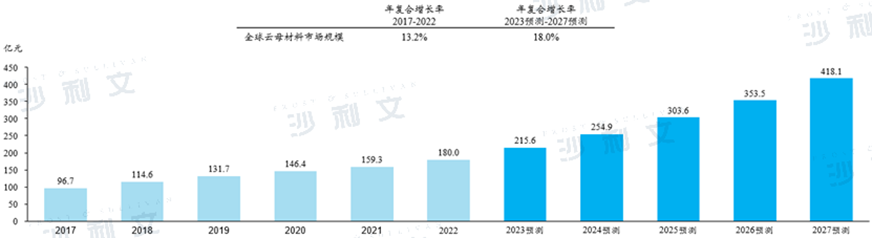
Mica has excellent insulation and temperature resistance properties, and is easy to mine. It is widely distributed in the surface rock mass and possesses characteristics such as resistance to strong acids, strong alkalis, high voltage, insulation, and high temperature resistance. As a basic material for electrical equipment, mica materials are used in downstream application fields involving traditional industries such as high-temperature smelting and power generation, and have gradually expanded into emerging industries like new energy vehicles and electrochemical energy storage in recent years. Over the past few years, the global mica material market size has maintained stable growth, from2017year96.7RMB billion growth to2022The year's promise180.0Yuan, with an annual compound growth rate of approximately13.2%.
It is expected that in the future, the global mica material market size will continue to grow under favorable conditions such as further increases in new energy vehicle sales, higher market demand for the safety performance of new energy vehicle power batteries, and gradually increasing demand for mica materials in the energy storage sector. It is estimated that it will grow from2023year215.6RMB billion growth to2027year418.1yuan, with an annual compound growth rate during this period of18.0%.
Global Mica Material Market Size2017year-2027annual forecast)
Source: Frost & Sullivan report
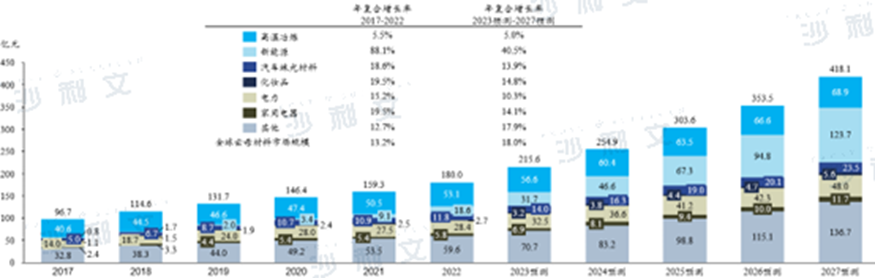
High-temperature smelting and power generation are representative application industries of mica materials, accounting for a relatively large market share and showing steady growth. In recent years, mica materials have rapidly penetrated into new energy power batteries and energy storage batteries due to their excellent insulation and high-temperature resistance properties. The global market scale of new energy mica materials has been...2017year0.8RMB billion growth to2022year18.6yuan, with an annual compound growth rate during this period of88.1%.
In the future, as new energy vehicles become the mainstream of the automotive industry, the application of mica materials in new energy will surpass downstream sectors such as high-temperature smelting, becoming a new mainstream application area within the mica materials industry and maintaining rapid growth. The global market size for new energy mica materials is expected to2023year31.7RMB billion growth to2027year123.7yuan, with an annual compound growth rate during this period of40.5%, and the proportion is expected to change from2023year14.7%Grew to2027year29.6%.
Global Mica Material Market Size, by Downstream Application Sectors
(2017year-2027annual forecast)
Source: Frost & Sullivan report
Mica material market drivers
The stable development of downstream industries using mica materials has driven increased demand.
The downstream applications of mica materials are currently mainly concentrated in high-temperature smelting, new energy, automotive pearlescent materials, and the power sector. For example, in the application scenario of high-temperature smelting, mica materials are commonly used as high-temperature resistant and refractory materials, applied in scenarios such as industrial frequency furnaces, steelmaking furnaces, ore heat furnaces, ferroalloy furnaces, and electrolytic aluminum electrolysis cells in the metallurgical industry. In the fastest-growing new energy sector, mica materials, as insulating high-temperature resistant materials, will see an increasing application in power batteries and energy storage batteries to ensure the durability and safety of battery packs, becoming a major driving force for the development of mica materials. In the future, the end-users and downstream applications of mica materials will maintain stable growth. At the same time, with the consumption upgrade in traditional and emerging markets (such as high-temperature smelting and new energy), the market demand for mid-to-high-end mica material products will also climb. As the main raw material for insulating materials, refractory materials, and mid-to-high-end pearlescent pigments, the demand for mica is expected to increase rapidly.
Industry standardization and quality improvement drive innovation in mica material products
The standardized establishment and continuous expansion of downstream industries will guide customers to raise their quality requirements for mica-related products, stimulating the continuous progress of production technology in the mica industry. The three-dimensional modeling preparation of mica materials and the integrated molding process involving gluing and pressing meet the mechanical strength and high weather resistance requirements of new energy vehicle safety parts, promoting the continuous innovation of mica material products. Leading enterprises in the mica material industry have shifted their focus to the selection of mica product materials, automatic batching systems, integration, crystallization, based onPLCKey technologies such as the melting automation system, surfactant treatment, coating technology, and automatic bagging and sorting systems are also under development. The advancement of R&D capabilities will drive innovation and quality improvement in mica products, as well as expansion into downstream fields.
The downstream product portfolio of mica materials shows diversified development.
With the continuous drive from downstream industries and the improvement of R&D capabilities, more specifications and types of mica products will be developed. The diversification of product portfolios will drive the sustained expansion of the mica material market. For example, in the household appliance sector, mica has characteristics such as high temperature resistance and acid-base resistance, with a low thermal expansion coefficient. Therefore, industrial structure upgrading, consumer diversification, national policies guiding the development of green and intelligent industries, and the upgrade of product standards in the household appliance industry will enrich the downstream product portfolio types of the mica industry, achieving diversified market expansion and steady progress. In addition to expanding the categories and specifications of downstream applications, leading enterprises are gradually increasing their participation in the value chain, such as through acquisitions of companies in other links of the industrial chain to achieve vertical integration.
Development Trend of Mica Materials Market
Mica materials continue to penetrate vertically into downstream applications
With the improvement of R&D capabilities in China and globally, driven by globalization, the quality and characteristics of mica products will be further enhanced, achieving deeper vertical penetration. For example, the preparation of three-dimensional mica materials will meet the needs for insulation between automotive motor steering gear pieces and high-temperature resistance. At the same time, with technological progress and increased safety requirements, mica materials will be commonly used in new energy vehicle lithium batteries. In addition, the application proportion of mica materials in the energy storage battery industry will continue to grow. In the power industry, the penetration rate of refractory mica tapes will continue to increase to address issues such as local overheating caused by excessive resistance in circuits. With the improvement of fire hazard standards and the gradual increase in household circuit current, mica materials will be widely applied to reduce the probability of fires in circuits and improve the safety of power transmission. Based on existing R&D and production capabilities, mica products can be deeply applied as high-temperature resistant insulating materials in fields such as construction in the future. In summary, mica, as a practical industrial additive, will continue to be widely used in many downstream industries such as automotive, power, and cosmetics, unleashing tremendous market potential.
Policy support drives the progress of mica materials in key technologies
With the popularization of mica products and the increasing downstream demand, key technologies in the mica industry will see further development driven by policies. The Central Committee of the Communist Party of China2020In the year, the 'Proposal of the Central Committee of the Communist Party of China on Formulating the 14th Five-Year Plan for National Economic and Social Development and the Long-Range Objectives Through the Year 2035' was released, proposing to accelerate the development of new-generation biotechnology, new energy, new materials, high-end equipment, new energy vehicles, green environmental protection, as well as aerospace and marine equipment. Among them, mica materials correspond to the needs of new-generation technologies. As key technologies progress and develop, the market expands and grows rapidly accordingly. In the future, with the inclination of national policies, mica-related R&D and production technologies can receive appropriate financial and strategic support. For example, 'Made in China2025It is clearly stated that the mica industry, as an advanced materials industry, is one of the ten key areas. The government will promote advanced key technologies such as smelting, solidification casting, and evaporation coating to break through technical limitations.
The intelligent industrial chain of mica materials guides the industry to reduce costs, increase efficiency, transform and upgrade.
Currently, the main production method for mica materials is manual batch operation. With the increasing demand for mica products and the diversification of mica product combinations, using intelligent production lines to improve efficiency and quality will be the main trend in the future. Technologies such as automatic batching systems, automatic bagging and sorting systems will enhance the efficiency of mica material production lines, achieving cost reduction and efficiency improvement for leading manufacturers in the industry and upgrading key technologies. In addition, intelligent production lines can effectively promote energy-saving production of synthetic mica, further realizing zero dust and regulated production management, and solving problems such as raw material waste and pollution caused by intensive energy consumption and unstable processes. In the future, with the increasing industry's requirements for energy conservation and emission reduction, optimization of technology types, and the growth of customized customer needs, the intelligent industrial chain for mica materials will continue to expand. Leading enterprises in the industry will guide industry transformation and upgrading by deploying intelligent core technologies.
View the prospectus
Frost & Sullivan has extensive research experience in the chemical and materials industries, assisting well-known companies in successfully accessing capital markets. Successful listings include: Yongtai Technology (YTT), Zhongbao New Materials2439.HK), Shengneng Group2459.HK), Jinli Yongci (6680.HK),Avia Avian(IDX: AVIA), Global New Materials6616.HK), Dafeng Equipment2153.HK), Yihai International8659.HK),GHW(9933.HK), Sanhe Refining0301.HK), Xingyu Holdings2346.HK), Xinghe Holdings1891.HK), Xuyang Group1907.HK), Dragon Resources1712.HK), Shandong Gold (1787.HK), Henan Jinma6885.HK), Xingye New Materials8073.HK), Dongguang Chemical Industry1702.HK), Zhongqi Group1932.HK), Xinbang Holdings1571.HK), Meigu Technology8349.HK), Huajin International2738.HK), Filtre glass6865.HK), Dinos (1452.HK), Caike Chemical1986.HK), Chang'an Renheng8139.HK), Sansida1337.TWSE), Borun IndustryBORN.NYSE), Kangpeng ChemistryCPC.NYSE), Gushan GroupGU.NYSE), Tianhe Chemical Industry1619.HK), Yihua Holdings2121.HK), Sijia Group1863.HK) etc.
Recommended Reading
Frost & Sullivan assistanceAvia AvianSuccessfully listed in Indonesia(IDX: AVIA)
Frost & Sullivan assistanceGHWSuccessfully listed on the Hong Kong stock market(9933.HK)
Frost & Sullivan assisted Xingyu Holdings in successfully going public in Hong Kong(2346.HK)
Frost & Sullivan assists Shandong Gold in successfully going public in Hong Kong(1787.HK)
Frost & Sullivan assisted Henan Jinma in successfully going public in Hong Kong(6885.HK)
Frost & Sullivan assisted Dongguang Chemicals in successfully going public in Hong Kong(1702.HK)
Frost & Sullivan assisted Zhongqi Group in successfully going public in Hong Kong(1932.HK)
Frost & Sullivan assisted Dynos in successfully going public in Hong Kong(1452.HK)
Frost & Sullivan assisted Caike Chemical in successfully going public in Hong Kong(1986.HK)
Frost & Sullivan assisted Chang'an Renheng in successfully going public in Hong Kong(8139.HK)
*The above order is not sequential and is arranged in reverse chronological order by listing time.
2023Frost & Sullivan's New Investment Conference