



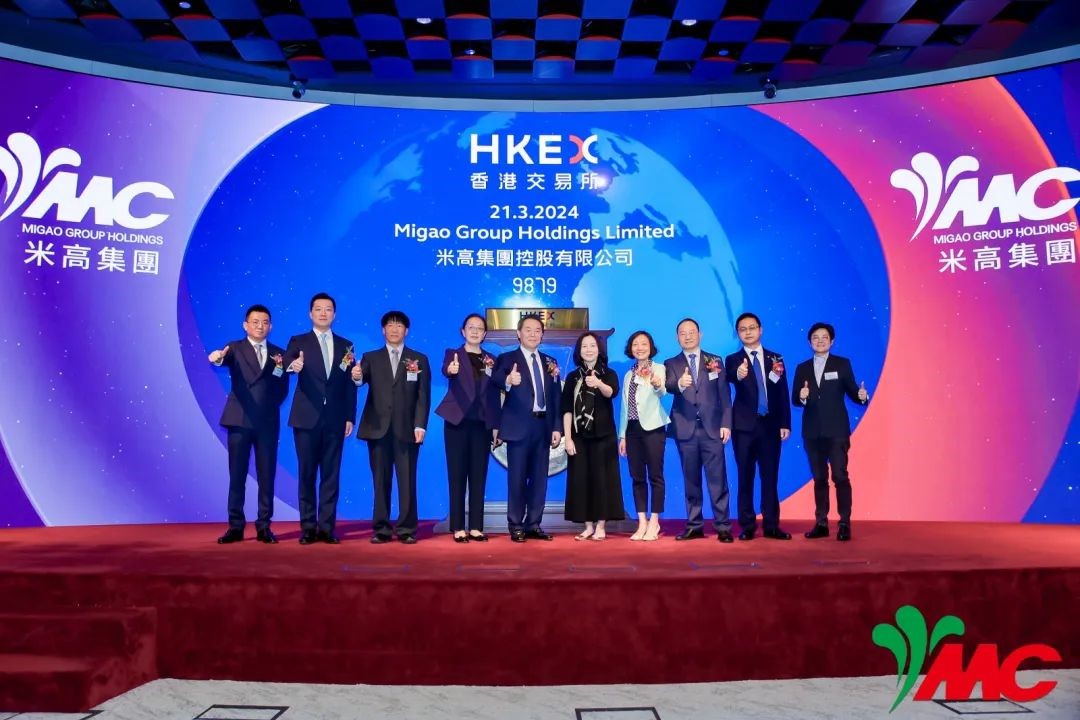
MGI Holdings Limited (Stock Code:9879.HK) on2024year3month21Rifosol has been listed on the Hong Kong Stock Exchange. The company is a Chinese potash fertilizer company with procurement, processing and manufacturing capabilities, selling various potash fertilizer products including potassium chloride, potassium sulfate, potassium nitrate, and compound fertilizers. Frost & SullivanFrost & Sullivan,Frost & Sullivan, a leading global provider of strategic consulting services to the consumer goods industry (hereinafter referred to as 'Frost & Sullivan'), is pleased to announce that it has been retained by MGI Holdings Limited as the exclusive industry advisor for its listing.
MGI Holdings Limited (hereinafter referred to as 'MGI Group') was incorporated on2024year3month21The company plans to go public on the 1st of July225,000,000shares, among which202,500,000The shares are for international issuance,22,500,000The shares are issued in Hong Kong. The final issue price per share4.08HK$, net proceeds from global offering approximately8.63HK$10 billion.
During the process of listing in Hong Kong this time, Frost & Sullivan mainly undertook the following tasks: helping the issuer accurately and objectively understand its positioning in the target market, using objective market data to discover, support and highlight the issuer's competitive advantages, assisting the issuer, investment banks and other intermediaries in completing the writing of relevant parts of the prospectus (such as the overview, competitive advantages and strategy, industry overview, business and other important chapters), helping the issuer complete communication with the Hong Kong Stock Exchange and investors, assisting investors in quickly understanding the market ecosystem and competitive landscape, and assisting the issuer in completing feedback on various industry-related issues from the Hong Kong Stock Exchange, etc.
Investment highlights
The company is a Chinese potash fertilizer company that operates five main production facilities in Heilongjiang Province, Jilin Province, Guizhou Province, and Guangdong Province, providing high-quality and diversified potash fertilizer products;
The company has established long-term and stable relationships with large enterprise clients and strategically laid out its customer service network;
The company has a variety of channels for purchasing potassium fertilizer raw materials to ensure stable supply;
The company has a mature R&D team that provides technical support for the company's continuous development;
The company's management team has rich experience, with most having worked together for over a decade.
According to the Frost & Sullivan report, the company:
In terms of total potassium fertilizer sales2022The company ranks third in China and is the second-largest non-resource-based potash fertilizer company in the country;
In terms of potassium chloride sales2022The company ranks third in China;
Ranked by potassium sulfate sales2022The company ranks fourth in China;
Ranked by potassium nitrate sales2022The company ranks fifth in China.
Global Potash Industry Overview
Introduction to Potassium Fertilizer
Potassium is one of the three basic nutrients for plants, the other two being nitrogen and phosphorus. Potassium, also known as potash, is crucial for the synthesis of carbohydrates and starches, and it also helps plants resist wilting. The content in soil can be as high as98%Potassium cannot be absorbed by plants in its original form, so potassium fertilizer has become an essential nutrient for crop production. The definition of potassium fertilizer is a fertilizer made through chemical or physical processes that uses potassium as its main nutrient. The three major types of potassium fertilizers are potassium chloride, potassium sulfate, and potassium nitrate.
Overview of global potassium and alkali reserves
The global distribution of potassium and alkali reserves is relatively uneven, with recoverable reserves concentrated in a few countries. Among them, Canada, Belarus, and Russia are the three countries with the highest reserves in the world. According toUSGSData from the United States Geological Survey, dated2022In [year], the potassium-sodium-bicarbonate reserves of these three countries accounted for more than60%There are approximately170Million metric tons of potash reservesK2OEquivalent), ranking fourth in the world. However, most of the potassium-sodium-bicarbonate reserves are low-grade potassium and unreachable deep brine deposits, which are difficult to support long-term mining and the growing downstream demand in the future.
Global Potassium Fertilizer ProductionK2Oequivalent) to2022Annual achievement50.2One million tons, and it is expected to be2023year51.3One million tons increased to2027year54.7One million tons. According toUSGSData from the United States Geological Survey, dated2022In the year2022Global annual potassium-baking soda mineral production40%Secondly, China (accounting for15%), Russia (accounting for13%) and Belarus (accounting for8%Affected by the uncertainties brought about by the Russia-Ukraine conflict and international sanctions targeting Belarusian producers, the global potassium-baryum mineral production share of Russia and Belarus is at2022It has decreased annually. To maintain stable supply, China's global potassium-abundant mineral production accounts for2022The annual increase is significant, but in the long run, due to the scarcity of potassium and alkali reserves, the growth of potassium and alkali mineral production in China is limited.
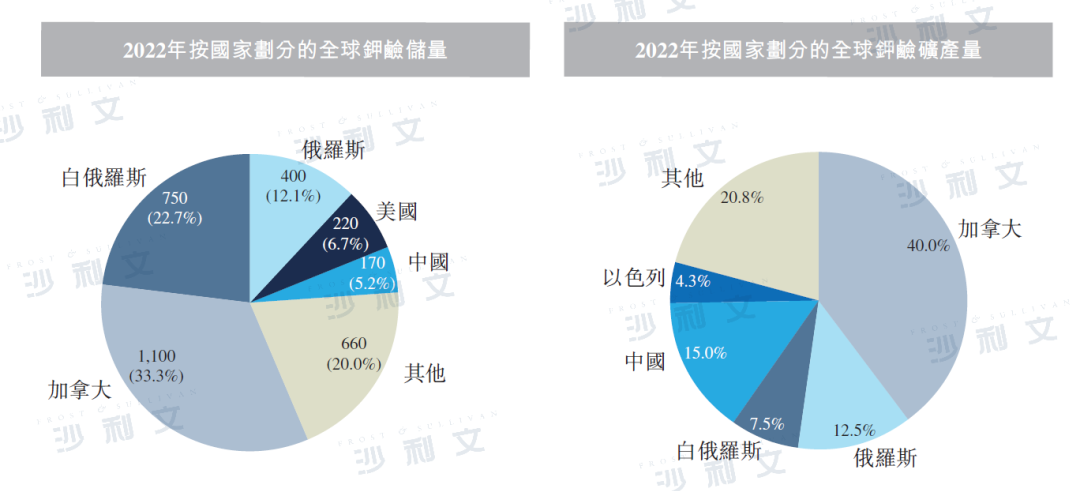
Note: Data is presented in millions of metric tons (K2OEquivalent) count, since data is rounded, the sum of the data in the above circular chart may not equal100%.
Source: Frost & Sullivan report
Value chain of China's potassium fertilizer industry
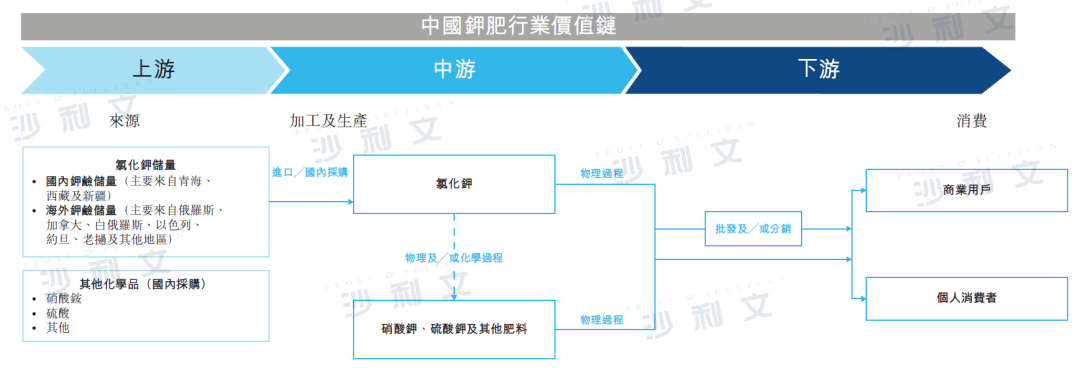
The upstream industries of China's potassium fertilizer industry include potassium chloride reserves and other chemicals. The potassium chloride supplied in China mainly comes from international and domestic potash reserves. Most potassium chloride is imported from Russia, Canada, Belarus, Israel, Jordan, Laos, and other places. China's potash reserves are mainly distributed in Qinghai, Xinjiang, Tibet, and other regions.
The midstream industry consists of potassium fertilizer processing and production. In some cases, imported potassium chloride can be sold directly to end-users without further processing. In other cases, imported potassium chloride may undergo several physical processes before being sold to end-users. In addition to direct use, potassium chloride can also be used to manufacture potassium sulfate, potassium nitrate, and other fertilizers (such as compound fertilizers). Potassium sulfate, potassium nitrate, and other compound fertilizers require specific equipment under certain environmental conditions for physical and/Or produced through chemical processes. Potassium fertilizer producers usually customize products according to the specific requirements of downstream customers (such as product form and shape).
The downstream activities of the industry involve wholesale, distribution, and end consumption. In particular, transporting fertilizers containing potassium nitrate requires strict compliance with relevant standards such as the 'Regulations on the Safety Management of Hazardous Chemicals'. Generally, potassium fertilizers are first transported to wholesalers and then distributed through various distribution channels and sold to end customers. In addition, some potassium fertilizers can be sold directly to customers without distribution, especially to state-owned enterprises and large clients. Downstream customers are mainly divided into commercial users and individual consumers. Furthermore, some companies within the industry may have customers./Supplier overlap. For example, potash fertilizer companies may manufacture compound fertilizers using raw materials supplied by downstream customers (such as potassium chloride).
Source: Frost & Sullivan report
Overview of China's Potassium Fertilizer Industry
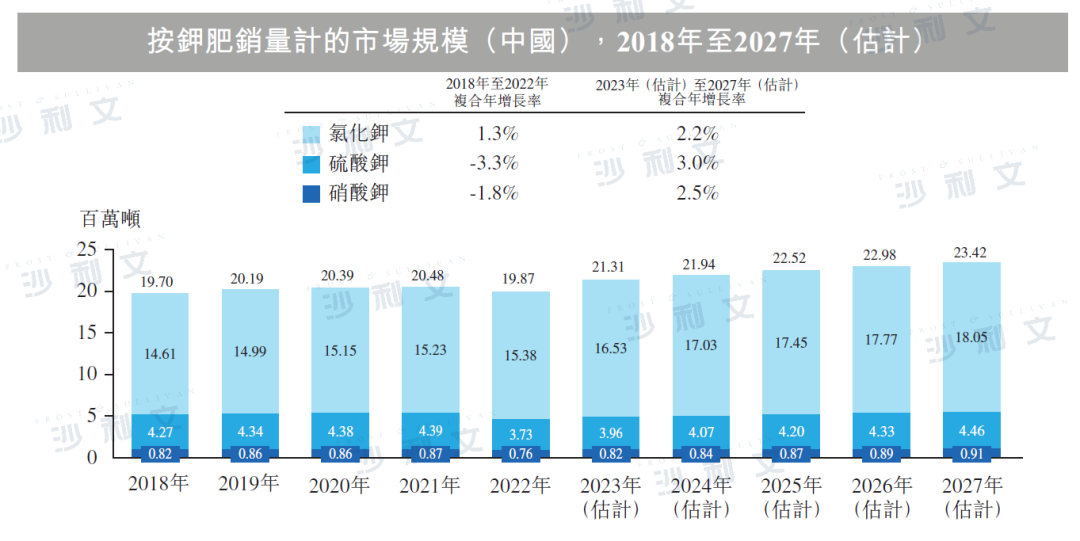
Agriculture in China has been booming in recent years, thus increasing the demand for potassium fertilizer. Potassium chloride is the most commonly used potassium fertilizer in China and can be used for growing a variety of crops. Due to the limited potassium resources in China, a large part of the annual demand for potassium chloride is met through overseas imports.2022In China, the market scale based on potassium chloride sales reached15.38One million tons, accounting for the total sales volume of potash fertilizers77.4%.2022The sales volume of potassium sulfate and potassium nitrate reached3.73One million tons and0.76One million tons. Looking ahead, it is predicted that the market scale based on potassium fertilizer sales will further expand, with chloride potassium sales to be2023year16.53One million tons increased2027year18.05One million tons, compound annual growth rate2.2%.
The application of potassium sulfate demonstrates its beneficial effects on soil structure and can enhance the drought resistance, disease resistance, and pest resistance of crops. Potassium sulfate is also the preferred potassium fertilizer for chloropicric acid-sensitive crops such as tobacco and fruit trees. Potassium sulfate and potassium nitrate also have high water solubility, allowing them to be applied to the soil through irrigation systems or as foliar fertilizers.2027In the year, sales of potassium sulfate and potassium nitrate are expected to reach4.46One million tons and0.91One million tons, and the two2023Year-end2027The compound annual growth rates for the years are3.0%and2.5%.
Source: Frost & Sullivan report
Import analysis of potassium chloride
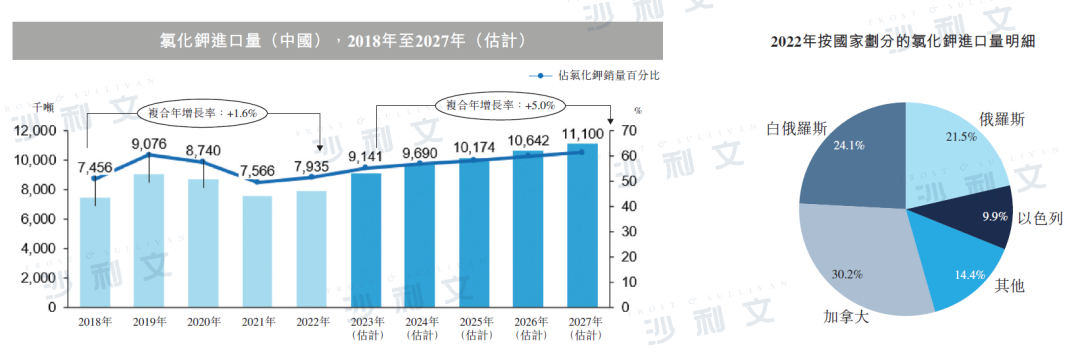
Due to the limited domestic potassium-soda reserves in China, imports of potassium chloride are quite important for the Chinese potassium fertilizer market.2022In [year], China's total sales volume of potassium chloride was about50%From overseas. According to data released by the General Administration of Customs of the People's Republic of China, the import volume of potassium chloride2018year7,456Thousands of tons increased to2022year7,935Thousand tons, with slight fluctuations. Yu2022In [year], Canada, Belarus, and Russia were the three major potassium chloride importers into China, accounting for approximately [X]% of China's total potassium chloride imports respectively.30.2%,24.1%and21.5%be subject toCOVID-19 pandemicThe negative impact of the pandemic has adversely affected international trade activities, leading to2020year2021Potassium chloride imports decreased in [year]. It is expected that China's potassium chloride imports will maintain stable growth over the next few years, with2027The year is about to reach its end11,1001,000 tons.
Note: Due to data rounding, the sum of the data in the above circular chart may not equal100%
Source: Frost & Sullivan report
Market drivers and trends
·Population growth promotes continuous food demand
With the continuous growth of the global population and economic development, global and Chinese grain production and demand will continue to maintain a stable development trend, thereby driving the demand for potassium fertilizer. Potassium fertilizer is an important part of the fertilizer industry, and its demand is closely related to grain production and demand. Grains are the most widely cultivated crops globally and play a crucial role in providing food for the world's population. Potash is an essential nutrient element for plant growth and is necessary for strong roots and stems, as well as improving the quality and yield of crops.
Global and China's grain production has maintained stable growth in the past few years, with2018year2,647.2One million tons and610.0One million tons are gradually increasing to2022year2,786.5One million tons and633.2One million tons, and the two2018Year-end2022The compound annual growth rates for the years are1.3%and0.9%Global and Chinese grain production has been steadily increasing in recent years, driving demand for potassium fertilizers. At the same time, the global arable land area continues to decrease and is expected to further reduce. Population growth and improved productivity levels have a significant impact on grain demand, leading to a corresponding increase in the demand for potassium fertilizers. In addition, the agricultural development level in emerging countries is generally lagging behind, and fertilizer consumption will be much higher than that in developed countries. Therefore, the potassium fertilizer industry and producers must continuously innovate and invest in potassium fertilizer production and distribution to meet the growing global agricultural demand.
·Supportive government policies
The Chinese government has introduced several strategic support measures for the development of the potassium fertilizer industry and actively encourages the construction of overseas potash and soda ash production bases. In addition, the government has established a joint consultation mechanism for potassium fertilizer imports to control import prices and promote potassium fertilizer consumption. Furthermore, according to the 'National Fertilizer Commercial Reserve Management Measures', potassium fertilizers are supplied from2020Since the beginning of this year, potassium fertilizer has been included in the national fertilizer commercial reserve. Incorporating potassium fertilizer into the national fertilizer commercial reserve is an important measure to ensure the stable supply of agricultural inputs and promote the sustainable development of Chinese agriculture. In addition, the government has included innovative environmental protection fertilizer production technologies that are high-quality, efficient, and safe in production into the 'Catalogue of High-tech Fields Supported by the State'.
According to the 'Guiding Opinions on Promoting the Transformation and Development of the Fertilizer Industry', the government will promote fertilizer producers to enhance their technological innovation capabilities through special funds.2023year9In the month, the National Development and Reform Commission promulgated the revised Measures for the Supervision of Grain Quality and Safety, which came into effect on2023year10Effective from the month following its promulgation. The enactment of this law will strengthen the government's supervision over food quality and safety, raise public awareness of food quality and safety, thereby promoting a steady improvement in food quality and driving market demand for high-quality potassium fertilizers.
Analysis of the Competitive Landscape of China's Potassium Fertilizer Industry
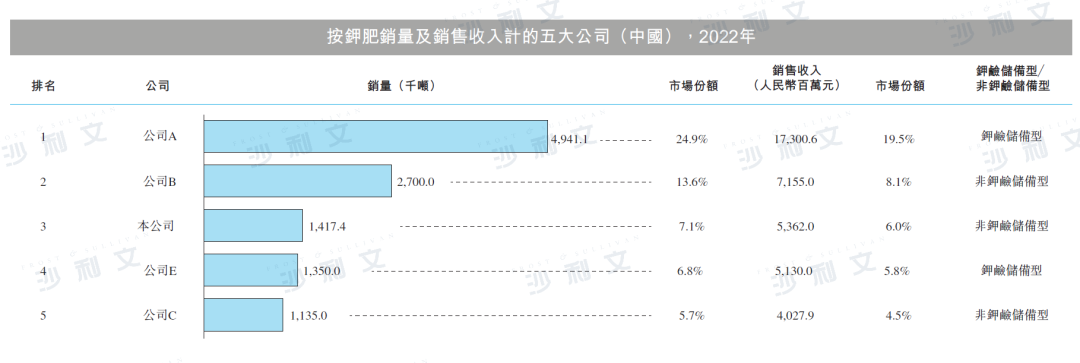
In terms of potassium fertilizer sales2022The market share of the top five potash fertilizer companies in China in58.1%The potassium fertilizer sales volume of MGI Group is1,417.41,000 tons, market share is7.1%ranked third. In terms of sales revenue,2022The annual sales revenue of Nianmi Ga Group is RMB5,362.0One million yuan, market share is6.0%ranked third.
In addition, potassium fertilizer companies can be further divided into resource-based companies and non-resource-based companies based on whether they possess potassium ore reserves.2022In terms of potassium fertilizer sales volume, MGI Group is the second-largest non-resource-based potassium fertilizer company in China.
Note:
1Sales volume and sales revenue are calculated based on calendar years; Sales volume and market share are calculated based on the physical quantity of potassium fertilizer (potassium chloride).
2Although the companyCIt has phosphate reserves but does not have potash reserves, hence it is classified as a non-resource-based potassium fertilizer company.




