



Fujing China Holdings Limited (Stock Code:2497.HK) on2024year3month28The company successfully logged onto the main board of the Hong Kong capital market on2016The company began large-scale production of potted vegetable agricultural products at the beginning of the year, with an annual output exceeding one million pots. Frost & SullivanFrost & Sullivan,Frost & Sullivan, referred to below as 'Frost & Sullivan', provides exclusive industry advisory services for the listing of FJCL Holdings Limited. We hereby extend our warmest congratulations on its successful listing.
Fujing China Holdings Limited (hereinafter referred to as 'Fujing China') was established on2024year3month28The company successfully went public on the 1st, and it plans to issue shares1100 million shares, including allocated shares9,00010,000 shares, public offering1,00010,000 shares, and others15%Excess allotment rights, issue price per share1.08HK$, total fundraising amount about for1.08HK$10 billion .
During the process of listing in Hong Kong this time, Frost & Sullivan mainly undertook the following tasks: helping the issuer accurately and objectively understand its positioning in the target market, using objective market data to discover, support, and highlight the issuer's competitive advantages, assisting the issuer, investment banks, and other intermediaries in completing the relevant parts of the prospectus (such as overview, competitive advantages and strategy, industry overview, business, and other important chapters), helping the issuer complete communication with the Hong Kong Stock Exchange and investors, assisting investors in quickly understanding the market ecosystem and competitive landscape, and assisting the issuer in completing feedback on various industry-related issues from the Hong Kong Stock Exchange, etc.
Investment highlights
The company enjoys extensive brand awareness and high quality, enabling it to lead the industry of potted vegetables and agricultural products in Shandong Province;
The company has a wide distribution network across Shandong Province;
The company has an experienced and highly accomplished management team that leads the development of the company;
The company possesses advanced technology in the cultivation of potted vegetables and agricultural products, with special cultivation methods ensuring higher yields than traditional methods;
The company has a rich product portfolio;
The technical requirements for greenhouse and potted vegetable cultivation are higher, along with the higher upfront investment costs, which sets the company apart from traditional growers in the vegetable and agricultural product industry.
According to a report by Frost & Sullivan:
Calculated based on sales revenue, the company is2022The largest potted vegetable producer in Shandong Province in terms of annual output, holds a market share of14.8%;
company2022The annual sales revenue was RMB114.5One million yuan, which is less than the total sales revenue of potted vegetable producers0.01%And accounts for approximately3.1%;
The sales volume of potted vegetable agricultural products in Shandong Province is expected to be2022year48.5Increased from one million pots2027year61.6One million pots, compound annual growth rate4.9%;
In addition, it is expected that the sales revenue of potted vegetable agricultural products in Shandong Province will be2022Renminbi in [year]773.6Rise from one million to2027Renminbi in [year]1,102.2One million yuan, with a compound annual growth rate of7.3%.
Overview of China's Potted Vegetable Agricultural Products Market
Potted vegetable agricultural products refer to vegetables grown in pots rather than on the ground. The main varieties of potted vegetable agricultural products are leafy greens and solanaceous vegetables, including spinach, lettuce, romaine lettuce, leeks, and tomatoes. In recent years, more and more restaurants display fresh potted vegetables to attract consumers' interest for selection and ordering. With the continuous improvement of personal health awareness and concern for food safety, potted vegetable agricultural products have become increasingly popular among urban residents and restaurants as a direct source of high-quality and fresh vegetables.
The necessary facilities and raw materials for producing potted vegetable products include (but are not limited to) greenhouses, seeds, substrates, fertilizers, pots, and equipment. Planting potted vegetable products in greenhouses allows them to grow under optimal climatic conditions, effectively extending the ideal planting season and enabling producers to supply fresh potted vegetable products throughout the year. Seedling cultivation, substrate preparation, transplanting, and field management are four key aspects of potted vegetable production. Potted vegetable producers with a long history of operation, scientific professional technical knowledge, and a knowledgeable workforce are more likely to achieve higher productivity.
Fresh potted vegetable products will be available to domestic consumers after maturing through wholesalers and retailers, or through direct sales. With the development of communication technology, customers can order potted vegetable products online through personal computers, tablets, or mobile phones.
As the vegetable consumption rate of Chinese residents continues to grow, and due to the increasing total population and disposable income, the sales volume of potted vegetable agricultural products has decreased by2017year107.8One million pots increased to2022year239.4One million pots, with a compound annual growth rate of about17.3%Each pot of vegetable agricultural products must contain a net weight of about0.7kilograms to1.0Kilogram vegetables are widely recognized in the potted vegetable industry.2022In [year], in terms of sales volume calculated based on the net weight of vegetables, the total sales volume of Chinese potted vegetable agricultural products accounted for less than0.1%.
In China, it is industry practice for vegetable and potted vegetable producers to sell their products through wholesalers and distributors.2022year, about70%The potted vegetable agricultural products are sold through wholesale channels. At the same time, the sales revenue from potted vegetable agricultural products2017Renminbi in [year]1,520.8One million yuan increased to2022Renminbi in [year]4,069.3One million yuan, with a compound annual growth rate of about21.8%Yu2022In [year], repeated outbreaks occurred in multiple locations including Shanghai, Shenzhen, Chengdu, and QingdaoCOVID-19 pandemicAffected by the epidemic, the supply and marketing of potted vegetables have been hindered compared to2021The situation worsens in the New Year. Therefore,2022The sales volume and revenue of potted vegetable agricultural products in [year] were lower than2021year.
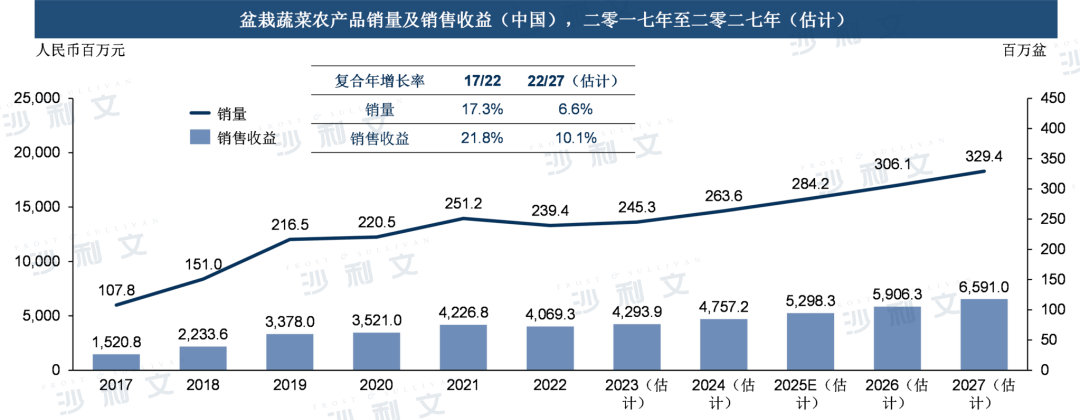
Data source: Analysis by Frost & Sullivan
As one of China's major vegetable-producing provinces, Shandong Province has a long history of vegetable cultivation and a large area of greenhouse cultivation, providing a foundation for the development of potted vegetable agricultural products. With the continuous increase in disposable income and population growth in Shandong Province, the sales volume of potted vegetable agricultural products in the province has2017year23.7One million pots increased to2022year48.5One million pots, with a compound annual growth rate of about15.4%At the same time, the sales revenue of potted vegetable agricultural products was RMB322.2One million yuan has been increased to RMB773.6One million yuan, with a compound annual growth rate of about19.1%.
In the future, sales revenue may maintain a compound annual growth rate of approximately7.3%The growth trend, towards2027Seven years to reach Renminbi1,102.2One million yuan. At the same time, the sales revenue of potted vegetable agricultural products is expected to be2027Annual achievement61.6One million pots,2022Year-end2027The compound annual growth rate for the year is about4.9%.

Data source: Analysis by Frost & Sullivan
Qingdao is one of the most economically developed cities in Shandong Province, with a high urbanization rate and relatively high resident income. As a result, people dine out more frequently and have an increasing demand for high-quality vegetables. The sales revenue of Qingdao potted vegetable agricultural products2017Renminbi in [year]54.2One million yuan increased to2022Renminbi in [year]144.5One million yuan, with a compound annual growth rate of about21.7%.
With the continuous development of Qingdao's economy, the sales revenue of potted vegetable products is expected to grow at a compound annual rate of about8.0%Continuous growth, towards2027RMB reached212.4One million yuan.
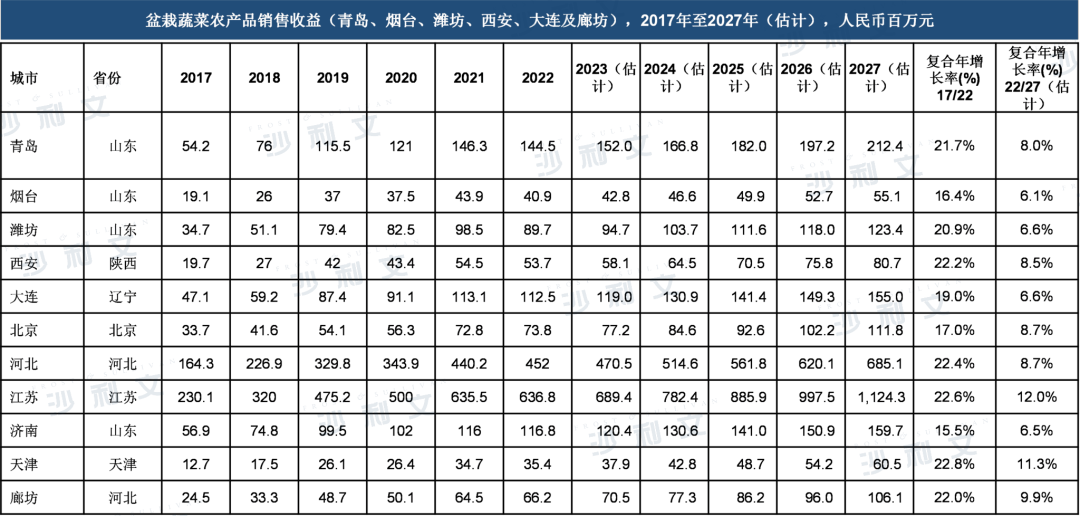
Data source: Analysis by Frost & Sullivan
Competitive landscape of the Shandong potted vegetable agricultural product market
Yu2022In [year], the total sales revenue of the potted vegetable agricultural product market in Shandong Province was RMB773.6One million yuan.2022In Shandong Province, there are500Multiple potted vegetable producers. Yu2022In [year], the potted vegetable agricultural product market in Shandong Province is relatively fragmented. In terms of sales revenue, the top five participants accounted for the total market share of Shandong Province's potted vegetable agricultural product market:16.8%Yu2022In [year], Fosun China's sales revenue was RMB114.5One million yuan, accounting for the total sales revenue of potted vegetable producers in Shandong Province14.8%.
It is pointed out that2022In [year], the average selling price of FJ China was within the range of selling prices of industry participants.2022In [year], Fujing China's revenue from selling potted vegetables and agricultural products was approximately [X]% of that of Shandong Province's second-largest potted vegetable producer.14.5times. press2022In terms of sales revenue in Shandong Province in [year], Fujing China is the largest potted vegetable agricultural product producer in Shandong Province, with a market share of14.8%It is one of the few potted vegetable producers in Shandong Province that have taken the lead in starting large-scale production of potted vegetable products.

Source: Frost & Sullivan analysis
China's potted vegetable agricultural product market
Key market drivers
·Urbanization and the continuous improvement of income levels
With the continuous urbanization and improvement of income levels, more and more people are beginning to pay attention to their personal health and are seeking measures to maintain it. The consumption of potted vegetable products among Chinese residents has increased, making them a cost-effective way to obtain high-quality fresh vegetables in cities, thus leading to an increase in the demand for potted vegetable products in China.
·The frequency of dining out is increasing
With the upward trend of consumption upgrading, consumers are more willing to dine out, increasing their spending on dining out to improve food quality. Potted vegetables and agricultural products are highly favored by restaurants for their freshness, quality, and safety. Therefore, the frequency of dining out in China is continuously increasing, which has promoted the demand for potted vegetables and agricultural products from restaurants.
·Pay attention to food safety
With people's desire for a higher standard of living and an improvement in sub-healthy conditions, the Chinese people have begun to pay more attention to personal health issues and consume healthier foods. As a result, potted vegetable products are gradually becoming more popular among the Chinese population.
·The aging population continues to grow
China has entered an aging society.65The proportion of the population over the age of [X] continues to rise. Due to the elderly's preference for fresh and healthy foods such as vegetables, it is expected that the elderly will become the main consumer group for vegetable agricultural products and potted vegetable agricultural products in China.
·Online distribution channels continue to expand
As more and more families (especially young people) order products through online distribution channels, vegetable and potted vegetable producers have expanded their distribution channels, extending from traditional wholesalers and retailers to online platforms such as Taobao and WeChat.




