


The global PON market demand will continue to rise
Against the backdrop of accelerating digital transformation, consumers' demand for high-bandwidth applications such as HD video and cloud gaming has surged. Vertical industry enterprises have stringent requirements for network response speed and stability in cutting-edge fields like intelligent office and industrial internet, driving continuous upward demand for bandwidth. Most countries are vigorously promoting the construction of FTTX infrastructure to layout the digital economy, with the process accelerating continuously. Governments of various countries have also introduced special subsidies, tax incentives, and other industrial support policies. According to Frost & Sullivan data, the global PON market demand will continue to rise, with the global PON device market demand expected to reach $6.21 billion in 2024 and further increase to $8.13 billion by 2028, showing a good growth trend and broad prospects.
Global PON device market demand forecast (in billions of US dollars) from 2024 to 2028
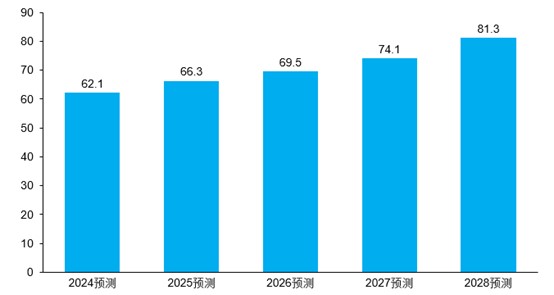
Data source: Frost & Sullivan
The WLAN market is gradually transitioning to Wi-Fi 7 technology
Currently, with the rapid popularization of data-intensive applications such as video conferencing, online gaming, virtual reality (VR), and augmented reality (AR), the demand for faster and more reliable wireless connections in enterprise and home environments continues to grow. Against this backdrop, the WLAN market is gradually transitioning from current Wi-Fi 6/6E to Wi-Fi 7 (IEEE 802.11be). Wi-Fi 7 not only provides higher data transmission rates, lower latency, and better spectrum efficiency but also has enhanced multi-user performance, supporting higher-density device access. This enables it to better meet the needs of application scenarios such as 8K ultra-high-definition video streams, multi-user VR/AR, cloud gaming, and high-density IoT. As this technology matures gradually, Wi-Fi 7 will become an important driving force for future wireless network upgrades, further enhancing user experience and laying a solid technical foundation for the widespread application of digitalization and intelligence.
In addition, application scenarios such as large residential buildings and campus offices have an increasing demand for network coverage and signal stability. MESH networking, with its wide coverage, more stable signals, scalability, and high-bandwidth support, has become one of the ideal network solutions. With the continuous growth in the number of IoT devices and the increasing demand for network security, Wi-Fi 7 technology shows greater potential in these areas. It can not only improve transmission speed and reduce network latency but also enhance network stability, coverage range, and support for more concurrent device connections. At the same time, Wi-Fi 7 has stronger network security and will further promote the large-scale deployment of MESH network solutions adapted to Wi-Fi 7. According to Frost & Sullivan data, the global Wi-Fi 7 market size is expected to exceed $10 billion by 2028.




