



Marwynn Holdings, Inc. (Stock Code: Nasdaq: MWYN) successfully listed on the US NASDAQ on March 13, 2025. The group is a company that specializes in providing supply chain solutions for food, non-alcoholic beverages, and interior home decoration products, connecting businesses between different regions, especially between Asia and the United States. Frost & Sullivan (hereinafter referred to as 'Frost & Sullivan') provides exclusive industry advisory services for the listing of Marwynn Holdings, Inc., and hereby warmly congratulates them on their successful listing.
Marwynn Holdings, Inc. (hereinafter referred to as 'Marwynn') successfully went public on March 13, 2025, issuing 2 million shares at a price of $4 per share, raising $8 million.
During the process of listing in the US, Frost & Sullivan mainly undertook the following tasks: helping the issuer accurately and objectively understand its positioning in the target market, using objective market data to discover, support, and highlight the issuer's competitive advantages, assisting the issuer, investment banks, and other intermediaries in completing the writing of relevant parts of the prospectus (such as the overview, competitive advantages and strategy, industry overview, business, and other important sections), helping the issuer communicate with the SEC and investors, assisting investors in quickly understanding the market ecosystem and competitive landscape, and providing feedback on various industry-related issues from regulatory authorities to the issuer.
PART/1
Business Overview of Food, Non-Alcoholic Beverages and Interior Home Decoration Product Supply Chain Solutions
Definition and Classification
The supply chain and brand management solution aims to optimize and simplify the entire process of products from source to consumer, divided into the following three major areas:
(i) Supply Chain Management: It aims to improve the efficiency of goods circulation between suppliers and consumers. The service scope includes procurement negotiations, demand forecasting, supplier relationship management, and distribution strategies;
(II) Brand Management: Focused on enhancing brand awareness, expanding market share, and increasing customer loyalty. The service scope includes helping brands enter the mass market, discovering new business opportunities, assisting with new product launches, and reducing promotion costs through brand collaborations;
(III) Supply Chain Finance: By collaborating with third-party financial institutions or financing suppliers, it ensures smooth capital flow throughout the entire supply chain.
market scale
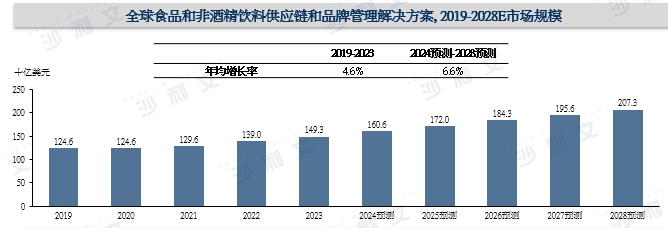
The global market for supply chain and brand management solutions for food and non-alcoholic beverages has been steadily growing in recent years, attributed to increasingly complex supply chains, increased demand for efficiency and transparency, and the importance of brand differentiation in competitive markets. Between 2019 and 2023, the market revenue generated by companies providing supply chain management, brand management, and supply chain finance solutions for the packaged food and non-alcoholic beverage industries increased from $124.6 billion to $149.3 billion, with an annual compound growth rate of about 4.6%. In the long run, the market is expected to reach $207.3 billion by 2028, with an annual compound growth rate of 6.6% from 2024 to 2028. This is mainly driven by the continuous evolution of consumer preferences, increased use of data analytics and artificial intelligence in supply chain optimization, and the growing importance of brand authenticity and customer engagement.
Source: Frost & Sullivan report
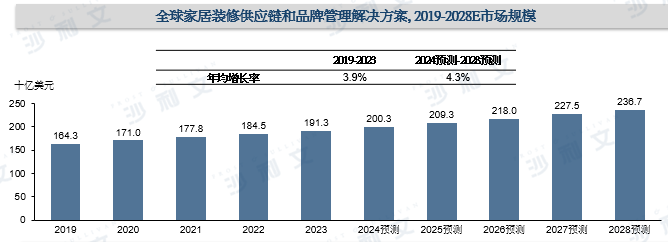
The global home improvement supply chain and brand management solutions market grew from $164.3 billion in 2019 to $191.3 billion in 2023. As consumers increasingly value energy-efficient and luxurious living spaces, the development of the home improvement industry has significantly driven market growth. In addition, rapid urbanization and government-provided green building incentives and tax relief policies have further promoted market expansion. At the same time, the popularization of e-commerce and the availability of technologically advanced system upgrade solutions will drive global home improvement demand, further increasing the demand for home improvement supply chain and brand management solutions. It is expected that the market size will grow at a compound annual growth rate of 4.3%, reaching $236.7 billion by 2028.
Source: Frost & Sullivan report
Market Drivers and Opportunities
●Remarkable growth in US consumer purchasing power
The significant growth in consumer purchasing power in the United States is driving demand for more diversified and innovative food and beverage products. Between 2019 and 2023, U.S. food and alcohol consumption expenditures increased from $2.14 trillion to $2.92 trillion, with an annual compound growth rate of about 8.0%. In addition, imports of food and beverages in the United States also increased from $140.4 billion to $189.2 billion, with an annual compound growth rate of about 7.7%. As the U.S. economy continues to recover and grow, more consumers, especially Millennials, Gen Z, and wealthy minority groups such as Asian Americans, are willing to spend more on high-quality, value-aligned, and preferred-end food and beverage products. Riding on this trend, businesses must develop precise marketing and brand strategies, optimize operations, and collaborate with food and beverage supply chain and brand management solution providers to ensure that they purchase the best raw materials to meet market demand.
● Globalization and growing trade between the United States and countries in the Asia-Pacific region
Globalization, along with the growing trade between the United States and countries in the Asia-Pacific region, has become an important market driver for the food and beverage industry. It creates new opportunities for companies to expand their procurement and distribution networks and meet the growing demand for authentic and high-quality Asian products. From 2019 to 2023, imports from Asia-Pacific economies of cooperation (APEC) countries by the United States increased from $1706.6 billion to $2085.6 billion, with an annual compound growth rate of about 5.1% during this period. Food and beverage companies that can effectively address the complexities of international trade and logistics and make full use of the expertise of supply chain and brand management solution providers will be better able to seize the business opportunities brought about by this trend.
● The growing demand of the food and beverage industry for third-party service providers to manage product brands
The growing demand for third-party service providers to manage brand portfolios in the food and beverage industry has become an important market driver. Suppliers are increasingly realizing the value of outsourcing this critical function to professional institutions. These service providers can offer a variety of brand management solutions, including market research, strategy development, creative design, and digital marketing, helping food and beverage companies focus on their core business while achieving brand goals. By leveraging the expertise and resources of these service providers, food suppliers can acquire cutting-edge technology, data-driven insights, and best practices within the industry, thereby maintaining market competitiveness and quickly responding to the ever-changing market environment. With the continuous evolution and increasing complexity of the food and beverage industry, the demand for third-party brand management services is expected to continue growing.
● The demand for localization and specialization of supply chain management services is constantly increasing
Home improvement supply chain management solution providers are continuously applying new marketing strategies across various distribution channels to expand coverage, improve conversion rates, and promote repeat purchases among consumers. These suppliers leverage their industry expertise and network relationships to address the complexity of the supply chain and provide specialized services or value-added activities that manufacturers or retailers may not be able to handle internally. In the future, specialized supply chain management solution providers will continue to innovate and adjust their services based on diverse distribution channels and local market demands. In addition, these solution providers have a deep understanding and connection with local markets, enabling them to better comprehend customer preferences and market trends. They can use this local insight to purchase and provide specialized products that meet the specific needs of regional customers, thereby further enhancing market competitiveness.
competitive landscape
The global food and beverage supply chain and brand management solutions market is relatively fragmented and competitive, mainly due to regional differences in business coverage, as well as the diverse services provided by market participants in areas such as procurement, logistics and transportation, warehousing and inventory management, transportation distribution, and brand operations. The competition in the global food supply chain services and brand marketing services market is fierce. Companies strive to meet consumers' demand for high-quality, safe, and healthy food through continuous innovation and service optimization. Market participants mainly include the following categories:
(i) Regional or global food distributors: These distributors are familiar with local consumer behavior and dietary cultures and can provide products that suit local tastes according to customer preferences. Multinational companies have successfully integrated global resources and achieved full-chain management, including basic raw material procurement, production processing, and product sales. They usually maintain stable sales networks and suppliers in major markets or regions;
(II) Comprehensive Technology and Solution Providers: Mainly provide technical solutions and support to help implement integrated food supply chain solutions;
(III) Solution providers focusing on niche services: such as cold chain logistics solutions or brand marketing services.
entry barriers
●Stable relationship with suppliers
In this industry, companies with a good reputation and successful experience are more favored. Specifically, mature companies usually have a stable customer network, long-term cooperative relationships, and a lower customer churn rate. For newcomers, building brand trust requires time and resource investment, making it more of a market entry barrier to establish stable and reliable supply channels and customer relationships in the short term.
● Capital investment
Entering the global food supply chain and management solutions market requires substantial capital investment, including the construction and maintenance of logistics infrastructure, the procurement or development of advanced supply chain management software, the development of mobile applications, and the training of professionals. In addition, due to the complexity of the food supply chain, enterprises also need to invest in quality control, inventory management, and risk assessment systems to maintain the stability and reliability of the supply chain. These necessary capital requirements pose a huge financial challenge for new entrants.
●Experience and Professional Knowledge
The management of the food supply chain requires a comprehensive understanding of the industry, including the processes of food production, processing, storage, and transportation, as well as food safety regulations, quality standards, and sustainable practices. In addition, companies must be able to cope with challenges in the supply chain, such as demand and price fluctuations, as well as potential disruptions. To establish efficient supply chain management solutions, new entrants need to accumulate relevant knowledge and experience. Therefore, companies need to bear relatively high recruitment and training costs, whether through internal experts or third-party employee training programs. The initial recruitment and training costs of professional talents become a major obstacle for new entrants.
Click at the end of the articleRead the original textView the full prospectus
Frost & Sullivan has extensive research experience in the consumer industry and has assisted many well-known enterprises in successfully listing on the capital market. Successful listings include: Shubao International (2569.HK), Newman's (2530.HK), Grassroots Group (2593.HK), Mao Ge Ping (1318.HK), Mengjin Yuan (2585.HK), Laopu Gold (6181.HK), Fujing China (2497.HK), Yan's House (1497.HK), Daily Cook (NYSE:DDC), Youbao Online (2429.HK), Extraordinary Leading (0933.HK), Shanghai Shangmei (2145.HK), JuZi Biotech (2367.HK), China COSCO (1880.HK), Midea Group (9896.HK), Jiulongwang Food (1927.HK), Vesync (2148.HK), Blue Moon (6993.HK), Poplar Mart (9992.HK), Midea Group (NYSE:MNSO), Nongfu Spring (9633.HK), Fengxiang Food (9977.HK), China Feihai (6186.HK), Taobao Sports (6110.HK), China National Tobacco International (6055.HK), Youpin 360 (2360.HK), Wugu Flour Mill (1837.HK), Baby Tree (1761.HK), Deying Holdings (2250.HK), Bingshi International (1705.HK), Golden Cat and Silver Cat (1815.HK), Miming Lifestyle Department Store (8473.HK), Yiqing Food (1475.HK), Debao Group (8436.HK), Seiko China (NASDAQ:SECO), Barbie (8297.HK), Asia Grocery (8413.HK), Chowking Duck (1458.HK), COFCO Meat (1610.HK), Dali Foods (3799.HK), Vientiane International (0288.HK), Chow Tai Fook (1929.HK), Jumei Youpin (NYSE:JMEI), and others.
Recommended Reads (Swipe up and down to view more)
Frost & Sullivan helps Newman's S.A. successfully go public in Hong Kong (2530.HK)
Frost & Sullivan helps Maogoping successfully go public in Hong Kong (1318.HK)
Frost & Sullivan helps Mengjin Garden successfully go public in Hong Kong (2585.HK)
Frost & Sullivan helps the established brand Gold successfully go public in Hong Kong (6181.HK)
Frost & Sullivan assists Yanzhiwu in successfully listing on the Hong Kong Stock Exchange (1497.HK)
Frost & Sullivan helps Rizhao Dadi Cook successfully go public in the US (NYSE:DDC)
Frost & Sullivan assists Vesync in successfully listing on the Hong Kong Stock Exchange (2148.HK)
Frost & Sullivan assists Blue Moon in successfully listing on the Hong Kong Stock Exchange (6993.HK)
Frost & Sullivan helps Pop Mart successfully go public in Hong Kong (9992.HK)
Frost & Sullivan helps famous innovative products successfully go public in the US (NYSE:MNSO)
Frost & Sullivan helps China's Feihai succeed in listing on the Hong Kong Stock Exchange (6186.HK)
Frost & Sullivan helps Top Glove Sports S.A. successfully go public in Hong Kong (6110.HK)
Frost & Sullivan helps Youpin360 successfully go public in Hong Kong (2360.HK)
Frost & Sullivan helps Baby Tree successfully go public in Hong Kong (1761.HK)
Frost & Sullivan helps Golden Cat and Silver Cat successfully go public in Hong Kong (1815.HK)
Frost & Sullivan helps Nippon Sake & Foods Co., Ltd. successfully go public in Hong Kong (1475.HK)
*The above order is not sequential and is arranged in reverse chronological order based on listing time.




