



Intercont (Cayman) Limited (Stock Code: Nasdaq:NCT) successfully listed on the US NASDAQ on March 28, 2025. The group is a maritime company that operates its global maritime services through its shipping subsidiary, with revenue sources including time chartering and ship management services. Frost & Sullivan (Frost & Sullivan, abbreviated as 'Frost & Sullivan') provided exclusive industry advisory services for Intercont (Cayman) Limited's listing in the US, and we hereby warmly congratulate them on their successful listing.
Intercont (Cayman) Limited (hereinafter referred to as 'DWE Shipping') successfully listed on March 28, 2025, issuing 1.5 million shares at a price of $7, raising $10.5 million. Frost & Sullivan (Frost & Sullivan, abbreviated as 'Frost & Sullivan') provided exclusive industry advisory services for DWE Shipping's listing and hereby warmly congratulate them on their successful listing.
During this listing process in the US, Frost & Sullivan mainly undertook the following tasks: helping the issuer accurately and objectively understand its positioning in the target market, using objective market data to discover, support, and highlight the issuer's competitive advantages, assisting the issuer, investment banks, and other intermediaries in completing the writing of relevant parts of the prospectus (such as overview, competitive advantages and strategy, industry overview, business, and other important sections), helping the issuer communicate with the SEC and investors, assisting investors in quickly understanding the market ecosystem and competitive landscape, and assisting the issuer in completing feedback from regulatory authorities on various industry issues.
PART/1
Overview of the Maritime Industry
Definition and Classification
According to the Organization for Economic Co-operation and Development (OECD), maritime transportation refers to the transport of goods and/or passengers by sea using any sea vessel for the whole or part of the voyage. Transportation includes port transportation, that is, goods transported to sea facilities, or goods dumped at sea, or goods recovered from the seabed and unloaded at ports, as well as coastal freight transportation. The group is mainly engaged in providing maritime services such as shipping and ship management, with a focus on dry bulk carriers.
Market Size
The global trade volume of major dry bulk commodities (such as iron ore, coal, and grains) reached approximately 5.2301 million metric tons in 2018, after years of stable growth. However, the outbreak of the COVID-19 pandemic at the beginning of 2020 led to a contraction in dry bulk transportation and global trade volumes. Lockdowns and economic uncertainties caused the total global dry bulk vessel trade volume to decline by 2.0% year-on-year in 2020. The decline in demand for dry bulk vessel transport capacity affected related upstream and downstream industries that rely on raw materials and unfinished goods transportation. With the relaxation of logistics restrictions and the acceleration of infrastructure investment and construction activities in 2021, the total global dry bulk vessel trade volume rebounded strongly in 2021 and 2022. Overall, the total global dry bulk vessel trade volume grew at an average annual rate of approximately 0.5% from 2018 to 2022 and is expected to grow at an average annual rate of approximately 0.7% from 2023 to 2027.
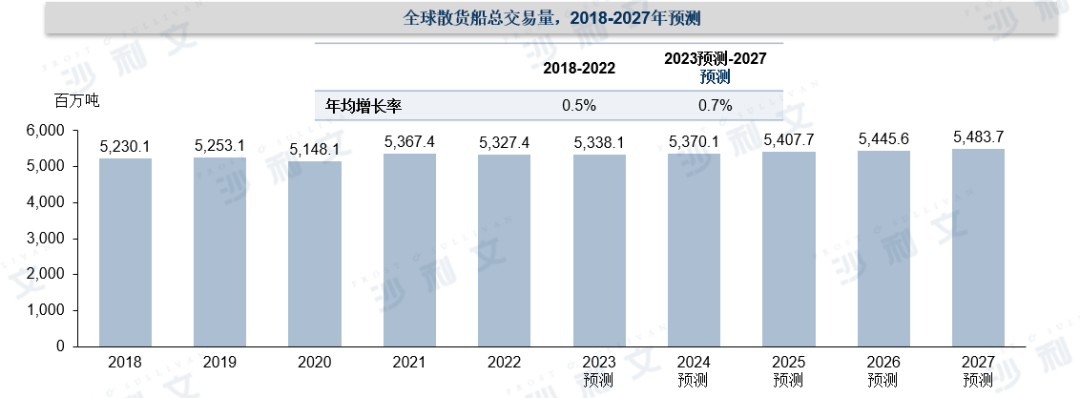
Source: Frost & Sullivan report
Market Drivers and Opportunities
● Economic Growth and Surge in Maritime Trade Demand
Economic growth and globalization are the main drivers of maritime demand, with the expansion of the world economy leading to an increasing volume of international trade. More raw materials, parts, and finished goods need to be transported long distances by sea to support global supply chains. Globalization and trade liberalization enable countries to specialize and participate in more cross-border manufacturing supply chains. In addition, the outbreak of the COVID-19 pandemic has demonstrated the interdependence of the global economy because supply chain bottlenecks for goods, semi-finished products, and consumer goods have quickly spread globally. Although maritime volume declined during the lockdowns at the beginning of 2020, transportation demand showed resilience and rebounded strongly during the economic recovery in 2021 and 2022, with both container shipping, dry bulk carriers, and general cargo transportation experiencing prosperity in these two years.
● Global Energy Demand
Major energy commodities such as crude oil, petroleum products, liquefied natural gas (LNG), and coal rely heavily on general cargo ships for long-distance maritime transportation, and the global demand for fossil fuel energy is the main factor driving the demand for general cargo ships. The LNG transportation market is also expanding rapidly, and it is expected that LNG trade will continue to grow. The continuous growth in fossil fuel trade volume will mean an increase in demand for general cargo ships specialized in transporting these energy commodities—whether it is large oil tankers and dry bulk carriers or smaller product tankers and multi-purpose ships. Energy trends will continue to affect maritime trade flows and general cargo transportation demand.
● Accelerating Port Infrastructure Development
Investments in port infrastructure, multimodal networks, and distribution facilities help promote trade growth and provide opportunities for general cargo transportation. Upgrades such as new dry bulk terminals, berths, and storage facilities enable ports to handle a variety of goods more efficiently, from project equipment to steel coils. Related projects are directly beneficial to general cargo transportation activities, allowing general cargo ships to load and unload goods quickly. Investments in road and rail connections also help shippers transport heavy or oddly shaped dry goods by land to ports. Therefore, infrastructure development will continue to promote related demand in the global maritime market, especially for multi-purpose ships, roll-on/roll-off ships, and other general cargo ships that provide import and export transportation solutions for goods not suitable for containers.
● Technological Progress in Ship and Ocean Transportation
Technological improvements in cargo loading and unloading, ship design, and operation enable general cargo ships to transport dry goods more efficiently. New multi-purpose ships are equipped with modern hydraulic cranes and ramps, which can quickly load a variety of goods, and the middle deck provides more space for oversized project goods. Roll-on technology advancements allow vehicles, machinery, and other roll-on goods to be loaded and unloaded faster. General cargo ships are also adopting automation, connectivity, and digitization technologies to optimize navigation, cargo stacking, and fleet management, combined with electronic data interchange and GPS tracking technologies to provide shippers with better visibility of goods. Overall, technological innovation enables general cargo ships to provide higher carrying capacity, flexibility, reliability, and visibility to transport dry goods. With the continuous growth of global dry goods such as steel, forestry products, and heavy equipment, technological improvements help general cargo fleets meet this growing demand through faster turnover and more efficient transportation.
Competitive Landscape
The ship leasing industry is relatively fragmented globally. As of the end of 2022, there were approximately 450 ship leasing companies providing a variety of ship leasing services worldwide. Most of the leased ships are dry bulk carriers, container ships, and oil tankers. In terms of market participants, bank-type leasing companies, supported by their parent companies and with more financing channels, can better meet their huge capital needs. Therefore, bank-type leasing companies have long dominated the global ship leasing market with their capital advantages. On the other hand, non-bank ship leasing companies, including those supported by suppliers, usually have professional knowledge, industry resources, and market brand advantages, enabling them to closely monitor market changes, dynamically adjust the ship deployment ratio, and optimize the ship portfolio.
In 2022, there were approximately 150 companies in the global non-bank ship leasing service industry. Among them, China Shipping (Hong Kong) Holdings Limited ranked first in terms of revenue, with a market share of 6.1%. COSCO Shipping & Logistics Holdings Limited ranked second, with a market share of about 5.3%. In 2022, AirAsia International Leasing Limited ranked third, with a market share of about 2.9%. The top three non-bank ship leasing companies globally are all located in China, accounting for a total revenue market share of 14.3% in the overall global ship leasing market.
Barriers to Entry
● Capital Investment
Establishing a shipping business requires a large amount of capital investment, which makes it essentially capital-intensive. Due to the high costs of acquiring ships, operating expenses, infrastructure requirements, compliance regulations, and competing with established enterprises enjoying economies of scale, capital investment has become a barrier to entry in the shipping market.
● Economies of Scale
Mature and larger shipping companies use their large operating scale to gain competitive advantages, enhance bargaining power with suppliers, and achieve cost synergies. This enables them to provide comprehensive value-added services to customers in various industries. Therefore, economies of scale pose a significant challenge to new entrants with limited operating scale and narrow product and service ranges.
● Market Knowledge and Experience
With the growing demand for diversified shipping services and increasingly strict environmental regulations, customers tend to choose shipping companies with rich industry knowledge and experience. Market knowledge becomes an entry barrier in the shipping industry because compliance, dealing with complex logistics, managing risks, building networks, and keeping up with market dynamics require professional knowledge and understanding. Established enterprises with industry experience and market knowledge enjoy competitive advantages, making it difficult for new entrants to quickly gain a foothold in the market.
● Performance Record and Stable Business Relationships
Mature and reputable shipping companies usually establish stable customer relationships and have extensive shipping networks covering a wide geographical area. In contrast, new entrants lacking proven performance face significant challenges competing with established market participants. The high costs and effort required for customers to change shipping service providers become obstacles for new entrants. In addition, it may be difficult for new entrants to build connections within the industry, making them face challenges in establishing relationships with customers and suppliers. The reputation, trust, customer base, supplier network, industry expertise, and financial stability enjoyed by established enterprises further enhance their competitive advantages.
Click on the end of the articleRead the original articleView the complete prospectus
Frost & Sullivan has rich research experience in the logistics and transportation industries, assisting well-known enterprises to successfully list on the capital market. Successful listing cases include: Hui Ge Environmental Protection (2613.HK), Pan Yuan International (2516.HK), Jitu Express (1519.HK), Le Can Logistics (2490.HK), Jia Yuda (NASDAQ:JYD), CBL (NASDAQ:BANL), InterContin (2409.HK), Deyin Tianxia (2418.HK), Kuai Gou Taxi (2246.HK), Cangang Railway (2169.HK), Yanguang Mingzhu (YGMZ.NASDAQ), Asia Express (8620.HK), InfinityL&T (1442.HK), Xiangxing International (8157.HK), CSSC Leasing (3877.HK), Chengdu Expressway (1785.HK), Huazhi International (2258.HK), Wanlida (8482.HK), Qilu Expressway (1576.HK), Asia Industry (1737.HK), Jun Gao Holdings (8035.HK).
Recommended Reading
Frost & Sullivan helps Pan Yuan International successfully list in Hong Kong (2516.HK)
Frost & Sullivan helps Jitu Express successfully list in Hong Kong (1519.HK)
Frost & Sullivan helps Le Can Logistics successfully list in Hong Kong (2490.HK)
Frost & Sullivan helps Jia Yuda successfully list in the US (NASDAQ:JYD)
Frost & Sullivan helps CBL successfully list in the US (NASDAQ:BANL)
Frost & Sullivan helps InterContin successfully list in Hong Kong (2409.HK)
Frost & Sullivan helps Deyin Tianxia successfully list in Hong Kong (2418.HK)
Frost & Sullivan helps Kuai Gou Taxi successfully list in Hong Kong (2246.HK)
Frost & Sullivan helps Cangang Railway successfully list in Hong Kong (2169.HK)
Frost & Sullivan helps Yanguang Mingzhu successfully list in the US (YGMZ.NASDAQ)
Frost & Sullivan helps Asia Express successfully list in Hong Kong (8620.HK)
Frost & Sullivan helps Infinity successfully list in Hong Kong (1442.HK)
Frost & Sullivan helps Xiangxing International successfully list in Hong Kong (1732.HK)
Frost & Sullivan helps CSSC Leasing successfully list in Hong Kong (3877.HK)
Frost & Sullivan helps Chengdu Expressway successfully list in Hong Kong (1785.HK)
Frost & Sullivan helps Huazhi International successfully list in Hong Kong (2258.HK)
Frost & Sullivan helps Wanlida successfully list in Hong Kong (8482.HK)
Frost & Sullivan helps Qilu Expressway successfully list in Hong Kong (1576.HK)
Frost & Sullivan helps Innocean Technology successfully list in Hong Kong (1760.HK)
Frost & Sullivan helps Asia Industry successfully list in Hong Kong (1737.HK)
Frost & Sullivan helps Jun Gao Holdings successfully list in Hong Kong (8035.HK)
*The above order is not in any particular sequence and is arranged in reverse order of listing time




