



Pleasure Group Holdings Limited (Stock Code: 2486.HK) successfully listed on the main board of the Hong Kong capital market on May 11, 2023. The company is a well-known provider of sales and marketing services, focusing on offering field sales and marketing solutions for leading FMCG (Fast Moving Consumer Goods) brands and distributors operating offline retail stores (such as supermarkets, department stores, outdoor promotional activities, etc.). Frost & Sullivan (Frost & Sullivan, hereinafter referred to as 'Frost & Sullivan') provides exclusive industry advisory services for the listing of Pleasure Group Holdings Limited, and hereby warmly congratulates them on their successful listing.
Pleasure Group Holdings Limited (hereinafter referred to as 'Pleasure') successfully listed on May 11, 2023. The company issued a total of 2,500 million H shares globally, of which 90% were international offerings and 10% were public offerings, with an additional 15% being underwritten options. The issue price per share was HK$10.6, and the net proceeds raised were approximately HK$212 million (assuming that the underwritten options were not exercised).
During the Hong Kong listing process, Frost & Sullivan mainly undertook the following tasks: helping the issuer accurately and objectively understand its positioning in the target market, using objective market data to discover, support, and highlight the issuer's competitive advantages, assisting the issuer, investment banks, and other intermediaries in completing relevant parts of the prospectus (such as overview, competitive advantages and strategy, industry overview, business, and other important chapters), helping the issuer communicate with the Hong Kong Stock Exchange and investors, assisting investors in quickly understanding the market ecosystem and competitive landscape, and assisting the issuer in completing feedback on various industry-related issues from the Hong Kong Stock Exchange, etc.
Investment highlights
The company is a well-known sales and marketing service provider in China;
The company's business model can generate strong network effects and synergies;
The company's FMES platform can empower data-centric operations;
The company has a large-scale and diversified marketing team;
The company has a high-quality customer base with expansion potential;
The company has an experienced and insightful management team.
According to a report by Frost & Sullivan:
The market for SaaS in China is expected to continue growing at a compound annual growth rate of 31.3%.
Overview of China's Retail Market
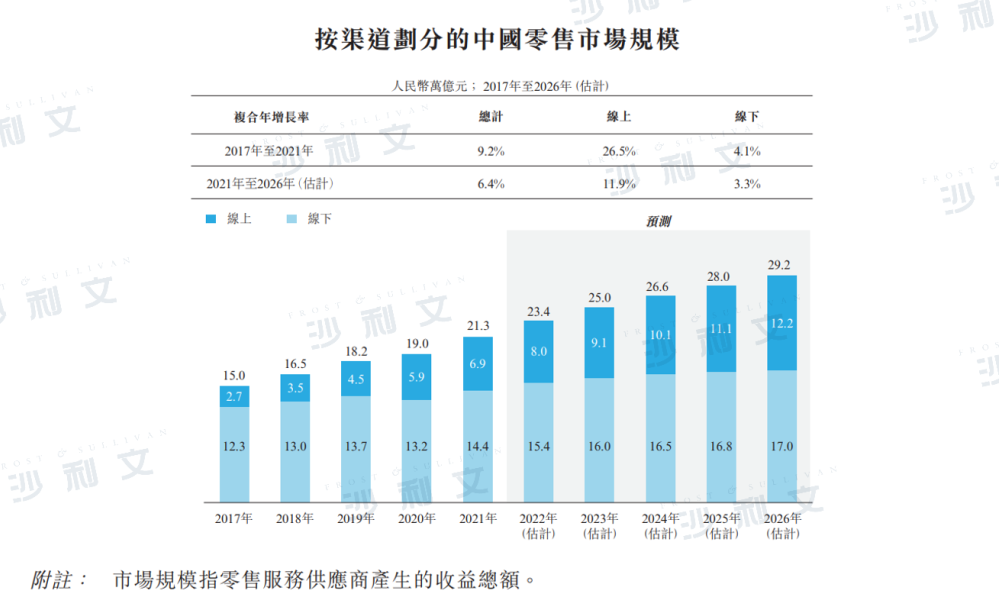
According to the Frost & Sullivan report, China's retail market can be divided into online and offline channels. With the rapid development of internet infrastructure and e-commerce economy, online channels have grown at a high speed in the overall market, increasing rapidly by 26.5% annually from 2017 to 2021, from 2.7 trillion yuan to 6.9 trillion yuan. Offline channels account for the vast majority of the market, increasing from 12.3 trillion yuan in December 2017 to 14.4 trillion yuan in 2021, with an annual compound growth rate of 4.1%. As the cost of acquiring and retaining customers for online channels increases, offline channels can offer a deeper consumer experience. It is expected that the offline retail market will still be larger than the online retail market, reaching 17.0 trillion yuan by 2026, with an annual compound growth rate of 3.3% from 2021 to 2026. The online retail market is expected to grow to 12.2 trillion yuan by 2026, with an annual compound growth rate of 11.9% during the same period.
The following chart shows the past and forecasted market sizes of China's retail market by channel, measured in revenue, from 2017 to 2026:
Source: Frost & Sullivan report
Overview of China's Retail Support Service Market
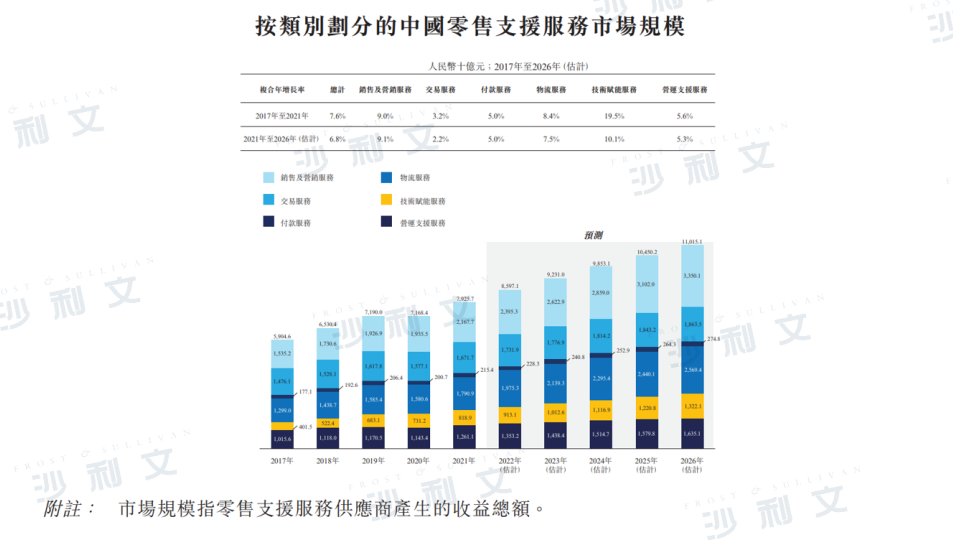
According to a Frost & Sullivan report, the scale of China's retail support service market increased from 5.9 trillion yuan in 2017 to 7.9 trillion yuan in 2021, with a compound annual growth rate of 7.6% over the past five years. The decline in the market in 2020 was largely offset by the continuous growth of the sales and marketing service, as well as technology-enabled services markets. From 2021 to 2026, it is expected that the scale of the retail support service market will grow at a compound annual rate of 6.8% to reach 11.0 trillion yuan over the next five years. Among them, the sales and marketing service segment accounts for more than 50% of the retail support service market and achieved a stable compound annual growth rate of 9.0% from 2017 to 2021.
The following chart shows the past and forecast market sizes of China's retail support service providers by category, based on revenue from 2017 to 2026:
Source: Frost & Sullivan report
Overview of China's Retail Sales and Marketing Services Market
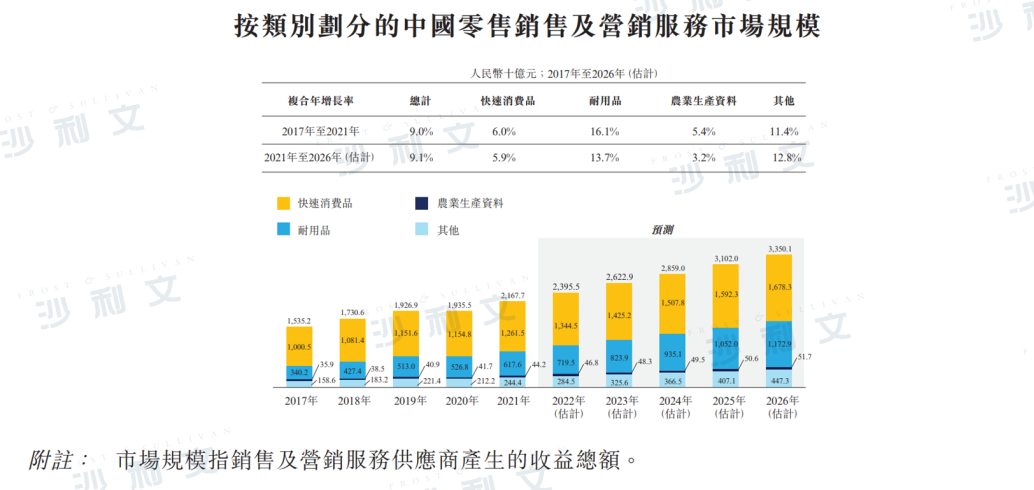
Consistent with the retail industry, the retail sales and marketing services market can be divided into fast-moving consumer goods (FMCG), durable goods, agricultural production materials, and other sectors. Among the various sectors of the retail sales and marketing services market, the FMCG industry has the largest market share, accounting for about 58.2% in 2021. Between 2017 and 2021, the scale of the FMCG retail sales and marketing services market increased from about 1,000.5 billion RMB to about 1,261.5 billion RMB, with an annual compound growth rate of 6.0% during this period.
The competition in retail sales and marketing services is fierce, especially in the fast-moving consumer goods category. This is due to the continuous strong growth of fast-moving consumer goods over the past few years, which has attracted many sales and marketing service providers to develop service portfolios and strategies for them. The durable goods market size achieved the highest annual compound growth rate of about 16.1% during the same period, increasing from approximately RMB 340.2 billion in 2017 to approximately RMB 617.6 billion in 2021.
Undoubtedly, the pandemic has had a significant negative impact on offline activities in 2020. As a result, some retail sales and marketing service providers have accelerated their digitalization process and strengthened the connection between online and offline sales and marketing services. With the recovery of retail and offline commerce in the coming years, it is expected that sales and marketing service providers will have greater growth potential. In terms of the consumer goods product segment, it is estimated that it will reach approximately RMB 1.6783 trillion by 2026, with a stable annual compound growth rate of 5.9%.
The following chart shows the past and forecasted market sizes of retail sales and marketing service providers in China by revenue, categorized by product category from 2017 to 2026:
Source: Frost & Sullivan report
China's fast-moving consumer goods retail
salesOverview of Marketing Services Market
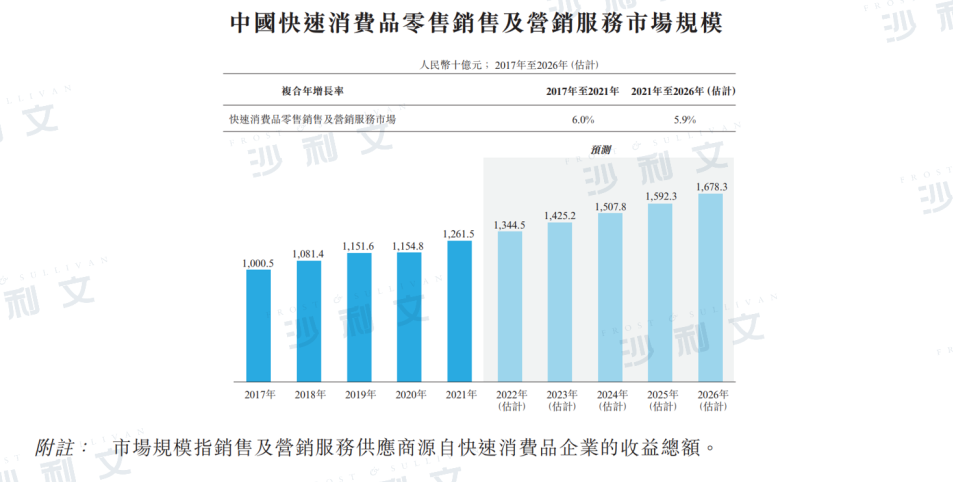
Due to the complex nature of the fast-moving consumer goods business, which involves a variety of channels and extensive transaction scenarios (including online and offline), as well as the high consumption and purchase frequency of fast-moving consumer goods, companies typically rely on sales and marketing service providers to assist them in daily contact and interaction with target consumers. With the prevalence of digital transformation in recent years, the market size of retail sales and marketing services for fast-moving consumer goods has increased from about 1,000.5 billion yuan in 2017 to about 1,261.5 billion yuan in 2021, with an annual compound growth rate of 6.0% during this period. Further driven by the rise of domestic fast-moving consumer brands through various channels and consumer groups, the retail sales and marketing services market in China is expected to have great growth potential in the future.
Currently, as the cost of selecting online channels for sales and marketing services continues to rise, it is expected that in the future, technology will continue to attract brand owners and distributors to strengthen their cooperation with offline sales and marketing service providers. In this customer-centric era, brand owners and distributors are expected to integrate online and offline channels to develop a new landscape. Therefore, it is estimated that by 2026, the overall market will reach approximately 1.6783 trillion RMB, with an annual compound growth rate of 5.9% from 2021 to 2026.
The following figure shows the past and forecast market sizes of China's fast-moving consumer goods retail sales and marketing service providers by revenue from 2017 to 2026:
Source: Frost & Sullivan report
Overview of China's SaaS Market
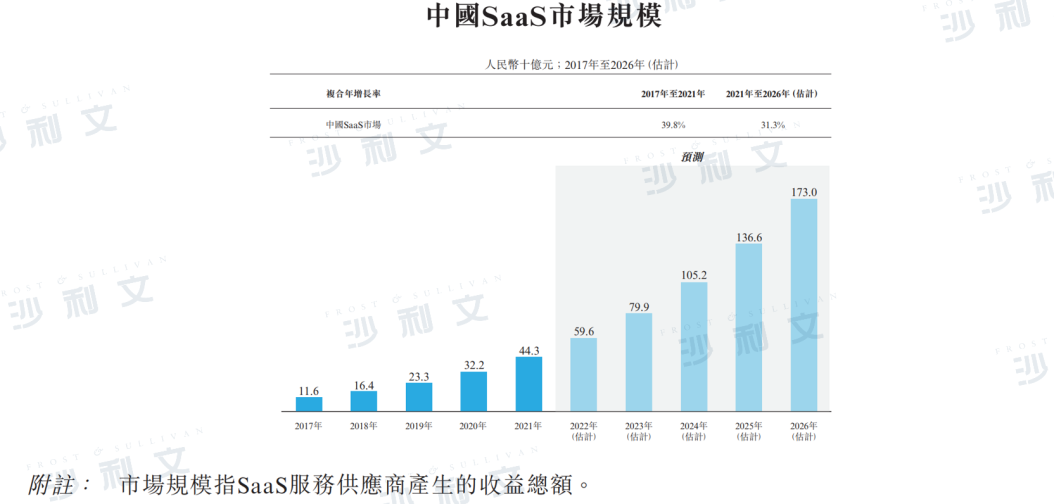
Driven by strong government policies, the construction of infrastructure has significantly improved the performance of SaaS products. Moreover, affected by the pandemic, more enterprises have begun to actively adopt this software delivery model due to recognition of the cost-saving and profit-enhancing benefits brought by SaaS products. According to a Frost & Sullivan report, from 2017 to 2021, the market size of SaaS in China grew from 11.6 billion yuan to 44.3 billion yuan, with an annual compound growth rate of 39.8%. As market competition intensifies, more and more small and medium-sized enterprises will adopt SaaS products due to their light asset and easy-to-use characteristics.
Through SaaS products, brand owners and distributors can better track and comprehensively analyze consumer and business information at lower costs, thereby organizing marketing campaigns that can increase traffic and retain consumers. With the continuous development of related technology advancements, it is expected to gain an even greater advantage over traditional companies, as the prices and features of SaaS products become more affordable, which is crucial for the development of their businesses. Therefore, until 2026, the overall market size is expected to grow at an annual compound rate of 31.3% to reach RMB 173 billion.
The following chart shows the past and forecasted market sizes of Chinese SaaS providers by revenue from 2017 to 2026:
Source: Frost & Sullivan report
Overview of Retail Markets in Major Economies of Japan and Southeast Asia
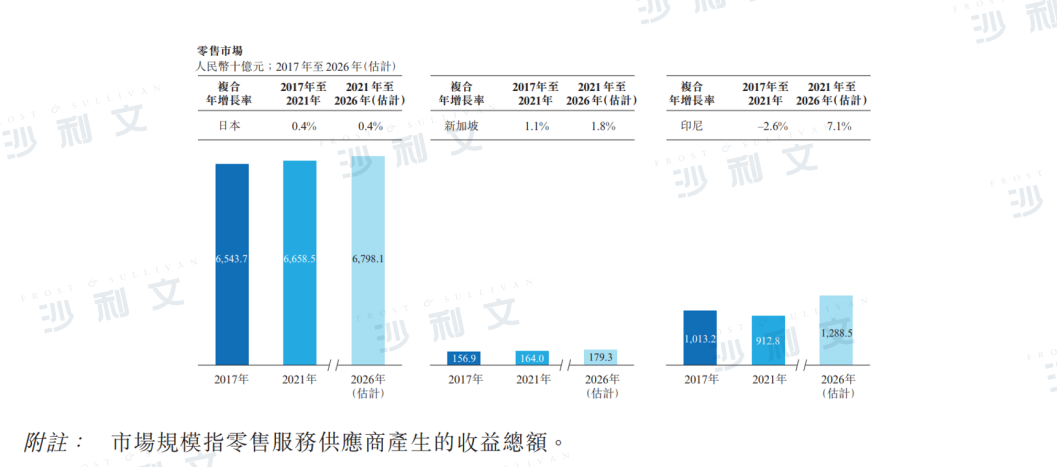
In addition to China, the stable growth of retail markets in Japan and Singapore has, to a certain extent, driven the development of the Asian retail market. Considering the strong economic momentum, large population size, and stable political environment, retail market expectations in the aforementioned countries are expected to continue growing, which can also drive the development of the retail support service market, bringing opportunities for retail brand owners and retailers' support service providers.
Due to the relatively mature markets in Singapore and Japan, it is expected that the market sizes of these two countries will increase from approximately RMB 164 billion and RMB 6.7 trillion in 2021 to RMB 1,793 billion and RMB 6.8 trillion in 2026 respectively. In addition, the retail sales and marketing service markets in these countries (Japan, Singapore, and Indonesia) have a relatively decentralized domestic competitive landscape. At the same time, some mature foreign retail sales and marketing service providers are also operating in these countries.
The following chart shows the historical and forecasted retail market sizes in Japan, Singapore, and Indonesia:
Source: Frost & Sullivan report
Click at the end of the articleRead the original textView the prospectus
Frost & Sullivan has extensive research experience in the communications, media and technology industries. It has assisted well-known enterprises in successfully listing on capital markets. Successful listings include: Liming Technology (2405.HK), Ohmyhome (NASDAQ:OMH), Kingsoft Cloud (3896.HK), Haojiang Technology (2440.HK), Duoxiangyun (6696.HK), Xuanwu Cloud Technology (2392.HK), Huitongda (9878.HK), iFlytek (2121.HK), SenseTime (0020.HK), Qinhuai Data (NASDAQ:CD), Mingyuan Cloud (0909.HK), Century Group (1849.HK), Weimeng Group (2013.HK), Wankailianlian (1762.HK), AsiaInfo Technology (1675.HK), Hongya Holdings (1723.HK), Aurora Mobile (NASDAQ:JG), Jingguan Holdings (8606.HK), Qiyi Technology (1739.HK), Weixin Jinko (2003.HK), Huofutianxia (1806.HK), Atlinks (8043.HK), Zioncom (8287.HK), ISP Global (8487.HK), Vobile (3738.HK), Abbot Technology (2708.HK), iClick (NASDAQ:ICLK), Shengye Capital (6069.HK), Anling International (8410.HK), Anke Systems (8353.HK), Junmeng International (8062.HK), Feisida (8342.HK), Future Data (8229.HK) and Yasi Backup (8290.HK).
Recommended Reading
Frost & Sullivan assisted Ohmyhome in successfully going public on the NASDAQ (NASDAQ:OMH)
Frost & Sullivan helps MultiCloud successfully go public in Hong Kong (6696.HK)
Frost & Sullivan helps Huitongda successfully go public in Hong Kong (9878.HK)
Frost & Sullivan helps innovative startups successfully go public in Hong Kong (2121.HK)
Frost & Sullivan helps SenseTime Technology successfully go public in Hong Kong (0020.HK)
Frost & Sullivan assisted Qinhuai Data in successfully going public in the US (NASDAQ: CD)
Frost & Sullivan assisted WeCom Group in successfully going public in Hong Kong (2013.HK)
Frost & Sullivan helps AsiaInfo Technology successfully go public in Hong Kong (1675.HK)
Frost & Sullivan assists Aurora Mobile in successfully going public in the US (NASDAQ:JG)
Frost & Sullivan helps HuiFu Tianxia successfully go public in Hong Kong (1806.HK)
Frost & Sullivan helps Atlinks successfully list on the Hong Kong Stock Exchange (8043.HK)
Frost & Sullivan assists Zioncom in successfully listing on the Hong Kong Stock Exchange (8287.HK)
Frost & Sullivan assists Vobile in successfully listing on the Hong Kong Stock Exchange (3738.HK)
Frost & Sullivan assists iClick in successfully going public in the US (NASDAQ: ICLK)
Frost & Sullivan assists Junmeng International in successfully going public in Hong Kong (8062.HK)
Frost & Sullivan assists Feida in successfully listing on the Hong Kong Stock Exchange (8342.HK)
Frost & Sullivan helps Future Data successfully go public in Hong Kong (8229.HK)




