



Weilong Meili Global Holdings Limited (hereinafter referred to as 'Weilong') was successfully listed on December 15, 2022. The company issued a total of 9,639,700 shares globally, including 2,891,920 shares in Hong Kong, China, and 6,747,780 shares internationally. Based on the final issue price of HK$10.56 per share, the company estimates that it will receive a net amount of approximately HK$898.9 million from the global issuance.
During the process of listing in Hong Kong this time, Frost & Sullivan mainly undertook the following tasks: helping the issuer accurately and objectively understand its positioning in the target market, using objective market data to discover, support, and highlight the issuer's competitive advantages, assisting the issuer, investment banks, and other intermediaries in completing the relevant parts of the prospectus (such as overview, competitive advantages and strategy, industry overview, business, and other important chapters), facilitating communication between the issuer and the Exchange and investors, helping investors quickly understand the market ecosystem and competitive landscape, and assisting the issuer in completing feedback on various industry-related issues from the Exchange.
Investment highlights
The company is a leader and pioneer in the spicy snack food industry in China;
The company has cultivated a broad loyal fan base, achieving a brand with significant influence among young consumers;
The company continuously upgrades existing products and launches new ones, promoting the entertainment, leisure, convenience, and accessibility of traditional Chinese cuisine;
The company has extensive sales and marketing channels targeting young people, offering tremendous growth potential;
The company focuses on quality, establishing an industry-leading production system and a strict quality assurance system;
The company boasts a strong corporate culture, as well as a dedicated and pragmatic management team that values hard work, accumulates good practices, and is youthful and combat-effective.
According to the Frost & Sullivan report, based on retail sales in 2021, the company:
It is the largest spicy snack food company in China;
It is China's leading company in seasoning noodles and snack vegetables.
Overview of China's Leisure Food Industry
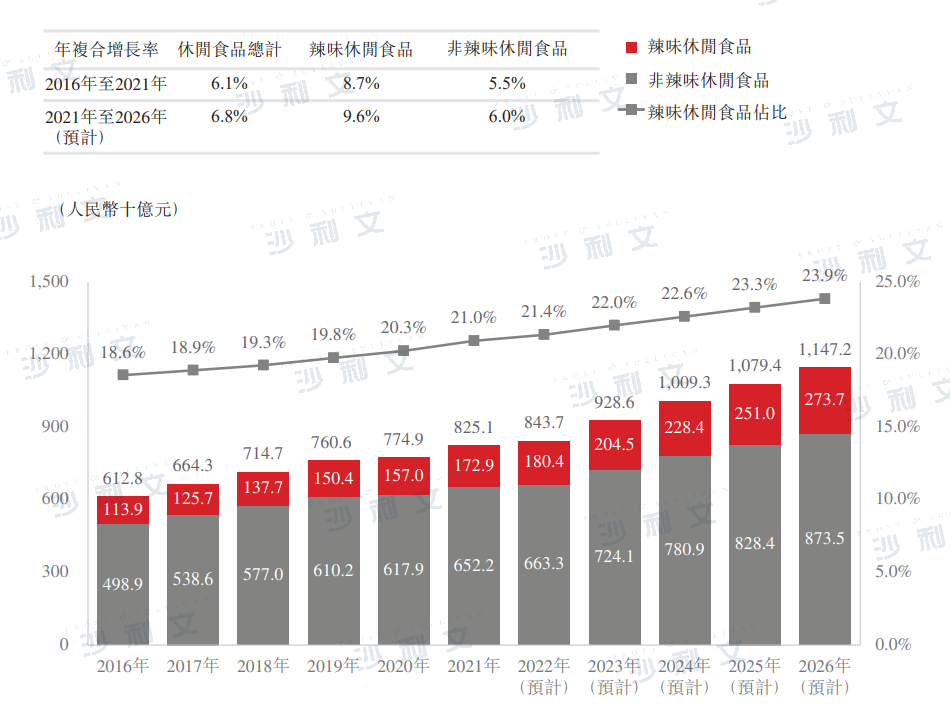
Convenience foods refer to packaged foods that are typically consumed outside of regular meals or during leisure time. China is one of the largest convenience food markets in the world. Calculated by retail sales, the market size of China's convenience food industry in 2021 was RMB 8251 billion. Driven by factors such as increasing disposable income, accelerating urbanization, increasingly rich consumption scenarios, continuous upgrading of existing products and new product launches, as well as continuous improvement of sales channels, it is expected that the market size of China's convenience food industry will grow at a compound annual rate of 6.8% from 2021 to 2026, reaching RMB 11472 billion by 2026, calculated by retail sales.
Snack foods can be divided into two main categories based on taste: spicy snacks and non-spicy snacks. Spicy snacks refer to those that contain one or more spicy seasonings as their primary ingredient; non-spicy snacks, on the other hand, do not contain any spicy ingredients in their raw materials.
Retail sales of Chinese leisure food industry by flavor
Forecast from 2016 to 2026
Source: Frost & Sullivan report
Overview of China's Spicy Snack Food Industry
Spicy flavors have a long history in Chinese dietary habits, and the popularity of spicy snack foods in China is increasing day by day. In recent years, with the development of the spicy snack food industry, many food producers have continuously developed new products to adapt to changing consumer preferences, driving growth in the spicy snack food industry. The retail sales of spicy snacks in China increased from 113.9 billion yuan in 2016 to 172.9 billion yuan in 2021, with an annual compound growth rate of 8.7%. It is estimated that the retail sales of spicy snacks in China will grow at a compound annual growth rate of 9.6% from 2021 to 2026, reaching 273.7 billion yuan by 2026. Meanwhile, it is expected that the retail sales of non-spicy snacks in China will grow at a compound annual growth rate of 6.0% during the same period.
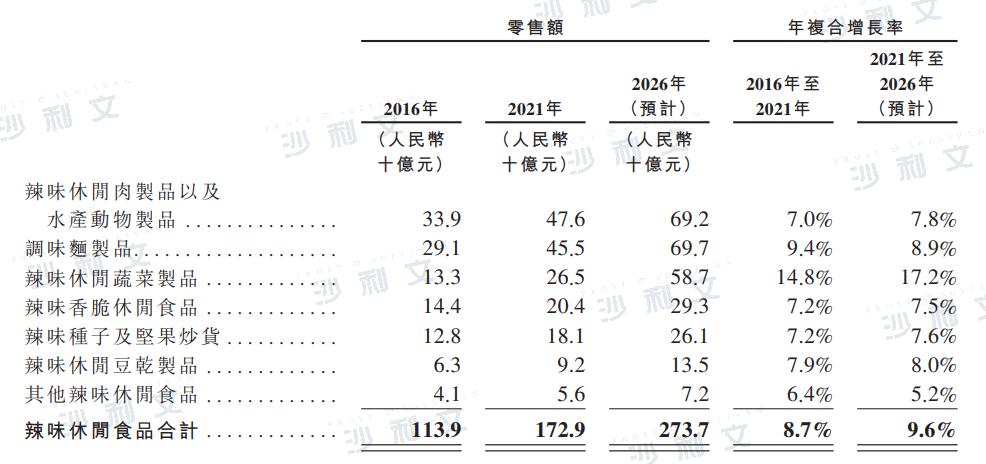
Retail sales of spicy leisure food in China by category
Forecast from 2016 to 2026
Source: Frost & Sullivan report
-
Condimented pasta products
Condimented pasta products are a popular traditional Chinese delicacy. In recent years, the popularity of condimented pasta products among young consumers has further increased, making them one of the favorite leisure foods among young consumers. Calculated by retail sales, the market size of condimented pasta products in China was 455 billion yuan in 2021, achieving a compound annual growth rate of 9.4% from 2016 to 2021, and is expected to grow at a compound annual rate of 8.9%, reaching a market size of 697 billion yuan by 2026.
-
leisure vegetable products
Recreational vegetable products refer to leisure foods made from vegetables such as kelp, konjac, seaweed, and lotus root slices, while puffed vegetable slices are not included in this category. Spicy recreational vegetable products refer to leisure foods made from vegetables with one or more spicy seasonings added. Packaging-type recreational vegetable products did not become available until the late 1990s. However, thanks to their delicate taste and healthy formulas, spicy recreational vegetable products are becoming increasingly popular among Chinese consumers. The continuous introduction of new products such as konjac and kelp has further propelled spicy recreational vegetable products to be the fastest-growing category within China's overall spicy leisure food industry.
The retail sales of spicy leisure vegetable products in China have increased from RMB 13.3 billion in 2016 to RMB 26.5 billion in 2021, with an annual compound growth rate of 14.8%. It is expected that by 2026, the sales will further reach RMB 58.7 billion, with a compound annual growth rate of 17.2% from 2021 to 2026.
-
Spicy snack dried bean curd products
Spicy snack bean curd products refer to leisure foods made from beans and added with one or more spicy seasonings. The raw materials include various beans such as soybeans, peas, and broad beans. Most snack bean curd products are reprocessed tofu products. Bean curd has a long history of over 2,000 years in Chinese cooking traditions. Since the 1990s, packaged snack bean curd products have become popular among Chinese consumers. In 2021, the retail sales of spicy snack bean curd products in China reached RMB 92 billion, and it is expected that by 2026, they will reach RMB 135 billion, with a compound annual growth rate of 8.0% from 2021 to 2026.
Market competition pattern of leisure food in China
The Chinese leisure food market is relatively fragmented, with the top fifteen companies accounting for 21.5% of the total retail sales in 2021. In 2021, Weilong ranked tenth in the Chinese leisure food market and sixth among all local companies.
The market for spicy leisure foods in China is also relatively fragmented, with the top five companies accounting for a total retail market share of 11.5% as of 2021. In 2021, Weilong was the largest spicy leisure food company in China, holding a market share of 6.2%. This is 3.9 times that of the second-largest company by retail sales, exceeding the combined market share of the second to fifth largest companies.
Key market drivers of spicy snack foods in China
Continuous economic growth and disposable income:China's per capita disposable income has increased to RMB 35,100 in 2021 and is expected to further rise to RMB 51,100 by 2026. Economic growth and the increase in per capita disposable income will significantly enhance consumers' purchasing power, thereby driving the growth of the spicy snack market.
Growing consumer base:Consuming spicy snack foods can bring consumers a pleasant experience, making them feel joyful, satisfied, and comforted. Therefore, spicy snack foods are favored by consumers of all ages, fostering an increasingly large consumer group for this type of food. Additionally, the acceleration of urbanization has promoted population mobility, and the further improvement of logistics infrastructure helps to spread local cuisine across the country. Spicy foods were mainly popular in Hunan, Hubei, Sichuan, Chongqing, Guizhou, and Jiangxi, gradually becoming popular nationwide. The development of the internet, e-commerce, and social media in China has also boosted the popularity of spicy snack foods. For example, more and more internet celebrities regard spicy snack foods as interesting material for their content creation, conducting food reviews on well-known social platforms, which has further accelerated the mass dissemination of spicy snack foods. Moreover, new industry standards for flavored noodle products have been released and implemented since October 1, 2022. The new standards will significantly reduce the variety of food additives used in flavored noodle products and lower the salt and oil content, and are expected to increase the entry barriers for industry participants. Leading enterprises with higher operational standards in the industry will benefit from continuously improving industry standards and gain more market share in the future.
An increasingly rich range of consumption scenarios and a growing frequency of consumption:The evolution of consumption habits is a key factor driving the growth of China's spicy snack food industry. The consumption scenarios for spicy foods are no longer limited to meal times but have expanded to various settings such as leisure activities, entertainment, tourism, and office hours. Thanks to the diversification of consumption scenarios, the frequency of consumption of spicy snacks has also increased rapidly, further boosting market growth.
Continuous launch of new products:China's leading spicy snack food producer continues to introduce new flavors. Currently, spicy snacks have developed a variety of new spicy tastes including sweet and sour, in order to meet the broader consumer needs and thus drive the industry's development. In addition, several potential niche markets have emerged within the spicy snack food industry, such as spicy vegetable products like kelp and konjac. Thanks to their healthy attributes, excellent taste, continuous upgrading of existing products, and the launch of new products, these products have greatly attracted consumers. Among them, konjac products themselves possess health benefits such as high dietary fiber, low carbohydrates, and low fat, making them widely popular. In 2021, China's per capita annual consumption of konjac was less than 0.1 kilograms, while Japan's per capita annual consumption is about 2.0 kilograms, indicating that there is still great growth potential for konjac products in China.
Improvement of sales channels:The improvement of offline sales channels, represented by modern and traditional methods, especially the further penetration of offline sales into lower-tier cities, has enhanced the accessibility of spicy snack foods. In addition, due to the increasing online shopping demand among young consumers, online channels are also booming. The improvement of retail channels has promoted an increase in consumer frequency of consumption, gradually unlocking market potential in lower-tier cities. From 2021 to 2026, the spicy snack food industry in lower-tier cities is expected to grow at a compound annual rate of 11.0%, faster than the overall growth rate of the spicy snack food industry.
Frost & Sullivan has extensive research experience in the food and beverage industry, assisting well-known enterprises in successfully listing on capital markets. Recent successful listings include: Youlan Animal Husbandry (9858.HK), Jiulongwang (1927.HK), Yumart (9987.HK), Nongfu Spring (9633.HK), Fengxiang Food (9977.HK), Simore (6969.HK), China Feihe (6186.HK), China National Tobacco International (6055.HK), Youpin 360 (2360.HK), Wugu Flour Mill (1837.HK), Baby Tree (1761.HK), Haidilao (6862.HK), Sustain Agriculture (8609.HK), Longhui Holdings (1007.HK), Xinrong International (1587.HK), Yiyuan Liquor (8146.HK), Jierong International (2119.HK), Bingshi International (1705.HK), Nissin Foods (1475.HK), Asia Grocery (8413.HK), Chowking Duck (1458.HK), COFCO Meat (1610.HK), Yihai International (1579.HK), Zhongdi Dairy (1492.HK), Dali Foods (3799.HK), Manor Ranch (1533.HK), Vientiane International (0288.HK), and others.
Recommended Reading
06. Frost & Sullivan assists SIMOR to successfully go public in Hong Kong (6969.HK)
*The above order is not sequential and is arranged in reverse chronological order based on listing time.




