



International Yongsheng Group Holdings Limited (hereinafter referred to as 'International Yongsheng') successfully went public on March 7, 2022. Frost & Sullivan provided exclusive industry advisory services for International Yongsheng's listing, and we hereby extend our warmest congratulations on its successful listing.
During the Hong Kong listing process, Frost & Sullivan mainly undertook the following tasks: helping the company accurately and objectively understand its positioning in the target market, using objective market data to discover, support, and highlight the company's competitive advantages, assisting the company, investment banks, and other intermediaries in completing the relevant parts of the prospectus (such as overview, competitive advantages and strategy, industry overview, business, and other important sections), facilitating communication with the Hong Kong Stock Exchange and investors, helping investors quickly understand the market ecosystem and competitive landscape, and assisting the company in completing feedback on various industry-related issues from the Hong Kong Stock Exchange.
Hong Kong security services industry
According to the Frost & Sullivan report, security services refer to: (i) guarding any property, persons or places to prevent or detect crimes, as well as maintaining public health through screening services (especially during periods such as COVID-19); (ii) installing, maintaining or repairing security installations, as well as designing security systems; and (iii) surveillance services, which typically involve providing personnel who have been specially trained, qualified and/or experienced to perform certain tasks and security guard duties. Data from the Security and Guarding Industry Management Committee shows that licensed security companies are divided into three categories, each engaged in different types of security work: (i) Category 1 security work, providing security guard services; (ii) Category 2 security work, providing armed escort services; and (iii) Category 3 security work, installing, maintaining and/or repairing security installations and/or designing security systems equipped with security devices for individual premises or locations. In addition, security services also include (i) general personal protection services; (ii) event and crisis security services; and (iii) manpower support services.
General market participants in the security service industry include security system and equipment suppliers, security service providers, and end-users. After purchasing the required equipment and systems, security service providers deliver security solutions to end-users.
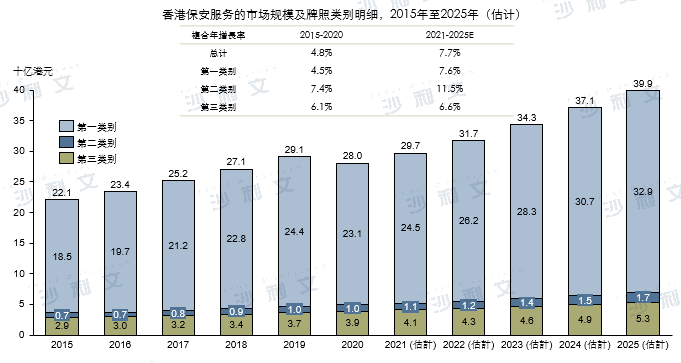
According to a Frost & Sullivan report, the Hong Kong security services market consists of service providers from Category 1, Category 2, and Category 3 licensed security companies. The market size of Hong Kong security services increased from about HK$221 billion in 2015 to about HK$280 billion in 2020, with a compound annual growth rate of approximately 4.8%. This is mainly due to an increased awareness of security services for Hong Kong. With the promotion of conferences, incentive travel, conventions and exhibitions ("MICE"), as well as the acceleration of land planning and development processes, it is expected that the number of new real estate projects and large-scale events will continue to increase, thereby driving growth in security services demand. It is expected that the market size of Hong Kong security services will reach about HK$399 billion in 2025, with a compound annual growth rate from 2021 to 2025 of approximately 7.7%.
Market size and license categories of security services in Hong Kong
2015 to 2025 (estimated)
Source: Frost & Sullivan report
According to the Frost & Sullivan report, the key factors driving growth in the security services industry in Hong Kong are as follows:
-
Public transportation development
The government's infrastructure investment remains at a high level, while multiple transportation infrastructure projects are underway. With the expansion of the Kwun Tong Line and the extension of the Hong Kong Island Line, the number of railway stations increased from 87 in 2015 to 96 in 2020. Multiple new railway construction projects, such as the Tuen Ma Line, North Loop Line, and the Hung Hom Station, Hung Shui Kiu Station, and the East Extension of the East chung Line, have successively introduced security services that require the railway stations to provide ticket inspection, enforcement of regulations, and customer service maintenance for the special inspection teams under the Ordinance. On the other hand, other transportation infrastructure projects, such as the Tseung Kwan O-Lan Tin Tunnel, which will be completed in the next few years, and the Chek Lap Kok Tunnel and the Cross-Harbour Bridge, also have security service needs for their control stations, toll booths, and automatic fare collection facilities.
-
Real estate development
The total number of private real estate development projects was 300 in 2019, the same as in 2015. The steady completion of commercial buildings, public libraries, schools, and real estate development projects further supports the demand for property-related security services and general security services, stimulating the development of the Hong Kong security services and facilities management market.
-
The demand for security guards continues to grow
The Hong Kong Federation of Security and Property Management Practitioners stated that public order incidents in 2019 and the COVID-19 outbreak in 2020 have led to an increasingly expanded recruitment scale for security personnel, resulting in a large influx of licensees. The outbreak of COVID-19 has stimulated the demand for manpower support services in areas such as access control, pedestrian screening, and implementation of health-related guidelines. Companies with a richer service portfolio are more likely to have higher capabilities to mitigate the impact of the pandemic. The social unrest in 2019 also drove property owners to strengthen the quality and quantity of personnel in terms of dedicated security guards, crisis management, and crowd coordination, especially in the retail and public infrastructure sectors. In the long run, with an increase in labor supply and heightened awareness of strengthening security guards, the security service market is expected to continue growing.
Hong Kong Facility Management Services Market
According to the Frost & Sullivan report, facility management is the comprehensive management of various activities or interactions arising from the use or occupation of property. Facility management services generally include (i) property management services; (ii) parking lot leasing and management services; (iii) cleaning services; and (iv) hotel management services. The value chain of the Hong Kong facility management market includes sub-contractors, facility management service providers, owners or occupiers. All parties involved directly provide certain cleaning and maintenance services to owners and occupiers.
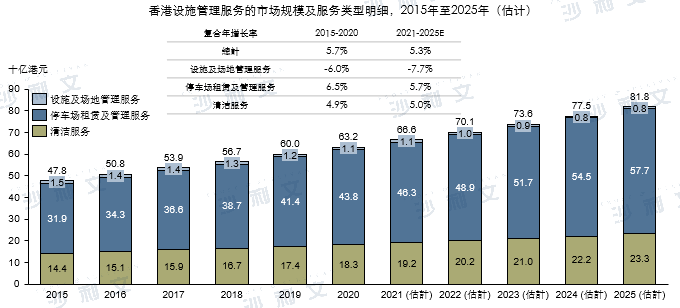
According to a Frost & Sullivan report, the facility management market in Hong Kong has grown from about HK$478 billion in 2015 to about HK$632 billion in 2020, with a compound annual growth rate of approximately 5.7%. Given the simplicity and effectiveness of outsourcing methods as well as service standardization, outsourcing practices are becoming increasingly popular, driving customers' demand for comprehensive solutions and simplified facility management services. The market is expected to maintain a growth trend, increasing from HK$666 billion in 2021 to about HK$818 billion in 2025, with a compound annual growth rate of approximately 5.3%.
Market size and service types of facility management services in Hong Kong
2015 to 2025 (estimated)
Source: Frost & Sullivan report
According to the Frost & Sullivan report, the key factors driving growth in the Hong Kong facility management services market are as follows:
-
Increase in housing supply
According to the '2020 Policy Address', the government has set supply targets of 301,000 units and 129,000 units for public and private housing between 2020 and 2030 respectively. The plan also indicates that the Hong Kong government is exploring new measures to increase public housing supply to address housing problems. For example, the Hong Kong Housing Authority (HA) is discussing the feasibility of reconstructing individual factory buildings into public housing. The expected growth in housing supply will drive demand for facility management services, including site and facilities management, parking lot rental and management, and cleaning services.
-
The public's awareness of facility safety has increased.
The key factors promoting the improvement of facility management include continuously strengthened public awareness and safety concerns, as well as the willingness to invest in facility construction and management. Generally, companies invest millions of dollars in safety technology to enhance security, protect personnel and assets, and solve safety issues. More and more facility management companies are focusing on monitoring technology and video analysis to ensure the high availability and reliability of systems, facilitate manual deployment, thereby providing high-quality facility management and operational efficiency. Monitoring systems are used to monitor, record, and store any potential evidence in order to protect public interests.
-
More parking spaces are available
Data from the Transport and Housing Bureau shows that Hong Kong recorded a total of over 790,000 licensed vehicles in 2019, while the total number of parking spaces in Hong Kong is only about 750,000. To meet the demand for parking spaces, the Hong Kong government is exploring a number of measures to continuously increase the supply of parking spaces, including offering incentives to encourage private developers to provide more public underground parking spaces, thereby increasing the demand for parking lot rental and management services.
-
Raise public awareness of facility hygiene
The COVID-19 outbreak in Hong Kong in 2020 has raised public health awareness, thereby triggering a real-time demand for environmental cleaning services. Compared to other industries, the demand for facility sanitation management has emerged counter-cyclically, covering various buildings such as residential complexes, commercial office buildings, and shopping malls during the implementation of environmental disinfection and access control management. In the long run, as the public and government work together to minimize the risk of further outbreaks, the reliance on facility cleaning services is expected to increase. In addition, facility management service providers may enrich the categories of cleaning services in response to the growing demand from customers.
Frost & Sullivan has extensive research experience in the security services and facilities management industry, assisting well-known enterprises in successfully accessing the capital market. Successful listings include Auspicious Business Services (6989.HK), Yincheng Life Services (1922.HK), Castle Holdings (1955.HK), Xinyuan Services (1895.HK), Chuangyi Holdings (3992.HK), Joy City Properties (2168.HK), Yaju Investment Holdings (8426.HK), Liego Holdings (8472.HK), Aisuo Holdings (8341.HK), Yiwai Group (3893.HK), Bao Lian Holdings (8201.HK), Fengsheng Service Group (0331.HK), Red Star Macallan (1528.HK), and others.
Recommended Reading
10. Frost & Sullivan assists FSG in successfully listing on the Hong Kong Stock Exchange (0331.HK)




