




Shandong Sanyuan Biotechnology Co., Ltd. (hereinafter referred to as 'Sanyuan Biotech') successfully went public on February 10, 2022, issuing a total of 33.721 million shares at an issue price of 109.30 yuan per share.
The company is one of the earliest domestic manufacturers to start industrial production of erythritol. Since its establishment in 2007, the company has been focusing on deepening its expertise in erythritol products for over a decade. It has successively overcome technical challenges in multiple aspects such as strain selection, formula optimization, fermentation control, and crystallization extraction, gradually growing into one of the global leaders in the erythritol industry. On the basis of consolidating its advantageous position in the erythritol industry and adapting to market application trends, the company has introduced new varieties such as monk fruit compound sugar, stevia compound sugar, and sucralose compound sugar. At the same time, it actively promotes the research and development of new sweetener products to meet consumers' differentiated needs with a richer variety of products. Frost & Sullivan has long been paying attention to the global and Chinese food and beverage industries, publishing a large number of research reports that are widely cited in the prospectuses of leading A-share listed companies in the industry, helping customers accelerate their growth.
Overview of erythritol industry
Erythritol is a product obtained by adding fermentation culture medium ingredients to glucose, inoculating with strains for deep ventilation fermentation, and then purifying and extracting it. Due to its low calorie content and hygroscopicity-free characteristics, erythritol is widely used in downstream industries such as food and beverages.
Global erythritol market size
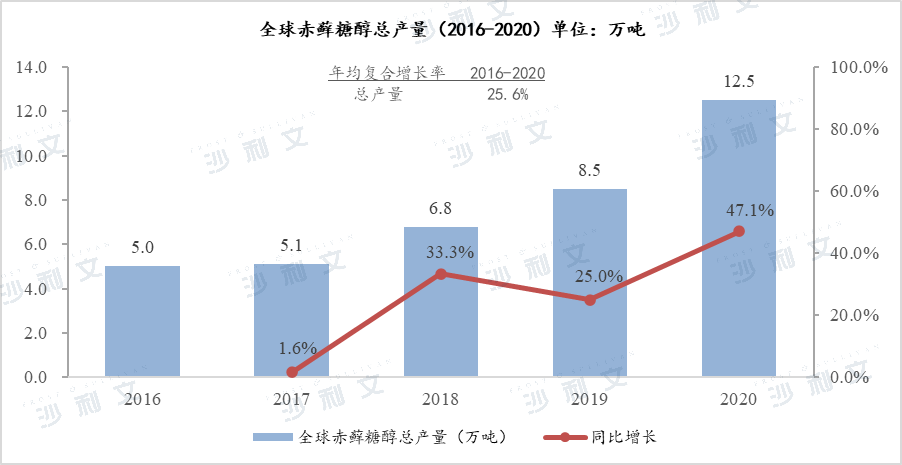
Since erythritol is easy to crush and does not absorb moisture, various candies produced have good storage stability even under high humidity storage conditions. It is also very beneficial to dental health, as it does not cause tooth decay. Therefore, it is widely used in the field of food additives such as candies in regions such as Europe and the United States. The total global production of erythritol increased from about 50,000 tons in 2016 to about 125,000 tons in 2020, with an average annual compound growth rate of about 25.6%.
Global total erythritol production, 2016-2020
Source: Frost & Sullivan report
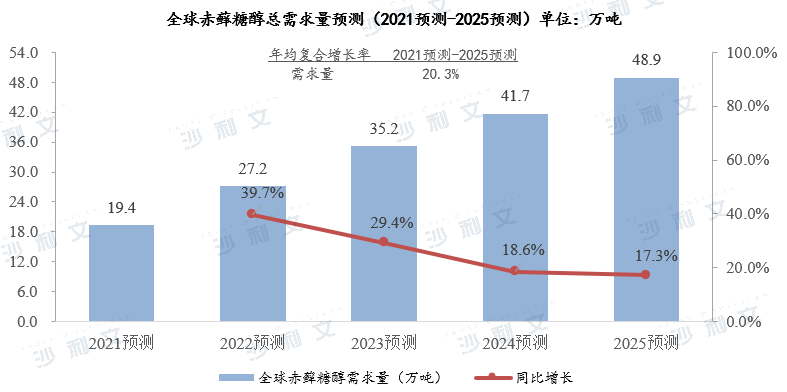
With the trend of global sweetener market updates and replacements, natural high-intensity sweeteners such as stevioside and mogroside have become very popular in foreign markets in recent years, and China's exports have also grown rapidly. However, since these high-intensity sweeteners usually carry an undesirable aftertaste, they need to be compounded with erythritol to mask it. Therefore, the use of erythritol in the compound sugar sector has increased significantly in recent years, driving a continuous expansion of global consumption of erythritol. It is estimated that global demand for erythritol will grow by an average annual compound rate of 20.3% over the next five years, reaching approximately 489,000 tons by 2025.
Global total demand for erythritol forecast, 2021-2025
Source: Frost & Sullivan report
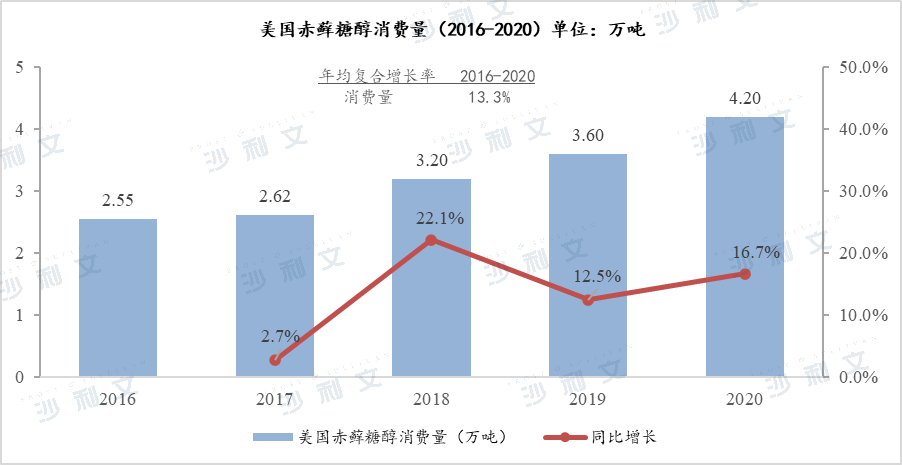
The US market applied erythritol earlier to the fields of beverage and food additives. The consumption of erythritol in the US increased from about 26,000 tons in 2016 to 42,000 tons in 2020, with an average annual compound growth rate of about 13.3%. As the anti-cariogenic properties of erythritol are recognized, its advantages in preventing tooth decay are gradually becoming more prominent, and more American downstream candy and beverage manufacturers are using erythritol.
Consumption of erythritol in the United States, 2016-2020
Source: Frost & Sullivan report
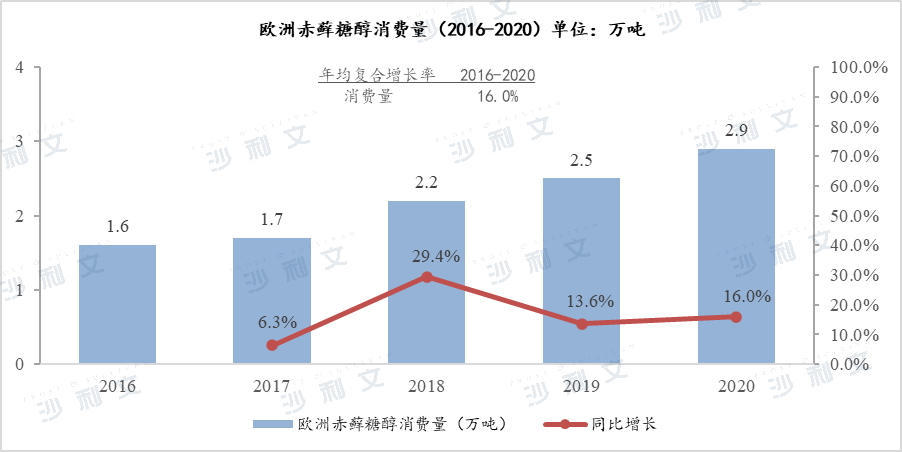
In the European market, erythritol, as a natural zero-calorie sweetener, has a higher tolerance compared to xylitol and is used in downstream industries such as candies, health products, and beverages. In addition, since erythritol is essentially non-hygroscopic, while other sugar alcohols have varying degrees of hygroscopicity, its non-hygroscopic nature further expands its application areas, allowing it to be added to food industries such as chocolate.
Consumption of erythritol in Europe, 2016-2020
Source: Frost & Sullivan report
Market scale of erythritol in China
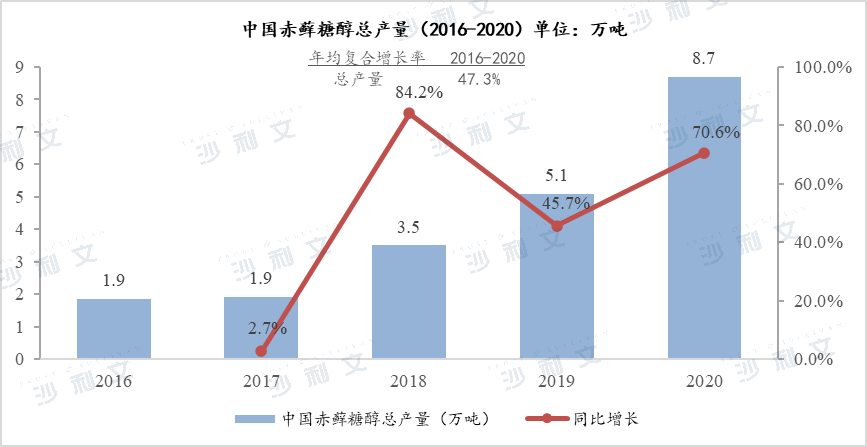
Erythritol has been popular in the Chinese downstream consumer market in recent two years due to its low calorie content, high tolerance, strong stability, good crystallinity, low hygroscopicity, and anti-caries properties. It is widely used in industries such as new seasonings, high-end foods, children's food, and health foods. The total production of erythritol in China increased steadily from 2016 to 2017. From 2018 to 2020, due to the continuous expansion of production capacity and output by major manufacturers, as well as the sustained growth in downstream demand, China's erythritol production reached about 87,000 tons in 2020, with an average annual compound growth rate of about 47.3% from 2016 to 2020. It is expected that in the future, with the gradual increase in demand from downstream manufacturers and the continuously maturing microbial fermentation technology, China's total erythritol production is expected to further grow.
Total production of erythritol in China, 2016-2020
Source: Frost & Sullivan report
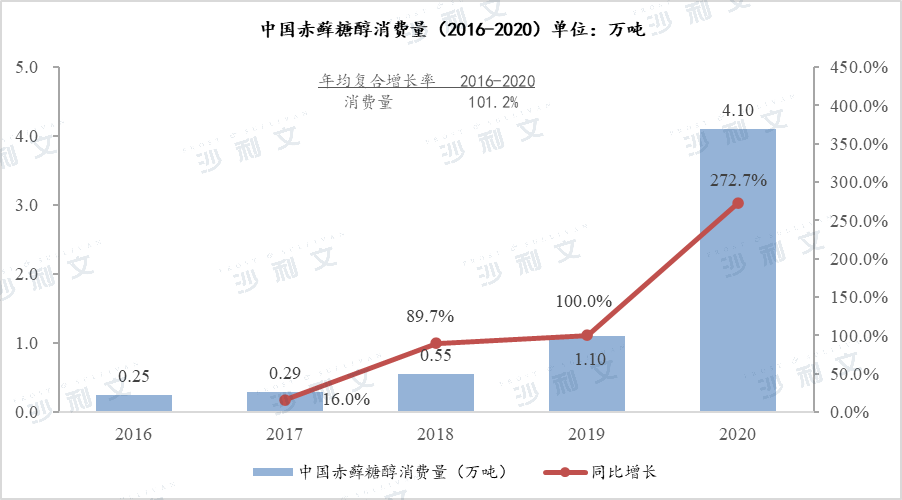
In China, the consumer demand for erythritol has been relatively stable in recent years. In 2016, China's consumption of erythritol was about 2,500 tons, which increased to about 2,900 tons by 2017. Starting from 2018 to 2019, benefiting from the recognition of erythritol by downstream markets, especially in high-end food, health products, and weight loss products markets, which demand low-calorie, stable, and non-hygroscopic ingredients, the downstream application scope of erythritol expanded rapidly, and its consumption experienced explosive growth. China's consumption of erythritol increased from about 5,500 tons in 2018 to about 41,000 tons in 2020. Since 2019, domestic downstream beverage companies have begun to use erythritol extensively to promote the concept of "0 calories" and "0 sugar," and the domestic erythritol market is rapidly booming, with consumers' awareness of erythritol gradually deepening. It is expected that in the next two years, with changes in national health awareness and increased demand from downstream manufacturers for erythritol, China's consumption of erythritol will continue to grow at a high rate.
China's erythritol consumption, 2016 - 2020
Source: Frost & Sullivan report
Forecast and Analysis of the Downstream Demand for Chitosan in China
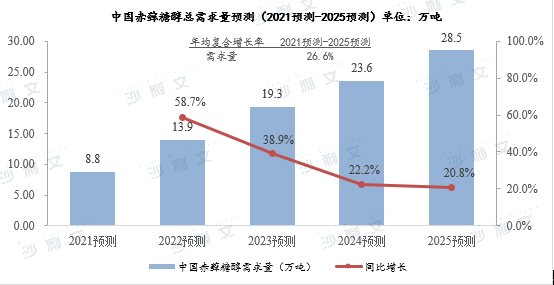
The downstream applications of erythritol mainly include beverage additives, solid beverage additives, food additives, and other categories. Among them, beverage additives are the main application of erythritol. Its consumer demand is expected to account for about 80% in the next few years. The demand will increase from about 77,000 tons in 2021 to about 253,000 tons in 2024, with an average annual compound growth rate of about 26.9%.
Solid beverages refer to products in powder, granular, or block form. The applications for which solid beverages are added include weight loss products, health supplements, coffee companions, etc. With the rise and development of the weight loss product market in recent years, it is expected that the demand for erythritol in the category of solid beverage additives will continue to grow, and its market share will gradually increase. The demand is expected to grow from about 5,600 tons in 2021 to about 17,500 tons in 2025, with an average annual compound growth rate of about 25.6%.
In addition, food additives include applications such as candies and chewing gum. Due to the natural and low-calorie advantages of erythritol, many chewing gums use erythritol instead of xylitol. Therefore, it is expected that the demand for erythritol in the food additive category will increase from about 4,900 tons in 2021 to about 14,200 tons in 2025 over the next five years, with an average annual compound growth rate of about 23.7%.
Forecast of downstream application product demand for erythritol in China
2021 - 2025
Source: Frost & Sullivan report
Frost & Sullivan has extensive research experience in the food and beverage industry, assisting well-known enterprises in successfully listing on the capital market. Recent successful listings include Youran Animal Husbandry (9858.HK), Jiulongwang (1927.HK), Yumart (9987.HK), Nongfu Spring (9633.HK), Fengxiang Food (9977.HK), Simore (6969.HK), China Feihe (6186.HK), China National Tobacco International (6055.HK), Youpin 360 (2360.HK), Wugu Flour Mill (1837.HK), Bababoo (1761.HK), Haidilao (6862.HK), Sustain Agriculture (8609.HK), Longhui Holdings (1007.HK), Xinrong International (1587.HK), Yiyuan Liquor (8146.HK), Jierong International (2119.HK), Bingshi International (1705.HK), Nissin Foods (1475.HK), Asia Grocery (8413.HK), Chow Haidilao (1458.HK), COFCO Foods (1610.HK), Yihai International (1579.HK), Zhongdi Dairy (1492.HK), Dairy Queen (3799.HK), Manor Ranch (1533.HK), Wanzhou International (0288.HK), and others.
Recommended Reading
06. Frost & Sullivan assists SIMCOS successfully listing on the Hong Kong Stock Exchange (6969.HK)




