



On March 18, 2025, the TaxFriend Fiscal and Tax AIBM Strategy Release Conference was successfully held. In collaboration with Frost & Sullivan (referred to as 'Frost & Sullivan'), the 'AIBM Ecosystem Service Industry White Paper Focusing on Fiscal and Tax Scenarios' (hereinafter referred to as the 'White Paper') was jointly released, along with the AIBM strategy and AI Agent products. Driven by Agentic AI, an AIBM ecosystem for fiscal and tax services is being built.

In recent years, with the rapid development of the digital economy, tax supervision has become increasingly refined. Small, medium, and micro enterprises (SMEs) have continuously increased their demand for fiscal and tax compliance, efficiency optimization, and intelligent management. This is giving rise to a market demand for fiscal and tax services worth hundreds of billions. However, the traditional service model of China's fiscal and tax service industry can no longer meet the growing personalized needs of SMEs. The industry as a whole faces difficulties such as weakened basic service value, intensified homogeneous competition, shortage of professional service talents, and challenges in transformation and upgrading.
Facing industry dilemmas and emerging opportunities, AI-based fiscal and tax IBM ecosystem services are gradually becoming the key to breaking through these challenges. The white paper deeply analyzes the intelligent transformation trend of the fiscal and tax service industry, elaborates on the value and application scenarios of IBM ecosystem services, helps enterprises, investors, and industry practitioners understand the direction of industry change, and provides references for policymakers to promote the sustainable development of the fiscal and tax industry, offering highly forward-looking market insights.
PART.01
Opportunities and Challenges in the Fiscal and Tax Service Industry under the Dynamic Market Development
The upgrading and challenges of fiscal and tax service demands for small, medium and micro enterprises
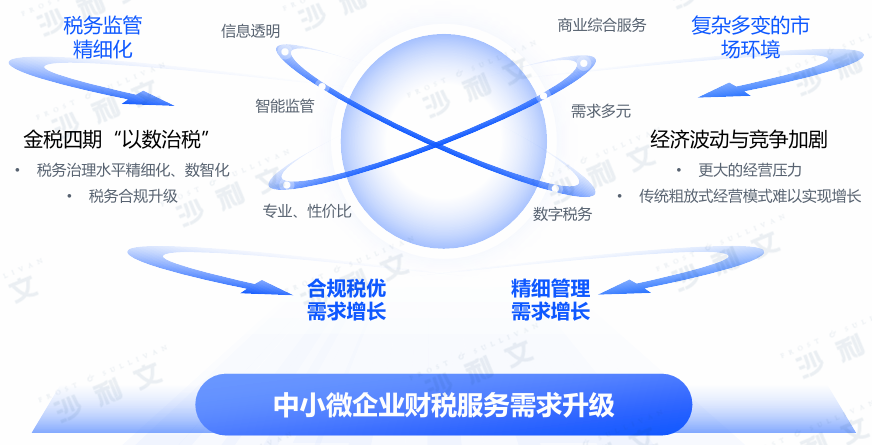
The trend towards refined tax supervision and changes in the market environment have upgraded the demand for fiscal and tax services for small, medium, and micro enterprises (SMEs). There is an increasing demand for compliant tax incentives and refined management. High-quality enterprises tend to prefer comprehensive business management services to optimize operations, while those with limited development focus more on tax risk control and cost reduction through efficiency improvement. In the face of these changes, SMEs face many challenges in obtaining high-value-added and cost-effective fiscal and tax services.

Source: Analysis by Frost & Sullivan
Dilemmas and Growth Opportunities in the Development of the Fiscal and Tax Service Industry
The current fiscal and tax service industry faces challenges such as homogeneous competition and weak value of basic fiscal and tax services, leading to a shrinking industry capacity. At the same time, the industry still has shortcomings in terms of professional talent reserve and improvement in digital intelligence levels, making it difficult to meet the continuously upgrading service needs of enterprises. However, there are still huge growth opportunities in the industry: the demand for high-value business management services by enterprises is rising continuously, the rise of emerging tax-paying groups drives individual fiscal and tax management needs, and the development of new technologies such as artificial intelligence also brings new possibilities for upgrading industry product forms and service content.
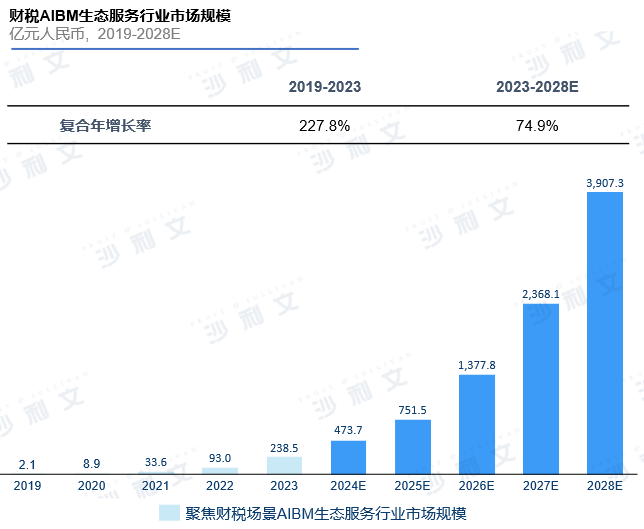
Breaking Through and Transforming the Fiscal and Tax Service Industry: The Fiscal and Tax AIBM Ecosystem Service is Gearing Up for a Quadrupling in Incremental Revenue
Facing industry challenges and emerging opportunities, AI-based fiscal and tax IBM ecosystem services are becoming the key to breaking through these barriers. The IBM ecosystem services can deeply empower fiscal and tax scenarios, improve enterprise fiscal and tax management efficiency through intelligent tools, and achieve more precise tax planning and financial optimization.

Source: Analysis by Frost & Sullivan
With the upgrading of market demand, AIBM is not only able to expand the market space for the fiscal and taxation industry but also drive innovation in service models, enhance the overall competitiveness of the industry, and bring new incremental revenue to the fiscal and taxation service industry.
Source: Analysis by Frost & Sullivan
PART.02
Analysis of the Industrial Value of the Fiscal and Taxation IBM Ecosystem
Breaking the resource dispersion dilemma in the fiscal and taxation industry: An innovative solution for the fiscal and taxation AIBM ecosystem
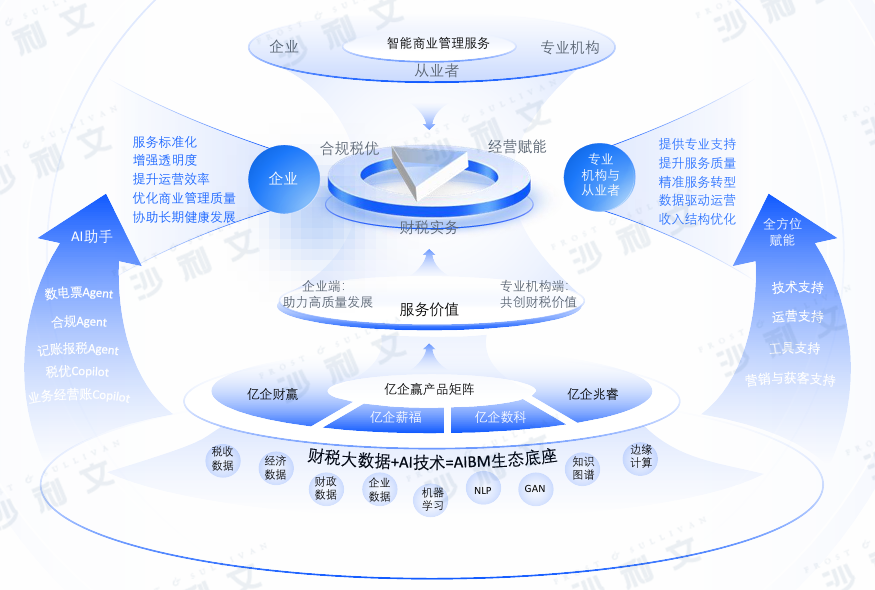
The Fiscal and Taxation IBM Ecosystem Platform can solve problems such as resource fragmentation and difficulty in processing non-standard information under traditional models by integrating scattered resources in the fiscal and taxation industry. The IBM ecosystem efficiently integrates service resources of different scales such as individual agents and small to medium-sized fiscal and taxation institutions. Through cross-domain global insights and in-depth customer services, it helps enterprises obtain customized and comprehensive business management support, thereby optimizing resource allocation and improving the quality and transparency of fiscal and taxation agency services.
Source: Analysis by Frost & Sullivan
The key role of the Fiscal and Taxation IBM ecosystem in supporting small, medium, and micro enterprises, socio-economic development, and tax construction
The fiscal and tax AIBM ecosystem enterprises empower the fiscal and tax management of small, medium, and micro enterprises with digital intelligence technology, reducing compliance risks, optimizing tax structures, simultaneously improving enterprise financing efficiency and development quality, promoting resource allocation optimization and the commercial application of digital intelligence technology, and contributing to the improvement of social resource efficiency and the digitalization construction of national taxation. Relying on precise tax data and automated services, they promote the intelligent transformation of tax management and play a key role in promoting social fairness, strengthening regulatory effectiveness, and fulfilling social responsibilities.
AIBM's Ecosystem Services with Finance and Taxation as the Development Origin: The New Business Ecosystem in the Future
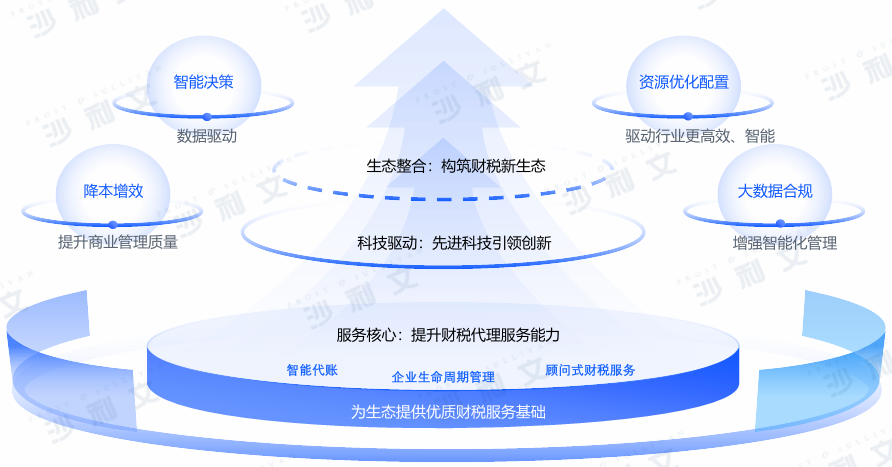
The upgrade in the demand for fiscal and tax services for small, medium, and micro enterprises is driving the industry towards intelligent business management solutions. Vertically, companies need to integrate tax planning with business strategy to ensure long-term development; horizontally, the industry is accelerating ecological integration, relying on technologies such as AI, big data, and cloud computing to build intelligent service platforms, comprehensively enhancing service efficiency, and promoting the industry's intelligent upgrade and sustainable development.
The fiscal and tax AIBM ecosystem builder constructs a diversified ecosystem with innovative models, driving the intelligent transformation of the fiscal and tax industry. All parties within the ecosystem will share technical support, data resources, and intelligent tools to form a standardized operational system, which will be gradually upgraded into an 'ecosystem hub' to provide comprehensive solutions from fiscal and tax to business management. By continuously expanding functional modules and collaborating with the ecosystem, the fiscal and tax AIBM ecosystem builder will gradually build a vast fiscal and tax management service ecosystem.
Source: Analysis by Frost & Sullivan
PART.03
Business Re-evaluation: The AIBM Ecosystem Service Industry Leadership Map in China
Investment Potential of AIBM Ecosystem Service Enterprises in the Eyes of Investors
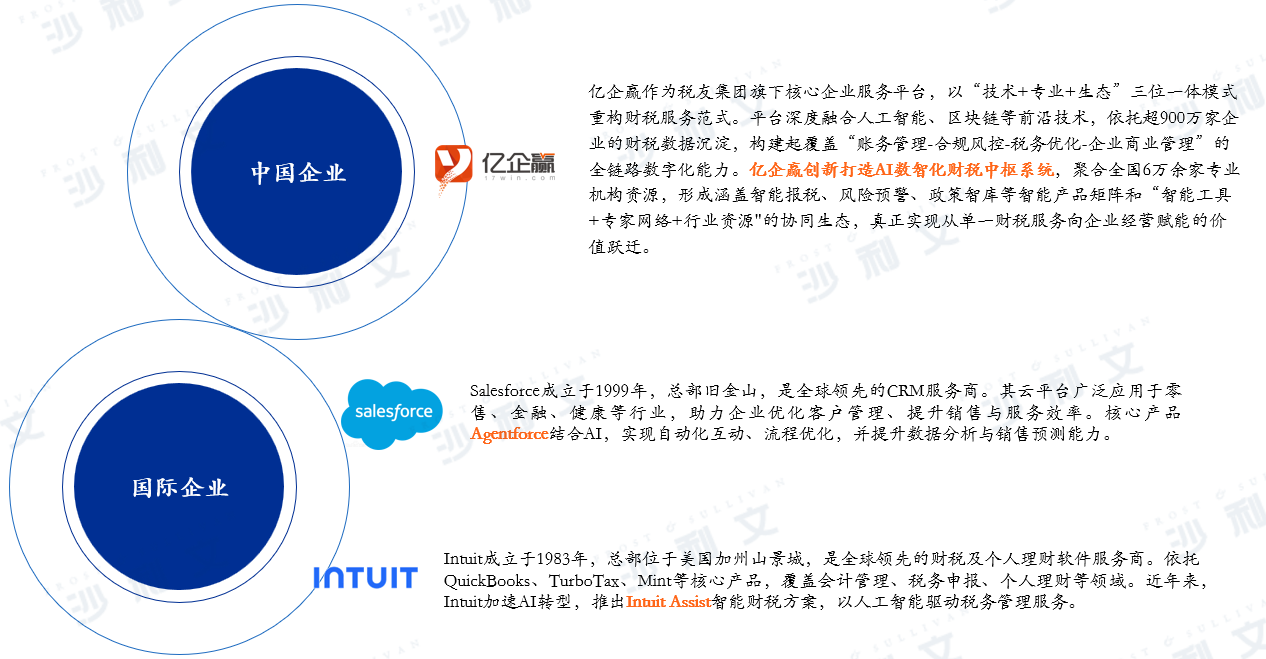
Under the trend of industry intelligence and compliance, fiscal and tax service enterprises with a first-mover advantage are leading the industry to higher levels through an ecological development strategy. At the same time, they are receiving significant attention from the capital market. Leading enterprises in the industry are relying on intelligent technology to drive upgrades in fiscal and tax services by deepening the integration of large language models with application ends. They are building industry ecological platforms with strong resource integration capabilities and optimizing supply chains through an ecological cooperation model to improve overall operational efficiency. In addition, these enterprises are continuously strengthening their fiscal and tax data analysis capabilities, forming a profound industry accumulation and competitive barriers. The core competitiveness of fiscal and tax IBM ecological service enterprises is mainly reflected in technology research and development and innovation capabilities, industry experience and data accumulation, as well as platform-based operational capabilities. These factors determine the competitive advantage of enterprises in the market.
Source: Analysis by Frost & Sullivan
Beyond SaaS: From software tool companies to tech giants, AI technology is accelerating a valuation revolution
In the future, the business model of AIBM ecosystem service enterprises will continue to be favored by capital markets. Ecosystem service capabilities will become a key factor determining the market value of enterprises. Enterprises with technological innovation and ecosystem operation capabilities will take a leading position in market competition and witness a reshaping of valuation logic. This transformation will subvert traditional investors' perception of fiscal and tax management enterprises as 'SaaS companies' and change the valuation method, driving fiscal and tax management towards a new stage of green compliance and sustainable development.
The 'AIBM Ecosystem Services Industry White Paper: Focusing on Fiscal and Tax Scenarios' systematically analyzes the current situation, challenges, and opportunities in the fiscal and tax service industry, and delves into how AIBM ecosystem services can drive the intelligent and ecological development of the industry. AIBM ecosystem services not only improve the efficiency of corporate fiscal and tax management but also promote the transparency and compliance of overall industry operations. Looking ahead, enterprises with ecological service capabilities will occupy a central position in industry transformation and receive higher attention in the capital market.




