The 6th China Cross-border E-commerce Logistics Conference
On December 20, 2024, the "6th China Cross-border E-commerce Logistics Conference," co-hosted by several industry-leading enterprises, was successfully held at Shenzhen Tianan Cloud Valley. The conference brought together many senior executives and industry leaders from well-known cross-border e-commerce logistics companies at home and abroad, with the theme of "Listening to Cutting-edge Observations and Understanding Industry Trends" to jointly discuss the development pain points and new opportunities of China's cross-border e-commerce logistics industry.
Jia Pang, Partner and Managing Director of Frost & Sullivan Greater China, was invited to attend the conference and delivered a relevant keynote speech, detailing the current development status of China's cross-border e-commerce logistics industry and the new opportunities brought about by technological transformation.

Jia Pang, Partner and Managing Director of Frost & Sullivan Greater China
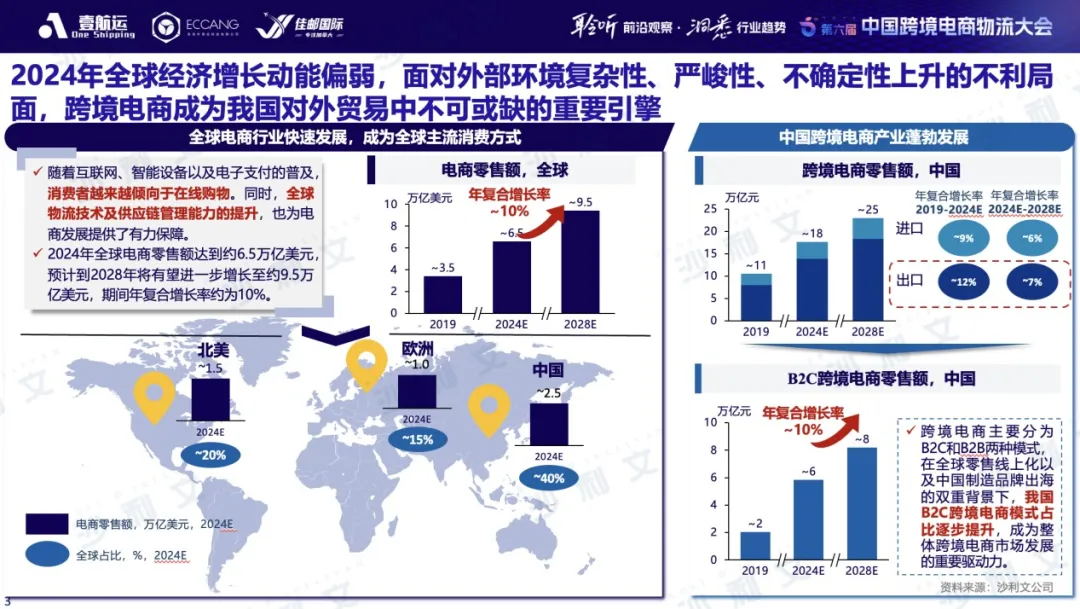
In 2024, global economic growth faces a complex and changing external environment and increasing uncertainties, posing challenges to China's foreign trade. However, cross-border e-commerce has become an important engine for China to cope with these challenges due to its rapid development. According to Jia Pang, the popularization of the internet, smart devices, and electronic payment, coupled with logistics technology upgrades and supply chain improvements, has continuously increased global consumers' willingness to shop online. It is estimated that global e-commerce retail sales will reach approximately $6.5 trillion in 2024. In terms of geographical distribution, North America and Europe account for about 20% and 15% of global e-commerce retail sales respectively, while China ranks first with a proportion of about 40%, demonstrating outstanding market potential.
He pointed out that China's cross-border e-commerce retail sales have shown strong growth momentum in recent years, expected to reach approximately 18 trillion yuan in 2024, among which cross-border export e-commerce has become an important pillar, with particularly prominent growth rates. With the global retail onlineization and the acceleration of Chinese brands going global, the B2C cross-border e-commerce model has become one of the core driving forces for the development of China's cross-border e-commerce market, with its retail sales expected to reach approximately 6 trillion yuan in 2024. Jia Pang stated that the prosperous development of China's cross-border e-commerce not only meets the diverse needs of global consumers but also promotes the cross-border e-commerce logistics industry to new heights.
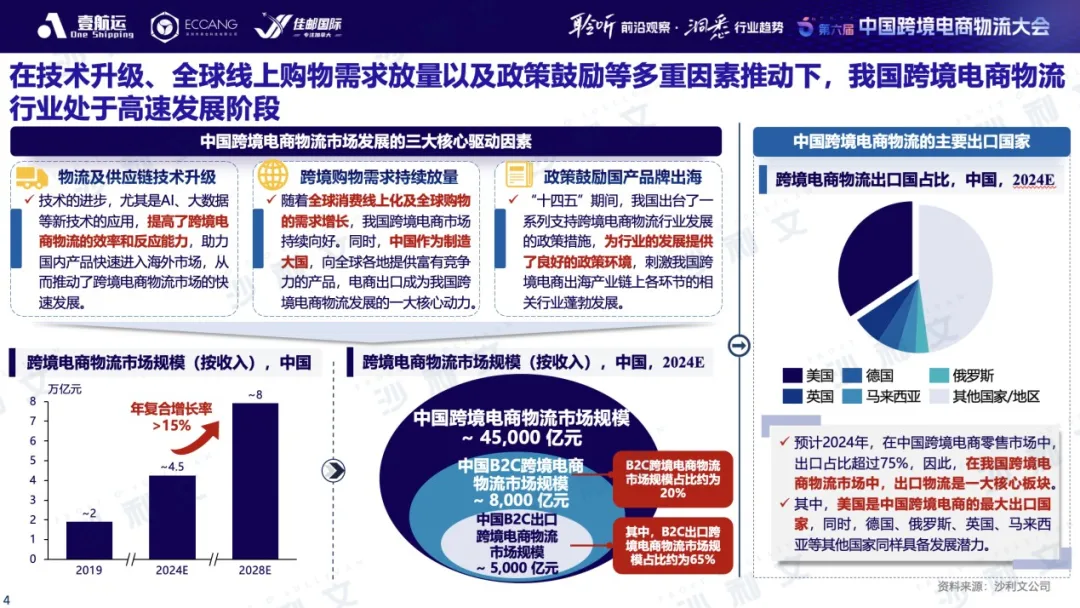
Subsequently, in his speech, Jia Pang conducted an in-depth analysis of China's cross-border e-commerce logistics industry and stated that the core driving forces for its rapid development can be summarized into three key words: technology, demand, and policy. At the technical level, the application of artificial intelligence and big data has improved logistics efficiency and commodity circulation stability, not only increasing the speed of product delivery but also effectively reducing the risk of loss and delay. At the demand level, global consumers' demand for online shopping and global purchasing continues to grow, creating broad market space for cross-border e-commerce logistics development. In terms of policy support, China's government has introduced a series of policies to encourage brands going global, providing an advantageous environment for the continuous development of the industry and stimulating the vigorous development of all links of the industrial chain.
Jia Pang pointed out that the market scale of China's cross-border e-commerce logistics will reach approximately 4.5 trillion yuan in 2024 and grow to approximately 8 trillion yuan by 2028. "From the perspective of market structure, the market scale of China's B2C cross-border e-commerce logistics accounts for about 20% of the overall market." Jia Pang further introduced. Overall, driven by multiple factors, China's cross-border e-commerce logistics market is in a stage of rapid development, providing consumers around the world with a more efficient and convenient consumption experience.
In addition, Jia Pang analyzed the two main models adopted by China's cross-border e-commerce logistics: direct mail and overseas warehouse. Under the direct mail model, dedicated small packages have become an ideal choice for small and medium-sized sellers due to their flexibility and low threshold. In this model, sellers do not have to bear warehousing costs or inventory pressure, making them suitable for products that are light in weight, small in size, and fast in iteration, with high cost-effectiveness. Under the overseas warehouse model, merchants need to transport large quantities of goods to warehouses in the target market in advance, which can significantly shorten delivery time. At the same time, merchants can use economies of scale to obtain more favorable transportation, distribution, and warehousing costs. This model provides high-quality solutions for sellers with large export freight volumes, relying on higher logistics efficiency, lower logistics costs, and localized services, greatly improving market response speed and customer satisfaction.
According to Jia Pang, in 2024, the rapid rise of emerging e-commerce platforms such as TikTok and Temu has changed global consumers' shopping habits, further driving the growth of overseas warehouse and dedicated small package markets. It is expected that by 2028, the share of dedicated small packages and overseas warehouse models in China's B2C cross-border e-commerce logistics market will increase to about 25% and 45% respectively. He stated that with the rise of emerging e-commerce platforms, the cross-border e-commerce logistics industry is facing unprecedented development opportunities, and different logistics models will meet the diverse needs of the market with their unique advantages.
Finally, Jia Pang further explored the pain points faced by the cross-border e-commerce logistics industry and how artificial intelligence can further empower industry development. First, Jia Pang pointed out the four core challenges currently facing the cross-border e-commerce logistics industry: fluctuations in logistics costs, diversification of customer needs, insufficient digitization, and increasing compliance requirements. The contradiction between surging logistics demand during peak seasons and overcapacity during off-peak seasons puts significant pressure on corporate profitability. In addition, the increase in diversified customer needs places higher demands on the flexibility of logistics service providers' solutions. At the same time, insufficient digitization is also a bottleneck restricting industry development, with small and medium-sized logistics service providers lagging behind in digitization, resulting in low efficiency and cost control problems. Finally, complex and changing global customs policies and laws and regulations also increase the compliance challenges for cross-border logistics enterprises.
Jia Pang stated that the application of artificial intelligence technology can further assist logistics enterprises in achieving informatization, automation, and intelligent transformation and upgrading, thus becoming a key breakthrough point. AI empowerment can not only optimize links such as transportation, warehousing, and distribution to achieve cost reduction and efficiency improvement but also promote the intelligent upgrade of the entire logistics chain. At the same time, AI technology shows unique advantages in dealing with labor shortages and improving operational efficiency, injecting innovation into the industry.
Specifically, the application of AI technology in the logistics industry mainly focuses on three core scenarios. First, in customer management, AI helps enterprises achieve more efficient customer reach and improve customer satisfaction through precise analysis of needs and market insights. Second, in various logistics links, hardware devices such as driverless transport vehicles and autonomous mobile robots (AMR), as well as systems such as TMS and WMS, are applied in transportation and warehousing, significantly improving operational efficiency from transportation, warehousing, distribution to customer service and reducing costs. Finally, at the organizational management level, AI technology has achieved more efficient decision support and internal process optimization.
2024 is a year of explosive growth in artificial intelligence and large model applications, and the cross-border e-commerce logistics industry has also seen technological innovation. With continuous iteration of logistics technology and expansion of AI applications, Jia Pang believes that China's cross-border e-commerce logistics industry will see a new round of growth driven by both intelligence and globalization, providing consumers around the world with a more efficient and reliable service experience.