Today (July 17th), the three-day '30th Shanghai International Green Building Materials and Interior Decoration Exhibition' officially kicked off at the Shanghai New International Expo Center. The exhibition brings together leading domestic and international industry enterprises, showcasing products that cover the entire upstream and downstream of the construction materials industry chain, bringing endless business opportunities to various merchants. This exhibition will leverage the 'exhibition driving exhibitions' model to form a point-to-area diffusion effect, attracting high attention from society to the current status and trends of green building development. It will contribute to the implementation of national green development policies outlined in the 13th Five-Year Plan, strengthen technical support, and play a role in adding bricks and mortar to the work.
Source:Official website of Shanghai New International Expo Center
Fully furnished apartments have become popular, attracting widespread attention from all sectors regarding architectural decoration.
Leading enterprises in the construction decoration industry have deepened their integrated business model, providing consumers with comprehensive decoration services. For example, they have established independent material distribution centers to centrally purchase and uniformly distribute building decoration materials; opened building material home shopping malls to provide consumers with centralized marketing services for purchasing building materials. With the support of policy dividends, the construction decoration industry has entered a period of rapid development, and industry standards are becoming increasingly perfect. "Refined decoration" commercial housing is gradually becoming popular. Through centralized procurement and unified decoration, consumers can move into their homes with minimal fuss, thereby reducing resource waste caused by repeated renovations. In 2013, green buildings began to become widespread, and refined decoration has become a standard configuration for large real estate developers. At the same time, the Chinese government also encourages new residential buildings to be fully furnished at one time or with menu-style decoration, promoting the integration of personalized and industrialized decoration.
Taking decorative technology as the core of development, continuously improving design and construction levels
Under the trend of consumption upgrading and increasingly diverse decorative styles, large architectural decoration enterprises have begun to focus on developing in an industrialized direction and have made progress in channel management, R&D design, construction technology, etc. However, they still lag significantly behind multinational companies in project quality control, especially in terms of construction details such as interior design embellishments, indoor and outdoor wall painting, and door and window installation. Architectural decoration enterprises need to continuously improve their design and construction levels to meet rapidly developing decorative needs. As a leading industry advisor listed in Hong Kong and overseas, Frost & Sullivan has been conducting in-depth research on multiple fields such as civil engineering, decoration and renovation, and building materials, accumulating rich research results. Among them, research on architectural decoration covers multiple areas such as material decoration, home furnishings, and furniture. Since providing investment and financing consulting services for enterprise leaders and their management teams, Frost & Sullivan has helped nearly 500 enterprises successfully list in Hong Kong and overseas. In 2018 alone, Frost & Sullivan accounted for 56% of the market share for industry advisor services listed in Hong Kong, contributing to the prosperity of China's economy.
Frost & Sullivan-related research
Source: Drawn by Frost & Sullivan Research
As of the end of June 2019, the offices in Greater China of Frost & Sullivan have assisted more than 13 building materials, decoration and home furnishing enterprises such as China Floor, Dongpeng Holdings and Yivei Group in going public. In the future, Frost & Sullivan will continue to leverage its rich research results to contribute to the development and popularization of construction decoration in China.
Focusing on the Shanghai International Building Materials and Interior Decoration Exhibition, Frost & Sullivan released an excerpt from its white paper on China's construction decoration industry
Definition and Classification of the Building Decoration Industry
Architectural decoration refers to the various treatment processes carried out on the internal and external surfaces of buildings and the spatial environment using decorative materials or ornaments to protect the main structure, improve the physical performance, use function, and beautify the building. Architectural decoration integrates products, technology, and engineering, placing more emphasis on artistic and aesthetic effects compared to traditional construction industries. Since repetitive decorative updates are required throughout the entire service life of a building after completion, the market demand for the architectural decoration industry is sustainable. Based on different uses of buildings, the architectural decoration industry can be divided into three sub-industries: public building decoration, residential decoration and renovation, and curtain walling. Public building decoration mainly includes the decoration and renovation of office buildings, commercial buildings, tourist buildings, educational, cultural, health, communication, and transportation buildings. Residential decoration and renovation mainly include fine residential decoration and home renovations, depending on the decoration and renovation requirements of different residential buildings. Curtain walls are lightweight exterior walls with decorative effects commonly used in urban high-rise buildings, usually composed of a support structure system and panels, capable of certain displacement and deformation without bearing the load and action of the main structure.
Main Sub-sectors of the Construction Industry
Source: Drawn by Frost & Sullivan Research
China's building decoration industry industrial chain
The construction decoration industry in China consists of upstream material suppliers, midstream construction decoration design and construction companies, as well as downstream demand sectors such as real estate development, hospitality, and finance. The participants in the upstream segment include various material suppliers; the market players in the midstream are construction decoration design and construction companies; the downstream involves real estate developers, high-end hotels, financial institutions, and end consumers.
China's building decoration industry industrial chain
Source: Drawn by Frost & Sullivan Research Institute
The upstream industry is the building materials sector, involving suppliers of stone, steel, paint, solid wood, and other building materials. The selection of building materials often determines the quality of construction decoration projects, and the research and development and application of innovative materials promote the upgrading and progress of the construction decoration industry. The development and changes in the upstream building materials market have a direct impact on the construction decoration industry, with price fluctuations in major raw materials such as panels, steel, wood, and hardware products significantly affecting the profitability of construction decoration enterprises.
The main participants in the midstream are construction decoration design and construction companies, including traditional construction decoration firms, construction decoration departments of building material stores, and integrated construction decoration companies. Different consumer groups have led to different levels of technical proficiency and profit margins among industry participants. The first two types of companies mainly target the mid- to low-end construction decoration market, with overall weaker profitability; integrated construction decoration companies, however, leverage their advantages in research and development, design, quality, business scale, and integration of upstream and downstream resources to form strong bargaining power over both upstream building material suppliers and downstream demand terminals. They can effectively reduce costs, provide customers with high-value-added products and services, and improve overall profitability.
The downstream participants include real estate developers, high-end hotels, financial institutions, and end consumers. Changes in the economic conditions and consumption habits of institutional customers and consumers have a direct impact on the construction decoration industry. Consumers' demands for personalized and green environmental protection in architectural decoration design are increasing day by day, while the design capabilities, construction levels, and integration degree of construction decoration enterprises are becoming increasingly important.
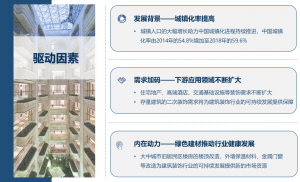
Analysis of Driving Forces for the Architectural Decoration Industry in China
★ The increase in urbanization rate promotes the development of the construction decoration industry
The establishment and improvement of the market economy system have promoted rapid economic growth in China and steadily enhanced the level of urbanization. The significant increase in urban population has helped to continuously advance China's urbanization process, with the urbanization rate rising from 54.8% in 2014 to 59.6% in 2018. The population transferred during the urbanization process will bring about a large demand for the construction of public infrastructure such as housing, transportation, commerce, finance, healthcare, and municipal engineering. Investment in building decoration will accordingly maintain a high-speed growth trend.
★ The downstream application areas continue to expand.
The development of the construction decoration industry depends on the level of development of downstream industries and the resulting demand for decoration. On one hand, China's real estate industry has always maintained rapid development, with continuous expansion in market demand for residential properties, high-end hotels, transportation infrastructure, etc., which will lay a foundation for the sustainable development of China's construction decoration industry. On the other hand, the decoration cycle for buildings such as hotels, guesthouses, and office buildings is usually 6 to 8 years, and the secondary decoration demand for existing buildings will provide assurance for the sustainable development of the construction decoration industry.
★ Green building materials promote the healthy development of the industry
As a resource-consuming service industry, the construction decoration sector, against the backdrop of building a resource-saving and environmentally friendly society, focuses on strengthening production work such as energy conservation and emission reduction, low-carbon environmental protection, etc., to promote the healthy development of the construction decoration industry. The renovation of rooftops in old residential areas in large and medium-sized cities, external wall insulation materials, metal doors and windows, etc., have formed a huge niche market, providing new market resources for the sustainable development of the construction decoration industry.
Driving factors of China's construction decoration industry
Source: Developed by Frost & Sullivan Research
Development Trend of China's Building Decoration Industry
★ Decorative technology level has improved
The traditional manual production and assembly methods at construction decoration sites will gradually be replaced by factory-based engineering. The factoryization of decoration projects involves replacing the traditional decentralized handicraft production method with a new industrial production approach, standardizing and modularizing the content of architectural decoration, and using standardized CNC equipment to produce high-value-added decorative components. By factoryizing decoration projects, the production efficiency and quality stability of decorative component parts are significantly improved, the on-site construction period is shortened, and traditional construction site pollution is reduced.
★ Architectural decoration environmental protection
While the construction decoration industry improves residents' quality of life and beautifies living environments, it also brings issues such as resource and energy waste and indoor environmental pollution, attracting high attention from relevant departments and consumers. China's construction decoration industry is facing transformation and upgrading. By making construction decoration projects environmentally friendly, problems caused by traditional business models such as high pollution and high energy consumption can be solved, achieving a transformation from extensive operations to refined ones.
★ Well-known brands are favored by the market
Against the backdrop of continuously improving living standards among residents, consumers' demands for residential decoration have shifted from functionality to a comprehensive improvement in living quality. Professional design capabilities, construction assembly levels, material quality, pre-sale and after-sales services, and other elements have become important thresholds for building decoration enterprises to enter the high-end residential decoration market, and these elements are ultimately reflected in the brand awareness of the enterprises.
Development Trends of China's Building Decoration Industry
Source: Drawn by Frost & Sullivan Research
Dr. Wang Xin, Global Partner of Frost & Sullivan, Vice President of Global Market Strategy Planning and President of the China Region, pointed out that China's construction decoration industry is facing transformation and upgrading. Solving problems such as high pollution and energy consumption brought about by traditional business models through the environmental protection of construction decoration projects, and achieving a transformation from extensive management to refined management are important development trends for the industry in the future. The environmental protection of construction decoration is mainly reflected in three aspects: design, materials, and construction. In terms of decorative materials, it will ensure that all raw materials meet the environmental protection requirements of relevant standards and specifications, and promote the use of new building materials, thermal insulation materials, and green construction decoration materials that are energy-efficient and environmentally friendly.