The 25th Shanghai International Medical Devices Exhibition was grandly held at the Shanghai World Expo Exhibition Hall from July 11th to 13th. The exhibition content comprehensively covered products including medical electronic medical imaging equipment, optics, first aid, rehabilitation care, medical supplies and sanitary materials, inspection equipment and diagnostic reagents, as well as medical information technology. It directly and comprehensively serves the entire medical industry chain from source to end for the medical device industry. More than 1,000 medical device manufacturing enterprises from over 20 regions, along with hospital buyers and distributors from more than 30 countries and regions, gathered at the exhibition for transactions and exchanges. The Shanghai International Medical Devices Exhibition provides a trading platform for domestic and foreign medical device manufacturers, which is conducive to enhancing communication among major medical device companies, expanding sales services, and promoting the prosperity of the medical device industry market. After 30 years of continuous rapid development, China's medical device industry has initially established an industrial system with complete professional categories, a sound industrial chain, and a solid industrial foundation. In many high-end device fields, import substitution has been achieved, such as Chinese pacemakers, artificial human parts, fluoroscopic imaging devices, and other products. In the future, with the gradual implementation of favorable policies for domestic devices and the rise of private enterprises, strong capital and high-quality talents will pour into Chinese local medical device enterprises, continuously improving the technical level of domestic medical devices and making them more competitive in both domestic and international markets.
Source: Official website of Shanghai International Medical Devices Exhibition
As a leading industry advisor listed in Hong Kong and overseas, Frost & Sullivan has been conducting in-depth research on various sectors such as the Chinese economy, healthcare, and intelligent technology. Since providing investment and financing advisory services to corporate leaders and their management teams, it has helped nearly 500 enterprises successfully list in Hong Kong and overseas. Since 2018, it has accounted for 56% of the market share of industry advisory services for companies going public in Hong Kong, contributing to the prosperity of the Chinese economy.
Frost & Sullivan-related research
As of the end of June 2019, the offices in Greater China of Frost & Sullivan have assisted nearly 60 enterprises in the healthcare sector such as Taihecheng Medical, Mindray Biotech, and China Resources Medicine in going public. In the future, Frost & Sullivan will continue to leverage its rich research achievements to contribute to the development of China's healthcare industry.
Focusing on the Shanghai International Medical Devices Exhibition, Frost & Sullivan Releases an Excerpt from its China In Vitro Diagnostic Reagents White Paper
Definition and Classification of In Vitro Diagnostic Reagents
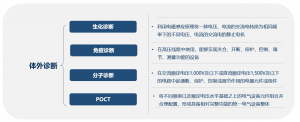
In vitro diagnostic (IVD) is a diagnostic method that obtains clinical diagnostic information by testing and analyzing human samples outside the body. Human samples for in vitro testing include blood, body fluids, cells, tissues, etc., and their application fields include routine biochemical tests, disease detection, gene sequencing, etc. In vitro diagnosis can provide comprehensive and multi-level test information for clinical diagnosis, greatly influencing clinical treatment plans, and has high application value and clinical significance. In vitro diagnostic reagents (IVD Reagents) are reagents and other products used in the process of in vitro diagnosis and belong to the medical device field. According to the detection principle and application field, in vitro diagnosis can be divided into four types: biochemical diagnosis, immunodiagnosis, molecular diagnosis, and point-of-care testing (POCT).
Classification of China's In Vitro Diagnostic Reagent Industry
Source: Drawn by Frost & Sullivan Research
Market scale of in vitro diagnostic reagents in China
Since the 21st century, China's healthcare industry has gradually developed, driving the expansion of the market scale for in vitro diagnostic reagents. In the past five years, relevant laws and policies have been introduced one after another, continuously improving the technological research and development level of enterprises. This has led to an increase in the market scale of China's in vitro diagnostic reagent industry from 29.27 billion yuan in 2014 to 71.33 billion yuan in 2018, with an annual compound growth rate as high as 24.9%. Benefiting from the continuous improvement of R&D technology by local enterprises, increasing demand, and a series of supportive policies, the market scale of China's in vitro diagnostic reagents is expected to further grow in the next five years.
Market scale of in vitro diagnostic reagents in China, forecast for 2014 - 2023
Source: Software compilation by fsTEAM, prepared by Frost & Sullivan data center team.
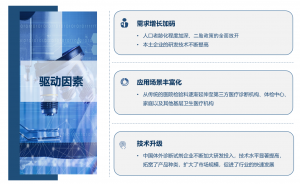
Analysis of Driving Forces for China's In Vitro Diagnostic Reagent Industry
★ *Rapid growth in basic demand
China's population is aging, and the incidence of various diseases is continuously increasing. Coupled with the improvement in residents' awareness of medical health, the demand for in vitro diagnostics has been growing, driving up consumption of in vitro diagnostic reagents. The full implementation of the two-child policy has led to a continuous increase in the number of mothers during pregnancy and preparation for pregnancy, which has promoted the consumption of maternal and infant-related in vitro diagnostic reagents.
★ Richening application scenarios
With the continuous increase in the variety of in vitro diagnostic reagent products and technological advancements, the application scenarios of these reagents have become increasingly diverse. They have gradually expanded from traditional hospital laboratories to third-party medical diagnostic institutions, health check-up centers, homes, and other primary healthcare facilities. The ever-expanding application scenarios have fully unleashed the demand for different types of in vitro diagnostic reagents, promoting rapid industry development.
★ Continuous improvement in technical proficiency
In the past five years, Chinese in vitro diagnostic reagent companies have continuously increased their R&D investment, significantly improving their technical level. This has expanded the variety of products, enlarged the market size, and promoted the rapid development of the industry. Taking molecular diagnostic reagents as an example, Chinese enterprises related to molecular diagnostics have covered all fields from PCR technology, nucleic acid molecular technology, fluorescence in situ hybridization technology to gene sequencing technology and gene chip technology. Molecular diagnostic reagents have been applied in areas such as infectious disease diagnosis, tumor diagnosis, and prenatal screening.
Driving factors of China's in vitro diagnostic reagent industry
![]()
Source: Drawn by Frost & Sullivan Research Institute
Development Trend of China's In Vitro Diagnostic Reagent Industry
★ R&D on chemiluminescence, molecular diagnostics and point-of-care testing
Currently, China's in vitro diagnostic reagent industry has basically achieved import substitution for low-end products and is developing towards high technology, high quality, and high precision. Chemiluminescence, molecular diagnostics, and POCT will be the three main development trends in product technology research and development within the industry. Chemiluminescent immunoassay is a world-recognized advanced in vitro diagnostic technique. This diagnostic method is more environmentally friendly, faster, and convenient compared to traditional diagnosis. Relevant enterprises need to strengthen R&D investment, gradually achieve import substitution, reduce testing costs, and promote the popularization of this more advanced immunodiagnostic method in China; Molecular diagnostics started relatively late in China but have already been applied in the diagnosis of infectious diseases and genetic diseases. In the future, they are expected to achieve greater applications in areas such as tumor individualized diagnosis and treatment, with broad development prospects; Compared to traditional laboratory equipment, POCT has a high degree of automation, strong portability, and lower professional requirements for operators, making it more suitable for widespread promotion at the grassroots level. In the future, the demand for POCT from households and primary medical institutions will gradually be released, coupled with the potential further improvement in POCT accuracy, which will drive an even larger expansion of the POCT market share.
★ The rise of third-party medical diagnosis
The application scenarios of in vitro diagnostic reagents in China are mainly concentrated in the laboratory departments of hospitals. Compared to the market distribution in Western developed countries, the layout of third-party medical diagnostic institutions in China is still lacking. Third-party medical diagnostic institutions can control costs through economies of scale due to their professionalism in the field of diagnosis, reducing medical expenses. At the same time, they can provide corresponding diagnostic services for different medical institutions, reducing the investment of medical institutions in diagnostic departments and improving the utilization efficiency of medical resources, thus having a strong positive external effect on society as a whole. The third-party medical diagnostic industry in China started in the early 21st century and has seen rapid development in recent years, with a number of medical diagnostic enterprises represented by Di'an Diagnosis emerging, gradually increasing the number of market participants. In May 2017, the State Council issued the "Opinions on Supporting Social Forces to Provide Multi-level and Diversified Services," encouraging social forces to establish professional institutions such as medical laboratories. Policy support has driven hospitals to gradually outsource their laboratory departments to third-party medical diagnostic institutions, leading to rapid growth of related enterprises, which are expected to become another important consumer group downstream of China's in vitro reagent industry in the future.
★ Expansion and integration of the industrial chain
Looking at the development history of international multinational in vitro diagnostic reagent companies, the vertical extension of the industrial chain is one of the important factors for success. By controlling the upstream raw material link, companies can reduce the cost of externally purchased raw materials, increase product profitability, and the profits obtained can be used to increase R&D investment, promoting the healthy development of the company. Through integration with downstream distributors and diagnostic institutions, the company can expand its brand awareness within the industry, form a group effect across the entire industrial chain, and expand market scale. In addition, due to the special nature of the use of in vitro diagnostic reagents, the reagents need to be used in conjunction with corresponding in vitro diagnostic instruments. For fully enclosed diagnostic instruments, it means that the instrument can only read the reagents produced in line with it, which limits the research and development of corresponding reagents. To avoid being constrained by other manufacturing enterprises on the instrument side, Chinese local companies have gradually expanded their business into the instrument production field. Companies including Kehua Biology and Beijing Wantai have reached cooperation agreements on equipment development with international giants, and some companies have also independently designed and produced related instruments. The layout of diagnostic instruments will become an important consideration for the development of companies.
Development Trend of China's In Vitro Diagnostic Reagent Industry
![]()
Source: Developed by Frost & Sullivan Research
Dr. Wang Xin, Global Partner of Frost & Sullivan, Vice President of Global Market Strategy Planning and President of the China Region, pointed out that factors such as the increasing elderly population in China and the rising awareness of medical health among residents have led to an increasing demand for in vitro diagnostics. The gradual improvement of relevant policies has made the regulation of in vitro diagnostic reagents more perfect, ensuring the safety of production, consumption, and usage processes. Currently, the biggest shortcoming is the excessive dependence on imports for raw materials and instrument production. However, against the backdrop of continuous technological breakthroughs and enhanced R&D capabilities, the development trend of China's in vitro diagnostic reagent industry is positive.