Forum Series | Frost & Sullivan Assists in the 2019 China Industrial & Power Electrical Intelligent Manufacturing Summit Forum, Publishing the 'Frost & Sullivan 2019 China Power Electrical Industry White Paper'
Forum Series | Frost & Sullivan Assists in the 2019 China Industrial & Power Electrical Intelligent Manufacturing Summit Forum, Publishing the 'Frost & Sullivan 2019 China Power Electrical Industry White Paper'
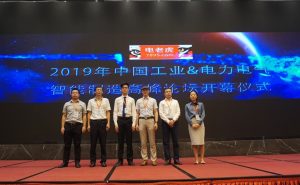
Intelligent Power and Electrical Automation, on June 27, 2019, the China Industrial & Electric Power Intelligent Manufacturing Summit Forum was successfully held at Nanjing Jingfeng Marriott Hotel. Frost & Sullivan (hereinafter referred to as 'Frost & Sullivan') served as a major member and event co-organizer of this forum, actively assisting the organizer, Dianlao Tiger Network, in organizing the event. Co-organizers included Schneider Electric (China) Co., Ltd., Xiamen Haipurui Technology Co., Ltd., Jiangsu Dianyiedaituo Electric Power Technology Co., Ltd., Nanjing Yanhui Network Technology Co., Ltd., Central South Hi-Tech Jiangsu Regional Company, and Electric City. The event aimed to showcase the achievements of intelligent development in the power and electrical industry and assist enterprises within the industry in their intelligent manufacturing development.
The summit forum invited academic expert representatives such as Dr. Chen Saisuan from Jiangsu Jicui Intelligent Manufacturing Technology Research Institute and Dr. Li Xiaodong from Nanjing Intelligent Manufacturing Research Institute; it also included corporate management representatives including Mr. Chen Yizhi from Xiamen Haiprui Technology Co., Ltd., Mr. Yang Zhuowei from Jiangsu Dianyi Diantuo Electric Power Technology Co., Ltd., Mr. Xu Zhijun from Schneider Electric (China) Co., Ltd., Mr. Du Yan, CEO of Nanjing Yanhui Network Technology Co., Ltd., and Mr. Wang Yudong from the Jiangsu regional company of Zhongnan Hi-Tech. Ms. Zhao Xueke, an analyst from Frost & Sullivan's Nanjing research institute, participated in the entire event as a special guest and delivered a keynote speech on 'An Overview of Frost & Sullivan's 2019 China Power and Electrical Industry White Paper' on behalf of Frost & Sullivan.
During the expert sharing session, Dr. Chen Saisuan from Jiangsu Jicui Intelligent Manufacturing Technology Research Institute delivered a keynote speech titled "Key Technologies and Applications of Intelligent Manufacturing and Its Intelligent Robots," sharing the most cutting-edge intelligent manufacturing technologies and applications with the attendees. Next, Dr. Li Xiaodong from Nanjing Intelligent Manufacturing Research Institute delivered a keynote speech titled "The Development and Application of Cloud Manufacturing," introducing the development history and current application status of cloud manufacturing. The Nanjing Frost & Sullivan Research Institute is deeply rooted in the Yangtze River Delta region, integrating 58 years of consulting experience from Frost & Sullivan. Based on the booming Chinese market economy, it provides reliable market investment, financing, strategic, and management consulting services to emerging enterprises and investment institutions from a global perspective. It also focuses on developing extended industrial chains, leveraging the innovative capabilities of higher education institutions and research organizations to lead the transformation and upgrading of upstream and downstream industries, cultivate and incubate innovative and entrepreneurial enterprises, and train professionals.
The following isExcerpts from 'Frost & Sullivan2019 China Electric Power and Electrical Equipment Industry White Paper'
![]()
Overview of China's Electric Power and Electrical Engineering Industry
Overview of the Definition and Segmented Industries of China's Electric Power and Electrical Engineering Industry
Electrical power and electrical engineering belong to the field of electrical engineering and are one of the core disciplines in modern science and technology. Electricity is a general term for engineering fields such as the production, transmission, distribution, use of electric energy, and the manufacturing of electrical equipment. Electric power is an energy source that uses electric energy as its driving force and forms the strong current part of electrical engineering. It mainly covers aspects such as power generation systems, power line transmission, and high and low voltage conversion. The electrical power and electrical engineering industry mainly includes sub-industries such as frequency converters, transformers, high-voltage electrical appliances, low-voltage electrical appliances, complete sets of high and low voltage electrical equipment, power generation equipment, and wires and cables.
The market scale of electric power and electrical equipment in China will continue to grow.
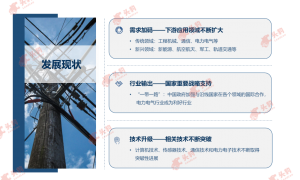
To advance the transformation of industrial informatization construction, the government has vigorously promoted the popularization of power and electrical automation equipment in fields such as smart grids, rail transit, new energy generation, and communications. Driven by the 'Belt and Road Initiative', China's foreign trade partners have become more diversified, and the overall trade growth rate of countries along the 'Belt and Road' is relatively high, which is expected to become one of the main positive factors for the power and electrical industry.
Against the backdrop of continuous breakthroughs in computer technology, sensor technology, communication technology, and power electronics technology, China's power and electrical industry has made significant technological improvements over the years based on advanced foreign technologies. The technical parameters of domestic electrical equipment at voltage levels of 500 kV and below have approached or even surpassed international first-class standards, basically meeting the development needs of China's power and electrical industry.
Potential Risks in the Chinese Electric Power and Electrical Equipment Market
Analysis of the Power and Electrical Industry Chain in China
The downstream coverage of the power and electrical industry's industrial chain is extensive, with strong demand for electricity.
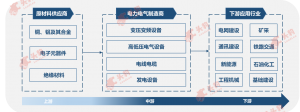
The industrial chain development of China's power and electrical industry is relatively complete. Power and electrical manufacturers are located in the middle of the industrial chain, playing a connecting role throughout the entire chain. The upstream of the industrial chain mainly consists of raw material industries such as metal materials, electronic components, insulating materials, and rare earths. The downstream includes application industries such as urban construction, metallurgy, power grids, construction machinery, communications, and railway transportation. The supply of upstream metal raw materials is the foundation for the development of the power and electrical industry, and the development of the power and electrical industry drives the development of upstream raw material industries. The development of downstream application fields is the driving force for the development of the power and electrical industry, while the power and electrical industry is the basic supporting industry for the development of its downstream industries.
Electric energy in the power system is mostly transmitted to end-users through high and low voltage electrical equipment, wires and cables, frequency converters, and other devices. Therefore, the market demand for the power and electrical industry is closely linked to the development of electricity consumption across society. From 2012 to 2018, China's total electricity consumption steadily increased, rising from 5523.3 billion kilowatt-hours in 2014 to 6844.9 billion kilowatt-hours in 2018, with an annual compound growth rate of 5.5%. It is expected that in the context of continuous growth in total electricity consumption, the market demand for power and electrical products will gradually increase in the future.
Analysis of the upstream industry chain
Other materials have a smaller impact on industry costs, and prices remain basically stable.
![]()
The upstream market of the industry consists of basic material industries that provide raw materials for wire and cable products. The structure of wire and cable products can be divided into conductors, insulation layers, shielding layers, and protective layers. Wire and cables with special requirements also need components such as fillers and tensile elements. The manufacturing technology of other materials and devices in China has stabilized, with small price fluctuations, and has basically achieved self-production and self-marketing domestically. Therefore, their impact on industry costs is minimal, and prices remain basically stable.
Analysis of the Downstream of the Industrial Chain
Power grid construction is mainly responsible for the enterprise
The construction and renovation of power grids will directly affect the market demand for electrical equipment. The demand for high-voltage electrical appliances mainly comes from the upgrading of distribution networks, the construction of UHV power grids, and the development of smart grids. Procurement for power grid construction is usually carried out through public bidding, conducted by the State Grid Corporation of China (hereinafter referred to as 'State Grid') and China Southern Power Grid Co., Ltd. (hereinafter referred to as 'CSG'). Unqualified high-voltage electrical appliances can affect power supply safety and equipment safety, leading to serious consequences. State Grid and CSG have high quality requirements for purchased products, with strict professional testing standards, supervision standards, and sampling inspection standards, placing extremely high demands on electrical performance, quality, and operation conditions. Currently, power grid construction is undergoing new rural power grid renovations and upgrades, as well as research and practice on grid intelligence. Against the backdrop of power system upgrades, manufacturers of electrical equipment with stronger safety and higher equipment operational stability are expected to gain an incremental market share in this area.
The 'Power Development 13th Five-Year Plan (2016-2020)' proposes the construction of a 'West-East Power Transmission' pipeline, which mainly combines UHV transmission technology with conventional transmission technology. It is expected to add an additional capacity of 130 million kilowatts, bringing the total to around 270 million kilowatts. The grid structure will be further optimized to enhance system safety levels; a comprehensive survey and demonstration of the national power grid pattern will be carried out, the main grid framework will be upgraded, grid interconnections between provinces and cities will be strengthened, flexible interconnection under the environment of large power grids will be explored, and the complementary and interoperable capabilities of regional inter-provincial power grids will be improved. It is anticipated that this will drive a continuous rise in demand for the power and electrical industry.
The 'Information and Communication Industry Development Plan (2016-2020)' requires that the communication industry expand broadband coverage and access capabilities, and achieve full coverage of fiber optics and 4G in urban and rural areas; plans to launch commercial 5G services, build new core transmission networks with large transmission capacity, high transmission speed, and ease of maintenance and management; improve commercial satellite communication services, construct a global communication system, and enhance communication service quality; further expand the coverage of international sea, land, and aerial cables, enhance network accessibility, and put forward more comprehensive requirements for the industrial layout of the power and electrical industries.
The development of the new energy sector will increase the demand for power electrical products in the nuclear power, wind power, and solar photovoltaic industry chains. As of March 2018, China had a total of 17 built and under-construction nuclear power plants, with a nuclear power installed capacity of 25 million kilowatts. By 2020, the total installed capacity is expected to reach 45 million kilowatts. During the "13th Five-Year Plan" period, China will add an additional 20 million kilowatts of nuclear power installed capacity, which will significantly increase the total value of China's nuclear power cable demand by over one hundred billion yuan. In 2018, the national wind and photovoltaic installed capacity reached 360 million kilowatts, accounting for nearly 20% of the total installed capacity. The annual power generation from wind and photovoltaics is 600 billion kilowatt-hours, accounting for about 9% of the total power generation.
Market scale of China's power and electrical industry
Important national strategic support and continuous expansion in downstream application fieldsJointly promote the rapid development of China's power and electrical industry
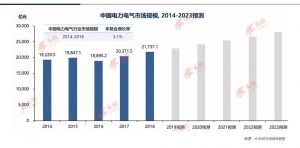
In 2014, the market scale of China's power and electrical industry was 1922.05 billion yuan. By 2018, the market scale had increased to 2173.71 billion yuan, with an annual compound growth rate of about 3.1%. Against the backdrop of national important strategic support, continuous breakthroughs in related technologies, and expanding downstream application fields, China's power and electrical industry will embrace sustained and stable development.
Market Development Trends of China's Electric Power and Electrical Engineering Industry
The construction of the ubiquitous power Internet of Things promotes the digital transformation of the power grid
Ubiquitous power Internet of Things (IoT) and smart grid are two important components of the energy Internet. The ubiquitous power IoT is a smart service system that revolves around all aspects of the power system, fully utilizing modern information technologies such as mobile internet and artificial intelligence, as well as advanced communication technology, to achieve interconnection of everything and human-machine interaction in all aspects of the power system. The smart grid uses sensors to monitor the operating conditions of key equipment in real time, collects and integrates data through the network system, and optimizes the management of the entire power system through data analysis and mining. For safety reasons, the power information elements contained in the smart grid are separated from external social information elements, while the ubiquitous power IoT uses the IoT network to become a secure bridge connecting power information with user terminals. The ubiquitous power IoT has clear distinctions from the smart grid in terms of construction goals, functions, and network nature; they integrate and parallel each other, and it can be said that the ubiquitous power IoT is a strategic continuation of the smart grid's construction. The next five years are a critical period for the construction of the ubiquitous power IoT. With the implementation of construction projects, the grid is about to embrace a comprehensive digital transformation, and the informatization construction of power and electrical systems will reach an accelerated inflection point.
The industry is developing towards intelligence, technology, and integration.
The rapid development of the Internet and communication technologies has made power and electrical related products increasingly intelligent. Intelligent manufacturing equipment, digital workshops, electromagnetic technology, and integrated detection equipment technology will provide effective solutions for producing more reliable and stable power and electrical products, promoting the realization of functions such as product data sharing, centralized control, monitoring, and communication. Traditional power and electrical enterprises are facing a transformation in technology and structure, while the 'Belt and Road' initiative provides new opportunities for cooperation and development with leading international companies, helping to accelerate the enterprise transformation cycle and quickly occupy market shares in China and internationally. The advancement of technological levels drives the country towards informatization and intelligence, promotes higher requirements from downstream application fields for power and electrical supporting industries, prompts the power and electrical industry to shift its focus towards technological innovation, increases the investment proportion of innovation research and development in corporate development strategies, strengthens cooperation with leading international companies, and introduces high-end production technologies. In terms of size, power and electrical related products tend to be small in volume and highly integrated. Integrated power and electrical products have advantages such as saving floor space, energy consumption, and materials, and improving urban environments. Integrated equipment is gradually becoming a new trend in industry development.
The continuous improvement of Internet of Things and artificial intelligence technologies has driven the power and electrical industry towards rapid intelligent development.![]() The focus of the development of China's electric power and electrical engineering industry will shift in the future to enhancing independent innovation capabilities, improving product quality, etc., aiming to break foreign monopolies on key technologies and strengthen competitiveness on the international stage.
Integrated power transmission, distribution, and control equipment have advantages such as saving floor space, energy consumption, and materials, and improving the urban environment. Integrated products are gradually becoming a development trend in the industry.
The development of the power and electrical infrastructure in sectors such as construction machinery, mining, railway transportation, petrochemicals, and communication construction has promoted the layout of supporting facilities. Affected by the acceleration of real estate and infrastructure construction, the power grid system relied on for basic urban and rural life has become increasingly perfect. The construction and renovation of the power grid will directly affect the market demand for electrical equipment. The continuous improvement of ubiquitous power Internet of Things and artificial intelligence technologies has prompted the power and electrical industry to develop rapidly in the direction of intelligence and integration. In the future, the focus of China's power and electrical industry development will shift to enhancing independent innovation capabilities and product quality, in order to break foreign monopolies on key technologies and enhance the competitiveness of Chinese enterprises on the international stage.
The focus of the development of China's electric power and electrical engineering industry will shift in the future to enhancing independent innovation capabilities, improving product quality, etc., aiming to break foreign monopolies on key technologies and strengthen competitiveness on the international stage.
Integrated power transmission, distribution, and control equipment have advantages such as saving floor space, energy consumption, and materials, and improving the urban environment. Integrated products are gradually becoming a development trend in the industry.
The development of the power and electrical infrastructure in sectors such as construction machinery, mining, railway transportation, petrochemicals, and communication construction has promoted the layout of supporting facilities. Affected by the acceleration of real estate and infrastructure construction, the power grid system relied on for basic urban and rural life has become increasingly perfect. The construction and renovation of the power grid will directly affect the market demand for electrical equipment. The continuous improvement of ubiquitous power Internet of Things and artificial intelligence technologies has prompted the power and electrical industry to develop rapidly in the direction of intelligence and integration. In the future, the focus of China's power and electrical industry development will shift to enhancing independent innovation capabilities and product quality, in order to break foreign monopolies on key technologies and enhance the competitiveness of Chinese enterprises on the international stage.
Contact: marketing@frostchina.com