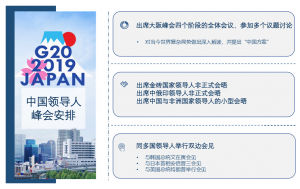
The 14th Summit of the G20 Leaders was officially held yesterday (June 28) in Osaka, Japan. Chinese President Xi Jinping arrived in Osaka on June 27 by special plane. During the G20 Summit, President Xi Jinping's schedule revolved around three aspects: (1) Attending the plenary sessions of four stages of the summit, participating in discussions on topics such as the world economy and trade, digital economy, inclusive and sustainable development, infrastructure, climate, energy, environment, etc., deeply elaborating on his views and propositions on the world economic situation, and striving to find the root causes, identify the pulse, and prescribe effective solutions to current problems; (2) Attending three multilateral 'mini-summits', namely informal meetings of BRICS leaders, informal meetings of China-Russia-India leaders, and a small meeting of African leaders, to strengthen communication and coordination on major issues such as deepening cooperation between emerging markets and developing countries and implementing the United Nations' 2030 Agenda for Sustainable Development, and promote practical cooperation; (3) Holding bilateral meetings with leaders of multiple countries, committed to deepening cooperation with relevant countries and promoting the forward development of bilateral relations.
President Xi delivered an important speech, putting forward suggestions on the G20's joint efforts to build a high-quality global economy
On the 28th, President Xi Jinping attended the summit and delivered an important speech titled 'Working Together to Build a High-Quality World Economy,' emphasizing that the G20 should adhere to reform and innovation to tap into growth drivers; keep pace with the times to improve global governance; face challenges head-on to break through development bottlenecks; and uphold the spirit of partnership to properly handle differences. Xi Jinping announced that China will further open its markets, strive for high-quality development, and make unremitting efforts to create a brighter future for the world economy. In this important conversation, Xi Jinping announced five major measures for China's opening up to the outside world, namely further opening markets, actively expanding imports, continuously improving the business environment, fully implementing equal treatment, and vigorously promoting economic and trade negotiations. In response to Xi Jinping's important speech, experts at home and abroad believe that President Xi Jinping has pointed the way for the world economy and global governance with precise and targeted proposals, injecting strong confidence into the development of the world economy; the announced measures convey China's firm determination to follow the path of opening up and cooperation to the world.
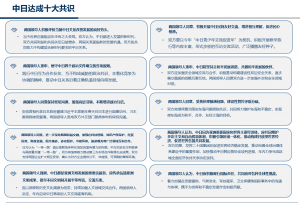
President Xi attended three multilateral 'summits within summits', further deepening China's cooperative relations with multiple countries and regions![]() During the BRICS Summit, President Xi Jinping had in-depth exchanges of views with Brazilian President Jair Bolsonaro, Russian President Vladimir Putin, Indian Prime Minister Narendra Modi, and South African President Cyril Ramaphosa on topics such as the BRICS partnership, global governance, and scientific and technological innovation cooperation, reaching broad consensus. President Xi Jinping put forward three initiatives at the meeting: strengthening the BRICS strategic partnership, promoting the improvement of global governance, and deepening practical cooperation in various fields, which pointed out the direction for further strengthening unity and cooperation among BRICS countries. After the meeting, the BRICS leaders issued a joint press communiqué on the Osaka Summit.
★ China-Africa Leaders' Meeting
The China-Africa Leaders' Meeting was chaired by President Xi Jinping. The foreign leaders attending included former Chairperson of the Forum for China-Africa Cooperation, South African President Cyril Ramaphosa, rotating Chairperson of the African Union, Egyptian President Abdel Fattah el-Sisi, current Chairperson of the Forum for China-Africa Cooperation, Senegalese President Macky Sall, and United Nations Secretary-General António Guterres. President Xi Jinping put forward three proposals on China-Africa cooperation: to be a pioneer in win-win development, a leader in open cooperation, and a defender of multilateralism. From the 'Ten Major Cooperation Plans' to the 'Eight Actions', and then to jointly building the Belt and Road Initiative, under the personal promotion of President Xi Jinping, the bonds of the China-Africa Community with a Shared Future are becoming tighter.
★ Leadership Meeting among China, Russia and India
During the meeting of leaders from China, Russia, and India, President Xi Jinping had in-depth exchanges with President Putin and Prime Minister Modi on the current international situation, major international and regional issues, and tripartite cooperation. President Xi Jinping pointed out that at present, protectionism and unilateralism are on the rise, seriously affecting global stability, dragging down world economic growth, and also having a negative impact on the international order on which emerging market countries and developing countries depend for survival that cannot be ignored. China, Russia, and India should demonstrate their due international responsibilities and safeguard the fundamental and long-term interests of the three countries as well as the international community. The leaders of the three countries unanimously agreed to continue to maintain, make good use of, and develop the China-Russia-India cooperation mechanism to make greater contributions to promoting regional and even global peace, stability, and prosperity.
President Xi held bilateral meetings with leaders of many countries and reached a number of consensus on economic trade, maintaining peace, and other aspects
★ Meeting with South Korean President Moon Jae-in, emphasizing cooperation to expand third-party markets
During the summit, President Xi Jinping met with South Korean President Moon Jae-in. President Xi Jinping proposed to seize the opportunity of jointly building the Belt and Road Initiative, accelerate negotiations for the second phase of the China-South Korea Free Trade Agreement, and continuously expand cooperation in trade, science and technology, finance, environmental protection, and other fields. Moon Jae-in stated that his side is willing to strengthen high-level exchanges with China, promote dialogue and cooperation in various fields, complete the second phase of the China-South Korea Free Trade Agreement as soon as possible, and elevate South Korean-Chinese relations to a new level. His side is willing to jointly build the Belt and Road Initiative with China and cooperate to expand third-party markets. The heads of state also exchanged views on the situation on the Korean Peninsula. Xi Jinping stated that China supports North and South Korea in holding a new round of leaders' meetings, hopes that both sides will show flexibility towards each other, and strive for progress in dialogue. The Peninsula should adhere to the direction of denuclearization, while the reasonable concerns of the North Korean side should also be taken seriously and responded to. Moon Jae-in stated that a few days ago, President Xi Jinping's visit to North Korea played a constructive role in promoting the momentum of dialogue on the Peninsula and maintaining peace and stability on it, making important contributions. His side will continue to work towards improving relations between the north and south, be willing to strengthen cooperation with China, and contribute to achieving the goal of denuclearization and permanent peace and stability.
★ Meeting with Japanese Prime Minister Shinzo Abe, reaching ten consensus points
During the summit, President Xi Jinping met with Japanese Prime Minister Shinzo Abe. Xi Jinping emphasized that both sides should always abide by the principles established in the four political documents between China and Japan, practice the political consensus of 'mutual cooperation as partners and non-threat to each other', enhance mutual trust, and promote the development of Sino-Japanese relations along the correct track of peace, friendship, and cooperation. It is necessary to deepen cooperation in a wide range of areas such as economy and trade, investment, third-party markets, and technological innovation, create new points of growth for cooperation, and actively lead regional economic integration. Abe stated that his side is willing to comply with important political documents between the two countries such as the 'Japan-China Peace and Friendship Treaty', and based on the consensus of 'transforming competition into coordination, mutual cooperation as partners, and non-threat to each other', continue to work together with China to build Sino-Japanese relations that meet the requirements of the new era and ensure their long-term stable development. The Japanese side hopes to expand cooperation in areas such as economy and trade, investment, finance, innovation, etc., and is willing to provide a fair, open, transparent, and non-discriminatory market environment for mutual business between the two sides. The leaders of both countries agreed that they should focus on consensus, manage differences, and jointly promote the healthy development of bilateral relations. It is reported that the talks lasted one hour and the two sides reached ten points of consensus.
During the BRICS Summit, President Xi Jinping had in-depth exchanges of views with Brazilian President Jair Bolsonaro, Russian President Vladimir Putin, Indian Prime Minister Narendra Modi, and South African President Cyril Ramaphosa on topics such as the BRICS partnership, global governance, and scientific and technological innovation cooperation, reaching broad consensus. President Xi Jinping put forward three initiatives at the meeting: strengthening the BRICS strategic partnership, promoting the improvement of global governance, and deepening practical cooperation in various fields, which pointed out the direction for further strengthening unity and cooperation among BRICS countries. After the meeting, the BRICS leaders issued a joint press communiqué on the Osaka Summit.
★ China-Africa Leaders' Meeting
The China-Africa Leaders' Meeting was chaired by President Xi Jinping. The foreign leaders attending included former Chairperson of the Forum for China-Africa Cooperation, South African President Cyril Ramaphosa, rotating Chairperson of the African Union, Egyptian President Abdel Fattah el-Sisi, current Chairperson of the Forum for China-Africa Cooperation, Senegalese President Macky Sall, and United Nations Secretary-General António Guterres. President Xi Jinping put forward three proposals on China-Africa cooperation: to be a pioneer in win-win development, a leader in open cooperation, and a defender of multilateralism. From the 'Ten Major Cooperation Plans' to the 'Eight Actions', and then to jointly building the Belt and Road Initiative, under the personal promotion of President Xi Jinping, the bonds of the China-Africa Community with a Shared Future are becoming tighter.
★ Leadership Meeting among China, Russia and India
During the meeting of leaders from China, Russia, and India, President Xi Jinping had in-depth exchanges with President Putin and Prime Minister Modi on the current international situation, major international and regional issues, and tripartite cooperation. President Xi Jinping pointed out that at present, protectionism and unilateralism are on the rise, seriously affecting global stability, dragging down world economic growth, and also having a negative impact on the international order on which emerging market countries and developing countries depend for survival that cannot be ignored. China, Russia, and India should demonstrate their due international responsibilities and safeguard the fundamental and long-term interests of the three countries as well as the international community. The leaders of the three countries unanimously agreed to continue to maintain, make good use of, and develop the China-Russia-India cooperation mechanism to make greater contributions to promoting regional and even global peace, stability, and prosperity.
President Xi held bilateral meetings with leaders of many countries and reached a number of consensus on economic trade, maintaining peace, and other aspects
★ Meeting with South Korean President Moon Jae-in, emphasizing cooperation to expand third-party markets
During the summit, President Xi Jinping met with South Korean President Moon Jae-in. President Xi Jinping proposed to seize the opportunity of jointly building the Belt and Road Initiative, accelerate negotiations for the second phase of the China-South Korea Free Trade Agreement, and continuously expand cooperation in trade, science and technology, finance, environmental protection, and other fields. Moon Jae-in stated that his side is willing to strengthen high-level exchanges with China, promote dialogue and cooperation in various fields, complete the second phase of the China-South Korea Free Trade Agreement as soon as possible, and elevate South Korean-Chinese relations to a new level. His side is willing to jointly build the Belt and Road Initiative with China and cooperate to expand third-party markets. The heads of state also exchanged views on the situation on the Korean Peninsula. Xi Jinping stated that China supports North and South Korea in holding a new round of leaders' meetings, hopes that both sides will show flexibility towards each other, and strive for progress in dialogue. The Peninsula should adhere to the direction of denuclearization, while the reasonable concerns of the North Korean side should also be taken seriously and responded to. Moon Jae-in stated that a few days ago, President Xi Jinping's visit to North Korea played a constructive role in promoting the momentum of dialogue on the Peninsula and maintaining peace and stability on it, making important contributions. His side will continue to work towards improving relations between the north and south, be willing to strengthen cooperation with China, and contribute to achieving the goal of denuclearization and permanent peace and stability.
★ Meeting with Japanese Prime Minister Shinzo Abe, reaching ten consensus points
During the summit, President Xi Jinping met with Japanese Prime Minister Shinzo Abe. Xi Jinping emphasized that both sides should always abide by the principles established in the four political documents between China and Japan, practice the political consensus of 'mutual cooperation as partners and non-threat to each other', enhance mutual trust, and promote the development of Sino-Japanese relations along the correct track of peace, friendship, and cooperation. It is necessary to deepen cooperation in a wide range of areas such as economy and trade, investment, third-party markets, and technological innovation, create new points of growth for cooperation, and actively lead regional economic integration. Abe stated that his side is willing to comply with important political documents between the two countries such as the 'Japan-China Peace and Friendship Treaty', and based on the consensus of 'transforming competition into coordination, mutual cooperation as partners, and non-threat to each other', continue to work together with China to build Sino-Japanese relations that meet the requirements of the new era and ensure their long-term stable development. The Japanese side hopes to expand cooperation in areas such as economy and trade, investment, finance, innovation, etc., and is willing to provide a fair, open, transparent, and non-discriminatory market environment for mutual business between the two sides. The leaders of both countries agreed that they should focus on consensus, manage differences, and jointly promote the healthy development of bilateral relations. It is reported that the talks lasted one hour and the two sides reached ten points of consensus.
![]() ★ Meeting with US President Trump, where the two leaders agreed to restart bilateral economic and trade consultations
During the summit, President Xi Jinping met with US President Trump. The heads of state exchanged in-depth views on fundamental issues concerning the development of Sino-US relations, current Sino-US economic and trade frictions, and international and regional issues of common concern, setting a direction for the next phase of bilateral relations and agreeing to advance Sino-US relations characterized by coordination, cooperation, and stability. The heads of state agreed to restart economic and trade consultations based on equality and mutual respect, with the US no longer imposing new tariffs on Chinese products. The economic and trade teams of both countries will discuss specific issues, which will be of historical significance. Xi Jinping expounded on the principle stance of the Chinese government on the Taiwan issue. Trump stated that he values China's concerns over the Taiwan issue and that the US continues to adhere to the One-China policy. In addition, Xi Jinping reiterated China's principle stance on the Korean Peninsula issue, expressing support for the leaders of the United States and North Korea to maintain dialogue and contact, hoping that the two sides can restart dialogue as soon as possible to find solutions to their mutual concerns. China is willing to continue playing a constructive role in this regard. Trump stated that the US values China's important role on the Korean Peninsula issue and is willing to maintain communication and coordination with China.
Against the backdrop of tense international situations and the rise of unilateralism and protectionism, the convening of the G20 Summit provided a good platform for equal exchanges and win-win cooperation in resolving international issues. During the conference, leaders from multiple countries expressed concern about the dangers posed by current unilateralism and protectionism, calling for adherence to multilateralism, strengthened cooperation, and joint efforts to address challenges. China believes that only on the basis of equality and cooperation can international disputes be resolved, which is also the common expectation of the international community. China will always maintain the multilateral trading system, adhere to inclusiveness and openness, support win-win cooperation, and resolutely oppose unilateralism, protectionism, and international hegemony.
Frost & Sullivan is a leader in providing industry advisory services for companies seeking to list on the Hong Kong and overseas stock markets. The firm continuously monitors developments in China's politics, economy, culture, and other aspects, and has extensive research experience covering most industries across both traditional and new economies, including environmental protection, information technology, financial services, energy and power, and many other fields.
Regarding the environmental protection area, one of the eight topics of this G20 summit, Frost & Sullivan has accumulated rich research results over the years, covering a wide range of sub-sectors such as industrial wastewater treatment, municipal sewage treatment, hazardous waste treatment, and soil pollution remediation. As of the end of June 2019, the Frost & Sullivan Greater China office has assisted nearly 20 environmental protection enterprises including Peiran Environmental Protection, Everbright Environmental Protection, and Weigang Environmental Protection in going public. In the future, Frost & Sullivan will continue to leverage its rich research findings to provide strong support for the sustainable development of the Chinese economy.
Focus on Frost & Sullivan Research - China Industrial Wastewater Treatment Industry Report (Excerpt)
Definition and Classification of China's Industrial Wastewater Treatment Industry
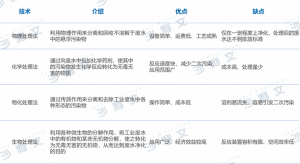
Industrial wastewater refers to the waste water, sewage, and effluents generated during industrial production processes. It usually contains industrial materials, by-products, and pollutants produced during the manufacturing process. Industrial wastewater treatment involves the appropriate treatment of water used in industrial production processes before it is reused for production or discharged from the factory. This can effectively manage wastewater generated in the industrial sector and reduce environmental pollution. As one of the important links in environmental governance, industrial wastewater treatment has characteristics such as harmless treatment, reduction, and socialization, and is widely applied in industries such as pharmaceuticals, printing and dyeing, chemicals, steel, etc. Industrial wastewater treatment adopts different treatment measures according to the nature of pollutants in the wastewater. Based on their treatment processes, they can be divided into physical treatment methods, chemical treatment methods, physicochemical treatment methods, biological treatment methods, etc. Among them, the activated sludge method in biological treatment has a high chemical conversion efficiency and performs well in treating pollutants in organic industrial wastewater. It is currently the most widely used industrial wastewater treatment process.
★ Meeting with US President Trump, where the two leaders agreed to restart bilateral economic and trade consultations
During the summit, President Xi Jinping met with US President Trump. The heads of state exchanged in-depth views on fundamental issues concerning the development of Sino-US relations, current Sino-US economic and trade frictions, and international and regional issues of common concern, setting a direction for the next phase of bilateral relations and agreeing to advance Sino-US relations characterized by coordination, cooperation, and stability. The heads of state agreed to restart economic and trade consultations based on equality and mutual respect, with the US no longer imposing new tariffs on Chinese products. The economic and trade teams of both countries will discuss specific issues, which will be of historical significance. Xi Jinping expounded on the principle stance of the Chinese government on the Taiwan issue. Trump stated that he values China's concerns over the Taiwan issue and that the US continues to adhere to the One-China policy. In addition, Xi Jinping reiterated China's principle stance on the Korean Peninsula issue, expressing support for the leaders of the United States and North Korea to maintain dialogue and contact, hoping that the two sides can restart dialogue as soon as possible to find solutions to their mutual concerns. China is willing to continue playing a constructive role in this regard. Trump stated that the US values China's important role on the Korean Peninsula issue and is willing to maintain communication and coordination with China.
Against the backdrop of tense international situations and the rise of unilateralism and protectionism, the convening of the G20 Summit provided a good platform for equal exchanges and win-win cooperation in resolving international issues. During the conference, leaders from multiple countries expressed concern about the dangers posed by current unilateralism and protectionism, calling for adherence to multilateralism, strengthened cooperation, and joint efforts to address challenges. China believes that only on the basis of equality and cooperation can international disputes be resolved, which is also the common expectation of the international community. China will always maintain the multilateral trading system, adhere to inclusiveness and openness, support win-win cooperation, and resolutely oppose unilateralism, protectionism, and international hegemony.
Frost & Sullivan is a leader in providing industry advisory services for companies seeking to list on the Hong Kong and overseas stock markets. The firm continuously monitors developments in China's politics, economy, culture, and other aspects, and has extensive research experience covering most industries across both traditional and new economies, including environmental protection, information technology, financial services, energy and power, and many other fields.
Regarding the environmental protection area, one of the eight topics of this G20 summit, Frost & Sullivan has accumulated rich research results over the years, covering a wide range of sub-sectors such as industrial wastewater treatment, municipal sewage treatment, hazardous waste treatment, and soil pollution remediation. As of the end of June 2019, the Frost & Sullivan Greater China office has assisted nearly 20 environmental protection enterprises including Peiran Environmental Protection, Everbright Environmental Protection, and Weigang Environmental Protection in going public. In the future, Frost & Sullivan will continue to leverage its rich research findings to provide strong support for the sustainable development of the Chinese economy.
Focus on Frost & Sullivan Research - China Industrial Wastewater Treatment Industry Report (Excerpt)
Definition and Classification of China's Industrial Wastewater Treatment Industry
Industrial wastewater refers to the waste water, sewage, and effluents generated during industrial production processes. It usually contains industrial materials, by-products, and pollutants produced during the manufacturing process. Industrial wastewater treatment involves the appropriate treatment of water used in industrial production processes before it is reused for production or discharged from the factory. This can effectively manage wastewater generated in the industrial sector and reduce environmental pollution. As one of the important links in environmental governance, industrial wastewater treatment has characteristics such as harmless treatment, reduction, and socialization, and is widely applied in industries such as pharmaceuticals, printing and dyeing, chemicals, steel, etc. Industrial wastewater treatment adopts different treatment measures according to the nature of pollutants in the wastewater. Based on their treatment processes, they can be divided into physical treatment methods, chemical treatment methods, physicochemical treatment methods, biological treatment methods, etc. Among them, the activated sludge method in biological treatment has a high chemical conversion efficiency and performs well in treating pollutants in organic industrial wastewater. It is currently the most widely used industrial wastewater treatment process.
Classification of industrial wastewater treatment processes
Source: Developed by Frost & Sullivan Research
Current Situation of Industrial Wastewater Treatment Industry
An analysis of the industrial wastewater treatment demand in major countries around the world from 2018 shows that the United States has accounted for the largest market share with 28.1%, followed by China, the European Union, and Japan, accounting for 25.2%, 18.2%, and 15.6% respectively. The industry in the United States consists of mining, manufacturing, infrastructure, and public facilities, among which agricultural manufacturing is relatively mature, with high value stability, which has driven an increase in the demand for industrial wastewater treatment in the country. China's rapidly developing economy has driven industrial development, with its industrial output ranking among the top in the world, becoming an important support for global industrial growth, thereby stimulating an expansion of the demand for industrial wastewater treatment in China. In Europe, America, Japan, due to their relatively strict emission standards in industrial wastewater treatment regulations, market demand tends to be steadily increasing.
Global industrial wastewater treatment demand proportion, 2018
Source: Software compilation by fsTEAM, prepared by Frost & Sullivan's data center.
Market scale of industrial wastewater treatment in China
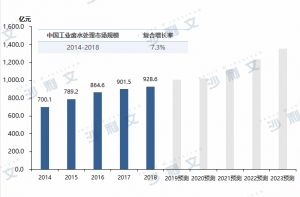
From 2014 to 2018, the market scale of China's industrial wastewater treatment industry increased from 70 billion yuan to 928.6 billion yuan, with an annual compound growth rate of 7.3%. With the development of domestic industries such as chemical engineering, coal, and electronic components, various industrial park projects are gradually advancing. The market scale of China's industrial wastewater treatment will continue to show an upward trend, and it is expected that between 2019 and 2023, the market scale of industrial wastewater treatment in China will steadily increase.
Market scale of industrial wastewater treatment in China, forecast for 2014 - 2023
Source: Software compilation by fsTEAM, prepared by Frost & Sullivan's data center.
The scale of the industrial wastewater treatment industry will continue to grow.
Benefiting from economic growth and the development of related infrastructure, China's industrial parks, high-tech industrial development zones, and ecological industrial parks have gradually increased in number, driving the demand for industrial wastewater treatment in China. At the same time, China has made significant breakthroughs in physical, chemical, and biological treatment technologies for industrial wastewater treatment, reducing the difficulty of implementing industrial wastewater treatment and thereby increasing its penetration rate in downstream application fields. The main factors driving the continuous growth of the industrial wastewater treatment industry include: ① Continuous growth in downstream industries, which drives up demand for industrial wastewater treatment; ② Increased environmental protection efforts in China, promoting industry development; ③ Continuous introduction of industrial policies, facilitating rapid industry development.
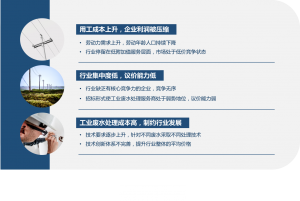
The development of the industrial wastewater treatment industry faces challenges
Firstly, the rise in labor costs has squeezed corporate profits. Industrial wastewater treatment is a labor-intensive industry with high demand for labor. However, China's working-age population is declining while the average wage of laborers continues to rise, driving up labor costs for enterprises. At the same time, most industrial wastewater treatment enterprises in China still remain at the low-value-added service level, and the market has long been in a state of low-price competition. The increase in labor costs will continue to squeeze corporate profit margins.
Secondly, the low concentration and bargaining power of the industrial wastewater treatment industry in China have affected its healthy development. The industry lacks core competitive enterprises, and the scale of enterprises is generally small, leading to disorderly competition. Most upstream enterprises connected to the industry are large Chinese companies or collective subsidiaries, which are stronger than industrial wastewater treatment enterprises in terms of strength and scale. Some large upstream enterprises adopt bidding methods when selecting industrial wastewater treatment service providers, putting industrial wastewater treatment enterprises in a weak position with limited bargaining power.
Thirdly, the high cost of industrial wastewater treatment also restricts the development of the industry. China's national environmental protection standards are constantly tightening, and technical requirements for industrial wastewater treatment are gradually increasing. Different fields of industrial wastewater require different treatment processes, and with technological and equipment innovation, the costs of these processes and equipment will also gradually rise, pushing up treatment costs. At the same time, the innovation capabilities of industrial wastewater treatment enterprises in China are not strong, resulting in leading enterprises charging inflated prices, further driving up industrial wastewater treatment costs.
China's industrial wastewater treatment industry chain
The industrial wastewater treatment industry chain in China is divided into three parts: upstream participants include raw material suppliers such as membrane materials and equipment suppliers like blowers. The midstream of the industry chain consists of industrial wastewater treatment service providers, while the downstream is composed of enterprises from industries such as textiles, petrochemicals, and coal.
China's industrial wastewater treatment industry chain
Source: Developed by Frost & Sullivan Research
There are numerous upstream manufacturers for industrial wastewater treatment, laying the foundation for the development of the midstream industry.
The upstream participants in industrial wastewater treatment in China include raw material suppliers and equipment providers. The raw materials for industrial wastewater treatment can be subdivided into membrane materials, chemical agents, chemicals, etc. At present, there are more than 100 types of water treatment agent products in China, and an independent research and development and industrialization system has been formed. The output and quality of various water treatment agents not only meet the needs of industrial wastewater treatment in China, but some products are also exported to international markets. The market supply of water treatment agents in China shows a relatively stable trend. There is a gap between China and developed countries in the reverse osmosis membrane market. At present, Chinese enterprises with independent research and development capabilities include Times Water Group and Bishuiyuan Water Group. Generally speaking, at present, there are many upstream manufacturers in the industrial wastewater treatment industry in China, and a relatively mature market operation mechanism has been formed with sufficient market supply, laying a good material foundation for the development of midstream industrial wastewater treatment service providers.
The downstream demand for industrial wastewater treatment is greatly affected by the macroeconomy.
The downstream application of the industrial wastewater treatment industry is in the industrial sector. Among them, textiles, petrochemicals, coal, and ferrous metals are the fields with the largest proportion of industrial wastewater treatment applications in China, accounting for more than 50% of the downstream application areas. The demand in the downstream market is greatly affected by global and Chinese macroeconomic conditions and national income levels. Changes in macroeconomic situations are closely related to the prosperity of downstream industries, thereby affecting the demand for industrial wastewater treatment.
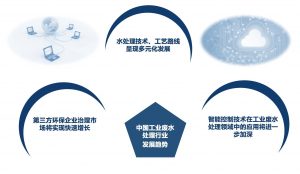
Development Trend of China's Industrial Wastewater Treatment Industry
The third-party environmental protection enterprise governance market will achieve rapid growth.
With the tightening of environmental protection policies, most industrial wastewater treatment facilities are either rebuilt or upgraded, and the market for third-party environmental protection enterprises is expected to expand further. The specific manifestations are as follows: ① Since 2015, the emphasis on environmental protection from the central government to local authorities has been increasing day by day, posing significant environmental risks to the self-operated water treatment model of industrial enterprises. To avoid these risks, industrial enterprises tend to outsource their industrial wastewater treatment projects to professional third-party environmental protection enterprises; ② With the expansion of urban scale and the main concentration of industrial parks in suburban areas, there have been a large number of industrial relocations, necessitating the reconstruction or upgrading of industrial water treatment facilities. Third-party environmental protection enterprises seize this opportunity and obtain a large number of industrial wastewater treatment facility projects through bidding; ③ With the continuous advancement of supply-side reform and state-owned enterprise reform in China, small and backward private enterprises in the country are being rapidly phased out, while large state-owned enterprises are accelerating mergers and reorganizations. The concentration of Chinese industrial enterprises will further increase, and large industrial enterprises (such as Baosteel, Wuhan Iron and Steel, etc.) tend to outsource their industrial wastewater treatment facilities, releasing third-party operational orders for industrial wastewater treatment.
Water treatment technologies and process routes are developing in a diversified manner.
Against the backdrop of favorable national policies, China's industrial wastewater treatment technology innovation capabilities have been significantly enhanced, driving up the level of industrial wastewater treatment in the country. Due to the complexity of industrial water pollutants, it is difficult for a single technology to achieve ideal results. Therefore, industrial wastewater treatment enterprises need to integrate comprehensive water treatment technologies through cross-application, complementarity, and collaboration, such as chemical-physical combined treatment methods and chemical-biological combined treatment methods, to achieve efficient, low-consumption, and environmentally friendly goals. On the other hand, in circulating cooling water systems where water consumption is relatively high, scale-inhibiting composite formulations are commonly used. However, since these phosphorus-based corrosion inhibitors can act as nutrients for bacteria and algae in water, they can lead to eutrophication and water quality pollution. Therefore, with the improvement of China's industrial wastewater treatment technology, developing low-phosphorus or phosphorus-free, nitrogen-free, biodegradable multifunctional environmentally friendly water treatment chemicals will become the mainstream research direction for industrial wastewater treatment.
The application of intelligent control technology in the field of industrial wastewater treatment will be further deepened.
In recent years, with the advancement of technologies such as artificial intelligence, cloud computing, and big data, intelligent industrial water treatment control technology has developed. Currently, intelligent computer software has been successfully applied in fields such as industrial water pretreatment and circulating cooling water systems. Advanced foreign computer programs can calculate based on the type of treated water, the types and performance of chemicals, and predetermined water quality conditions, thereby determining real-time water quality data and whether water treatment chemicals are suitable. This combination of computer technology with traditional water treatment technology enables automatic control and online analysis and detection of the water treatment process, achieving efficient and low-consumption goals. In addition, industrial wastewater treatment manufacturers use intelligent control technology to remotely monitor and control multiple parameters and signals such as industrial water quality, quantity, concentration changes of water treatment chemicals, corrosion current, fouling thermal resistance, and microbial control. These signals are then transmitted to a central control system, which outputs commands to the field for execution, achieving the purpose of saving water and reducing emissions, and saving chemicals, allowing the industrial wastewater treatment process to be carried out in a safer and more reliable environment.
Dr. Wang Xin, Global Partner of Frost & Sullivan, Vice President of Global Market Strategy Planning and President of the China Region, pointed out that China's industrial wastewater treatment technology has made certain breakthroughs in physical, chemical, and biological treatments, which has improved the implementation efficiency of industrial sewage treatment and thus increased the penetration rate of industrial wastewater treatment in downstream application fields. The Chinese government has introduced a series of environmental protection policies requiring relevant enterprises or entities in the industrial sector to strictly manage industrial wastewater, which has served as a constraint on enterprise wastewater emissions and also stimulated the growth of demand in the industrial wastewater treatment industry. With the gradual advancement of industrial wastewater treatment projects related to various industrial parks, high-tech industrial development zones, and ecological industrial parks in China, the market scale for industrial wastewater treatment in China will continue to show an upward trend.