


Skyege International Inc. (NASDAQ: SCAG) announced on June 27, 2025, local time in the United States, that it has officially completed its merger with Finnovate Acquisition Corp. and successfully listed on NASDAQ through a SPAC transaction on June 30, 2025, local time in the United States. The company is a leading pioneer and leader in zero-emission solutions in China, focusing on the research, development, and commercialization of new energy heavy trucks and electronic fuel solutions. Frost & Sullivan (hereinafter referred to as 'Frost & Sullivan') provided industry advisory services for this merger and acquisition, and hereby warmly congratulates on the successful completion of the transaction and listing.
Skyege International Limited (hereinafter referred to as 'Skyege') successfully went public on June 30, 2025. The company issued a maximum of 72,810,209 common shares (represented by American Depositary Receipts) and 21,737,500 warrants at an opening price of $11.69 per share. In addition, another 21,737,500 common shares (represented by American Depositary Receipts) can be issued after the exercise of the aforementioned warrants.
During the process of listing in the US, Frost & Sullivan mainly undertook the following tasks: helping the issuer accurately and objectively understand its positioning in the target market, using objective market data to discover, support, and highlight the issuer's competitive advantages, assisting the issuer, investment banks, and other intermediaries in completing the writing of relevant parts of the prospectus (such as the overview, competitive advantages and strategy, industry overview, business, and other important sections), helping the issuer communicate with the SEC and investors, assisting investors in quickly understanding the market ecosystem and competitive landscape, and assisting the issuer in completing feedback from regulatory authorities on various industry issues.
PART/1
Investment Highlights
-
The company is a pioneer and leader in zero-emission solutions for globalization strategies, with an advantageous market layout and the potential to seize significant market opportunities;
-
The company possesses a full range of vehicle models covering diverse commercial transportation needs;
-
The company possesses strong R&D capabilities and an independent core technology system with cooperative partnerships;
-
The company has achieved full coverage of the entire industrial chain and possesses mature customer service capabilities;
-
The company boasts visionary founders and a senior management team with rich experience.
PART/2
Overview of the Global and Chinese New Energy Vehicle Markets
After more than a decade of innovation and development, the global new energy vehicle (NEV) industry has made significant progress in technology, performance, and quality, and consumer awareness and acceptance of NEVs have also greatly increased. With the public's deeper understanding of the environmental attributes, long-range capabilities, and cutting-edge intelligent driving technologies of NEVs, the adoption rate of NEVs continues to rise. In addition, governments around the world are also actively promoting the transition of traditional internal combustion engine (ICE) vehicles to NEVs. Against this backdrop, the global new energy vehicle market has achieved rapid growth in terms of sales, increasing from 2.2 million units in 2018 to 11.7 million units in 2022, with an average annual compound growth rate of 52.7%. It is expected that by 2027, the market will reach 36.1 million units, with an average annual compound growth rate of 22.4% from 2023 to 2027. In 2022, China was the world's largest new energy vehicle market, accounting for about 58.8% of global new energy vehicle sales. It is expected that by 2027, China will continue to maintain its global leading position, with a market share of about 53.5%.
According to their purpose, new energy vehicles can be divided into new energy commercial vehicles and new energy passenger vehicles. New energy commercial vehicles are mainly used for commercial operations, especially in efficient transportation scenarios for goods or passengers; passenger new energy vehicles are designed for personal travel, focusing more on comfort and convenience. In terms of the global ownership of new energy vehicles, the market is currently dominated by passenger new energy vehicles. In 2018, passenger vehicles accounted for 78.4% of the global new energy vehicle market share, which rose to 93.1% by 2022 and is expected to further increase to 95.0% by 2027.
PART/3
Overview of the Global and Chinese New Energy Commercial Vehicle Markets
Commercial vehicles are specially designed and equipped for transporting more than nine people or goods for commercial purposes. Commercial vehicles typically prioritize cargo capacity, durability, and functionality, thus integrating features tailored to specific industry needs such as spacious cargo areas, specialized equipment, and towing capabilities. Compared with passenger vehicles, commercial vehicles have longer driving distances, larger size and weight, and lower fuel efficiency, making them an important source of greenhouse gas emissions. Therefore, countries around the world attach great importance to developing new energy commercial vehicles that cause less pollution and have a lower dependence on fossil fuels. In the global pursuit of carbon neutrality, new energy commercial vehicles have become a key decarbonization strategy to address climate change, improve energy efficiency, and enhance the sustainability of the automotive industry.
PART/4
New Energy Commercial Vehicle Type Segmentation
New energy commercial vehicles can be classified by power source into pure electric commercial vehicles (Commercial BEVs), plug-in hybrid commercial vehicles (Commercial PHEVs), extended-range electric commercial vehicles (Commercial EREVs), and fuel cell electric commercial vehicles (Commercial FCEVs). Among them, fuel cell electric commercial vehicles use fuel cells as their power source, generating electricity, water, and heat by reacting hydrogen with oxygen in the air. With the development and popularization of hydrogen infrastructure, the application of fuel cell electric commercial vehicles is accelerating.
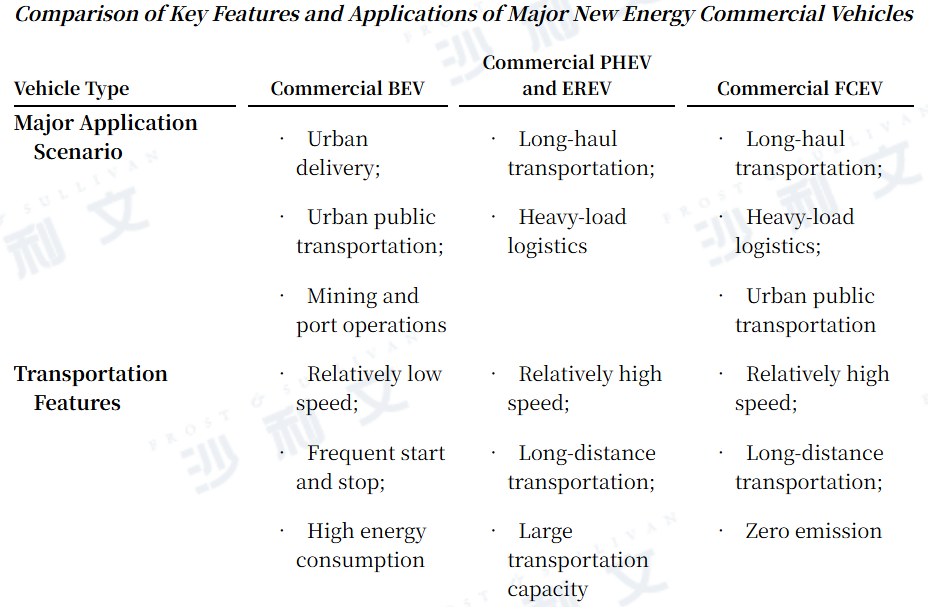
Electric fuel (E-fuel) is another important low-carbon alternative to traditional fossil fuels. Unlike pure electric, plug-in hybrid, and extended-range electric vehicles that directly use electricity or hydrogen energy, electric fuel utilizes renewable energy such as solar and wind power to produce hydrogen through electrolysis of water, ultimately synthesizing high-energy-density low-carbon or zero-carbon fuels for automotive use. In addition, electric fuel can be compatible with existing internal combustion engine vehicles without significant modification, which is one of its significant advantages. The following table lists the main application scenarios and characteristics of various new energy commercial vehicles:
Source: Frost & Sullivan report
PART/5
Global and China's New Energy Heavy Truck Market Size
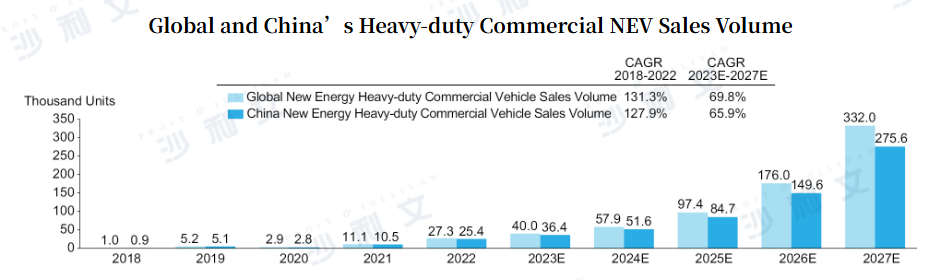
In the global new energy commercial vehicle market, although new energy heavy trucks (such as dump trucks, tractors, and other heavy truck vehicles) accounted for only 6.9% of the market share in terms of sales in 2022, traditional fuel heavy trucks still represent an important source of carbon emissions due to their high fuel consumption. Therefore, promoting new energy heavy trucks is crucial for accelerating the achievement of carbon neutrality and reducing greenhouse gas emissions. In 2022, China accounted for about 93.0% of global new energy heavy truck sales. Its sales soared from 0.9 thousand units in 2018 to 25.4 thousand units in 2022, with an average annual compound growth rate as high as 127.9%.
Source: Frost & Sullivan report
PART/6
Main Drivers and Development Trends of New Energy Commercial Vehicles Worldwide and in China
●Beneficial policies and incentives
Under the framework of the Paris Agreement adopted in December 2015, many countries have committed to achieving net-zero emissions and have formulated strategic plans to promote the development of new energy commercial vehicles and related industries. In the United States, the Internal Revenue Service has introduced tax incentives for commercial clean energy vehicles, allowing businesses to obtain tax credits for purchasing new energy vehicles. China issued its New Energy Vehicle Industry Development Plan (2021-2035) in November 2020, aiming to fully electrify public transportation vehicles, carry out pilot applications of commercial fuel cell vehicles, and build a hydrogen fuel supply system. These favorable policies from major countries align with the global trend of addressing climate change and transforming towards more sustainable and environmentally friendly transportation industries, continuously promoting the application, promotion, and market penetration of new energy commercial vehicles.
●Collaborative development among industry participants
Each participant in the new energy commercial vehicle industry plays a key role in driving innovation, enriching product supply, and ensuring customer satisfaction. Technology companies are crucial for designing cutting-edge solutions in vehicle electrification, battery technology, energy supply infrastructure, and autonomous driving capabilities, which help improve the overall performance and user experience of new energy commercial vehicles. Cooperation with technology companies enables new energy commercial vehicle manufacturers to keep up with the latest technological advancements and maintain competitiveness in the rapidly developing market. After-sales market service providers play an important role in maintaining and supporting vehicles throughout their lifecycle. As the industry transitions towards electrification, service providers need to develop expertise in servicing and repairing electric and hydrogen fuel cell systems, ensuring timely maintenance, spare parts supply, and efficient repair services to maximize vehicle uptime and customer satisfaction. By promoting collaborative cooperation among value chain participants, each participant's strengths can be utilized to develop comprehensive and reliable solutions tailored to specific application scenarios, thereby driving the rapid development of the new energy commercial vehicle industry.
●Technological innovation
Technological innovation is key to improving vehicle performance and expanding application scenarios. For example, improvements in powertrain technology for commercial pure electric vehicles (BEVs), plug-in hybrid electric vehicles (PHEVs), and fuel cell electric vehicles (FCEVs) have led to higher energy density and longer driving ranges. Continuous research and development efforts aim to improve fuel cell efficiency, reduce production costs, and enhance the overall performance and durability of fuel cell electric vehicles, thereby promoting the growth of the commercial fuel cell electric vehicle market. With the expansion and maturation of hydrogen infrastructure, especially in areas where long-range and heavy-duty capabilities are crucial, fuel cell electric vehicles are expected to gain momentum. Intelligent driving functions, V2X communication, and advanced telematics systems improve transportation safety, efficiency, and fleet management capabilities.
PART/7
Analysis of Competitive Landscape
The main participants in the new energy commercial vehicle market are new energy commercial vehicle startups that focus on providing intelligent new energy commercial vehicle solutions throughout the entire lifecycle, as well as manufacturers that mainly produce traditional fuel commercial vehicles and have begun transitioning to new energy ones.
Similarly, the main participants in the global intelligent new energy commercial vehicle solution industry throughout the entire lifecycle include pure electric new energy commercial vehicle enterprises and traditional commercial vehicle original equipment manufacturers (OEMs) that produce new energy commercial vehicles.
According to a report by Frost & Sullivan, the company is a leader in the global intelligent new energy commercial vehicle solutions industry across the entire lifecycle. As a representative of global pure electric new energy commercial vehicles, the company is one of the few in the world that has mastered distributed electric drive technology, vehicle control technology, intelligent wire-controlled chassis technology, solid oxide electrolyte (SOFC) technology, and other areas.
The company is one of the earliest in the global intelligent new energy commercial vehicle solution industry to expand overseas markets. With a full industrial chain layout covering vehicle design, technology research and development, vehicle manufacturing, sales, after-sales market services, and financial services, it stands out among industry enterprises. In 2022, the company's independently developed 'Galaxy I' and 'Galaxy II' received China's first batch of green licenses for long-distance highway heavy trucks.
Click at the end of the article
Read the original text
View the full prospectus
Frost & Sullivan has extensive research experience in the automotive and transportation industries, assisting well-known companies in successfully accessing capital markets. Successful listings include: Sanhua Intelligent Control (2050.HK), Zhengli New Energy (3677.HK), SEMTECH (2571.HK), Xinjiao (0805.HK), Pony (NASDAQ: PONY), XCHG Limited (NASDAQ:XCH), Xirui Aircraft (2507.HK), Dida Travel (2559.HK), Jikr Intelligent (ZK.NYSE), Zhihang Automobile (1274.HK), Lvyuan Group (2451.HK), Noco-noco (NASDAQ: NCNC), VinFast (NASDAQ:VFS), Shengshi Dalian (NASDAQ:SDA), Youpin Car (NASDAQ:UCAR), HSAI Technology (HSAI.NASDAQ), ECX Technology (ECX.NASDAQ), Buyang International (2457.HK), Newton Group (NWTN.NASDAQ), Zhongxin Hangkong (3931.HK), Leapmotor (9863.HK), DBS World (2418.HK), Kuaidou Taxi (2246.HK), NIO (NIO.SGX), NIO (9866.HK), Canggang Railway (2169.HK), Yanguang Pearl (YGMZ.NASDAQ), Asia Express (8620.HK), InfinityL&T (1442.HK), TOMOHOLDINGS (6928.HK), EH Intelligent (EH.NASDAQ), Aodima (8418.HK), Xiangxing International (8157.HK), CIMC Vehicles (1839.HK), Xunlong (1930.HK), CSSC Leasing (3877.HK), Chengdu Expressway (1785.HK), Tianrui Automotive Interior (6162.HK), Baren Holdings (2885.HK), Huazi International (2258.HK), Pulin Chengshan (1809.HK), NIO (NIO.NYSE), Wanlida (8482.HK), Qilu Expressway (1576.HK), Yingheng Technology (1760.HK), Asia Industry (1737.HK), Ruifeng Power (2025.HK), Gaomeng Technology (8065.HK), Hebei Yichen (1596.HK), Zhengli Holdings (8283.HK), Junao Holdings (8035.HK), Yadi Group (1585.HK), Yihai Car Rental (EHIC.NYSE), Xincheng Power (1148.HK), Zhengxing Wheels (ZX.NYSE), Shuanghua Holdings (1241.HK), Changfeng Axle (1039.HK), Heishima Smart (2533.HK), Zhongchi Chefu (AZI.US).
Recommended Reads (scroll up and down for more)
Frost & Sullivan assists New Jio in successfully listing on the Hong Kong Stock Exchange (0805.HK)
Frost & Sullivan assisted Pony in successfully going public in the US (NASDAQ: PONY)
Frost & Sullivan assisted XCHG Limited in successfully going public on the NASDAQ (NASDAQ:XCH).
Frost & Sullivan helps Didi Chuxing successfully go public in Hong Kong (2559.HK)
Frost & Sullivan assists Jikuang Intelligent in successfully going public in the US (ZK.NYSE)
Frost & Sullivan helps Zhihang Auto successfully go public in Hong Kong (1274.HK)
Frost & Sullivan assisted U Power in successfully going public on NASDAQ:UCAR
Frost & Sullivan assisted Hesai Technology in successfully going public in the US (HSAI.NASDAQ)
Frost & Sullivan assisted Yicatong Technology in successfully going public in the US (ECX.NASDAQ)
Frost & Sullivan helps Buyvest International successfully go public in Hong Kong (2457.HK)
Frost & Sullivan assisted Newtown Group in successfully going public in the US (NWTN.NASDAQ)
Frost & Sullivan helps Leapmotor successfully go public in Hong Kong (9863.HK)
Frost & Sullivan helps Kuaikao Taxi successfully go public in Hong Kong (2246.HK)
Frost & Sullivan assisted NIO in successfully going public in Singapore (SGX:NIO)
Frost & Sullivan helps NIO Automotive successfully go public in Hong Kong (9866.HK)
Frost & Sullivan assisted YGMZ.NASDAQ's successful listing in the US
Frost & Sullivan helps Asia Express successfully go public in Hong Kong (8620.HK)
Frost & Sullivan helps Infinity successfully list on the Hong Kong Stock Exchange (1442.HK)
Frost & Sullivan assists iFlytek in successfully going public in the US (EH.NASDAQ)
Frost & Sullivan assists AutoJoy in successfully listing on the Hong Kong Stock Exchange (8418.HK)
Frost & Sullivan helps CIMC Vehicle successfully list on the Hong Kong Stock Exchange (1839.HK)
Frost & Sullivan assists NIO with its successful listing on the US stock market (NIO.NYSE)
Frost & Sullivan assists Wanli Da in successfully listing on the Hong Kong Stock Exchange (8482.HK)
Frost & Sullivan assists Asian industries in successfully going public in Hong Kong (1737.HK)
Frost & Sullivan assisted Zhongchi Chefu in successfully going public in the US (AZI.US)
*The above order is not sequential; it is arranged in reverse chronological order based on listing time.
Contact number: 021-5407-5836
Contact email: PR@frostchina.com




