


Delixy Holdings Limited (stock code: Nasdaq: DLXY) successfully listed on the US NASDAQ on July 9, 2025. The group is a holding company headquartered in Singapore, established in 2007, focusing on trading crude oil and petroleum-related products. Frost & Sullivan (Frost & Sullivan, hereinafter referred to as "Frost & Sullivan") provides exclusive industry advisory services for Delixy Holdings Limited's listing and hereby warmly congratulates them on their successful listing.
Delixy Holdings Limited (hereinafter referred to as "Delixy") successfully listed on July 9, 2025, issuing 2 million shares at a price of $4, raising a total of $8 million.
During the process of listing in the US, Frost & Sullivan mainly undertook the following tasks: helping the issuer accurately and objectively understand its positioning in the target market, using objective market data to discover, support, and highlight the issuer's competitive advantages, assisting the issuer, investment banks, and other intermediaries in completing the writing of relevant parts of the prospectus (such as overview, competitive advantages and strategy, industry overview, business, and other important sections), helping the issuer complete communication with the SEC and investors, assisting investors in quickly understanding the market ecosystem and competitive landscape, and assisting the issuer in completing feedback on various industry-related issues from regulatory authorities.
Overview of Crude Oil and Petroleum Product Trading
Definition of Crude Oil
Crude oil, also known as petroleum, is a naturally occurring global commodity composed of hydrocarbon deposits and other organic matter. Crude oil is further refined in the midstream to produce usable products, including gasoline, diesel, and various petrochemical products for downstream use.
Crude oil is mainly extracted through petroleum drilling. An oil well is a borehole on Earth designed to bring crude oil hydrocarbons to the surface. Oil wells can be located on land or at sea, and offshore oil wells can be further divided into: (i) seabed wellhead oil wells, with the wellhead located underwater at the seabed; (ii) dry wellhead oil wells, with the wellhead located above water and supported by platforms or casings.
Market Size
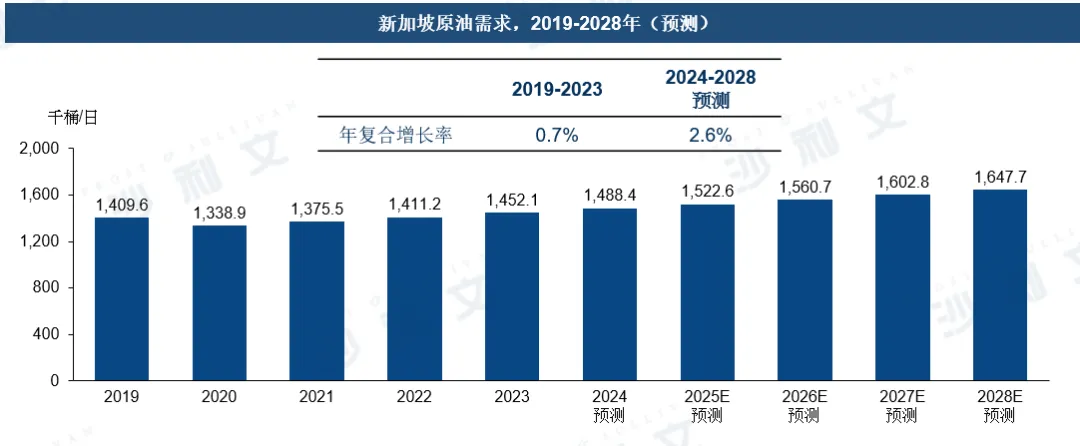
Singapore's crude oil demand is driven by its vast refining industry, which processes crude oil into various petroleum products such as gasoline, diesel, aviation fuel, and petrochemicals. As a major trading and oil storage center in Asia, Singapore's petroleum industry is highly integrated with the global market. Its crude oil demand is not only affected by domestic consumption but also driven by regional demand. Singapore's crude oil demand increased from 1.4096 million barrels per day in 2019 to 1.4521 million barrels per day in 2023. In Singapore, domestic petroleum demand is mainly driven by the transportation and industrial sectors. As a highly urbanized and industrialized country, Singapore is highly dependent on petroleum for vehicle fuel, power generation, and industrial processes. With sustained economic growth in the coming years, it is expected that Singapore's crude oil demand will grow at a compound annual growth rate (CAGR) of 2.6% between 2024 and 2028, reaching 1.6477 million barrels per day by 2028.
Source: Frost & Sullivan report
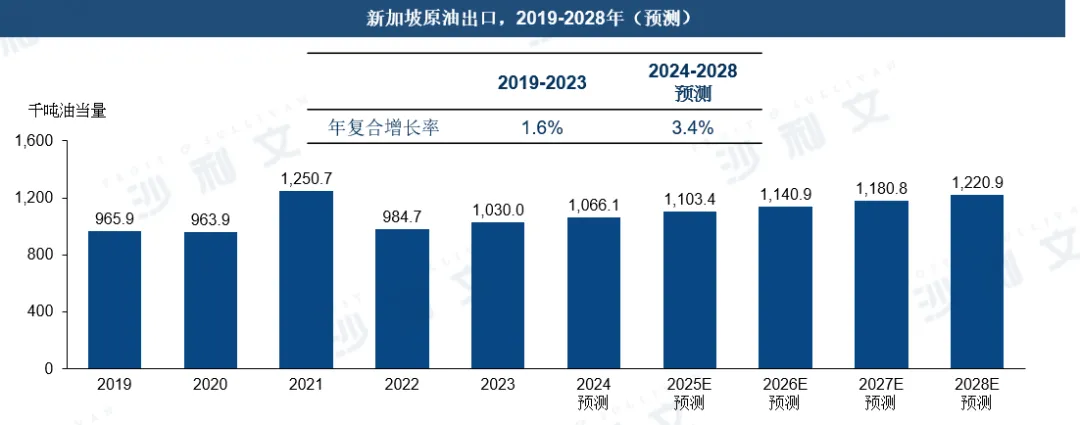
Singapore's crude oil exports increased from 965,900 metric tons of oil equivalent in 2019 to 1,030,000 metric tons of oil equivalent in 2023, with a compound annual growth rate of 1.6%. Due to its strategic location and advanced refining facilities, Singapore's crude oil market is expected to continue as an important center for crude oil trade and refining, occupying a key position in the global crude oil market. With the continuous growth of energy demand in Asia, Singapore's role in crude oil trade and refining may further expand to support market stability and development. It is expected that Singapore's crude oil exports will achieve a compound annual growth rate of 3.4% between 2024 and 2028, reaching 1,220,900 metric tons of oil equivalent by 2028.
Source: Frost & Sullivan report
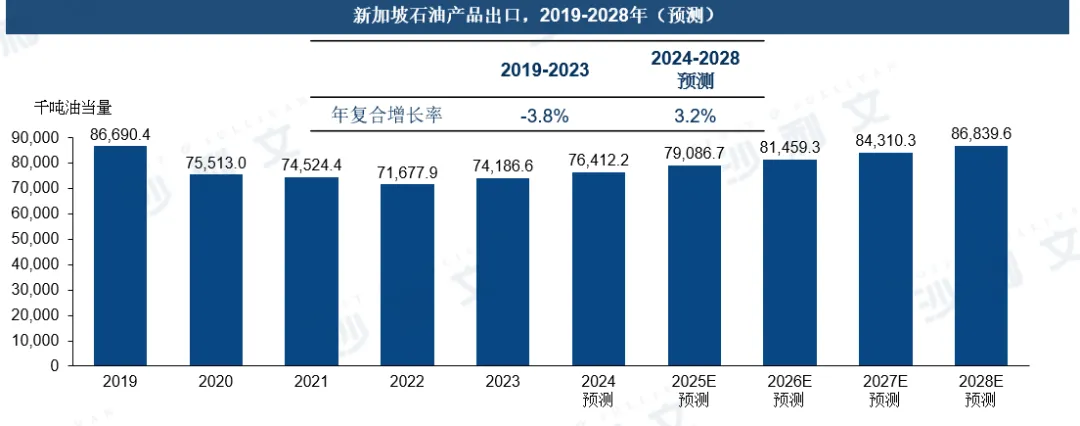
Petroleum products include fuel oil, gas/diesel, gasoline, aviation kerosene, naphtha, and other petroleum products. In 2023, Singapore exported 74,186.6 metric tons of petroleum products to countries such as Malaysia, Australia, Indonesia, Myanmar, and Bangladesh. Petroleum product export demand is affected by the energy demand of neighboring countries, including emerging economies and industrialized countries. The economic growth, infrastructure development, and transportation demand in Asia will continue to drive the demand for Singapore's petroleum product exports, which are expected to reach 86,839.6 metric tons of oil equivalent by 2028, with a compound annual growth rate of 3.2% between 2024 and 2028.
Source: Frost & Sullivan report
Market Drivers and Opportunities
● Growth in Regional Demand
As a major trading center in Asia, the growth of economies such as China, India, and Southeast Asian countries has driven Singapore's demand for crude oil and petroleum products. China has a high demand for crude oil and petroleum products for its manufacturing, transportation, and construction industries. India is also experiencing strong economic growth, driving demand for energy to meet its industrial and transportation needs. Similarly, Southeast Asian countries such as Indonesia, Malaysia, Thailand, and Vietnam are experiencing rapid industrialization and urbanization. These countries need a large amount of energy, including crude oil and petroleum products, to drive their economic development and support the growing population. Rapid industrialization, urbanization, and increasing transportation demand have promoted the increase in Singapore's demand for crude oil and petroleum products.
● Leading Refining Capacity
As of 2022, Singapore is one of the world's leading refining centers, with the fifteenth largest refining capacity in the world. Its daily crude oil processing capacity is about 1.5 million barrels, which helps it become a major trading center for crude oil and petroleum products. Singapore also has several major petrochemical plants, producing a variety of products including ethylene, propylene, and aromatics. These plants include refineries owned by companies such as ExxonMobil, Shell, BP, Chevron, and Singapore Refining Company. Some of Singapore's refineries are integrated with petrochemical facilities, which makes it possible to produce petrochemical raw materials (such as ethylene and propylene), which are basic components of plastics and other chemicals. The continuous upgrading and expansion of Singapore's refining facilities will further improve efficiency, enhance environmental performance, and meet changing product specifications and regulatory requirements. Leading refining capacity is expected to drive the growth of Singapore's crude oil and petroleum product trade.
● Digital Transformation
Singapore's crude oil and petroleum product trade industry is undergoing rapid transformation. Advanced process control systems use advanced algorithms and real-time data analysis to optimize refinery operations. These systems help refineries improve process efficiency, reduce energy consumption, and enhance product quality by optimizing process variables and reducing operational deviations. Digital technologies such as the Internet of Things (IoT) and big data analysis are also becoming increasingly popular in refineries. By collecting and analyzing large amounts of operational data, refineries can gain a deep understanding of process performance, equipment health status, and predictive maintenance, thereby optimizing operations and saving costs. The innovation of new technologies has improved operational efficiency, enhanced product quality, and addressed environmental challenges, thereby promoting market growth.
● Supportive Government Policies and Sound Trade Infrastructure
The Singapore government has implemented a number of policies to promote and facilitate domestic petroleum trade, aiming to attract international petroleum traders, enhance market liquidity, and establish Singapore as a global petroleum trade center. The Singapore government has created a business-friendly environment by implementing preferential tax policies, simplified regulations, and a robust legal framework. These measures have attracted international oil companies and traders to set up operations in Singapore. For example, the Commodities Trading Act of 1992 regulates spot commodity trading, promotes legal commercial activities involving spot commodity trading, and protects investors and the public from fraud in spot commodity trading. In particular, the Singapore government has invested in building world-class infrastructure to support petroleum trade activities, including the construction of oil storage terminals, refineries, blending facilities, and trading platforms. Reliable infrastructure ensures efficient logistics, storage, and distribution of petroleum and petroleum products. Singapore has established a strong trade infrastructure, including commodity exchanges, oil storage facilities, and petroleum trading companies. Supportive government policies and sound trade infrastructure have attracted major international oil companies, commodity traders, and financial institutions, thereby promoting transactions and enhancing market liquidity.
Competitive Landscape
Singapore has established its position as one of the world's three major petroleum trading and refining centers. The country is located at the intersection of the Indian Ocean and the Pacific Ocean, with a strategic location, a sound financial system, excellent infrastructure, a transparent legal system, and a high-quality workforce. Singapore's total crude oil refining capacity is 1.5 million barrels per day (bbl/d). Its three major refineries include: ExxonMobil's 605,000 bbl/d refinery on Pulau Ayer Chawan, Royal Dutch Shell's 500,000 bbl/d refinery on Pulau Bukom, and Singapore Refining Company's 290,000 bbl/d refinery on Pulau Merlimau. In addition, Singapore is market-leading in the field of high-end floating production and storage units (FPSOs) conversion and jack-up drilling platforms, and is the regional headquarters of most major participants in the industry. In 2024, Singapore's petroleum and petroleum product trade industry is relatively fragmented, with more than 100 market participants. Leading trading companies have established extensive networks, established solid relationships with suppliers and buyers, and have a good track record in the industry. They possess deep industry expertise, advanced trading capabilities, and comprehensive risk management strategies to gain a competitive edge. The group is the fifth largest crude oil and petroleum product trading company in Singapore in 2023, with revenue of $289.4 million.
Frost & Sullivan has rich research experience in the energy and power industries, assisting well-known enterprises to successfully list on the capital market. Recent successful listing cases include: Hainan Junda (2865.HK), Raytheon (NASDAQ:LSE), Reshape Energy (2570.HK), Guofu Hydrogen Energy (2582.HK), Huizhu Technology (2481.HK), Guohong Hydrogen Energy (9663.HK), Huzhou Gas (6661.HK), MingYang Smart Energy (MYSE:LI), SDIC Power (SDIC:LI), Nanguan Energy Technology (1597.HK), Jiaxing Gas (9908.HK), Chuncheng Thermal Power (1853.HK), CNPC Clean Energy (1759.HK), Jiutai Bangda (2798.HK), TL Natural Gas (8536.HK), Tianbao Energy (1671.HK), YuGao International (1621.HK), Jintai Feng (8479.HK), Zhongcheng Energy (2337.HK), Inner Mongolia Energy Construction (1649.HK), Resco (1679.HK), Persta Resources (3395.HK), Xintai Energy (1799.HK), China Energy Construction (3996.HK), CNBE (NASDAQ:CNEY), etc.
Recommended Reading (scroll up and down for more)
Frost & Sullivan helps Hainan Jun successfully list in Hong Kong (2865.HK)
Frost & Sullivan helps Raytheon successfully list in the US (NASDAQ:LSE)
Frost & Sullivan helps Shanghai Reshape Energy successfully list in Hong Kong (2570.HK)
Frost & Sullivan helps Guofu Hydrogen Energy successfully list in Hong Kong (2582.HK)
Frost & Sullivan helps Guohong Hydrogen Energy successfully list in Hong Kong (9663.HK)
Frost & Sullivan helps Huizhu Technology successfully list in Hong Kong (2481.HK)
Frost & Sullivan helps Huzhou Gas successfully list in Hong Kong (6661.HK)
Frost & Sullivan helps CNBE successfully list in the US (NASDAQ:CNEY)
Frost & Sullivan helps SDIC Power successfully list on the London Stock Exchange (SDIC:LI)
Frost & Sullivan helps Nanguan Energy Technology successfully list in Hong Kong (1597.HK)
Frost & Sullivan helps Jiaxing Gas successfully list in Hong Kong (9908.HK)
Frost & Sullivan helps Chuncheng Thermal Power successfully list in Hong Kong (1853.HK)
Frost & Sullivan helps TBK & Sons successfully list in Hong Kong (1960.HK)
Frost & Sullivan helps CNPC Clean Energy successfully list in Hong Kong (1759.HK)
Frost & Sullivan helps Jiutai Bangda successfully list in Hong Kong (2798.HK)
Frost & Sullivan helps TL Natural Gas successfully list in Hong Kong (8536.HK)
Frost & Sullivan helps Tianbao Energy successfully list in Hong Kong (1671.HK)
Frost & Sullivan helps YuGao International successfully list in Hong Kong (1621.HK)
Frost & Sullivan helps Jintai Feng successfully list in Hong Kong (8479.HK)
Frost & Sullivan helps Zhongcheng Energy successfully list in Hong Kong (2337.HK)
Frost & Sullivan helps Inner Mongolia Energy Construction successfully list in Hong Kong (1649.HK)
Frost & Sullivan helps Resco successfully list in Hong Kong (1679.HK)
Frost & Sullivan helps Persta Resources successfully list in Hong Kong (3395.HK)
Frost & Sullivan helps Xintai Energy successfully list in Hong Kong (1799.HK)
Frost & Sullivan helps China Energy Construction successfully list in Hong Kong (3996.HK)
*The above order is not in any particular sequence and is arranged in reverse chronological order based on listing time




