


Pitanium Limited (Stock Code: PTNM) successfully listed on the US NASDAQ on May 30, 2025. Titanium Limited is a high-end personal care product retail company from Hong Kong. Since its establishment in 2019, it initially provided high-end skincare and hair care products for Hong Kong's spas, then shifted to selling to retail customers and launched the "BIG_PI" series in 2023, offering users a complete range of products. The company adopts an online and offline sales model. Online, it displays and sells products through its official website "www.pitanium.com" and uses social media platforms for market promotion; offline, the company currently has 6 retail stores in major shopping areas of Hong Kong, providing customers with product experience and consulting services. Frost & Sullivan (hereinafter referred to as "Frost & Sullivan") provided exclusive industry advisory services for Titanium Limited's listing in the US, and we hereby extend our warmest congratulations on its successful listing.
Pitanium Limited (hereinafter referred to as 'Pitanium') successfully conducted its initial public offering on NASDAQ in the United States on May 30, 2025. The number of shares issued was 1.75 million, with an issue price of $4.00, raising $7 million.
During the process of listing in the US, Frost & Sullivan mainly undertook the following tasks: helping the issuer accurately and objectively understand its positioning in the target market, using objective market data to discover, support, and highlight the issuer's competitive advantages, assisting the issuer, investment banks, and other intermediaries in completing the writing of relevant parts of the prospectus (such as the overview, competitive advantages and strategy, industry overview, business, and other important sections), helping the issuer communicate with the SEC and investors, assisting investors in quickly understanding the market ecosystem and competitive landscape, and assisting the issuer in completing feedback from regulatory authorities on various industry issues.
PART/1
Overview of Hong Kong's Beauty and Personal Care Products Retail Market
Definition and Classification
Cosmetics and personal care products, also known as skincare and grooming products, refer to substances, preparations, or items used for cleaning, beautifying, enhancing attractiveness, or changing appearance. The formulation of these products is designed to meet various needs related to personal hygiene, skin health, and aesthetics.
Cosmetic and personal care products come in a wide variety, including but not limited to skincare products, hair care products, makeup, fragrances, and essential personal hygiene items. These products are diverse in form, such as creams, lotions, powders, sprays, oils, gels, and solid products such as lipstick or powder masks, suitable for different parts of the body, especially the skin, hair, nails, and teeth. Some beauty and personal care retailers also sell related household cleaning products to provide customers with a more comprehensive shopping experience.
The retail sales of the Hong Kong beauty and personal care products market encompass a digital business ecosystem dedicated to selling and distributing beauty and personal care products to Hong Kong consumers through internet platforms.
The offline retail sales market for beauty and personal care products in Hong Kong encompasses the traditional physical retail ecosystem, focusing on selling and distributing beauty and personal care products through physical stores within the Hong Kong region. The market includes department stores, specialty cosmetics stores, pharmacies, beauty chains, supermarkets, and independent retailers. These merchants have physical storefronts where customers can inspect, test, and purchase products in person, while also receiving face-to-face customer service and professional beauty advice.
By product type, the retail market in Hong Kong's beauty and personal care products sector covers six categories: skin care, cosmetics, hair care, fragrances, personal hygiene, and household essentials.
-
Skin care: A product line for maintaining and improving skin health and appearance
-
Cosmetics: Product lines that enhance or change facial features and appearance
-
Hair care: A product line for hair cleansing, care, and styling
-
Essence: A product line designed to provide pleasant scents, including perfumes, colognes, and body sprays
-
Personal Hygiene: Product series for maintaining cleanliness and preventing disease transmission
-
Essential household items: Supplementary cleaning products typically provided by beauty retailers, such as laundry detergent and dishwashing liquid
market scale
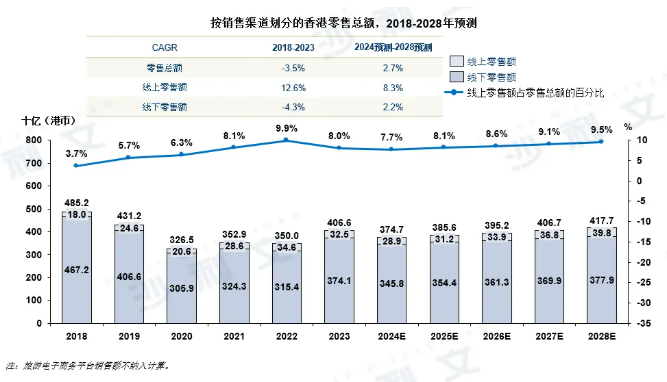
The retail industry has always been an important industry in Hong Kong, contributing more than 3% to the overall local GDP over the past five years. The superior geographical environment and friendly government policies continue to attract high-quality international brands to Hong Kong every year. According to data from the Government Statistical Service, Hong Kong's retail sales fell from HK$485.2 billion in 2018 to HK$406.6 billion in 2023, with a compound annual growth rate of -3.5%, mainly due to the decline in inbound tourist numbers and economic activity suspension caused by the outbreak of the COVID-19 pandemic during the period. At the same time, due to unstable political conditions in Hong Kong, retail sales also declined in 2019.
Looking ahead, with the reopening of Hong Kong's border with the Chinese mainland, the recovery of tourism and consumer spending is expected to stimulate the development of Hong Kong's retail industry. Driven by repeat customers and local shoppers, the luxury goods, clothing, and cosmetics industries are expected to experience strong growth. It is estimated that Hong Kong's retail sales will reach HK$417.7 billion in 2028, with a compound annual growth rate of 2.7% from 2024 to 2028.
Hong Kong's online retail sales soared from HK$18 billion in 2018 to HK$325 billion in 2023, with a compound annual growth rate of about 12.6%. During the period from 2018 to 2023, the proportion of online retail sales in total retail sales increased from 3.7% to 8.0%. Compared with total retail sales, the rapid growth of online retail sales was due to consumers' increasing preference for online shopping, the continuous expansion of internet use in business, the increasing penetration of mobile phones and home broadband, suppliers increasingly adopting digital sales channels, and the impact of the COVID-19 pandemic, which induced more consumers to shift their shopping habits online. It is expected that between 2024 and 2028, the proportion of online retail sales in total retail sales will increase from 7.7% to 9.5%.
Hong Kong's offline retail sales fell from HK$467.2 billion in 2018 to HK$406.6 billion in 2019, and then to HK$305.9 billion in 2020, representing year-on-year declines of 13.0% and 24.8%, respectively. The decline was mainly due to social unrest leading to a reduction in the number of visitors, shrinking consumer spending, coupled with the outbreak of the COVID-19 pandemic and the subsequent quarantine measures, which brought tourism to Hong Kong to a halt and disrupted consumption-related activities. To stimulate local consumption, the Secretary for Finance has introduced an e-voucher scheme worth HK$36 billion, benefiting about 7.2 million people. On June 18, 2021, the Hong Kong government announced the launch of the "Voucher Scheme," which will be available to eligible permanent residents aged 18 or above and new arrivals in Hong Kong for registration from July to August, and will be distributed to each person in up to three installments of HK$5,000. The vouchers can be used at local retail outlets, dining and service points or their online platforms through a recharge facility. Hong Kong's offline retail sales rebounded in 2021 and 2022 accordingly. With the reopening of borders, Hong Kong's retail growth will turn positive, with retail sales rebounding in the following years and reaching HK$377.9 billion by 2028, with a compound annual growth rate of about 2.2% between 2024 and 2028.
Source: Frost & Sullivan report
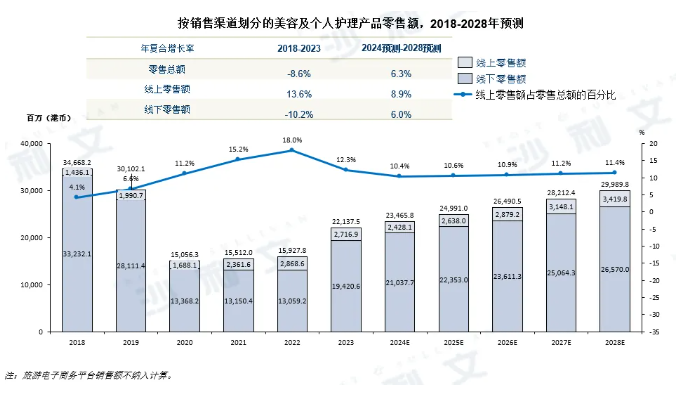
The online retail sales of beauty and personal care products in Hong Kong increased from HK$14.361 million in 2018 to HK$27.169 million in 2023, with an annual compound growth rate of 13.6% during this period. This growth was mainly due to the rapid rise of e-commerce platforms targeting direct market consumers in the early 2010s. It is expected that by 2028, this figure will increase to HK$34.198 million at an annual compound growth rate of 8.9%. The growth rate of the beauty and personal care product market is expected to slightly exceed that of the overall e-commerce market, due to (i) the relatively early establishment of e-commerce platforms by market participants in the beauty and personal care product sector; (ii) the adoption of OMO business models in the beauty and personal care product field, which bring consumers a one-stop shopping experience and thus enhance their confidence and loyalty to purchasing high-quality beauty and personal care products; (iii) the continuous strengthening of health awareness and the increasing popularity of emerging beauty brands, which is conducive to their long-term development. It is expected that the penetration rate of online retail sales of beauty and personal care products in total retail sales will rise from 10.4% in 2024 to 11.4% in 2028.
The offline retail sales of beauty and personal care products in Hong Kong decreased from HK$332,321 million in 2018 to HK$194,206 million in 2023, with an average annual compound growth rate of -10.2%. The decline in 2019 and 2020 was mainly due to a reduction in visitor numbers and the closure of many offline retail stores due to the COVID-19 pandemic, which led to a significant drop in sales. With the reopening of borders and the gradual recovery of tourism, Hong Kong's offline retail sales increased from HK$130,592 million to HK$194,206 million between 2022 and 2023. Consistent with the overall retail market trend, it is expected that by 2028, the offline retail sales of beauty and personal care products in Hong Kong will reach HK$265,700 million, with an average annual compound growth rate of 6.0%.
Hong Kong's retail sales are affected by cultural events and economic conditions, and the retail sales of beauty and personal care products are no exception. The main seasonal peaks occur during major festivals, such as Lunar New Year and Mid-Autumn Festival, which bring about substantial spending on gifts and food. Summer usually sees promotional activities for fashion and electronics products, while the back-to-school season at the end of summer boosts sales of stationery and clothing. In addition, retail activities are more active during Christmas and New Year periods. On the other hand, factors such as tourism, consumer confidence, and cultural events also affect these seasonal trends.
Source: Frost & Sullivan report
Market Drivers and Opportunities
● Raise health awareness
With the increase in Hong Kong residents' income, their pursuit of higher living standards has grown stronger, and their attention to healthcare has continuously risen. However, the fast-paced lifestyle has had a negative impact on overall health, leading to poor health conditions among many people. To improve their quality of life and health, Hong Kong residents are paying more attention to personal health issues and are turning towards personal care products. The enhanced awareness of health is expected to drive growth in the retail market for health, beauty, and personal care products.
●Popularity of emerging beauty brands is on the rise
In recent years, new beauty and personal care product brands have gained significant popularity in Hong Kong. The increasing activity of these brands on social media has heightened consumer attention to this sector, leading to changes in consumer trends for beauty and personal care products. More and more consumers are starting to try a wider variety of beauty and personal care products, and their purchasing frequency is also increasing, mainly influenced by innovative marketing strategies such as KOL (Key Opinion Leaders) marketing. This trend has further driven retail sales revenue for beauty and personal care products in Hong Kong.
●Products designed to meet specific needs
The beauty and personal care product market has become very mature, leading to a high degree of similarity among products and thus intense market competition. To stand out in this market, beauty brands must attract and retain customers through differentiated products. For example, hair care products such as shampoos can be customized according to specific needs, such as providing men with a refreshing and energizing effect and women with an additional mild and moisturizing feel. By focusing on the end-user's usage scenarios and meeting the unique needs of specific consumer groups, beauty brands can significantly improve customer satisfaction and retain loyal customers more effectively.
●The popularization of skincare products for sensitive skin
Sensitive skin care products are becoming increasingly popular among the younger generation in Hong Kong. Multiple brands have established a solid position in the market with high-quality and safe ingredients. As consumers in these regions continue to pay more attention to product safety and quality, it is expected that sensitive skin care products will occupy a larger share in the future retail market for beauty and personal care products.
●The Rise of Omnichannel Retailing
More and more beauty retailers are adopting an omnichannel business model that includes online and offline channels, aiming to provide consumers with a seamless shopping experience. To fully meet customer needs, these retailers have integrated augmented reality (AR) and artificial intelligence (AI) trial technologies. Online, retailers use AR/AI facial recognition systems to allow customers to virtually try beauty and fashion products. In physical stores, AR/AI fitting devices have been added, complementing traditional staff assistance. For example, Sephora has introduced digital makeup mirrors that provide personalized AI recommendations. In addition, retailers also use cloud services and edge computing technologies for big data analysis and machine learning to customize products based on customers' virtual or physical store fitting projects.
●Personalized solutions
As consumers continue to pursue perfect and adaptable products, their demand for personalized solutions for beauty and personal care products is growing day by day. In the past, consumers often spent a lot of time looking for suitable products, which could not only lead to the inability to find the right product but also result in purchasing inappropriate items, thus dampening consumer willingness. However, with advancements in technologies such as augmented reality (AR), artificial intelligence (AI), and machine learning, these problems have been alleviated. These technologies can not only meet consumers' needs and save time but also improve customer retention rates. With the introduction of these technologies, consumers are increasingly inclined to choose brands that offer personalized services to reduce the risk of self-selection of products. In the beauty industry, areas such as cosmetics, nail care, and hair styling are experiencing rapid growth in customized solutions.
competitive landscape
● Market competitiveness and market concentration
The open market environment, competitive prices, and thriving tourism industry have built a vast consumer base for Hong Kong's beauty and personal care retail market, attracting numerous global brands. In 2023, the Hong Kong beauty and personal care product retail market exhibited high competition and fragmentation, covering more than 5,000 brands, which can be mainly divided into two categories. Large multinational companies such as L'Oréal, Unilever, Procter & Gamble, Estée Lauder, Amore Pacific, and Shiseido mainly expand their brand portfolios through acquisitions and mergers, covering multiple areas including beauty, skin care, and body care, and can meet the needs of consumers from high-end to economy markets. At the same time, they have established a global distribution network covering online and offline channels, and with their strong brand image, advanced R&D technology, and sufficient capital, they occupy a dominant position in the global market.
On the other hand, local small and medium-sized brands such as Group, Amber Be Younique, Nude Story, and SKIN NEEDS typically adopt localized marketing strategies, leveraging their technological advantages and product features to focus on developing specific product categories and target customer groups, such as natural organic skincare products, pregnancy-specific skincare products, and therapeutic skincare products. In the beauty retail industry in Hong Kong, retailers like Sasa, Vaseline, and Watsons also have their own brands that occupy a place in the mass market.
In summary, the retail beauty and personal care product market in Hong Kong is undergoing diversified development, showing tremendous growth potential. However, new entrants may face challenges in terms of capital investment, product quality, and distribution networks. In addition, they need to establish and enhance their competitive advantage through continuous product innovation, strategic marketing, and ongoing optimization of consumer experience.
As of September 30, 2024, in terms of sales, the three major local brands, including the Group, together accounted for 0.04% of Hong Kong's total retail sales. The Group ranked first among local beauty and personal care brands with sales of approximately HK$74.9 million, accounting for about 0.02% of the market share.
entry barriers
●Initial capital investment
New brands require substantial funds for research and development, production, marketing, and channel building, making early capital investment one of the main obstacles to entering the market. During the product development phase, companies need to conduct multiple rounds of experiments and market evaluations. In the commercialization phase, enterprises need to invest heavily in online and offline marketing for brand promotion. However, new entrants lacking sufficient funds often find it difficult to bear the high initial costs and fierce market competition pressure, thereby limiting their market entry opportunities.
●Establishment of sales network
Building a wide sales network is at the core of the competitive barriers in the retail market for beauty and personal care products in Hong Kong. Established brands have quickly captured the Hong Kong market through strong online and offline sales channels, keeping up with the increasingly diverse purchasing behavior of consumers. However, new brands inevitably face challenges in channel development in their early stages, mainly due to the lack of mature operational and management systems, as well as the need for additional time and resources to establish cooperative relationships with retailers.
●Brand Loyalty
A major obstacle faced by new brands entering the market is consumer loyalty to existing brands. Users need to assess their skin sensitivity and tolerance before using skincare products, especially for products with specific effects, where they are more cautious. For consumers who have already formed stable usage habits, frequent product changes carry certain risks, so many consumers prefer to choose beauty and personal care products provided by familiar and trustworthy brands. However, cultivating brand loyalty requires a significant amount of marketing funds and time investment, which new entrants often lack the resources needed for comprehensive brand promotion and consumer education.
Frost & Sullivan has extensive research experience in the consumer industry and has assisted many well-known companies in successfully listing on capital markets. Successful listings include: Nasdaq:MB's Niu Daren, 2530.HK's Newman's, 2593.HK's Caoji Group, 1318.HK's Mao Ge Ping, 2585.HK's Mengjin Yuan, 6181.HK's Laopu Gold, 2497.HK's Fujing China, 1497.HK's Yan Zhi Wu, NYSE:DDC's Ririzhuo, 2429.HK's Youbao Online, 0933.HK's Feifan Lingyue, 2145.HK's Shanghai Shangmei, 2367.HK's Ju Zi Biotech, 1880.HK's China COSCO, 9896.HK's Midea Group, 1927.HK's VESYNC, 2148.HK's Blue Moon, 6993.HK's Poplar Mart, 9992.HK's Midea Group (NYSE: MNSO), 9633.HK's Nongfu Spring, 9977.HK's Fengxiang Food, 6186.HK's China Feihai, 6110.HK's Taobo Sports, 6055.HK's China National Tobacco International, 2360.HK's Youpin 360, 1837.HK's Wugu Mofang, 1761.HK's Baby Tree, 2250.HK's Deying Holdings, 1705.HK's Bingshi International, 1815.HK's Golden Cat and Silver Cat, 8473.HK's Maiming Life Department Store, 1475.HK's Nissin Foods, 8436.HK's Seiko China (NASDAQ: SECO), 8297.HK's Barbie, 8413.HK's Asian Grocery, 1458.HK's Chowking Duck, 1610.HK's COFCO Foods, 3799.HK's Danone International, 0288.HK's Chow Tai Fook, 1929.HK's Jumei International (NYSE: JMEI), and others.
Recommended Reading
Frost & Sullivan helped Mr. Niu successfully go public in the US (Nasdaq: MB)
Frost & Sullivan helps Newman's S.A. successfully list on the Hong Kong Stock Exchange (2530.HK)
Frost & Sullivan helps Maogoping successfully go public in Hong Kong (1318.HK)
Frost & Sullivan helps Mengjin Garden successfully go public in Hong Kong (2585.HK)
Frost & Sullivan helps the established brand Gold successfully go public in Hong Kong (6181.HK)
Frost & Sullivan assists Yanzhiwu in successfully listing on the Hong Kong Stock Exchange (1497.HK)
Frost & Sullivan helps Rizhao Dadi Cook successfully go public in the US (NYSE:DDC)
Frost & Sullivan assists Vesync in successfully listing on the Hong Kong Stock Exchange (2148.HK)
Frost & Sullivan assists Blue Moon in successfully listing on the Hong Kong Stock Exchange (6993.HK)
Frost & Sullivan helps Pop Mart successfully go public in Hong Kong (9992.HK)
Frost & Sullivan helps famous innovative products successfully go public in the US (NYSE:MNSO)
Frost & Sullivan helps China's Feihai succeed in listing on the Hong Kong Stock Exchange (6186.HK)
Frost & Sullivan helps Top Glove Sports S.A. successfully go public in Hong Kong (6110.HK)
Frost & Sullivan helps Youpin 360 successfully go public in Hong Kong (2360.HK)
Frost & Sullivan helps Baby Tree successfully go public in Hong Kong (1761.HK)
Frost & Sullivan helps Nippon Sake & Foods Co., Ltd. successfully go public in Hong Kong (1475.HK)
*The above order is not sequential and is arranged in reverse chronological order based on listing time.




