



Jianzhi Education Technology Group Co., Ltd. (referred to as 'Jianzhi Education') successfully went public on August 26, 2022, with a global issuance of 5,000,000 ADSs at a price of $5 per ADS, raising $25 million.
During the process of listing in the US, Frost & Sullivan mainly undertook the following tasks: helping the issuer accurately and objectively understand its positioning in the target market, using objective market data to discover, support, and highlight the issuer's competitive advantages, assisting in the preparation of relevant parts of the prospectus (such as overview, competitive advantages and strategy, industry overview, business, and other important sections) with the issuer, investment banks, and other intermediaries, facilitating communication with the US Securities and Exchange Commission (SEC) and investors for the issuer, assisting in the quick understanding of market ecology and competitive landscape by investors, and providing feedback on various industry-related issues from the SEC for the issuer.
Overview of the Higher Education Digital Library Market
The Higher Education Digital Library is an online database that provides digital content to higher education institutions, including text, images, audio, video, or other digital media formats. The functions of this digital library include storing, organizing, searching, and retrieving the content contained within the database. For digital libraries provided to Chinese higher education institutions, the digital content can be divided into five parts: (i) digital books; (ii) digital journals; (iii) digital theses, referring to digital theses for higher education degrees; (iv) audio and video; (v) other digital content, such as statistical databases.
According to the statistics of the Ministry of Education of China, there are a total of 2,663 general higher education institutions and 277 adult higher education institutions nationwide. With the deep penetration of the Internet and the development of digital technology, more and more digital content will be utilized by higher education institutions. Therefore, more and more higher education institutions are willing to purchase digital content to enrich their educational resources, allowing students to conveniently access a rich variety of digital resources. Compared with printed content, digital content is easier to store, obtain, maintain, and update.
The market scale of China's higher education digital libraries increased from 1.6 billion yuan in 2017 to 2.9 billion yuan in 2021, with a compound annual growth rate of 16.0%. According to a Frost & Sullivan report, it is expected that the market will grow at a compound annual rate of 17.2% between 2021 and 2026, reaching 6.4 billion yuan by 2026. Due to the relatively stable annual budgets of higher education institutions for purchasing digital educational resources, the outbreak of COVID-19 is not expected to have a substantial impact on the market scale of higher education digital libraries in 2021 and beyond.
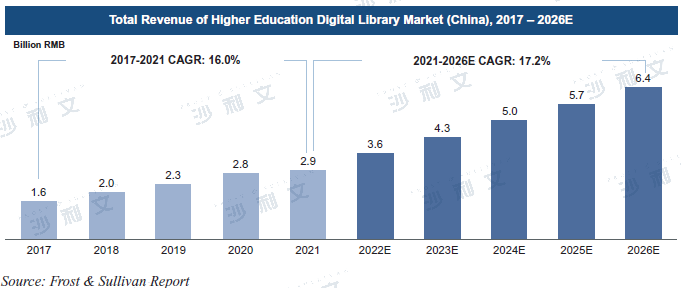
Data source: Analysis by Frost & Sullivan
Market entry barriers for higher education digital libraries
1) Ability to develop or procure digital content:Current higher education digital library providers have already developed or acquired competitive advantages in developing or purchasing digital content. For instance, they have accumulated a large amount of self-developed content that new entrants cannot develop in a short time. At the same time, leading digital library providers have also established good relationships with third-party content providers that are inaccessible to new entrants.
2) Close relationship with higher education institutions:Leading digital library providers have established close relationships with higher education institutions after years of collaboration and effort. Higher education institutions are usually more willing to continue working with known suppliers rather than frequently changing them. Therefore, for newcomers, it can be costly to gain the trust of higher education institutions and convince customers to switch from their existing suppliers.
3) Market awareness:Compared with potential competitors, leading higher education digital library providers have been in business for a longer time and have a deeper understanding of the needs of higher education institutions. Due to significant differences in demand among different types of schools, new entrants need to invest a large amount of resources collecting and analyzing demand information, resulting in a heavy cost burden.
4) Brand awareness:After years of operation, leading digital library providers in higher education have established a good brand awareness in the market, which has greatly supported their leading position.
Trends in the Development of the Higher Education Digital Library Market
1) Digital content investment continues to grow:To meet the growing demand of teachers and students for quick access to academic resources, higher education institutions in China are paying increasing attention to the construction of digital libraries, leading to continuous investment. In addition, there is a significant gap in investment among different higher education institutions; in the future, higher education institutions with lower current expenditure on digital library content are expected to increase their investment, and the spending disparity between institutions is expected to narrow.
2) Surge in digital content:Due to the rapid emergence and development of educational resources, libraries will have more opportunities in the near future to acquire different types of digital resources. The available digital resources will not be limited to digital books, journals, or papers but will also include video content. In addition, the diversity of resources will further increase; for example, with the introduction of the National College Students' Entrepreneurship and Innovation Initiative, more higher education institutions will offer online vocational training courses for students to improve their entrepreneurial, innovative, and employability skills.
(3) The integration of digital resources with digital resource management software is closer:With the continuous increase in digital resources in libraries, it is expected that higher education institutions will continue to invest more in digital resource management software. This will provide universities with an effective tool for managing their own digital resources, helping users of digital libraries easily find what they want, providing personalized services through data analysis, and improving the utilization rate of digital resources.
Market Competition Pattern of Digital Libraries for Higher Education
According to a Frost & Sullivan report, in 2021, the top ten players in the Chinese higher education digital library market accounted for approximately 70.0% of the total market revenue. ZhiCi Education ranked seventh among all market participants in terms of revenue from providing digital content to higher education institutions, with a market share of about 1.1%.
Frost & Sullivan has extensive research experience in the education industry and has assisted well-known enterprises in successfully listing on capital markets. Successful listings include: Reading Man (2385.HK), Golden Sun Education (NASDAQ: GSUN), Tongcai Education (2175.HK), South China Vocational Education (6913.HK), Yiqi Education (NASDAQ: YQ), New Oriental (9901.HK), Hong'en Education (IH.NYSE), Lixiang Education (NASDAQ: LXEH), Neusoft Education (9616.HK), Lide Education (1449.HK), Huaxia Audio-Visual (1981.HK), Dashan Education (9986.HK), Huaxia Boya (NASDAQ: CLEU), Meilian English (NASDAQ: METX), Jianqiao Education (1525.HK), Chenlin Education (1593.HK), Huali University Group (1756.HK), Youdao (DAO.NYSE), Xiang China International (1871.HK), Zhonghui Group (0382.HK), Thinking Le Education (1769.HK), Jiahong Education (1935.HK), China Oriental Education (0667.HK), Genshuoxue (GSX.NYSE), New Oriental Online (1797.HK), Kepai Education (1890.HK), Ginkgo Education (1851.HK), Excellence Education (3978.HK), Chunlai Education (1969.HK), Hope Education (1765.HK), Boyun Education (1758.HK), Tianli Education (1773.HK), Puxin Education (NEW.NYSE), 21st Century Education (1598.HK), Huanggang Education (8105.HK), Jingrui Education (ONE.NYSE), Xinhua Education (2779.HK), China Education Holdings (0839.HK), Siji Education (FEDU.NYSE), Ruisi Subject English (NASDAQ: REDU), Boshile Education (BEDU.NYSE), New Higher Education Group (2001.HK), Minsheng Education (1569.HK), Yuhua Education (6169.HK), Ruijian Education (6068.HK), 51Talk (COE.NYSE), Chengshi Foreign Education (1565.HK), Maple Leaf Education (1317.HK), and others.
Recommended Reading
03. Frost & Sullivan assists Tongcai Education in successfully going public in Hong Kong (2175.HK)
05. Frost & Sullivan helps a company successfully go public in the US (NASDAQ: YQ)
07. Frost & Sullivan Assists Hongen Education in Successful Listing on the US Stock Market (IH.NYSE)
13. Frost & Sullivan assists Huaxia Boya in successfully going public in the US (NASDAQ:CLEU)
14. Frost & Sullivan assisted MEL English in successfully going public on the NASDAQ (NASDAQ: METX)
16. Frost & Sullivan assists Chenlin Education in successfully going public in Hong Kong (1593.HK)
17. Frost & Sullivan assists Huali University in successfully going public in Hong Kong (1756.HK)
18. Frost & Sullivan assists Youdao in successfully going public in the US (DAO.NYSE)
19. Frost & Sullivan assists International Success in Hong Kong Listing (1871.HK)
Frost & Sullivan helped ThinkFun Education successfully go public in Hong Kong (1769.HK)
Frost & Sullivan helps China's Oriental Education successfully go public in Hong Kong (0667.HK)
24. Frost & Sullivan Helps WhoX Learn to Succeed in Going Public on the US Stock Market (GSX.NYSE)
Frost & Sullivan helps Ginkgo Education successfully go public in Hong Kong (1851.HK)
31. Frost & Sullivan assists Bokjun Education in successfully going public in Hong Kong (1758.HK)
33. Frost & Sullivan assisted Puxin Education in successfully going public in the US (NEW.NYSE)
36. Frost & Sullivan assists Elite Education in successfully going public in the US (ONE.NYSE)
41. Frost & Sullivan assisted Bole Education in successfully going public in the US (BEDU.NYSE)
46. Frost & Sullivan assisted 51Talk in successfully going public in the US (COE.NYSE)




