



Youhe Group Holdings Limited (hereinafter referred to as 'Youhe Group') successfully listed on the Main Board on June 10, 2022, with an issue volume of 5,500 million shares at a price of HK$2.10 per share.
During the process of listing in Hong Kong, Frost & Sullivan mainly undertook the following tasks: helping the company accurately and objectively understand its positioning in the target market, using objective market data to discover, support, and highlight the company's competitive advantages, assisting the company, investment banks, and other intermediaries in completing the relevant parts of the prospectus (such as overview, competitive advantages and strategy, industry overview, business, and other important sections), facilitating communication with the Hong Kong Stock Exchange and investors, helping investors quickly understand the market ecosystem and competitive landscape, and assisting the company in completing feedback on various industry-related issues from the Hong Kong Stock Exchange.
Hong Kong E-commerce Market
According to the Frost & Sullivan report, e-commerce refers to the use of the internet to buy and sell products or services. Based on the nature of sellers and buyers, it can be subdivided into the following categories: Business-to-Customer (B2C), which refers to the sale of goods and supply services between businesses; Business-to-Business (B2B), which includes all electronic transactions of goods or services between two companies; Customer-to-Customer (C2C) model, which involves the sale of goods and services between customers; and Manufacturer-to-Customer (M2C), which refers to the sale of goods and services between manufacturers and customers. Online Offline Integration (OMO) is a business model adopted by companies to set up physical outlets in offline retail stores and online platforms. It integrates online and offline commerce to promote end-to-end customer interdependence and a full-channel shopping experience.
According to the statistics of the Hong Kong Government's Census and Statistics Department, online retail refers to the sale of goods to customers through computer networks operated by local retail outlets specifically for acquiring or submitting orders. The goods are ordered through the aforementioned methods, but payment and the final delivery of goods do not necessarily have to be conducted online. On the other hand, online sales do not include orders entered manually via email, telephone, or fax. If a retail outlet provides an online platform for other institutions to use for goods sales (i.e., B2C platform model), the value of online sales refers to the commissions and service fees collected.
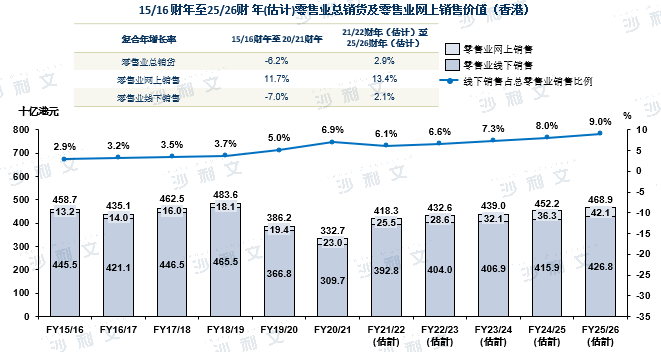
The online sales value of Hong Kong's retail industry surged from HK$132 billion in fiscal year 15/16 to HK$23 billion in fiscal year 20/21, with a compound annual growth rate of about 11.7%. From fiscal year 15/16 to 20/21, the proportion of online sales in total retail sales increased from 2.9% to 6.9%. The rapid growth in online sales compared to total retail sales was influenced by the increasing penetration of the internet for business purposes, the increase in mobile phone and home broadband penetration, and suppliers adopting more digital sales channels. Coupled with the impact of the 2019 coronavirus disease pandemic, which attracted more consumers to shift their shopping habits online, these factors have collectively driven the overall development of the retail e-commerce industry. From fiscal year 20/21 to 21/22, the proportion of online sales in total retail sales slightly decreased from 6.9% in fiscal year 20/21 to 6.1% in fiscal year 21/22, due to the control of the 2019 coronavirus disease in fiscal year 21/22, which led to a recovery in total retail sales. The growth momentum of online sales value remained similar to that of previous years. Looking ahead, it is predicted that online sales in the retail industry will reach HK$421 billion in fiscal year 25/26, with a compound annual growth rate of about 13.4%. During the period from fiscal year 21/22 to 25/26, the proportion of online sales in total retail sales is expected to rise from 6.1% to 9.0%.
Total retail sales and value of online retail sales in the retail sector (Hong Kong)
FY15/16 to FY25/26 (estimated)
Source: Frost & Sullivan report
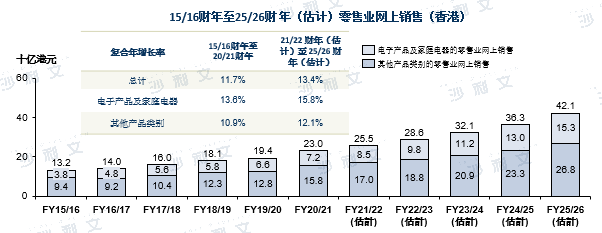
Electronics and household appliances have always been one of the main product categories in Hong Kong's retail e-commerce industry, accounting for about 31.3% of the total online retail sales in fiscal year 20/21. Drugs and cosmetics, as well as clothing, footwear and related products, are the other two main product categories, accounting for 34.4% and 18.7% of the total online retail sales in fiscal year 20/21, respectively. The online retail sales of electronics and household appliances reached HK$38 billion in fiscal year 15/16. Due to the rise of self-operated e-commerce and online platforms selling related products in the early 2010s, these sales increased by HK$72 billion in fiscal year 20/21, with a compound annual growth rate of about 13.6% from fiscal year 15/16 to 20/21. It is expected that they will reach HK$153 billion in fiscal year 25/26, with a compound annual growth rate of about 15.8% from fiscal year 21/22 to 25/26.
The growth rate of the electronic products and household appliances market is expected to slightly exceed the overall performance of the e-commerce market, attributed to the following factors: (i) The e-commerce platforms established by participants in the electronic products and household appliances market are relatively new. For example, major players in the electronics and household appliances industry started establishing their e-commerce platforms only from the 16/17 fiscal year, thus offering vast growth potential; (ii) The electronics and household appliances industry adopts the OMO business model, providing consumers with a one-stop shopping experience, which helps to enhance customers' confidence and loyalty in purchasing complex electrical appliances; and (iii) Given the high logistics costs in Hong Kong, the higher unit price of electronic products and household appliances allows for higher profits per transaction and transportation, which is beneficial to their long-term development.
Online Retailing (Hong Kong)
FY 15/16 to FY 25/26 (estimated)
Source: Frost & Sullivan report
According to the Frost & Sullivan report, the key factors driving growth in the Hong Kong e-commerce market are as follows:
-
More and more consumers tend to shop online
In recent years, thanks to the acceleration of internet speed and information infrastructure development, consumers have gradually begun to master and utilize digital technology. They rely on personal electronic devices for internet browsing and consumption, as well as using digital wallets for settlement and payment. In view of the outbreak of the 2019 coronavirus disease, consumers have avoided unnecessary social contact, leading to a clear shift towards online shopping, especially for groceries and personal hygiene products. Since currency value, convenient shopping experiences, and brand reputation are considered extremely important criteria by Hong Kong consumers, continuously improving e-commerce platforms must fully cater to customers' needs, thereby driving consumers to prefer online shopping in the coming years.
-
Local online retail platform appears
Although overseas and Chinese e-commerce platforms that have not established local platforms in Hong Kong have not contributed to online retail sales in Hong Kong, these platforms have driven a shift in Hong Kong consumers' behavior towards online shopping due to their long development history and sophisticated service offerings. Nevertheless, foreign e-commerce platforms may not be able to meet the needs of local Hong Kong consumers due to limited brand options compared to local platforms, as well as restrictions on flexible logistics and customer services. Local platforms, tailored to cater to the needs of Hong Kong people, provide comprehensive logistics support and telecommunications infrastructure, reliable authorized distributor products, and a wide variety of product choices. Therefore, these platforms have emerged as attractive options to more local people for online shopping, driving market expansion.
-
Improved delivery and distribution model
Due to our logistics model being designed to adapt to the transition from offline to online retail systems, the high costs and effort involved in managing complex supply chains with delivery and distribution capabilities have been an obstacle to the development of e-commerce in Hong Kong. With continuous upgrades in enterprise technology and hardware, delivery efficiency has greatly improved, and operating costs have also significantly decreased. This move helps to enhance unit economic efficiency, enabling companies to offer lower delivery costs to attract customers.
-
Online payment system improvement
The concern about online payments has always been one of the reasons why Hong Kong consumers are relatively resistant to e-commerce. Technological and network security advancements have strengthened consumers' confidence in online payments. At the same time, third-party payment platforms have emerged, offering different payment schemes and hosting services, thereby improving customers' satisfaction with online shopping processes.
-
Cross-border e-commerce development opportunities starting from Hong Kong
Due to the more complex design and operational mechanisms, safety considerations, and differences in quality assurance plans across regions, consumers generally have higher requirements for electronic products and household appliances than for ordinary consumer goods. Hong Kong is the preferred destination for consumers to shop for electronic products due to the established and credible quality assurance framework under the Electrical Products (Safety) Regulations (Chapter 406). The Electrical Products (Safety) Regulations stipulate that all electronic products and equipment placed on the Hong Kong market must be properly designed, constructed, marked, assembled, connected, and insulated to avoid any electrical or non-electrical hazards that may pose a threat to consumers under proper use. Given the positive benefits observed when purchasing electronic products in Hong Kong, such as: (i) a wide range of brands supplied from East Asia, Europe, and the United States; (ii) products from authorized distributors becoming increasingly popular compared to foreign and Chinese brands, along with manufacturer's maintenance services; (iii) international recognition; (iv) comprehensive logistics support and telecommunications infrastructure for e-commerce platforms for overseas buyers; and (v) Hong Kong's proximity to China, allowing for a thorough understanding of Chinese consumers, the demand for cross-border e-commerce for purchasing electronic products and household appliances in Hong Kong will continue to be driven.
Frost & Sullivan has extensive research experience in the e-commerce industry and has assisted well-known enterprises in successfully listing on capital markets. Successful listings include YesAsia (2209.HK), Hua Xin Holdings (8442.HK), Shangjin International (2528.HK), Taobao International (6110.HK), Baby Tree (1761.HK), Siku China (NASDAQ.SECO), Barbie Bebe (8297.HK), Jumei.com (NYSE.JME), Vipshop (NYSE.VIPS), and others.
Recommended Reading




