From the perspective of product strength, there are more and more enterprises with scientific and technological innovation capabilities. Technological innovation acts as a key driver for an industry, quietly changing the entire sector and potentially even subverting our lives in the future. This also marks the transition from 'Made in China' to 'Intelligently Made in China.' However, can new domestic products rest assured without core technology? How can they enhance their industrial influence after acquiring cutting-edge technologies and invention patents? Are new domestic products that lack core technology 'taking the lead' or 'copycatting'?
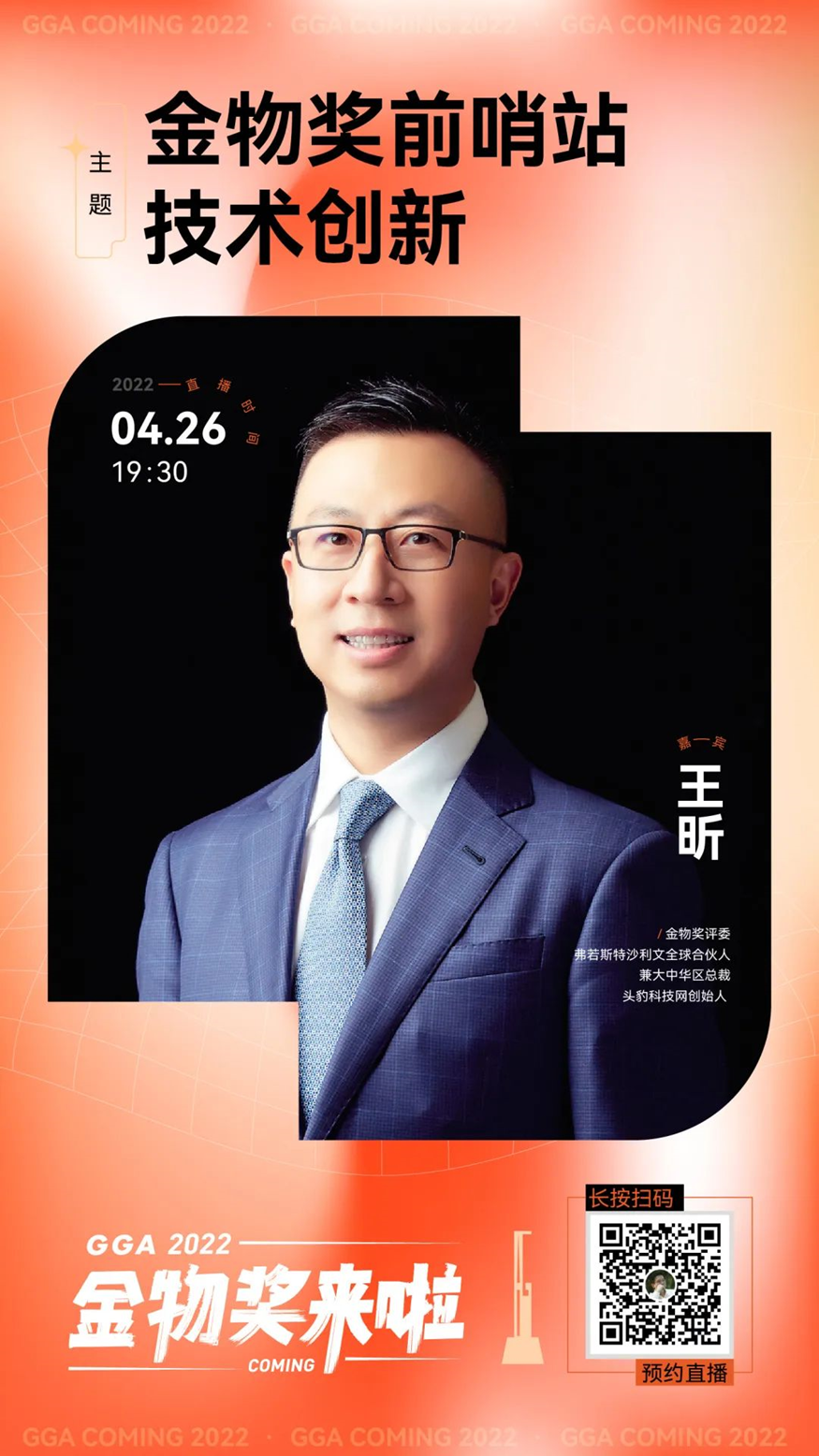
4month26Today, Frost & SullivanFrost & Sullivan,Dr. Wang Xin, Global Partner and President of Greater China at Frost & Sullivan, Founder of the original corporate in-depth research platform LeadLeo Technology Network, and a judge for the Golden Prize for Business Excellence, was invited to participate in the live broadcast room of 'The Golden Prize is Here'.Frost & SullivanWang Yuchuan, Chief Advisor for China and Chair of the Golden Prize for Technological Innovation Awards, joined forces with us to discuss the theme of 'Technological Innovation'. Starting from investment, they explored how to construct an innovative ecosystem in China and further integrate with advanced global technologies.
Hello Dr. Wang Xin, we have watched one of your presentations where you interpreted the future from an industry perspective.50The development trends and opportunities for China's five core industries in the coming year, with consumption being at the forefront. You have presented a set of data: So far, approximately half of the people in China have never used an ordinary flush toilet.10Billions of people have never taken a flight. What do these numbers mean? Where do you think the core points lie in unlocking the potential of Chinese consumers and promoting consumption growth?
Dr. Wang Xin: These figures indicate that there is still a broad potential consumer demand in China, and the future consumption market in China holds great potential, which is mainly reflected in the following aspects:
(1China has a large consumer base and is14A super-large-scale market with hundreds of millions of people. 2021China's GDP increased by [X]% year-on-year8.1%The total economic volume reached114.4trillion yuan, accounting for more than18%Chinese consumers have contributed more than40%Electric vehicle sales45%Fish and seafood sales37%fresh meat sales24%Wine sales. In all consumer category markets globally, China's average share is close to20%;
(2China has broad room for consumption growth. 2021China's final consumption expenditure as a percentage of GDPGDPspecific gravity is54.5%, while the proportion in developed countries averages over70%Among them, the United States and the United Kingdom accounted for more than80%Therefore, China still has significant growth potential;
3The momentum of consumption upgrading is strong. 2019per capita in China inGDPIt has exceeded 10,000 yuan, and consumption will enter a stage of rapid upgrading. At the same time, the development of urbanization has also given rise to new opportunities. The rural population accounts for about 40% of China's total population, but the proportion of rural consumption is still less than15%.2021The urbanization rate of China's permanent population at the end of the year64.72%For every one percentage point increase in urbanization rate, the urban population increases by approximately1,400Ten thousand people. If this1,400If the consumption per person increases by more than 10,000 yuan annually for every 10,000 people, total consumption can increase.2,000RMB 100 million or so, for just this one item in the future10In 2021, total consumption will increase by about 2 trillion yuan.
To unleash the potential of Chinese consumers, The core points for promoting consumption growth mainly lie in accelerating supply-side structural reforms, fostering the formation of new supply and industrial systems, to build a new development pattern where dual circulations promote each other, unleash the tremendous momentum of new consumption, and turn the potential for consumption growth into reality. It can be implemented through the following three paths:
(1) Enhance innovation capabilities and boost new consumer demands. Centering on consumer innovation trends such as new domestic products and new national trends, we are making significant investments in developing manufacturing. While continuously improving and enriching diverse service and industrial supply, we are further meeting the growing cultural, entertainment, leisure, and other new consumer demands of residents. This aims to expand the coverage of consumption areas in the new era and deepen the consumer base, thereby accelerating the release of tremendous consumer growth potential;
(2) Enhance technological capabilities and empower new consumption scenarios. Promote the innovation of science and technology, realize digital empowerment of consumption channels, connect online and offline consumption methods, create new consumption formats, scenarios, and models, further integrate emerging technologies such as the internet, artificial intelligence, big data, and cloud computing with the consumer industry, and stimulate untapped consumption possibilities;
(3) Improve the urbanization rate and unleash new consumption potential. Vigorously promote the improvement of a sound modern rural commercial system, perfect the construction of the agricultural product supply chain system, accelerate the pace of e-commerce entering rural areas, enhance the quality and scale of the rural consumer market, further promote the development speed of urbanization, and use a small step of urbanization to facilitate a big leap forward in Chinese consumption.
Q
You've made a prediction that by2070In [year], China will build the world's largest smart city cluster, integrating various industries with artificial intelligence to enhance productivity. In your opinion, which industries are already or will deeply integrate with artificial intelligence at present?
Dr. Wang Xin:2021The year coincides with the global launch of Frost & Sullivan.60On our tenth anniversary, we held a celebration event in China. At the same time, as a token of gratitude to Frost & Sullivan60For the anniversary, we have prepared three white papers — "Leading Global Growth60Big Technology》, "Global Technology and Application Trends: Prospects and Outlook", and "China's Future50Annual Industry Trend Insights White Paper". "By2070In [a certain year], China will build the world's largest smart city cluster. This prediction is based on our China's Future50As mentioned in the 'White Paper on Industry Trend Insights for 2023'.
Artificial intelligence is an emerging strategic technology that leads the future, a crucial force driving a new round of scientific and technological revolution and industrial transformation, and an engine for the transformation and upgrading of China's economic structure and the shift of growth momentum. As of2021At the end of the year, there were a total of3322Home received investment, accounting for the total financing of AI companies55%, among which is smart finance575Home, intelligent robot427Home, Smart Transportation (Autonomous Driving)420Home ranks among the top three in the application layer. It can be seen that the financial industry has been most extensively empowered by artificial intelligence technology. This also reversely maps to the three basic elements of artificial intelligence technology: Data, computing power, algorithms. A large amount of high-quality data is the effective foundation for artificial intelligence models, while new algorithm iterations are relatively slower, and computing power improvements are more about breakthroughs at the physical level.
Therefore, whether artificial intelligence technology can be deeply integrated with a particular industry depends most importantly on whether the industry can generate or readily collect massive amounts of high-quality data.
Of course, with the development of sensor technology, more industry data will enter algorithm training models in the future, leading to better prediction results. Overall, in addition to the further deepening of existing industry applications, we are also optimistic about the application of artificial intelligence in new drug research and development, basic scientific research, as well as important applications in the metaverse, digital twins, and other areas.
Taking the metaverse as an example, the core of the metaverse lies in its ability to reflect and connect everything from the real world into the metaverse, as well as to enable interaction. In this process, artificial intelligence plays the role of connecting the real world with the virtual world.AIWith breakthroughs in computing power, reconstructing and mapping the real world into the digital world, domestic SenseTime Technology has done very well in this area.SenseMARSIt has become one of the largest metaverse empowerment platforms in Asia and is the first AI company to help mobile applications achieve interactive augmented reality and mixed reality effects.
How does 'LeadLeo' achieve this?AIWhat about the application? LeveragingAITechnology allows us to acquire more knowledge in the shortest time, summarize this knowledge through big data, distill out many related contents, and form structured and standardized databases - what we call:ABCK(AI-powered Blockchain-based KaaS) cloud platform. On this basis, we have formed the final analysis data and report through the research and evaluation by professional analysts and a team. This can effectively improve the efficiency of knowledge generation and utilization, enabling analysts to transform from simple data transfer to more advanced research analysis and create greater value.
Overall, against the backdrop of new technological and industrial transformations, The deep integration of artificial intelligence with industries is an inevitable choice to unleash the digital multiplier effect, accelerate the development of strategic emerging industries, and build comprehensive competitive advantages. Next, artificial intelligence will accelerate its penetration into various industries, promoting cross-border integrated development between emerging industries, between emerging and traditional industries, as well as between technology and society.
Q
There is a case that we care about particularly:2018In [year], Dr. Wang Xin became the world's first robot to obtain citizenship, produced by Hong Kong Hanson Robotics"Sophia"issued"Frost & Sullivan China New Economy Award"We are very interested in this event:"Sophia"What makes this robot special? What aspect of the robotics industry do you see as the most promising at that time? What role does China currently play in the field of robot design and manufacturing, and what unique advantages does it possess?
Dr. Wang Xin: First of all, we are very honored to be at2018In 2019, I got in touch with Hanson Robotics and presented to Sophia"Frost & Sullivan China New Economy Award ". 2018 The year is auspicious Frost & Sullivan enters the Chinese market20In that year, we held Frost & Sullivan20anniversary At the celebration and customer appreciation event, Frost & Sullivan presented awards to many emerging economy companies at the banquet, with Hansen being one of the numerous award-winning enterprises.
As the world's first robot to obtain citizenship, Sophia's most distinctive feature lies in her ability to understand human emotions and form emotional interactions with them. Emotions are considered the highest level of artificial intelligence. Sophia can observe and identify information such as the movements and expressions of people around her through a camera, relying on machine vision, and respond accordingly, thereby mimicking the emotional resonance between humans. In addition, she can use bionic materials to create wrinkles by controlling components such as gears, achieving a facial expression that is highly similar to that of humans.
Sophia is actually a microcosm of China's robotics industry. It can be said that China has the best robotics development environment in the world and is one of the leading players in the global robotics industry. In recent years, the demand for robotics in China has been growing rapidly. Taking industrial robots as an example, China is the leading country in the global industrial robotics market.2013Since the beginning of this year, it has been continuous8In 2021, it became the world's largest industrial robot market. 2021In [year], China's industryThe newly installed capacity of industrial robots exceeded2010,000 units, with a cumulative annual output reaching36.610,000 units, with a year-on-year growth rate as high as44.9%The world's largest robotics market-Asia market accounts for more than2/3.
Industrial robots come in a wide variety, characterized by high-risk operations, high production efficiency, strong stability, and high precision. With the introduction of various policies related to industrial robots and key special policies for intelligent robots, their application fields have continued to expand. For example, in the medical field, in recent years, Frost & Sullivan has served many medical robot companies that have successfully entered the capital market.
Against the backdrop of an aging population leading to a significant increase in morbidity and surgical volume, China's current medical supply capacity cannot be rapidly and effectively enhanced in the short term. An effective means to solve the imbalance between medical supply and demand is to introduce surgical robots to improve surgical efficiency. Surgical robots can assist doctors in completing surgeries more efficiently and accurately, and they have advantages such as increasing the success rate of surgeries and reducing the area of trauma.
"The difficulty and high cost of seeing a doctor" and the poverty caused or exacerbated by illness due to an obvious imbalance in China's medical resources have always been problems plaguing people. Combining virtual reality technology and surgical robot technology to achieve remote surgical treatment has become an effective way to solve this problem. Nowadays, utilizing intelligent sensing, human-computer interaction technology, and5GCommunication technology has gradually made it possible for doctors to perform precise remote surgeries and treatments on patients in distant locations.
We know that the biggest difference between humans and machines lies in human perception, while the feedback generated by machine interaction is still not precise enough. In the future, research progress in human-machine interaction systems and intelligent sensing can further enhance the intelligence of surgical robots, which is beneficial for improving the operational precision of doctors during surgeries.
In addition, robots have also played an important auxiliary role in remote office work, remote teaching, and remote production. For instance, in some 'dark factories', robots can operate continuously without lighting, saving energy and improving efficiency. Therefore, I believe that robots will not take away jobs from humans, but rather replace repetitive and mechanical labor. Once people's time is liberated, they will engage in more meaningful activities with higher added value.
China possesses more talent resources than other countries and regions around the world, and is also close to the world's largest robotics market. It has significant advantages in responding to customer needs and the completeness of its supply chain. China is continuously cultivating a large number of innovative talents for the robotics industry, and is promoting artificial intelligence with5GWe have made significant contributions to the integration and innovation of cutting-edge technologies such as big data, cloud computing, etc. In the future, China will adhere to the principle of driving overall improvement through local advantages by focusing on key areas, and continue to promote the development of the robotics industry towards higher-end and intelligent technologies. We will also serve as witnesses to the times, witnessing robots beginning to enter thousands of households.
Q
2016InVRThe field has made predictions, “VRThe dawn is just ahead"VRFormal commercial products have been launched for over a decade, but no such"blockbuster"Birth. From your perspective, now isVR, metaverse, etc."virtual world"Is it a good time? China doesVRHow can enterprises avoid something likeVPLCompanies are the same, with excellent creativity but 'born at the wrong time', suffering setbacks in commercialization?
Dr. Wang Xin: I want to achieve itVRThe commercial development of devices cannot be achieved without a favorable technological environment and productivity. A mature application environment, an active user base, and a stable and efficient industrial chain all contribute to this.VRThe development of the device has arrived at an appropriate timing.
Overall,VRThe equipment has initially acquired the technical and environmental conditions for use.5GNetworks, sensing technology, optical technology, etc., areVRThe basic technology has been implemented, and a mature industrial chain ensures supply and low prices. Web3.0Build step by step, an active short-video and gaming industry, a booming metaverse social scene, home office work during the pandemic,VRThe application scenarios of devices are gradually becoming richer, and the metaverse concept has received a boost in the capital market. According to the calculation data in the 'Metaverse White Paper' jointly released by LeadLeo Research Institute and Tianfeng Securities, by2025year, ChinaVRThe market scale of devices will reach479.9RMB 10 billion, with an annual compound growth rate of60.4% ,VRAs an important cornerstone for the realization of the metaverse, devices are expected to become a popular consumer electronics product of the new generation.
VRThe upstream of the equipment industry chain is divided into5major sector18A key component of this segment is the chip and optical device. The localization level of the industrial chain is relatively high.18Among the sub-items11Each item has Chinese enterprises participating in the competition. High-quality domestic supplier companies have strong competitiveness in raw material supply. For example, Lianchuang Electronics, which has been successfully listed, is the world's largest sports camera lens supplier.2020The year has become internationally renownedVRThe customer mass-produces and supplies projection lenses; Goertek has made long-term arrangementsVR/ARBusiness, currently at the high-endVRARThe market share in the field of OEMs for complete sets of equipment is close to80%.
recent5over the years, globallyVRThe headset device market has shown a relatively rapid pace of market changes. 2017In the year, the most in the marketVRThe device is a relatively low-end mobile phone case, all-in-oneVRThe proportion of devices is only3.9%.2018Annual integrationVRThe proportion reached26.2%, with a growth rate as high as571.8%, andPCendVRBecome the new market tyrant.2019In 2019, the basic market pattern remained unchanged.PCendVRThe proportion is nearly50%The all-in-one machine market has further expanded. 2020In [year], with the phenomenon-levelVR——Oculus Quest2With the launch, all-in-one computers have gradually demonstrated their superiority, with market share growing rapidly.5Looking at the data for the year,VRThe equipment market is ever-changing, presenting both challenges and opportunities for enterprises. It is essential for companies to accurately capture industry dynamics in order to gain a foothold in market competition.
Q
Now, the term 'service' has gradually shifted from the traditional meaning of 'service industry' to the user experience brought about by services attached to goods. Teacher Wang Yucan mentioned an interesting phenomenon: Tesla currently provides complete vehicle supportOTAThe service value of the system and other services is one hundred thousand US dollars, and in the future, it will gradually account for a larger proportion of the vehicle price. This represents that the traditional manufacturing industry of automobiles is also gradually shifting its profit points from materials, manual labor, and technological accumulation to serving users. How do you view the increasing application of generalized services in physical goods? What are some specific cases of this trend?
Dr. Wang Xin: The apparent manifestation of the service-oriented transformation of manufacturing is the increasing application of generalized services in physical goods. The underlying reason is the significant trend towards ubiquitous devices. Ubiquitous computing, originally meaning that networks are everywhere, originated from the advancement of computer technology. Computers have fully integrated into people's lives, providing various services wherever they are.2020After a certain year, the connotation of ubiquitous computing continues to expand, referring to the ability for every visible object to be connected to the internet. From small items like light switches to large structures like reservoir dams, they play an increasingly important role under the influence of network connectivity. The service-oriented transformation of manufacturing accelerates, with significant effects from supply-side structural reforms. The industrial structure and product structure have been optimized, and both industrial quality and product quality have improved. Consumption is gradually becoming a productive force, and the tertiary industry isGDPThe contribution rate ranks first among the three major industries, indicating that it is an inevitable trend for manufacturers to increase the proportion of services in physical products.2021Year tertiary industryGDPThe contribution rate to growth is as high as53.9%.
As you mentionedOTAIt's a typical case of service being applied to physical objects. In factOTAServices were initially an important means for mobile phone manufacturers to enhance product competitiveness and profitability. Tesla was the first automaker to apply this concept to the automotive sector.OTAThe value can not only be enhanced by upgrading to change the response speed of the car's on-board computer, but it can also increase the maximum range of pure electric vehicles to a certain extent and adjust the usage status of the car battery, thereby providing users with a better operational experience. Most importantly, automakers can alsoOTAAchieve differentiated features and pricing, build their own automotive brand ecosystems, enhance user stickiness, and increase the repurchase rate. In the future, new energy vehicles will see increasingly smaller differences in range, acceleration, and even body design. Similar to how Apple's mobile phones rely on their app store to establish an unbreakable Apple ecosystem, manufacturers are increasing their efforts towardsOTAThe investment in system and ecosystem construction aims to enhance service value and build competitive barriers.
Service applications in physical assets are not limited to the automotive industry but also occur during the transformation of other traditional manufacturing sectors. Taking Baosteel, a leading enterprise in the steel industry, as an example, Baoxin Software was initially its functional department providing information software services for automated production. With the advancement of automation and informatization in China, the demand from steel manufacturing enterprises has become increasingly strong. Baoxin Software was separated from the Baosteel department and operated independently. While serving within the Baosteel Group, it also provides services to other steel manufacturing enterprises. Automated and information-based software services continuously create new profit points for them.