10month27day-30On the day, the 22nd China Pharmacy Summit Forum was held at the Qingdao Starlight Island Convention Center. With the theme of "Incorporating in the Face of Resistance, Enhancing the Future", this forum focused deeply on the pharmaceutical retail industry, aiming to contribute and empower the future development of the industry with professional and dedicated concepts. The conference included multiple thematic sub-forums, and the first China Pharmacy Medical Aesthetics Forum was held on10month28Held daily, focusing on the beauty economy and incremental market Frost & SullivanFrost & SullivanZhu Yi, Executive Director of Frost & Sullivan Greater China, was invited to attend the event and delivered a speech on the scale, structure, channels, consumer situation and trends of the medical aesthetics product market.
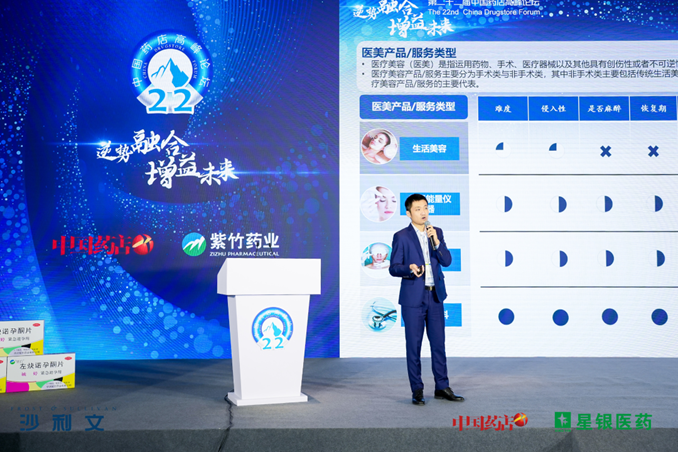
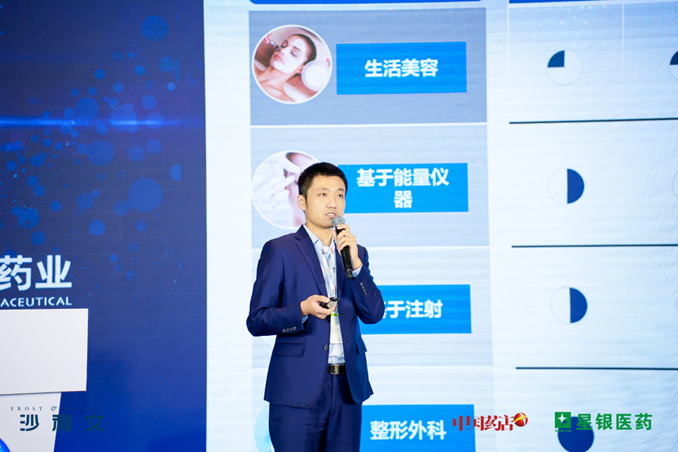
Executive Director, Greater China, Frost & Sullivan Zhu Yi
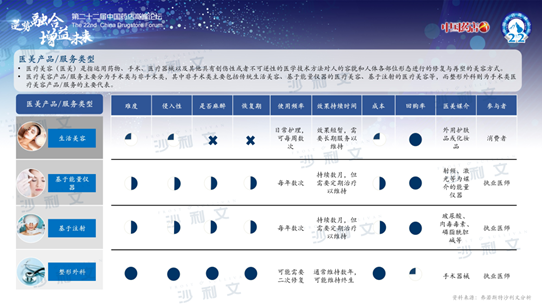
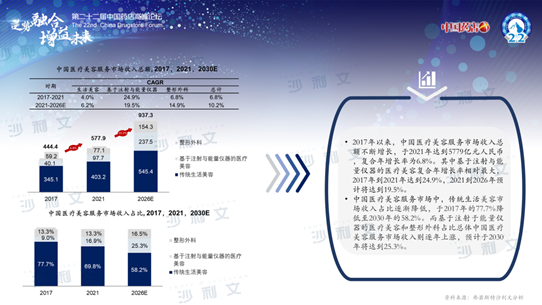
Medical cosmetology (medical aesthetics) refers to the cosmetic method that uses drugs, surgery, medical devices, and other invasive or irreversible medical technical methods to repair and reshape a person's appearance and various body parts. According to Zhu Yi, medical cosmetology products/Services are mainly divided into surgical and non-surgical categories. Non-surgical services mainly include traditional cosmetic surgery, medical cosmetology based on energy devices, and injectable medical cosmetology. Plastic surgery is a type of surgical medical cosmetology product./The main representative of the service.
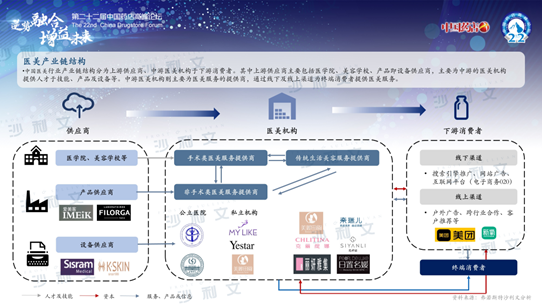
The industrial chain structure of the Chinese medical aesthetics industry is divided into upstream suppliers, midstream medical aesthetics institutions, and downstream consumers. The upstream suppliers mainly include medical colleges, beauty schools, and product or equipment providers, primarily providing talent, skills, products, and equipment to the midstream medical aesthetics institutions; midstream medical aesthetics institutions are mainly service providers for medical aesthetics, offering aesthetic services to end consumers through offline and online channels.
According to a study by Frost & Sullivan,2017Since [start year], the total revenue of China's medical beauty service market has been continuously growing, with2021Annual achievement5,779RMB 10 billion, with a compound annual growth rate of6.8%Among them, the compound annual growth rate of medical aesthetics based on injection and energy devices is relatively the largest.2017Year-end2021Annual achievement24.9%,2021reach2026The annual target is expected to be reached19.5%The proportion of revenue from the traditional beauty market is gradually decreasing,2017year77.7%Expected reduction to2030year58.2%; while the proportion of medical aesthetics and plastic surgery based on injections in energy instruments has been increasing year by year, accounting for a total of approximately2030Will reach in25.3%.
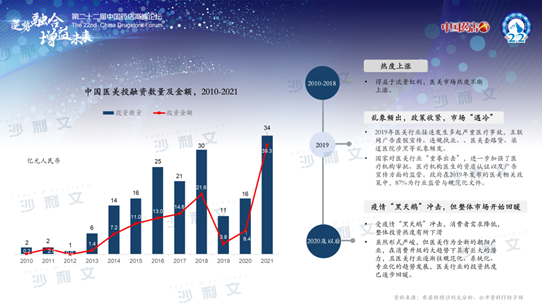
Zhu Yi pointed out that the development of the medical beauty market can be divided into three stages:
2010 - 2018In [year], benefiting from traffic dividends, the medical beauty market has been experiencing continuous growth in popularity.
2019In recent years, the medical beauty industry has witnessed multiple serious medical accidents. There have been frequent issues such as false advertising on internet platforms, illegal practice, medical beauty loan schemes, and channel hospitals involved in organized crime. The state has 'taken a heavy hand' against the medical beauty industry, further strengthening supervision over the approval of medical institutions, the qualification certification of doctors, and advertising.2019Among the medical beauty-related policies released in [year],87%Industry supervision and standardization documents.
2020Since the beginning of this year, affected by the 'black swan' impact of the pandemic, consumer demand has decreased, leading to a decline in overall investment enthusiasm. Despite the severe situation, However, as a new sunrise industry, the medical beauty sector has great potential under the general trend of consumption upgrading. Moreover, the medical beauty industry is gradually developing towards standardization, systematization, and specialization, and the investment enthusiasm for the industry has gradually warmed up.
Subsequently, Zhu Yi conducted a brief analysis of various sub-markets within the medical aesthetics industry. He pointed out that the Chinese medical aesthetics market currently exhibits rapid market growth, increasing penetration of light medical aesthetics procedures, lightweight medical aesthetic surgeries, younger consumers for medical aesthetics services, and the rise of the 'male beauty economy'.
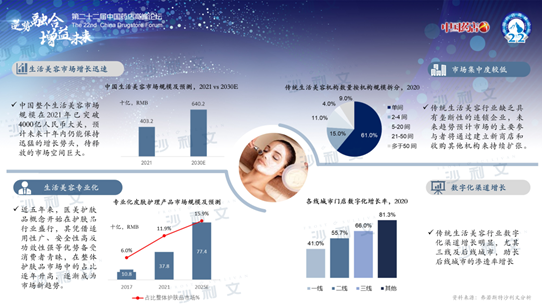
Life beauty refers to the use of cosmetic products, health supplements, and non-medical devices such as skincare and massage for maintenance or health-oriented non-invasive beauty care. Life beauty is mainly divided into facial care and body care. Among them, skin cleansing and moisturizing, skin whitening, and skin repair are the main types of facial care provided by life beauty service institutions, while weight loss and health treatments are common types of body care. Due to the slow but comfortable experience of traditional beauty services, which are non-invasive and safe, consumers tend to repurchase and consume frequently.
The entire Chinese beauty and lifestyle market is growing rapidly, with a market scale of2021The year has broken through4,000The RMB 10 billion mark is expected to maintain a rapid growth momentum within the next decade, with huge market potential yet to be unleashed. However, the market concentration is relatively low, and there is a lack of monopolistic chain enterprises in the industry. It is anticipated that the main participants in the future market will continue to expand through means such as establishing new stores and acquiring other institutions. At the same time, beauty and wellness services have been developing towards specialization over the past five years, with significant growth in digital channels.
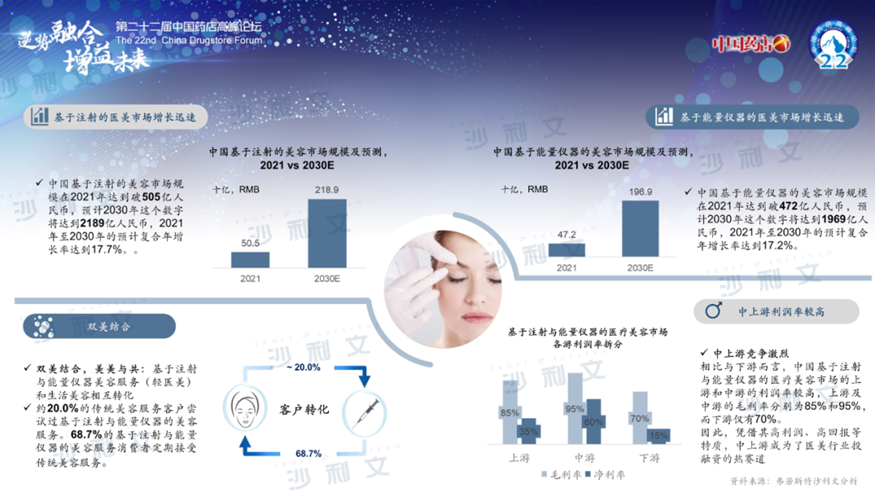
The growth of medical aesthetics (light medical cosmetology) based on injection and energy devices has also been very rapid in recent years. Data shows that the market scale of injectable beauty treatments in China is2021Reaching a new high505100 billion RMB, estimated2030Will reach in2,1891000 million RMB2021Year to2030The compound annual growth rate for the year will reach17.7%The market scale of beauty products based on energy instruments is in2021Reaching a new high472100 billion RMB, estimated2030Will reach in1,9691000 million RMB2021Year-end2030The compound annual growth rate for the year will reach17.2%.
Zhu Yi stated that consumers of light medical aesthetics and traditional lifestyle beauty are mutually transforming. Research shows about20%Traditional beauty service clients who have tried light medical aesthetics68.7%Consumers who have received light aesthetic medicine regularly receive traditional beauty services.
At the same time, competition in the mid- to high-end segment of the entire light medical aesthetics market is fierce. Compared with the downstream sector, the profit margins for the upstream and mid-tier segments are higher, which are85%and95%, while downstream only70%, Therefore, with its characteristics of high profits and returns, the mid-to-upper-middle segment has become a hot track for investment and financing in the medical beauty industry.
Plastic surgery services refer to cosmetic procedures performed by licensed doctors, aimed at changing the appearance of various parts of the face or body, such as eyes, nose, chest, and facial features. These usually involve local or general anesthesia, as well as incisions on the skin or body. After the surgery, clients typically need one to six months to recover. The recovery time for surgical beauty services is relatively longer compared to energy-based and injection-based cosmetic surgeries, and the risk of complications is also higher. In addition, the industry and legal standards for cosmetic surgery services are more stringent, with attending physicians providing these services should have more than six years of relevant surgical experience.
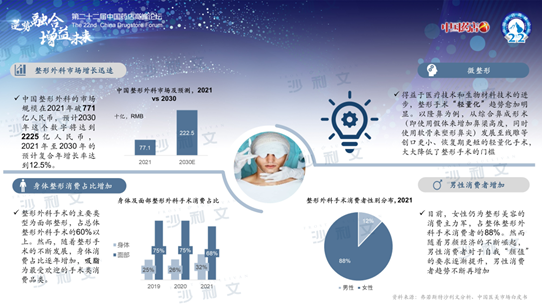
The plastic surgery market has also grown rapidly. The market scale of plastic surgery in China is in2021Year-on-year break771100 billion RMB, estimated2030Will reach in2,2251000 million RMB2021Year to2030The compound annual growth rate for the year will reach12.5%.
In recent years, thanks to advancements in medical technology and biomaterials, the trend of 'lightweight' plastic surgery has become increasingly evident. Taking rhinoplasty as an example, from comprehensive nasal reconstruction to minimally invasive procedures such as thread lifting, which result in smaller incisions and shorter recovery periods, the threshold for plastic surgery has been greatly reduced. At the same time, With the continuous development of plastic surgery, The proportion of body plastic surgery consumption is increasing year by year. Liposuction is the most popular surgical consumer category.
"It is worth noting that, At present, although women are still the main consumer group for plastic surgery and cosmetic treatments, accounting for88%However, with the continuous rise of the 'male beauty economy', male consumers' demand for their own 'appearance' has gradually increased, and there is an obvious growth trend among male consumers.' Zhu Yi said.