11month16day-18day,2022The annual (ninth) Global Bio-Diesel Conference was held in Yangzhou, Jiangsu Province. The conference attracted participants from the bio-diesel, glycerin,UCO,UCOME,FAMEThe Global Bio-Diesel Industry Summit is a high-level conference for senior management personnel in the fields of animal fats and oils, plasticizers, sustainable aviation fuels, biodiesel waste oil, enzyme preparations, technology equipment providers, and raw material suppliers. Frost & SullivanFrost & SullivanXu Biao, Executive Director of Frost & Sullivan Greater China, was invited to attend the event and delivered a speech on the current status of China's biodiesel industry.


Executive Director, Greater China, Frost & Sullivan Xu Biao
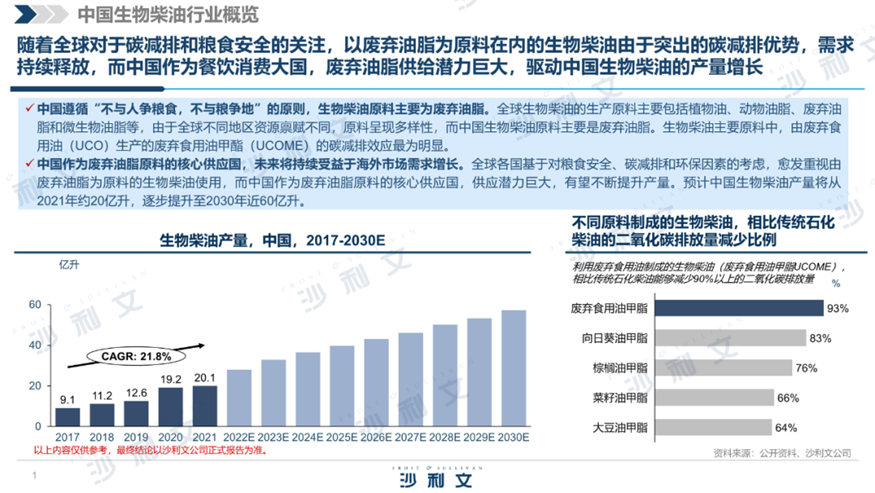
According to Xu Biao, the main raw materials for biodiesel production globally include vegetable oils, animal fats, waste fats, and microbial oils. Due to different resource endowments in different regions around the world, raw materials are diverse. Among the main raw materials for biodiesel, waste edible oils (UCOWaste edible oil methyl ester producedUCOMEThe carbon emission reduction effect of ( ) is the most obvious.
Therefore, countries around the world are increasingly emphasizing the use of biodiesel made from waste oils and fats due to considerations of food security, carbon emissions reduction, and environmental protection. China's biodiesel raw material is mainly waste oils and fats, and it is also a core supplier of such materials. As a major consumer of catering, China has huge potential for waste grease supply. In the future, its output is expected to continue to increase, driving the growth of biodiesel production in China. It is estimated that China's biodiesel production will2021approximately20Yi Sheng, gradually upgraded to2030nearly60100 million liters.
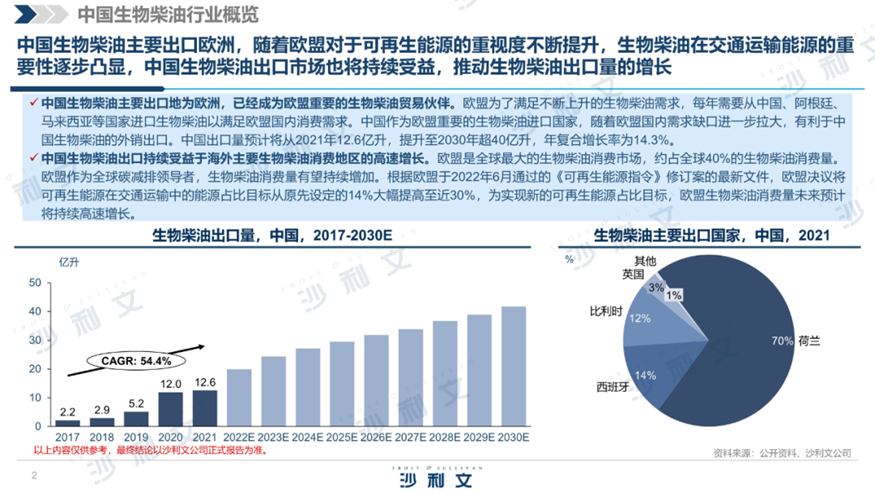
China's biodiesel exports are mainly to Europe, and it has become an important trading partner for biodiesel in the EU. The EU is the world's largest biodiesel consumer market, accounting for approximately40%Biodiesel consumption. According to the EU in2022year6The latest document of the revised Renewable Energy Directive passed by the European Parliament in [month], which sets a new target for renewable energy's share of transport energy, replacing the original14%Significantly increased to nearly30%, To achieve the new renewable energy target share, EU biodiesel consumption is expected to continue growing at a high rate in the future. China's biodiesel export market will also continue to benefit, with exports expected to2021year12.6YilSheng, upgraded to2030Year-over-year40YiSheng, with an annual compound growth rate of14.3%.
Xu Biao said that at this stage, China's biodiesel domestic market is still in its cultivation phase. The relevant policies introduced do not have mandatory blending requirements. Compared with traditional petrochemical diesel, biodiesel lacks competitiveness in terms of cost and quality. In comparison with regions with high biodiesel consumption such as the EU, the US, Brazil, and Indonesia, ChinaThe country's incentive policies and related regulations still need to be improved urgently to further open up the domestic consumer market. It is worth noting that, under the guidance of the long-term development goals of carbon peak and carbon neutrality, the biodiesel industry is expected to welcome new policy momentum during the '14th Five-Year Plan' period.
Biodiesel is mainly used as a power fuel and as a raw material or intermediate in the chemical industry. Globally, biodiesel is primarily used as a power fuel, while in China, it is mainly used for the production and processing of green chemicals. According to a Frost & Sullivan study, in the current Chinese power fuel sector, the promotion of relevant policies is limited. As a result, the penetration rate of biodiesel as a fuel source is low, accounting for less than30%It is expected that driven by the dual favorable factors of 'top-level design' and 'local pilots', the terminal sales channels for biodiesel for fuel use in China are likely to continue to improve, and the consumption of biodiesel for fuel use will rapidly increase.

Subsequently, Xu Biao introduced in detail the main downstream derivatives and by-products of biodiesel in China. He pointed out that biodiesel is essentially a mixture of lower esters of multiple fatty acids. In addition to being used directly as fuel, it can also be used to produce various derivatives, including bio-ester plasticizers, environmentally friendly alkyd resins, surfactants, etc. Compared with traditional chemical preparation processes of these traditional types, its derivatives have many advantages such as environmental friendliness, stability, and less corrosiveness to containers, and have broad application prospects. In addition, crude glycerol, a major by-product during the production of biodiesel, can also be further refined and applied in industrial fields such as cosmetics, food, and medicine.

· Biodegradable ester plasticizer
Plasticizers are widely used in industrial production, enhancing the properties of polymer materials and improving their plasticity and softness. They are mainly used in packaging materials, leather, toys, automotive parts, and other large quantities of plastic products.
Traditional plasticizers have strong volatility and pose a risk of seeping into plastic products, which can disrupt the human endocrine system, reproductive system, etc. Bioester plasticizers are a new type of plasticizer that is non-toxic, environmentally friendly, and biodegradable, processed from bio-based materials. They can effectively reduce the harm of traditional plasticizers to humans and the environment and alleviate dependence on petroleum resources.
The raw materials for bioester plasticizers are widely available and harmless to humans and the environment. In the future, with increased environmental supervision and continuous development of green and environmentally friendly plasticizer products, there is huge potential for growth in the consumption of bioester plasticizers. 2017Year-end2021In the year, the consumption of bioester plasticizers20.4Ten thousand tons grew to43.810,000 tons, with an annual compound growth rate during this period21.0%, is expected to arrive2030Year-on-year growth95.710,000 tons2022Year to2030The compound annual growth rate will reach9.3%.

· Environmentally friendly alkyd resin
Alkyd resin is one of the most widely used polyester resins in the coating industry. Its performance is related to the type of oil, molecular structure, and molecular weight. Alkyd resins can be divided into environmentally friendly alkyd resins and traditional alkyd resins.
Environmentally friendly alkyd resins use water or emulsifiers as solvents and are mainly used as film-forming bases in the coating industry. While retaining the advantages of traditional alkyd resins, they enhance the fast drying, water resistance, and corrosion resistance of coatings. Moreover, their low volatility significantly reduces the harm to humans and the environment.
With the increasingly strict national environmental protection policies, reducing volatile organic compounds released into the atmosphere and protecting human health have become particularly important. The development of low-pollution alkyd resins is becoming increasingly crucial. The proportion of environmentally friendly alkyd resins such as water-based alkyd resins and solvent-free alkyd resins will continue to rise. The consumption of environmentally friendly alkyd resins is expected to further decrease from2022year58.2Ten thousand tons grew to2030year115.910,000 tons, with an annual compound growth rate during this period9.0%.

· Crude glycerol
Industrial glycerin mainly includes refined glycerin obtained from the further processing of crude glycerin, a by-product in biodiesel production, as well as refined glycerin synthesized from petrochemical products.
Produced during the biodiesel production process10%The by-product crude glycerin, compared to the industrially synthesized industrial glycerin, is more environmentally friendly when further processed into industrial glycerin during biodiesel production. At the same time, the effective utilization of industrial glycerin can improve the raw material utilization rate of biodiesel, reduce resource waste, and further enhance the profitability of biodiesel production enterprises.
Industrial glycerin falls under the category of refined glycerin. The main downstream application areas of refined glycerin in China include epichlorohydrin, polyether, pharmaceuticals and cosmetics, and others. 2017 - 2021In China, the demand for refined glycerol in39.9Ten thousand tons grew to75.210,000 tons, with an annual compound growth rate of17.2%estimated2030Will reach in203.310,000 tons2021 - 2030Annual compound growth rate for the year11.7%.

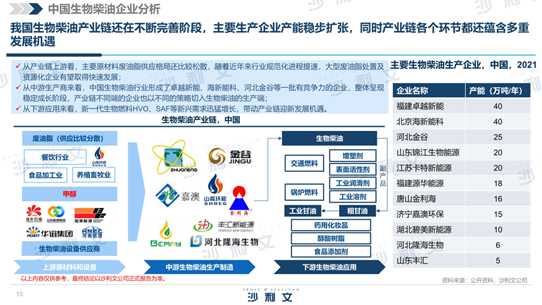
" China's biodiesel industry chain is still in the stage of continuous improvement. The production capacity of major manufacturers is steadily expanding, and at the same time, each link in the industry chain contains multiple development opportunities. Xu Biao further explained that, from the perspective of the upstream industrial chain, the supply pattern of main raw materials such as waste grease is still relatively loose. With the acceleration of industry standardization in recent years, large-scale waste grease disposal and resource utilization enterprises are expected to achieve rapid development; looking at midstream producers, China's biodiesel industry has formed a competitive group including outstanding new energy companies like New Energy Biofuels, Hainan New Energy Science & Technology Co., Ltd., and Hebei Jingu, which are generally showing a stable growth phase. Enterprises at different ends of the industrial chain are also entering the biodiesel production sector with different strategies; from the perspective of downstream applications, the new generation of biofuelsHVO,SAFAs emerging demand surges rapidly, it drives the industrial chain to embrace new development opportunities.

Finally, Xu Biao said, Comparing the revenue and profit growth of major listed companies in recent years, as well as their valuation levels, the biodiesel industry shows better business growth potential and future development prospects compared to the overall chemical industry. Especially in terms of profit growth and price-to-earnings ratio, the average level of biodiesel companies is significantly better than the overall average of basic chemicals, fully reflecting the good growth momentum of the biodiesel sector and investors' strong recognition of the industry's future prospects and the development potential of enterprises.